
On this page
Start here
Quick answer
If your Signature Kitchen Suite refrigerator trips a breaker, leave it disconnected long enough to identify whether the trip is at the appliance, the outlet's GFCI protection, or the household circuit. Without opening or moving a built-in refrigerator, inspect the accessible plug and cord for damage or moisture, confirm the appliance is on a dedicated grounded outlet with no adapter, power strip, or extension cord, and reset the household or GFCI protection only once if the area is dry and there is no odor or smoke. If the breaker trips again immediately or when the compressor starts, do not increase fuse capacity or keep resetting it; arrange qualified electrical or Signature Kitchen Suite service. The exact model and when the trip occurs are needed to distinguish an installation or circuit problem from an appliance fault.
Before you begin
Safety first
- Do not increase fuse or breaker capacity, bypass GFCI protection, use an extension cord or power strip, open the refrigerator cover, probe wiring, or replace an internal fuse or compressor component. Stop immediately for a wet or damaged plug or cord, damaged outlet, water intrusion, strange noise, odor, smoke, or a protection device that trips again.
Work through in order
Diagnostic checks
Use only checks that match the exact appliance or system and its official guide.
-
Check 1
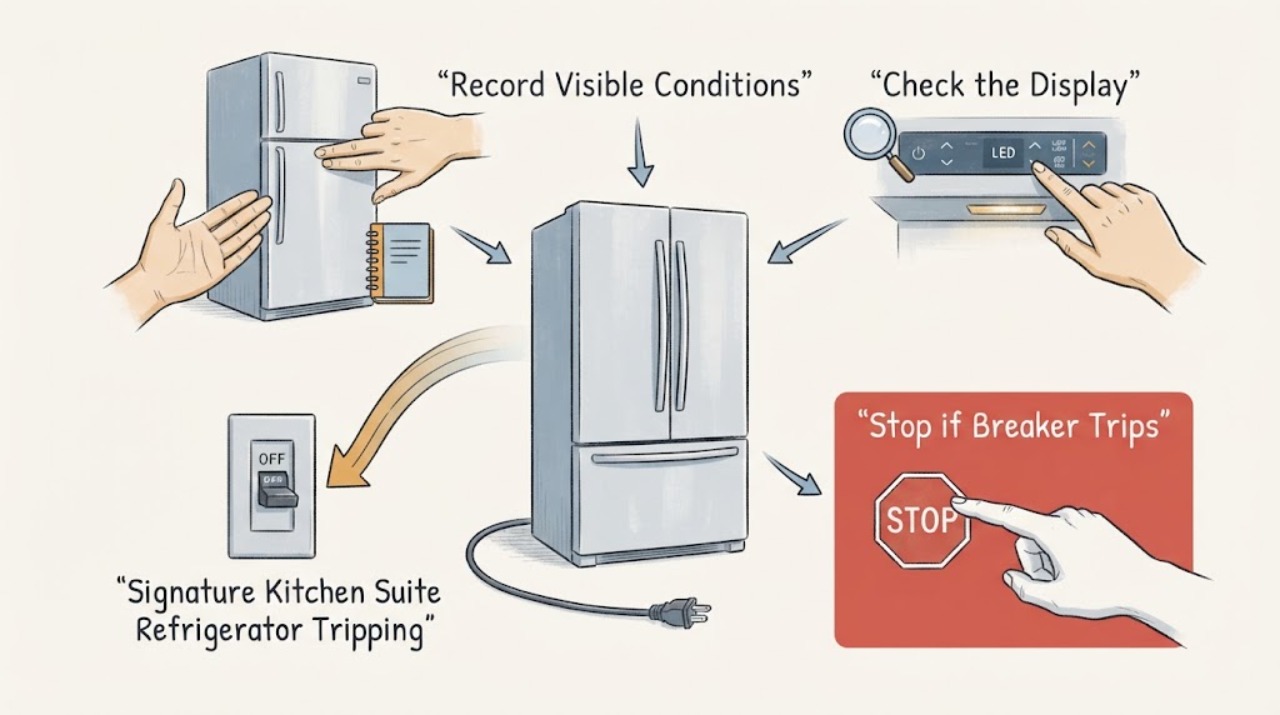
Record the trip pattern before reconnecting anything. Note whether the breaker or GFCI trips immediately when the refrigerator is connected, after cooling starts, after a door or dispenser event, or only when other appliances are running. Record whether the refrigerator display and interior lights are off and note the exact model from the rating label if it is accessible without moving the appliance.
Expected result: The protection trips instantly, trips after a delay when cooling begins, trips only on a GFCI or shared circuit, or no longer trips but the refrigerator has no display or cooling.
Next step: Use the timing to choose the external circuit and cord checks below, and provide it with the exact model when requesting service.
Why this matters
Why: The timing tells the electrician or service technician what was happening at the time of the trip, but it does not identify a compressor, control, wiring, or outlet part by itself. A shared-circuit trip makes the installation load relevant; a repeat trip tied to the refrigerator leaves an appliance fault possible.
-
Check 2
From a dry, safe position, inspect only the visible plug, cord, and outlet area. Look for water, dust, looseness, crushed or frayed cord insulation, heat discoloration, or a damaged receptacle. Confirm that the refrigerator is not connected through an adapter, power strip, or extension cord and that it is intended to use a dedicated grounded outlet. Do not pull out a built-in refrigerator to reach the rear connection.
Expected result: The cord or plug is damaged or wet, the outlet is damaged or loose, a multi-outlet connection or extension is present, or the external connection looks dry and intact.
Next step: Do not reconnect a damaged or wet connection; arrange qualified electrical or Signature Kitchen Suite service. If the connection is intact, continue to the circuit-protection check without moving the appliance.
Why this matters
Why: Moisture, damage, a loose connection, or an unsuitable shared connection can create an electrical hazard or overload. A dry, intact visible connection does not rule out a fault inside the refrigerator or in concealed wiring.
-
Check 3
If there is no smoke, odor, water, visible damage, or immediate hazard, check the household electrical panel and any GFCI protection serving the refrigerator. Reset the tripped protection only once using the normal user control, and do not increase fuse capacity or keep resetting a device that trips again.
Expected result: The protection resets and stays on, trips immediately again, or will not reset; other appliances on the same circuit also lose power or the refrigerator alone causes the trip.
Next step: Leave the refrigerator disconnected when the protection trips again or will not reset, and contact a qualified electrician or appliance service. Do not bypass GFCI protection or substitute a larger fuse or breaker.
Why this matters
Why: A stable reset can indicate a temporary circuit event, while an immediate repeat trip or a protection device that will not reset indicates an unresolved electrical condition. If other appliances share the trip, circuit overload or installation wiring must be considered; if only the refrigerator causes it, an appliance-specific fault remains possible.
-
Check 4
If the circuit stays on and the connection is safe, reconnect the refrigerator without moving it and wait at least five minutes before judging a restart. Observe whether the trip happens immediately, when the cooling system starts, or not at all. Follow the exact model manual if it provides a different restart instruction.
Expected result: The breaker stays on and cooling resumes, the breaker trips as the refrigerator starts cooling, or the breaker trips immediately when power is restored.
Next step: Stop after this controlled reconnection. If the breaker trips at either point, disconnect only from a safe location and arrange qualified service instead of trying another restart.
Why this matters
Why: Signature Kitchen Suite installation guidance says to wait at least five minutes after reconnecting or restoring power so the compressor can cycle. A repeat trip during or immediately after restart remains an electrical fault signal; the timing alone does not prove a failed compressor or start device.
-
Check 5
After a stable power check, inspect the refrigerator's visible display and cooling status without opening service panels. If the display is lit but cooling is disabled, look in the exact model manual for a control OFF or Demo/Display Mode indication; do not apply a mode sequence from another model. If the display remains dark or cooling does not return, record the result for service.
Expected result: The display is lit with a mode indication, the display is dark despite stable power, or the display is normal but the breaker or cooling symptom returns.
Next step: Use only the exact model instructions for a documented mode. Otherwise leave the refrigerator out of service and arrange Signature Kitchen Suite service with the model and trip history.
Why this matters
Why: Some Signature Kitchen Suite models document a control OFF or Display Mode that can leave lights or a display active while cooling is disabled. A dark display with stable supply or a recurring breaker trip points beyond a simple mode setting, but it does not identify the failed assembly.
Use your observations
Decision map
Find the observation that best matches what you see, then follow the next safe action.
-
PATH 01Next step
What you see
The breaker or GFCI trips immediately when the refrigerator is connected, or it trips again immediately after one safe reset.
Do this next
Leave the refrigerator disconnected and contact a qualified electrician or Signature Kitchen Suite service. Do not keep resetting the protection or probe the appliance.
Why this path and its safety boundary
Why it matters: An unresolved short, ground-fault, damaged connection, or appliance electrical fault is possible; the trip is not a normal restart condition.
-
PATH 02Next step
What you see
The breaker trips only when other appliances share the circuit, while the refrigerator's visible cord and plug are dry and intact.
Do this next
Keep the refrigerator on the dedicated grounded outlet specified for the installation and have a qualified electrician evaluate the circuit load. Do not add a power strip or larger fuse.
Why this path and its safety boundary
Why it matters: Circuit overload or an installation problem is more likely than a proven refrigerator part failure.
-
PATH 03Next step
What you see
The breaker stays on until the refrigerator begins cooling, then trips again after the five-minute reconnection interval.
Do this next
Stop further restarts and arrange qualified appliance and electrical service. Provide the exact model and the delay between reconnection, cooling start, and the trip.
Why this path and its safety boundary
Why it matters: A load-related appliance or circuit fault remains possible, but the timing does not establish a compressor, start device, or control part as the cause.
-
PATH 04Next step
What you see
The breaker holds, but the refrigerator display is dark or the appliance does not cool after the supply is restored.
Do this next
Check only the exact model manual for a documented mode, then arrange Signature Kitchen Suite service if the display or cooling does not return. Do not move a built-in unit or open its electrical enclosure.
Why this path and its safety boundary
Why it matters: A control OFF or model-specific display mode is possible on some models, but a dark display with stable supply can also indicate an internal power or control fault.
-
PATH 05Next step
What you see
Water or dust has entered the electrical area, the cord or outlet is damaged, or the refrigerator produces a strange noise, odor, or smoke when power is present.
Do this next
Turn off power only from a safe location, keep the refrigerator disconnected, and contact an authorized service center or qualified electrician. Do not touch a wet plug or attempt a repair.
Why this path and its safety boundary
Why it matters: This is an immediate electrical or appliance safety boundary, regardless of whether the breaker has tripped yet.
Helpful context
Understand the symptom
A breaker trip is an electrical event, not a diagnosis of a particular refrigerator part. The useful distinction is whether the protection trips as soon as the refrigerator is connected, only when cooling starts, only at a GFCI outlet, or when other appliances share the circuit. Signature Kitchen Suite has built-in, side-by-side, column, and undercounter refrigeration, so use the exact model manual for the electrical requirements and controls.
Keep all user checks external. Do not remove a refrigerator cover, probe the outlet, replace an internal fuse, modify the cord, or work on wiring. Signature Kitchen Suite manuals say damaged cords and internal service require qualified personnel, and they direct users to turn off power for strange noise, odor, smoke, water intrusion, or other unsafe conditions.
When checks do not resolve it
Need a professional?
Arrange qualified electrical or Signature Kitchen Suite service when the breaker trips again after one safe reset, trips as cooling starts, the outlet and circuit appear normal but the refrigerator causes the trip, or the refrigerator remains dark or uncooled after power is restored. A qualified electrician should evaluate a shared-circuit overload or questionable outlet.
Safety scope: Do not increase fuse or breaker capacity, bypass GFCI protection, use an extension cord or power strip, open the refrigerator cover, probe wiring, or replace an internal fuse or compressor component. Stop immediately for a wet or damaged plug or cord, damaged outlet, water intrusion, strange noise, odor, smoke, or a protection device that trips again.
Have this ready
- Provide the exact model, installation type, dedicated or shared circuit status, whether protection is a breaker or GFCI, the trip timing, whether other appliances were running, the visible cord and outlet condition, display and cooling status, and any water, odor, smoke, or unusual noise.
Common questions
FAQ
Why does my Signature Kitchen Suite refrigerator keep tripping the breaker?
The trip may involve the household circuit, a GFCI outlet, the installation load, or an appliance electrical fault. Record whether it happens immediately or when cooling starts, check the visible connection and dedicated-outlet setup, and reset protection only once if safe. A repeat trip requires qualified service rather than repeated resets.
Can I plug a Signature Kitchen Suite refrigerator into an extension cord or power strip?
No. Signature Kitchen Suite installation guidance calls for a dedicated outlet and warns against extension or multi-outlet connections. Have a qualified electrician correct the outlet or circuit if the refrigerator is sharing an unsuitable connection.
Should I reset the breaker if the refrigerator trips it?
Only make one normal reset when the area is dry, there is no damage, smoke, odor, or water, and it is safe to do so. Do not increase fuse capacity or repeatedly reset protection. If it trips again, leave the refrigerator disconnected and contact a qualified electrician or Signature Kitchen Suite service.
How long should I wait before reconnecting the refrigerator?
Signature Kitchen Suite installation guidance says to wait at least five minutes after reconnecting the plug or restoring power so the compressor can cycle. If the breaker trips again after that controlled restart, stop testing and arrange service.
Read the exact guide
Official sources
- Signature Kitchen Suite Built-in Refrigerator Owner's ManualSignature Kitchen Suite · Signature Kitchen Suite SKSCR2401P refrigerator circuit-breaker, GFCI, power, control-mode, and safety guidance
- Signature Kitchen Suite Integrated Refrigeration Installation GuideSignature Kitchen Suite · Signature Kitchen Suite built-in refrigeration dedicated outlet, cord, grounding, and restart requirements
- Signature Kitchen Suite Side-by-Side Refrigerator Owner's ManualSignature Kitchen Suite · Signature Kitchen Suite side-by-side refrigerator power reconnection, dedicated branch circuit, and safety guidance
Community feedback
Share a repair observation
Share a plain-text repair observation. Accepted observations are published automatically; this page may take a moment to update.