
On this page
Start here
Quick answer
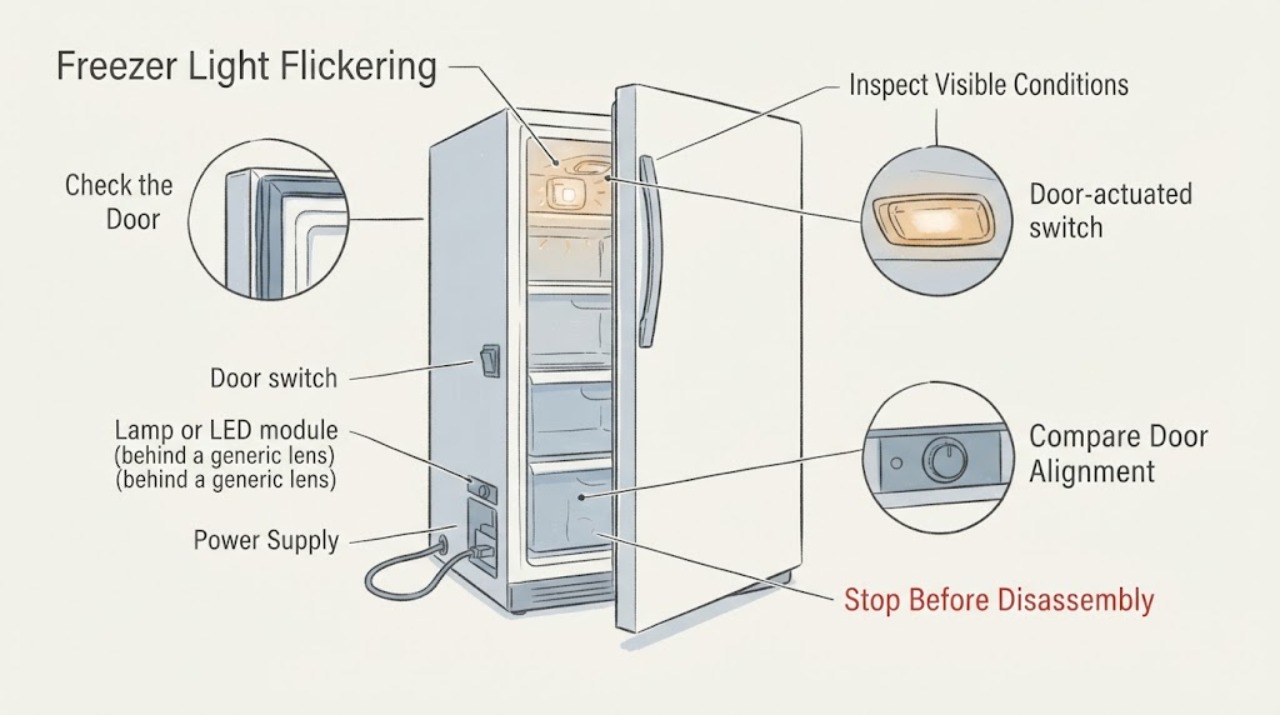
Stop using the light as a reason to keep opening the Smeg freezer and first check for a safety problem. If there is a burning smell, smoke, arcing, a hot or damaged plug, water at an electrical part, repeated breaker tripping, or the freezer is also losing cooling, turn the appliance off and isolate power only from a safe, dry position; do not touch or dismantle the light. With no hazard present, note whether the flicker happens only as the door moves, only when the door is nearly closed, or continuously while the door is still. Check the door seal and frame for a misalignment that could affect the door switch, identify whether your model uses an incandescent lamp or LED lighting, and clean only accessible surfaces according to the exact manual. Never remove a lamp or LED module while energized. Persistent flicker, a failed light, or any whole-appliance power or cooling symptom needs qualified Smeg service.
Work through in order
Diagnostic checks
Use only checks that match the exact appliance or system and its official guide.
-
Check 1
Stop and screen for a hazard before touching the door or light area. If there is smoke, a burning smell, arcing, melted plastic, a hot or wet connection, a repeated breaker trip, or simultaneous loss of cooling, move clear and isolate power only from a safe, dry position; do not touch the light or attempt another flicker test.
Expected result: The freezer has an electrical, heat, moisture, fire, or cooling warning, or it is cool and dry with stable cooling and no visible damage.
Next step: For smoke, fire, or escalating electrical danger use local emergency procedures. Otherwise keep the freezer out of service and arrange qualified appliance or electrical inspection before investigating the light.
Why this matters
Why: A hazard or whole-appliance symptom changes the task from light diagnosis to safety and service. A stable, undamaged appliance may proceed to low-risk observation.
-
Check 2
From the normal user position, observe the timing of the flicker without pressing the door switch, taping it open, or using a tool. Note whether it occurs only while opening or closing, only near the fully closed position, or while the door is still and the appliance is otherwise undisturbed.
Expected result: The flicker follows door movement, occurs when the door is almost closed, or continues with no door movement.
Next step: Do not repeat the observation if there is heat, odor, arcing, or a cooling alarm. Record the pattern for service and continue only with external, unpowered visual checks.
Why this matters
Why: Movement-linked flicker points toward the door switch, hinge-area wiring, or alignment. Flicker with the door still points more toward the lamp or LED module, lighting control, or power supply.
-
Check 3
With the freezer door closed as much as possible, inspect the gasket, cabinet frame, hinges, and nearby shelves for food packages, frost, dirt, a fold, or a gap that could keep the door from reaching its normal closed position. Do not force the door, lift it, or remove hinge covers.
Expected result: A package or frost ridge obstructs the door, the gasket is displaced or damaged, the door sags, or the door and seal appear aligned.
Next step: Remove only a plainly accessible obstruction and clean accessible residue as the manual permits. If the door remains misaligned, the seal is damaged, or frost returns, keep the appliance off and request service.
Why this matters
Why: A door that does not reach the same position can change the light-switch state and allow warm air in. A damaged seal or hinge can also produce a cooling problem, not merely a flickering light.
-
Check 4
Read the model label and its official product page or manual to identify whether the freezer uses an incandescent lamp or LED lighting and whether a door-open alarm or related control is fitted. Do not assume a visible LED panel is a user-replaceable bulb.
Expected result: The documentation identifies an incandescent lamp, an LED module, or a model-specific lighting assembly, or the model information is unavailable.
Next step: If the model cannot be identified, stop at observation and arrange service. Never remove a lamp, LED cover, or module while power is connected.
Why this matters
Why: Smeg uses different lighting types and configurations across freezer models. The correct service path and replacement method therefore depend on the exact model, not on the lamp's appearance.
-
Check 5
After power is disconnected and only if the exact manual permits user cleaning, inspect the accessible light lens and surrounding area for moisture, food residue, frost, discoloration, or a loose-looking cover. Use a dry or suitably damp soft cloth as directed, keep water out of electrical parts, and do not remove the lamp or LED assembly.
Expected result: The lens or area is dirty or damp, the cover or light body is cracked or discolored, or the accessible area is clean and intact.
Next step: Dry the area fully and leave the freezer unpowered if there is damage or moisture. Arrange qualified service for a cracked, hot, discolored, or persistently flickering light.
Why this matters
Why: Contamination or moisture can affect light output, but discoloration, cracking, or a loose assembly may indicate heat or electrical damage. A clean, intact lens shifts attention to the switch, module, control, or supply.
-
Check 6
From a safe external position, compare the light symptom with the rest of the appliance: display, alarm, interior temperature, compressor or fan behavior, and any power interruption. Do not use another appliance or repeatedly cycle the freezer as a live test when the freezer connection is suspect.
Expected result: Only the light flickers while cooling remains normal, the display or alarm also flickers, the freezer is warming, or the appliance loses power.
Next step: Keep the freezer closed and arrange qualified service for any combined light, power, alarm, or cooling symptom; move food to safe cold storage if temperature is uncertain.
Why this matters
Why: An isolated light symptom is more consistent with a lamp, LED module, switch, or local control. Flicker across displays or cooling together suggests a supply or control fault that can damage the appliance or spoil food.
-
Check 7
Prepare a service handoff without opening the cabinet: record the exact model, lighting type, flicker timing, door position, seal and hinge condition, display or alarm behavior, cooling status, and any odor, heat, smoke, water, or breaker event. Take photos only from a safe, dry, unpowered position.
Expected result: The issue is isolated to the light, or the evidence shows a door, supply, control, or cooling fault as well.
Next step: Keep the light and freezer out of service until qualified Smeg service confirms the repair path, especially when any damage or cooling abnormality is present.
Why this matters
Why: A flickering light is a symptom rather than proof of a failed bulb or switch. Model-specific lighting and door hardware require correct parts and safe service boundaries.
Use your observations
Decision map
Find the observation that best matches what you see, then follow the next safe action.
-
PATH 01Next step
What you see
There is smoke, burning smell, arcing, melted plastic, water at an electrical part, a hot connection, or a repeated breaker trip.
Do this next
Stop immediately, move clear, and use local emergency procedures for fire or escalating electrical danger. Isolate power only from a safe, dry location and arrange qualified inspection; do not touch or dismantle the light.
-
PATH 02Next step
What you see
The freezer is also warming, showing a temperature alarm, losing power, or behaving abnormally at the compressor or display.
Do this next
Treat the symptom as a whole-appliance power or cooling fault. Keep the door closed, move food to safe cold storage when temperature safety is uncertain, and request qualified service.
-
PATH 03Next step
What you see
The flicker occurs only as the door moves or near the closed position.
Do this next
Check for an obstruction, frost, gasket gap, or visible alignment issue without forcing the door or pressing the switch. Request service for persistent movement-linked flicker or hinge-area damage.
-
PATH 04Next step
What you see
The light flickers while the door is still and the freezer otherwise cools normally.
Do this next
Identify the model's lamp or LED type and leave the light unpowered for service if flicker persists. Do not substitute a bulb or open an LED module without exact model instructions and appropriate qualification.
-
PATH 05Next step
What you see
The light area is cracked, wet, hot, discolored, or damaged, or the model information cannot confirm a safe user lamp procedure.
Do this next
Keep the freezer out of service and arrange qualified Smeg service. Do not clean inside the light assembly or remove a cover while power is connected.
Helpful context
Understand the symptom
Flicker location is the first useful clue
A light that flickers only while the door moves suggests a door switch, hinge, or wiring movement; a light that flickers while the door is still suggests the lamp, LED module, control, or supply. A door that is not fully closed can also leave the light or door alarm in an unexpected state. Smeg lists different lighting technologies and door features across freezer models, so do not assume that a replaceable bulb, LED assembly, switch, or control board is present.
Protect the freezer contents
If the light problem occurs with a warm cabinet, temperature alarm, stopped compressor, or a door that no longer seals, treat it as a cooling issue rather than a cosmetic lamp issue. Keep the door closed, move food to safe cold storage if temperature safety is uncertain, and arrange service. Avoid repeated door opening while trying to watch the light.
Only after diagnosis
Potential parts
- freezer lamp or LED lighting module
Only consider this category after the model documentation identifies the lighting type and service diagnosis finds the light source faulty rather than the switch, control, or supply.
Confirm the complete Smeg model and the manufacturer's service information; an incandescent lamp and an LED module are not interchangeable. - freezer door switch
Only consider this category when flicker follows door movement or the closed-door state is not detected and qualified diagnosis implicates the switch.
Do not bypass the switch or infer fit from appearance; confirm the exact model and service procedure. - lighting control or power component
Only consider this category when the light and door switch are sound but the light and other appliance functions indicate a control or supply fault.
Electrical diagnosis and replacement require qualified service and exact model verification.
When checks do not resolve it
Need a professional?
Stop and arrange urgent qualified inspection for smoke, burning smell, arcing, a hot or damaged connection, water at electrical parts, repeated breaker trips, or simultaneous loss of cooling. For isolated persistent flicker, keep the light and appliance out of service until qualified Smeg service identifies the model-specific lamp, LED module, door switch, control, or supply fault.
Common questions
FAQ
Why does my Smeg freezer light flicker when I open or close the door?
Movement-linked flicker can point to the door switch, hinge-area wiring, or door alignment. Check for a package, frost, gasket gap, or visible damage without pressing the switch or forcing the door. Persistent flicker needs service.
Can I replace the Smeg freezer LED or bulb while it is plugged in?
No. Do not remove a lamp, LED cover, or module while energized. Follow the exact model manual and use qualified service when the lighting type or replacement procedure is not explicitly user-accessible.
What if the freezer light flickers and the freezer is also getting warm?
Treat that as a power or cooling fault, not only a light problem. Keep the door closed, protect food in safe cold storage if temperature is uncertain, and arrange qualified service. Stop immediately for smoke, odor, heat, arcing, water, or repeated breaker trips.
Read the exact guide
Official sources
- FZU36L FreezersSmeg USA · Smeg FZU36L freezer; interior lighting, incandescent lighting, door-open alarm, temperature alarm, power-on light, and cooling features
- FZU18L FreezersSmeg USA · Smeg FZU18L freezer; LED lighting, door-open alarm, temperature alarm, power-on light, gasket, hinge, and no-frost features
- Instruction ManualSmeg · Smeg refrigerator and freezer manual; electrical safety, cleaning, defrosting, lamp service, door, leveling, and authorized repair boundaries
Community feedback
Share a repair observation
Share a plain-text repair observation. Accepted observations are published automatically; this page may take a moment to update.