
On this page
Start here
Quick answer
First identify which Beko freezer light is flickering: the interior light when the door moves, a front/status indicator, or a display icon. Beko says indicator meanings vary by model, while many units use an interior LED and direct light faults to authorized service. Check the symptom with the door held normally, note whether the freezer is still cold, and inspect only the plug, cord, and outlet from the outside. If there is a burning smell, heat, sparking, repeated tripping, a damaged cord or plug, loss of cooling, or flickering across other household lights, stop using the freezer and obtain qualified electrical or appliance service. Do not remove the light cover or probe the control panel while energized; a standard-bulb replacement is model-specific and must be done unplugged according to the manual.
Before you begin
Safety first
- The reader-level scope is identification, normal door and cooling observation, external inspection of the power path, and manual lookup. Internal LED, holder, door-switch, control-board, wiring, and live electrical diagnosis require qualified service; a standard-bulb procedure is allowed only when the exact manual permits it and the appliance is unplugged.
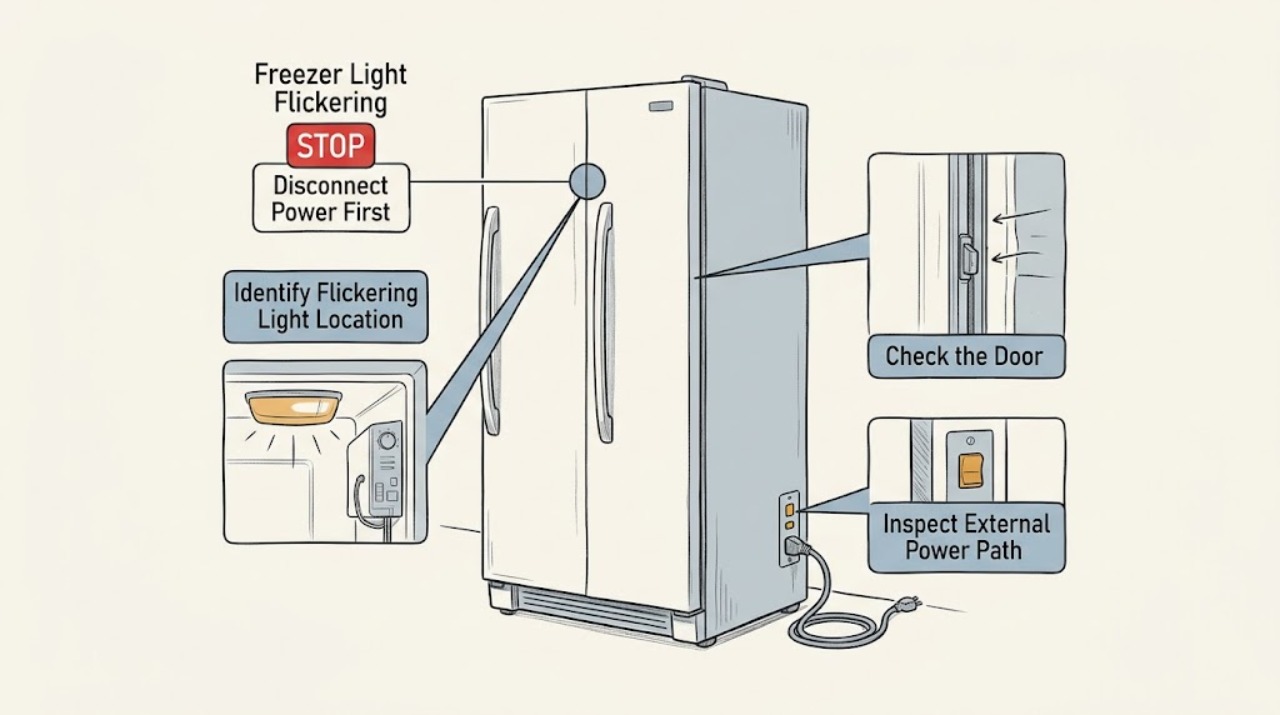
Work through in order
Diagnostic checks
Use only checks that match the exact appliance or system and its official guide.
-
Check 1
From a dry position, observe whether the flicker is the interior lamp, a colored indicator, or a display icon; note whether it occurs only when the freezer door opens, closes, or moves near the latch.
Expected result: Record interior illumination that flickers, an indicator that flashes while the door is closed, a display icon that changes, or several lights that flicker together.
Next step: Photograph or write down the light color, icon, and timing, then compare it with the exact Beko manual. Do not remove a cover just to identify the lamp.
Stop if: Stop observing if there is sparking, smoke, a burning odor, hot plastic, or a shock; move away and arrange qualified service without touching internal parts.
Why this matters
Why: A door-linked interior flicker points toward the lamp, door switch, or its control path. A status or display change may be a model-defined operating or temperature warning rather than a failed lamp; several lights changing together raises a power or control concern.
-
Check 2
Close the freezer door normally, verify that the door is not blocked or held partly open, and observe the cabinet temperature and food condition without repeatedly opening the door.
Expected result: Record a lamp that flickers only during door movement with stable freezing, a lamp that flickers while the door is closed, a high-temperature indicator, or food that is softening.
Next step: Keep the door closed and protect the food while you use the model manual to identify the indicator. Arrange appliance service for a persistent warning, loss of cooling, or a light that flickers with the door closed.
Stop if: Do not adjust hidden switches, bypass the door switch, or continue testing if the freezer is warming, the cabinet is wet, or the door cannot close safely.
Why this matters
Why: A door-motion-only flicker with stable cooling is more consistent with the illumination or door-switch path. A warning indicator, softening food, or flicker while closed may indicate a power, sensor, control, or cooling fault that needs service rather than a bulb change.
-
Check 3
With the freezer left in place, inspect the visible plug, cord, outlet face, and nearby power strip or extension connection for looseness, damage, discoloration, heat, buzzing, or an odor of overheated plastic.
Expected result: Record an intact cool connection, a loose or damaged plug or cord, a warm or discolored outlet, repeated breaker trips, or other lights in the home flickering at the same time.
Next step: If the connection is damaged, hot, buzzing, sparking, or the freezer trips protection, stop using it and contact a qualified electrician or appliance technician as appropriate. Do not move a heavy freezer or repeatedly reset a breaker to test it.
Stop if: Do not touch exposed conductors, open the outlet, remove the freezer rear cover, use a damaged cord, or probe the outlet or appliance with a meter unless you are qualified for that work.
Why this matters
Why: An intact external connection makes a lamp or appliance control issue more plausible but does not prove it. Heat, damage, buzzing, trips, or whole-home flicker can indicate an electrical hazard beyond the freezer.
-
Check 4
Use the freezer's model identification label and the matching Beko manual to determine whether the interior light is an LED module or a standard bulb and whether the observed indicator has a defined warning meaning.
Expected result: Record a manual that identifies an LED, a manual that permits a standard-bulb replacement, a model-specific warning code, or no matching documentation.
Next step: Save the model information and the symptom description for service. If the manual clearly permits a bulb change, unplug the appliance first and follow that manual; otherwise stop at external observation.
Stop if: Do not remove an LED diffuser, bypass a switch, substitute a bulb, or access a control board without model-specific instructions and a safe power disconnection.
Why this matters
Why: An LED fault generally needs Beko-authorized service according to Beko's guidance. A standard bulb is replaceable only under the exact manual procedure and with the appliance unplugged; an unmatched manual does not justify guessing a lamp or rating.
-
Check 5
Only when the cord, plug, outlet, and freezer exterior are dry and undamaged, and there is no smell, heat, spark, or active temperature warning, make one normal power interruption at the accessible plug or approved isolator; restore power once and observe without opening panels.
Expected result: Record steady light and cooling, the same flicker immediately, a delayed warning indicator, or a trip or abnormal sound when power returns.
Next step: Keep the door closed, monitor whether cooling remains stable, and provide the restart result and timing to Beko or an appliance technician. If protection trips or any hazard sign appears, leave the appliance off and escalate.
Stop if: Do not perform this reset when any connection is hot or damaged, when water is present, when the freezer is already warming, or when power has been repeatedly tripping.
Why this matters
Why: A single clean restart can distinguish a transient control state from a repeatable fault, but it does not prove the lamp or control circuit is healthy. A repeat flicker, trip, warning, or abnormal sound needs service.
Use your observations
Decision map
Find the observation that best matches what you see, then follow the next safe action.
-
PATH 01Safety boundary
What you see
Only the interior light flickers as the freezer door opens or moves, while the freezer stays cold and there are no electrical warning signs.
Do this next
Use the exact Beko manual to identify the light type. Arrange service for a Beko LED fault or for any flicker that persists with the door closed.
Why this path and its safety boundary
Why it matters: The illumination lamp, door switch, or its connection is more likely than a whole-home power problem, but the model determines whether the lamp is an LED or standard bulb.
Safety stop: Do not bypass the door switch, remove an LED module, or work inside the cabinet while energized.
-
PATH 02Safety boundary
What you see
A colored indicator or display icon flickers while the door is closed, or it appears with a temperature warning or a model-specific error indication.
Do this next
Check the exact model manual, keep the door closed, protect the frozen food, and arrange appliance service if the warning persists or cooling is affected.
Why this path and its safety boundary
Why it matters: The flicker may be an operating or high-temperature warning, sensor indication, or control fault rather than an interior-lamp problem.
Safety stop: Do not clear a warning repeatedly, change hidden settings, or assume a red or flashing indicator is only a bad bulb.
-
PATH 03Safety boundary
What you see
The flicker is accompanied by heat, discoloration, buzzing, burning odor, sparks, a damaged cord or plug, repeated trips, or flickering in other household lights.
Do this next
Stop using the freezer if it can be done without touching a hazard, keep clear of damaged equipment, and obtain qualified electrician or appliance service; contact the utility for a service-equipment concern.
Why this path and its safety boundary
Why it matters: These are electrical warning signs that may extend beyond the freezer lamp and can present shock or fire risk.
Safety stop: Do not touch exposed wiring, open the outlet or electrical panel, repeatedly reset protection, or attempt a live repair.
-
PATH 04Safety boundary
What you see
The matching Beko manual identifies a standard bulb and the only symptom is a failed or flickering interior lamp with no hazard signs.
Do this next
Follow only the exact Beko manual procedure after unplugging the appliance; if the lamp still flickers or the holder is damaged, arrange service.
Why this path and its safety boundary
Why it matters: A bulb or holder issue is possible, but the appliance must be isolated from mains power before any permitted bulb replacement.
Safety stop: Do not substitute an unverified bulb, work with power connected, or continue if the cover, holder, cord, or plug is damaged.
-
PATH 05Safety boundary
What you see
The freezer uses an LED, the model manual is unavailable or does not permit a bulb change, or the flicker continues after a safe single restart.
Do this next
Arrange Beko-authorized or qualified appliance service and provide the model, light location, timing, cooling condition, and any reset result.
Why this path and its safety boundary
Why it matters: The lamp module, door switch, wiring, or control circuit needs model-specific diagnosis; the symptom cannot safely identify a replacement part.
Safety stop: Do not dismantle the light assembly, probe the board, bypass a switch, or keep operating an appliance with an electrical warning sign.
Helpful context
Understand the symptom
“Flickering light” can describe three different Beko signals
A light inside the freezer may be an illumination LED or, on some older models, a replaceable bulb. A colored indicator or display icon may instead signal power, fast-freeze mode, or a high-temperature warning. Beko says the indicator meanings vary by model, so the exact model manual matters before interpreting a flashing symbol. Note the location and trigger before assuming the lamp itself has failed.
Cooling performance changes the urgency
If the freezer remains cold and only the interior lamp flickers as the door moves, the fault may be limited to the lamp, door switch, or connection. If the light change occurs with a temperature warning, a display error, compressor stopping, or food softening, treat it as a possible power, control, or cooling issue. Do not repeatedly open the door to test it; protect the frozen food while arranging service.
Keep the electrical boundary on the outside
Look at the cord, plug, and outlet without removing panels or touching bare conductors. CPSC lists flickering or dimming lights, unusual sounds, heat, odors, and sparks as warning signs. Beko directs LED-light faults to service and says a standard bulb must be changed only after unplugging the appliance and following the model manual. A freezer with an unexplained flicker is not a reason to test live terminals.
Safety boundary
Stop conditions
- Stop using the freezer and obtain qualified help for smoke, sparks, burning odor, hot or discolored connections, buzzing, shock, damaged cord or plug, or repeated trips.
- Do not open the outlet, electrical panel, rear cover, control board, or light assembly for live testing or probing.
- Do not bypass the door switch, substitute an unverified bulb, or remove an LED module without the exact model procedure and a safe power disconnection.
- If the freezer is warming, food is softening, or a high-temperature or fault indicator persists, keep the door closed and arrange appliance service rather than treating the symptom as a lamp-only fault.
- If other household lights flicker at the same time, treat the issue as a possible building electrical problem and contact a qualified electrician or utility rather than repeatedly resetting the freezer.
When checks do not resolve it
Need a professional?
Arrange urgent electrical or appliance service for sparks, smoke, burning odor, heat, buzzing, shock, a damaged cord or plug, repeated trips, or flickering across other household lights. Arrange prompt Beko or qualified appliance service for a persistent interior LED flicker, an unknown model light type, a flickering indicator with cooling changes, a door switch concern, or a light that still flickers after the exact manual's safe bulb procedure. A standard-bulb replacement is appropriate only when the matching manual explicitly permits it and the appliance is unplugged first.
Safety scope: The reader-level scope is identification, normal door and cooling observation, external inspection of the power path, and manual lookup. Internal LED, holder, door-switch, control-board, wiring, and live electrical diagnosis require qualified service; a standard-bulb procedure is allowed only when the exact manual permits it and the appliance is unplugged.
Common questions
FAQ
Why is my Beko freezer light flickering?
First identify whether it is the interior illumination, a colored indicator, or a display icon. An interior flicker may involve the LED, bulb, or door switch; a status light may be signaling fast-freeze, power, temperature, or a model-specific fault. The exact Beko manual is needed before interpreting the signal.
Is a flickering Beko freezer light a temperature problem?
Not always. If only the interior lamp flickers and the freezer remains cold, the illumination path is more plausible. If a warning indicator flickers or the food is softening, keep the door closed and arrange service because the symptom may involve temperature, sensing, power, or control functions.
Can I replace the Beko freezer light myself?
Only if the exact model manual identifies a standard bulb and gives a replacement procedure. Beko says many units use an LED and directs LED faults to service; it also says to unplug the appliance before replacing a standard bulb. Do not remove an LED assembly or probe the control panel.
What should I check before calling for a Beko freezer light problem?
Record which light flickers and when, note whether the freezer remains cold, and inspect the visible plug, cord, and outlet for looseness, heat, damage, discoloration, buzzing, or odor. Do not open panels or repeatedly reset a breaker to test the freezer.
When is a flickering freezer light an electrical emergency?
Treat sparks, smoke, a burning odor, hot or discolored connections, buzzing, shock, repeated trips, or flickering in other household lights as electrical warning signs. Stop using the freezer if it can be done safely, keep clear of damaged equipment, and obtain qualified electrical or appliance help.
Read the exact guide
Official sources
- CPSC Guide to Home Wiring HazardsU.S. Consumer Product Safety Commission · CPSC household wiring guidance used for the external electrical safety boundary; it does not diagnose a Beko freezer lamp or control fault.
- What do the indicator lights mean?Beko UK · Beko support guidance used to distinguish indicator lights from interior illumination; exact meanings vary by freezer model.
- How do I replace the internal light in my Beko fridge or fridge freezerBeko UK · Beko support guidance used for the distinction between LED and standard-bulb interior lights; the exact model manual controls any replacement procedure.
- Freezer / User ManualBeko · An opened Beko English manual used as an example of model-specific indicator behavior; it is not assumed to match an unspecified freezer, so the reader must use the exact model manual.
Community feedback
Share a repair observation
Share a plain-text repair observation. Accepted observations are published automatically; this page may take a moment to update.