
On this page
Start here
Quick answer
Some Smeg freezer sounds are part of normal operation: a compressor hum, refrigerant bubbling or flowing, brief cracking as materials or ice expand, water during defrost, or air movement in a No-Frost model. A new or harsh sound needs a different decision. Keep the door closed while you listen, note whether food is softening, and check only safe external causes such as an unlevel cabinet, contact with a wall, or vibrating containers. Stop and arrange service for scraping or impact that may involve ice or a fan, a sudden loud change, loss of cooling, repeated electrical trips, burning smell, smoke, or overheating. Do not remove covers, chip ice, touch the compressor, or test a live appliance after damage.
Before you begin
Safety first
- Do not use a Smeg freezer with smoke, burning smell, electrical damage, water at electrical parts, repeated circuit trips, severe scraping or impact, or loss of cooling until qualified service has assessed it.
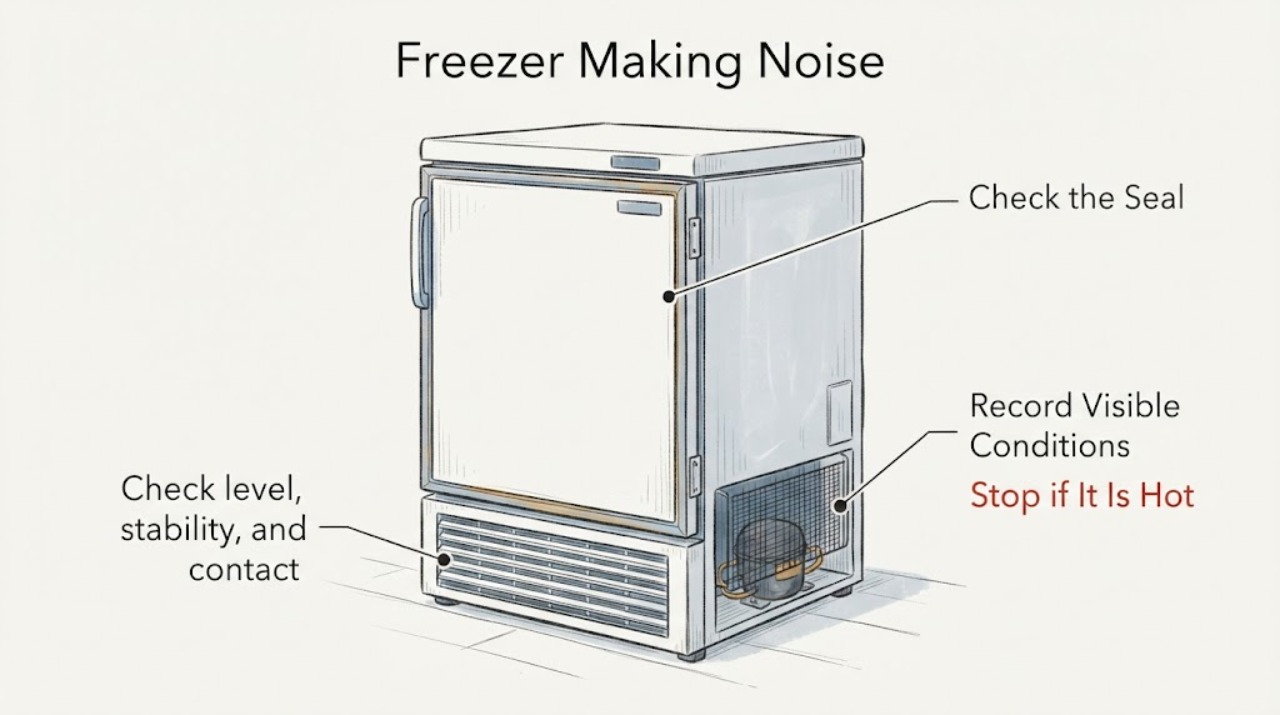
Work through in order
Diagnostic checks
Use only checks that match the exact appliance or system and its official guide.
-
Record the sound without creating a new test
Keep the freezer door closed and note the sound's character, when it occurs, how long it lasts, and whether it follows compressor start, defrost, door opening, or a temperature change. If there is smoke, burning odor, heat, water near electrical parts, or a repeated trip, stop from a dry safe position and do not listen by restarting it.
Expected result: The sound is a steady hum, a brief click or crack, bubbling/flowing, water, or air movement; or it is a new grinding, scraping, clanging, repeated impact, electrical buzz, or alarm accompanied by warming food.
Next step: For a normal-pattern sound with stable cooling, continue with safe external checks. For a changed or hazardous pattern, keep the freezer closed and arrange service without repeating the event.
Why this matters
Why: The first group matches sound patterns Smeg describes as possible normal operation. A new harsh sound, a sound tied to scraping ice, or a noise with cooling or electrical symptoms is a fault pattern rather than a normal-sound label.
-
Check whether food is still frozen and the door seals
Without unloading the freezer, note whether food remains hard frozen, whether a temperature alarm is active, and whether the door closes fully. Look for a package preventing closure or a torn, displaced seal; do not leave the door open to inspect for a long period.
Expected result: Food is softening, the alarm remains active, frost is changing unusually, the door does not close, or the freezer is holding its expected temperature with a sound door seal.
Next step: If cooling is declining, keep the door closed, protect food using food-safety guidance, and arrange prompt service. If temperature is stable, continue only with the external vibration checks.
Why this matters
Why: Softening food or a door that cannot seal means the noise may accompany a cooling or air-leak problem. Stable temperature and a closed seal make a cabinet vibration or normal operating sound more likely, but do not clear a sudden grinding or electrical sound.
-
Check level, stability, and contact with the wall
From the front and sides, observe whether the cabinet rocks, whether it is visibly leaning, and whether the rear or side touches a wall, cabinet, pipe, or other hard surface. Do not move a built-in or heavy freezer by force; use only the model's accessible leveling adjustment or arrange help if it needs moving.
Expected result: The cabinet is unstable or touching a hard surface, or it is stable with clearance and no external contact.
Next step: If a safe, accessible leveling adjustment is clearly described for the model, have it corrected while the appliance remains stable; otherwise book service. Do not pull on refrigerant tubing or rear components.
Why this matters
Why: A compressor or cabinet vibration can be amplified when the appliance is unlevel or transmits vibration into a wall or cabinet. If it is stable and clear, the noise is more likely internal or a normal operating event.
-
Remove simple sources of internal and external vibration
With the door opened only briefly, check whether bottles, trays, drawers, shelves, or packages are touching one another or the cabinet wall. Also look for items sitting on top of the freezer. Rearrange only loose items that can be moved without force; do not reach behind panels or into a fan guard.
Expected result: The sound changes when loose containers are separated or when an item on top is removed, or it continues unchanged with no contact found.
Next step: If the noise stops after a harmless rearrangement and cooling is stable, monitor without repeated door opening. If it continues or returns, keep the freezer in service only if there are no warning signs and arrange an authorized assessment; do not dismantle it.
Why this matters
Why: A sound that changes with a loose object is a vibration interaction rather than proof of a compressor failure. An unchanged sound, especially a scrape, knock, or fan-like growl, may be internal and needs the model-specific service path.
-
Distinguish No-Frost airflow from ice or fan scraping
Use the exact Smeg manual to identify whether the freezer is No-Frost. Compare the recorded sound: a soft airflow or brief defrost crack is different from a rhythmic scrape, ticking, or fan noise that changes with the door or appears with heavy frost. Do not chip ice, insert tools, or remove a fan cover to reach the source.
Expected result: The model is No-Frost and the sound is a soft, intermittent airflow/defrost sound; or the noise is a persistent scrape, fan-like growl, or impact with frost or reduced cooling.
Next step: For persistent scraping, keep the door closed as much as possible and arrange service using the exact model manual. Do not manually defrost with heat or sharp tools unless the model manual explicitly provides a safe procedure and the appliance can be isolated without food risk; service is the safer route for a new harsh sound.
Why this matters
Why: Smeg describes air circulation and defrost-related sounds as normal in relevant models. Persistent scraping can indicate ice contacting a fan or another internal obstruction, but the source cannot be confirmed safely from outside.
-
Check external electrical warning signs without opening the unit
From a dry, safe position, observe whether the plug, cord, socket, breaker, or residual-current device has heat marks, discoloration, buzzing, damage, or a repeated trip. Do not touch a wet plug, exposed conductor, or hot/discolored connection, and do not repeatedly reset a breaker to listen again.
Expected result: There is smoke, burning odor, a hot or discolored connection, visible damage, buzzing at the supply, or a repeated trip; or none of these warnings is present.
Next step: Keep the circuit isolated and arrange qualified electrical/appliance service for any warning sign. If no warning is present, continue only with sound, temperature, clearance, and installation observations; do not perform a live test.
Why this matters
Why: These symptoms can indicate an electrical fault or unsafe supply and are not explained by ordinary compressor or refrigerant sounds. The absence of an electrical warning does not make a sudden mechanical noise normal.
-
Protect food if cooling performance has changed
If the freezer is warming or power has been interrupted, keep the door closed as much as possible and use an appliance thermometer if one is already available. Separate clearly thawed or leaking food from other food without tasting it, and follow local food-safety guidance for temperature and ice-crystal decisions.
Expected result: Food remains at a safe frozen state, still has ice crystals, or is at or below the applicable safe temperature; or food is warm, fully thawed, leaking, or its history is unknown.
Next step: Keep the freezer closed and arrange prompt service for cooling loss. Discard food that local guidance identifies as unsafe; do not keep reopening the freezer to investigate the sound.
Why this matters
Why: A noise plus cooling loss is an appliance-performance fault, not merely an acoustic nuisance. FDA guidance says appearance or odor alone is not enough to decide whether food is safe after an outage.
-
Choose monitoring or authorized service
Review the sound recording/notes, model code, freezer type, temperature result, and external checks. A sound is eligible for cautious monitoring only when it matches the model's normal pattern, cooling is stable, the cabinet is safe, and no electrical or burning warning exists.
Expected result: The sound remains a documented normal pattern with stable freezing, or it is new, worsening, unexplained, accompanied by warming food, or associated with damage or an electrical symptom.
Next step: For any unresolved or worsening noise, contact Smeg or an authorized appliance technician with the model and recording/description. Do not open the sealed system, add refrigerant, or continue using it after a stop condition.
Why this matters
Why: A normal pattern can be observed without repeated testing. A changed or unresolved noise may involve the compressor, fan, frost, sealed system, mounting, or control and needs professional diagnosis.
Use your observations
Decision map
Find the observation that best matches what you see, then follow the next safe action.
-
PATH 01Safety boundary
What you see
Smoke, burning smell, hot or damaged cord/plug, water at electrical parts, or repeated circuit trip is present
Do this next
Stop handling the freezer from a dry safe position, isolate the circuit if it can be done safely, keep the door closed, and arrange qualified electrical/appliance service.
Why this path and its safety boundary
Safety stop: Do not reconnect, repeatedly reset, or open the appliance to locate the sound.
-
PATH 02Safety boundary
What you see
Food is softening, an alarm remains active, or the freezer is no longer holding temperature
Do this next
Minimize door opening, protect food using current food-safety guidance, and arrange prompt service for the noise and cooling fault.
Why this path and its safety boundary
Safety stop: Do not keep testing cycles or decide food safety from smell or appearance alone.
-
PATH 03Safety boundary
What you see
The sound is a gentle hum, refrigerant bubbling/flowing, brief cracking, defrost water, or No-Frost airflow and cooling is stable
Do this next
Monitor the pattern with the door closed and confirm the model manual describes the sound as normal.
Why this path and its safety boundary
Safety stop: Escalate if the sound suddenly changes, becomes harsh, or is joined by warming food or an electrical warning.
-
PATH 04Safety boundary
What you see
The freezer rocks, touches a wall/cabinet, or loose containers vibrate
Do this next
Correct only an accessible, model-supported leveling or contact issue and separate loose containers without force.
Why this path and its safety boundary
Safety stop: Do not pull the appliance, refrigerant tubing, or rear components to silence a vibration.
-
PATH 05Safety boundary
What you see
The sound is persistent scraping, rhythmic impact, or fan-like noise with frost or a cooling change
Do this next
Keep the door closed and arrange Smeg or authorized service to inspect the internal fan/ice or cooling system.
Why this path and its safety boundary
Safety stop: Do not chip ice, use sharp tools or heat, or remove a fan guard or cover.
-
PATH 06Safety boundary
What you see
The sound is new or suddenly louder but there is no immediate electrical or food-safety warning
Do this next
Record the model, sound pattern, timing, and temperature result, then arrange an authorized assessment if it persists or returns.
Why this path and its safety boundary
Safety stop: Do not dismiss a new harsh noise solely because the freezer still feels cold at that moment.
-
PATH 07Safety boundary
What you see
The freezer type or model cannot be identified
Do this next
Use the rating label and Smeg documentation to identify it; until then, treat an unexplained harsh sound as unresolved and avoid dismantling it.
Why this path and its safety boundary
Safety stop: Do not apply a No-Frost or manual-defrost instruction from another model.
-
PATH 08Safety boundary
What you see
The sound remains unexplained after safe external checks
Do this next
Keep the freezer closed as much as practical and contact Smeg or an authorized appliance technician with the model and observations.
Why this path and its safety boundary
Safety stop: Do not open the sealed cooling system, add refrigerant, or keep restarting it to reproduce the noise.
Helpful context
Understand the symptom
Sounds Smeg describes as normal
The opened Smeg manuals describe several sounds that can occur while a freezer regulates temperature: a hum when the compressor runs, bubbling or splashing from refrigerant in the tubes, brief cracking from thermal expansion or automatic defrost, water flowing to an evaporation container, and air movement in a No-Frost freezer. These sounds are judged by their pattern and by whether the appliance still freezes normally. A sound that is suddenly louder, changes character, or arrives with poor cooling is not cleared just because a similar quiet sound can be normal.
Start with the cabinet and the things touching it
Smeg's troubleshooting guidance points to level and stability, anything touching the rear, and objects vibrating inside the appliance. Those checks can remove a rattle without disturbing the sealed cooling system. Do not pull an integrated freezer out, tilt it, or work behind it unless the installation instructions and a qualified person make that safe; a freezer that is tight against cabinetry or has damaged wiring needs service rather than force.
Treat cooling loss and electrical symptoms as separate warnings
Noise alone is not a temperature measurement. If food is softening, an alarm is active, frost is changing rapidly, or the freezer no longer holds temperature, protect the food while keeping the door closed as much as possible and arrange service. If there is smoke, a burning smell, heat damage, water at electrical parts, or a repeated circuit trip, stop handling the appliance from a dry, safe position and leave it isolated. Never decide that food is safe by tasting it.
Only after diagnosis
Potential parts
- evaporator or circulation fan
Only consider this after a qualified diagnosis confirms that a fan is the source of the noise and identifies the exact Smeg model.
Confirm model-specific fit and electrical compatibility with Smeg or the technician; do not access or test the fan yourself. - compressor mounting or isolation component
Only relevant if service confirms that abnormal vibration is transmitted from the compressor or its mounting rather than from cabinet contact.
The sealed cooling system and compressor area require qualified service; do not pull or adjust rear tubing. - door gasket
Only relevant if a professional or model manual confirms that a damaged seal is causing warming, frost, or repeated compressor operation alongside the noise.
Confirm the complete model and door configuration before ordering; a gasket does not explain an electrical arc or mechanical impact by itself.
When checks do not resolve it
Need a professional?
Provide the model code, freezer type, sound description or recording, when it occurs, temperature/alarm result, door and frost observations, and any contact, vibration, electrical, or food-safety symptoms.
Safety scope: Do not use a Smeg freezer with smoke, burning smell, electrical damage, water at electrical parts, repeated circuit trips, severe scraping or impact, or loss of cooling until qualified service has assessed it.
Common questions
FAQ
Which Smeg freezer noises are normal?
Smeg manuals describe possible normal sounds including compressor hum, refrigerant bubbling or flow, brief cracking during temperature changes or defrost, defrost water, and No-Frost air movement. A sudden, harsh, scraping, or impact sound, or any noise with cooling loss, needs service.
Why is my Smeg freezer vibrating or rattling?
Check from outside whether the cabinet is level, touches a wall or cabinet, or has loose containers touching each other or the freezer wall. If those causes are absent or the noise persists, arrange service rather than adjusting rear components.
What if the noise sounds like a fan scraping ice?
Keep the door closed and do not chip ice, use heat, or remove a fan cover. A persistent scrape, heavy frost, alarm, or cooling change needs Smeg or authorized service to inspect it safely.
Should I unplug a noisy Smeg freezer?
Do not unplug it while standing in water or touching a wet or damaged connection. Isolate it only from a dry, safe position when there is an electrical or burning warning, and arrange qualified service. If food is warming, minimize door opening while protecting food under current food-safety guidance.
Read the exact guide
Official sources
- Freezer / User ManualSmeg · Smeg No-Frost freezer airflow, performance checks, normal noise patterns, and service guidance
- Are You Storing Food Safely?U.S. Food and Drug Administration · Freezer food storage and food-safety decisions during a power interruption
- Freezer / User ManualSmeg · Smeg freezer operation, noise troubleshooting, installation clearance, level, and authorized service guidance
- Food and Water Safety During Power Outages and FloodsU.S. Food and Drug Administration · Freezer temperature monitoring and food handling after power outages
Community feedback
Share a repair observation
Share a plain-text repair observation. Accepted observations are published automatically; this page may take a moment to update.