
On this page
Start here
Quick answer
First confirm that the Smeg appliance actually has an automatic ice maker. Smeg lists models with an automatic, filtered-water ice maker and other refrigerator-freezer models with a manual ice maker or ice tray, so one model's water or control procedure cannot be applied to another. Read the product code from the appliance label and open the matching Smeg manual. Then check the documented ice-maker or tray position, the freezer temperature and special modes, the external water supply or filter only if that model uses them, and the bin or tray for a visible frozen blockage. Do not chip ice with a sharp tool, pour heat into the compartment, remove sealed panels, or bypass a sensor. Protect frozen food if the compartment is warming, and arrange qualified service for leaks near electrical parts, damaged wiring, persistent cooling failure, or any internal water, refrigeration, or ice-maker repair.
Before you begin
Safety first
- This article supports product identification and ordinary-access checks only. It does not authorize sharp-tool or heat defrosting, powered-mechanism access, water-line disconnection, electrical work, sealed-system work, or generic part replacement.
Work through in order
Diagnostic checks
Use only checks that match the exact appliance or system and its official guide.
-
Check 1
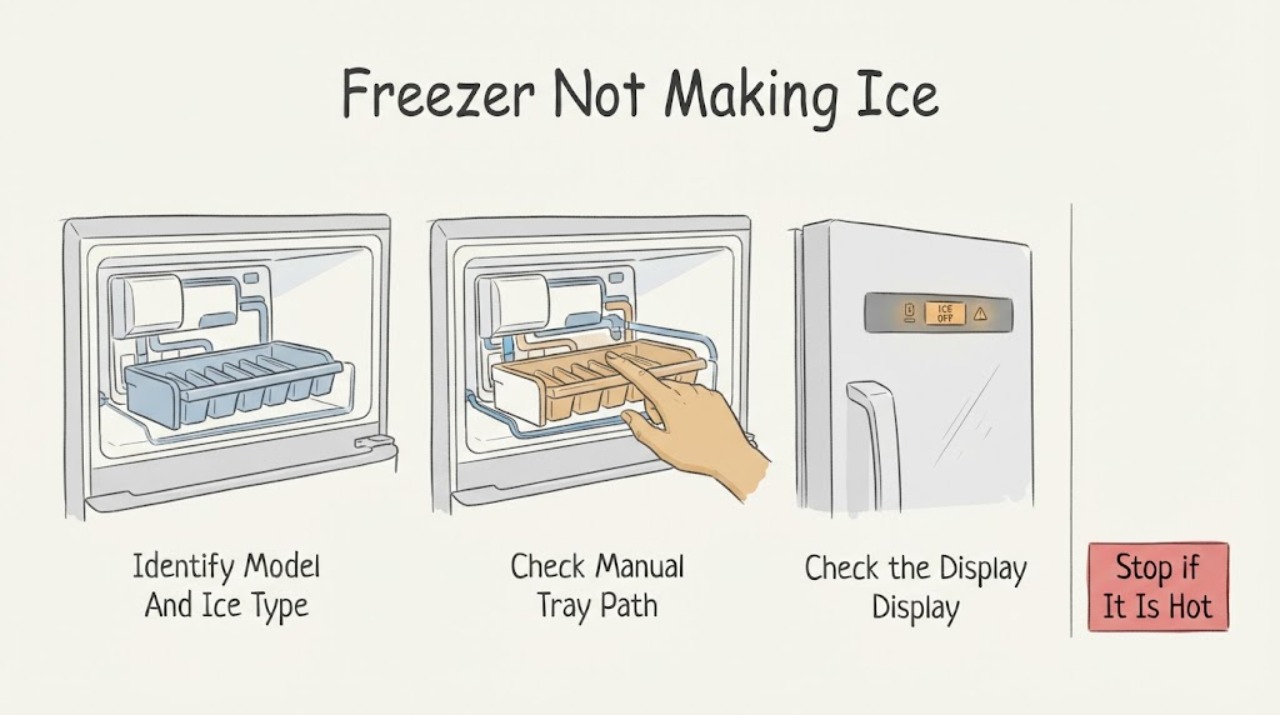
Read the Smeg product code from the appliance label and use Smeg's official manual lookup; inspect the manual or product information to determine whether the appliance has a manual tray, an automatic ice maker, or no ice-making function.
Expected result: Record the exact product code, the ice-maker type, whether the tray or bin is present, and whether the model uses an external water connection or a filtered-water path; do not infer the design from appearance alone.
Next step: Follow only the matching manual's ice-making procedure and continue to the tray or automatic-model branch below; if the product code cannot be read or matched, ask Smeg or a qualified technician to identify the appliance.
Stop if: Do not remove trim, panels, wiring, or a sealed ice-maker cover to find the product code or determine the mechanism.
Why this matters
Why: A manual tray requires a user-supplied fill-and-freeze step, while an automatic model may require its own enablement, water, filter, bin, and sensor conditions. If the model has no ice maker, no ice production fault exists.
-
Check 2
If the matched model has a manual ice maker, inspect the tray from ordinary access and follow the manual's fill, level, freeze, and release instructions without overfilling or forcing the tray.
Expected result: Record whether the tray is present, was filled as specified, freezes solid, releases ice normally, or is cracked, displaced, dry, or blocked by a fused mass.
Next step: Correct only the manual's ordinary fill or position issue; if the tray does not freeze while the freezer is otherwise cold, or if it is damaged or stuck, stop forcing it and arrange service.
Stop if: Do not use a knife, screwdriver, boiling water, hair dryer, or other heat source to break ice or release a tray, and do not operate with a cracked tray that can leak.
Why this matters
Why: A dry tray or incorrect position explains no ice from a manual maker. A tray that does not freeze, is cracked, or cannot release ice may indicate a cooling, tray, or handling problem rather than an automatic water-supply fault.
-
Check 3
If the matched model has an automatic ice maker, use the exact manual to confirm that ice production is enabled, the bin or drawer is seated, the door or drawer closes fully, and any documented Sabbath, Holiday, showroom, or power-saving mode is not disabling production.
Expected result: Record the control state, display or alarm, bin position, visible ice level, and whether ice is fused around the outlet or mechanism; do not reach into a moving auger or force a motor-driven part.
Next step: Restore only a documented setting or bin position, remove loose accessible ice without sharp tools if the manual permits, and request service if the control will not enable production or the mechanism remains blocked.
Stop if: Do not bypass a sensor, hold a switch closed, reach into a powered mechanism, dismantle the ice maker, or use heat to clear a blockage.
Why this matters
Why: A disabled function, special mode, open drawer, displaced bin, or visible frozen blockage can stop an otherwise cold automatic ice maker. Smeg documents model-specific functions, so an option name or control sequence from another product may not apply.
-
Check 4
Only for a model whose manual identifies an automatic water connection or filter, inspect the external shutoff position, visible tubing, filter seating, and accessible connection for an obvious closed valve, kink, disconnection, or leak without loosening any fitting.
Expected result: Record whether water service is present, the visible line is kinked or disconnected, the filter is the correct documented type and seated, the ice-maker fill area is dry, or the path cannot be judged without moving the appliance or opening a panel.
Next step: Correct only a clearly accessible condition described by the matching manual; do not operate the maker if it leaks, and arrange qualified appliance or plumbing service when the path requires disconnection or internal access.
Stop if: Do not disconnect water tubing, open a filter housing not covered by the manual, pull out a built-in appliance, repair a hidden leak, or use the ice maker with water near electrical parts.
Why this matters
Why: An external supply, filter, or visible line condition can prevent an automatic maker from filling, but a manual-tray model does not have the same water path. A leak or uncertain connection needs service instead of repeated filling attempts.
-
Check 5
From the display and ordinary freezer access, record the temperature indication, door or temperature alarms, cooling mode, fast-freezing state, and whether stored food remains properly frozen; do not change several settings or repeatedly open the door.
Expected result: Classify the appliance as cold with an ice-only fault, warming with an alarm, showing an unknown display message, or having no power or display; note unusual frost, condensation, or repeated cycling.
Next step: Use the matching manual for one documented setting correction only; protect or relocate food as needed and request qualified refrigeration service for warming, recurring alarms, no power, or an unexplained display.
Stop if: Stop for a damaged cord, wet electrical area, burning odor, smoke, sparks, repeated breaker trips, severe leak, or food that is no longer safely frozen.
Why this matters
Why: Cold storage with no ice points toward the identified tray, control, bin, or water path. Warming, alarms, or loss of frozen-food condition indicates a broader cooling, door, power, or control concern that takes priority over ice production.
-
Check 6
With the appliance stable and no leak or electrical hazard, clear only loose ice or packaging that the exact manual identifies as ordinary-access debris, then perform at most one model-documented power recovery if the manual provides it.
Expected result: Record whether the mechanism becomes unobstructed, the display returns normally, water or ice production resumes during the next normal cycle, or the same fault, alarm, leak, or blockage returns.
Next step: Stop further attempts and give the technician the product code, ice-maker type, settings, water-path observations, food temperature condition, and one recovery result.
Stop if: Do not repeatedly unplug and reconnect, chip bonded ice, pour heat into the freezer, operate with a leak, or open the cabinet or sealed refrigeration system.
Why this matters
Why: A loose accessible obstruction or transient control state may explain a single interruption. A returning blockage, no fill, no freeze, unusual noise, leak, or repeated alarm indicates a part, cooling, water, or control fault that a reset cannot repair.
Use your observations
Decision map
Find the observation that best matches what you see, then follow the next safe action.
-
PATH 01Safety boundary
What you see
The matched Smeg product uses a manual ice maker or ice tray.
Do this next
Follow the exact manual's ordinary fill, freeze, and release instructions and observe whether the tray freezes and releases normally.
Why this path and its safety boundary
Why it matters: The appliance is not expected to fill the tray automatically; water supply and automatic-valve diagnoses do not apply unless the manual separately identifies them.
Safety stop: Stop for a cracked or stuck tray, inability to freeze, leaking water, or any need to chip ice or use heat.
-
PATH 02Safety boundary
What you see
The matched Smeg product has an automatic ice maker using its documented water path.
Do this next
Follow the exact manual for settings and ordinary-access checks; do not substitute a manual-tray procedure or a different Smeg model's control sequence.
Why this path and its safety boundary
Why it matters: The relevant checks are the model's enablement, bin or drawer, documented water or filter path, freezer condition, and sensor or blockage behavior.
Safety stop: Stop for a leak, water near electrical parts, a blocked powered mechanism, or any required panel or fitting access.
-
PATH 03Safety boundary
What you see
The freezer is cold, but ice production is disabled in the documented controls, a special mode is active, the bin is displaced, or a visible loose blockage is present.
Do this next
Restore one documented setting or bin position and clear only loose accessible debris as permitted; observe one normal cycle before requesting service.
Why this path and its safety boundary
Why it matters: A user-setting, bin, or accessible obstruction may be preventing a normal automatic cycle.
Safety stop: Do not bypass a sensor, force an auger, reach into a powered mechanism, or use heat or a sharp tool.
-
PATH 04Safety boundary
What you see
An automatic model has no fill, a closed external water supply, a kinked visible line, an incorrectly seated documented filter, or a visible leak.
Do this next
Correct only a clearly accessible condition described by the manual; stop and arrange qualified appliance or plumbing service for leaks, hidden tubing, or internal access.
Why this path and its safety boundary
Why it matters: The water path may be limiting production, but a leak or uncertain connection is not a safe DIY repair.
Safety stop: Do not loosen fittings, disconnect tubing, move a built-in appliance, or operate with water near electrical parts.
-
PATH 05Safety boundary
What you see
The freezer is warming, an alarm persists, power is absent, or frozen food is softening while ice production has stopped.
Do this next
Keep the door closed, protect food according to local food-safety guidance, and arrange qualified refrigeration service promptly.
Why this path and its safety boundary
Why it matters: This is a broader food-preservation or cooling problem, not merely an ice-maker inconvenience.
Safety stop: Stop for burning odor, smoke, sparks, wet electrical areas, a damaged cord, repeated breaker trips, or a severe leak.
-
PATH 06Safety boundary
What you see
The product code cannot be matched, the manual does not cover the symptom, or ice production remains absent after the documented ordinary checks.
Do this next
Stop experimentation and provide the product code, ice-maker type, display or alarm, temperatures or food condition, water-path findings, and manual steps already followed to Smeg or a qualified technician.
Why this path and its safety boundary
Why it matters: The installed configuration and fault path are unresolved; guessing a part or using another model's procedure can create a water, electrical, or food-safety problem.
Safety stop: Do not order a generic valve, sensor, tray, filter, or control, and do not open the cabinet or sealed refrigeration system.
Helpful context
Understand the symptom
Confirm the ice-maker design before checking water
There is no universal Smeg freezer ice-maker procedure. Smeg's own product pages show automatic ice makers on some standalone freezers and a manual ice maker on at least one refrigerator-freezer model. A manual tray will not fill itself, while an automatic model may depend on a documented water path, control, bin, or sensor. Use the product code and matching manual to identify which design is installed.
Separate ice production from the freezer's cooling state
A freezer can be cold enough to preserve food yet have an ice-making control or water-path issue, or it can be warming and fail to make ice as a symptom of a broader cooling problem. Note the display, alarms, special modes, and food condition. Do not change several settings at once or assume that Fast Freezing, Sabbath, Holiday, or another mode has the same effect on every model.
Use ordinary-access checks only
Safe checks include the product label, manual, ice tray or bin position, visible ice blockage, door closure, and any clearly accessible external water line or filter that the manual identifies. Do not use a knife or heat to free ice, reach into moving mechanisms, disconnect a water fitting, or remove a sealed cover. Leaks near power, a warming freezer, damaged wiring, or repeated alarms need service.
Safety boundary
Stop conditions
- Do not chip ice with a knife or sharp tool, apply direct heat, force a tray or bin, or reach into a powered mechanism.
- Do not bypass an ice-maker sensor, door switch, control, or other safety device, and do not dismantle sealed panels or the refrigeration system.
- Do not disconnect water tubing, loosen fittings, move a built-in freezer, or operate when water is near electrical parts.
- Stop for a warming freezer, persistent temperature or door alarm, severe leak, damaged cord, wet electrical area, burning odor, smoke, sparks, or repeated breaker trips.
- Protect frozen food and seek qualified refrigeration service when food is softening or the freezer cannot maintain its normal cold state.
- Do not assume all Smeg freezers use the same ice-maker type, water supply, filter, control mode, or replacement part; match the product code and manual first.
When checks do not resolve it
Need a professional?
Arrange Smeg or qualified appliance service when the ice-maker type cannot be confirmed, an automatic maker has no fill after documented external checks, a manual tray does not freeze, the freezer is warming, an alarm or display fault persists, a leak or unusual noise appears, the bin or mechanism is damaged, or any diagnosis requires panels, internal wiring, water fittings, refrigeration components, or a built-in appliance to be moved. Protect food separately if the freezer is no longer keeping it frozen.
Safety scope: This article supports product identification and ordinary-access checks only. It does not authorize sharp-tool or heat defrosting, powered-mechanism access, water-line disconnection, electrical work, sealed-system work, or generic part replacement.
Common questions
FAQ
Do all Smeg freezers have an automatic ice maker?
No. Smeg's product information shows automatic ice makers on some freezer models and a manual ice maker on at least one refrigerator-freezer model. Read the product code and matching manual before checking water or controls.
What should I check if a Smeg automatic ice maker is not making ice?
Confirm the exact model, use its manual to verify that ice production is enabled, check the bin or drawer and visible ice blockage, and inspect only the external water or filter path that the manual identifies. Do not disconnect fittings or bypass a sensor.
What if my Smeg model uses an ice tray?
A manual tray is not expected to fill itself. Follow the matching manual's fill, freeze, and release instructions. If the tray will not freeze, is cracked, leaks, or is stuck, do not use sharp tools or heat; arrange service.
Can a freezer mode stop Smeg ice production?
Some Smeg models document special modes that can affect ice production or appliance functions, but the names and behavior are model-specific. Check the exact manual and do not copy a control sequence from another Smeg freezer.
When is no ice a food-safety or service problem?
If the freezer is warming, an alarm persists, frozen food is softening, water is near electrical parts, or the appliance has a leak, damaged cord, burning odor, smoke, sparks, or repeated power trips, protect the food and stop using the appliance until qualified service assesses it.
Read the exact guide
Official sources
- Freezers Stainless steel FZU30LXSmeg USA · Official product information for the specific Smeg FZU30LX model; it demonstrates another automatic configuration and is not a universal Smeg procedure.
- Free standing refrigerator FC48MDNESmeg S.p.A. · Official product information for the specific Smeg FC48MDNE refrigerator-freezer; it demonstrates a manual ice-maker configuration and is not an automatic-freezer procedure.
- Freezers Stainless steel FZU18LXSmeg USA · Official product information for the specific Smeg FZU18LX model; it demonstrates one automatic-ice-maker configuration and must not be generalized to every Smeg freezer.
- User manual - Download ManualsSmeg S.p.A. · Smeg's official manual lookup; the exact product code and language must be matched before applying an ice-maker procedure.
Community feedback
Share a repair observation
Share a plain-text repair observation. Accepted observations are published automatically; this page may take a moment to update.