
On this page
Start here
Quick answer
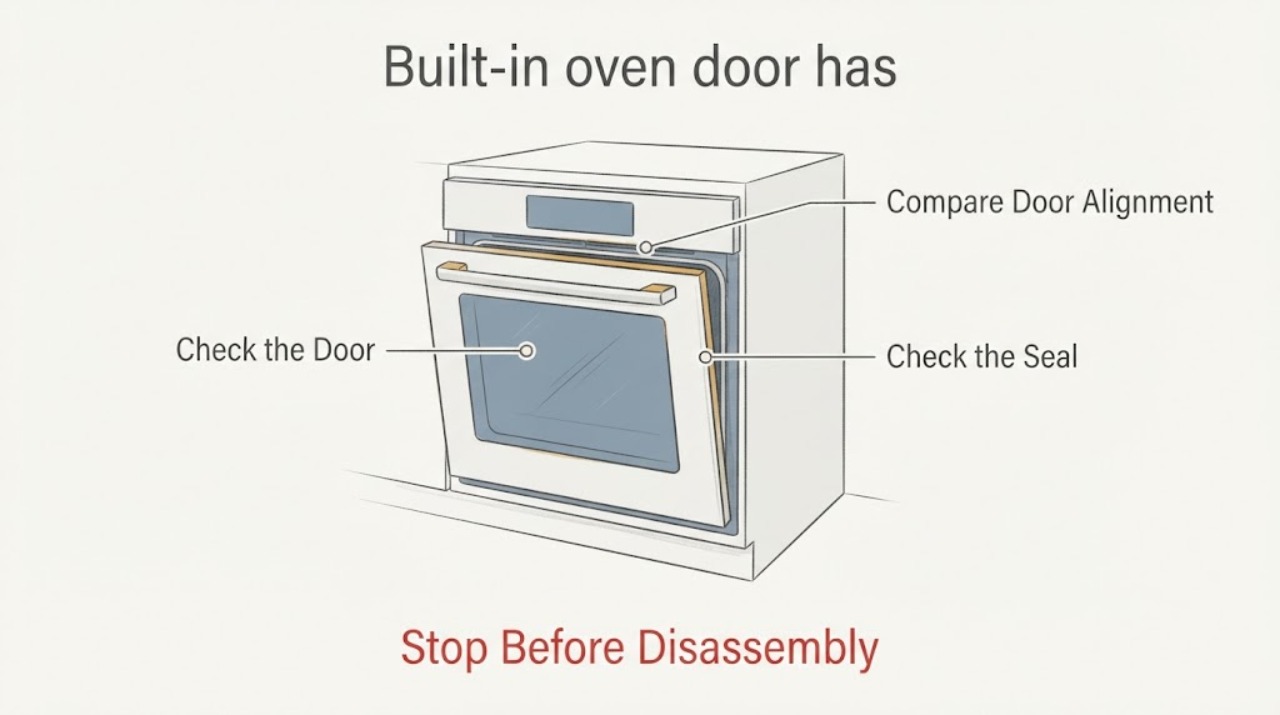
A large bottom gap with a loose or wobbling built-in Smeg oven door is not something to correct by bending tabs, adjusting hinges or removing glass without the exact manual. With the oven switched off and fully cool, check only whether the door closes squarely, whether glass or the frame visibly moves, and whether the seal is displaced or damaged. Do not use the oven if the door cannot close securely, hot air escapes unusually, glass is loose or cracked, or the door is hanging from only part of its frame. Record the full model and serial information and use Smeg service; Smeg says door and glass instructions are manual-specific.
Work through in order
Diagnostic checks
Use only checks that match the exact appliance or system and its official guide.
-
Check 1
Turn the oven off, let it cool completely, and do not start another cooking or cleaning cycle. If the door is hanging loose, the glass is cracked or the frame can separate further, isolate the appliance from power only if this can be done safely without touching hot, damaged or exposed wiring.
Expected result: The door is secure and closes without force; or it wobbles, sags, catches, leaves a large opening, exposes loose glass or shows scorching/damage.
Next step: For any loose, cracked, damaged or incompletely closing result, leave the oven unused and arrange Smeg or qualified appliance service. Do not run pyrolytic cleaning or test the oven at temperature.
Why this matters
Why: A secure cold door permits only the external checks below. A loose, damaged or incompletely closing door is a structural and heat-containment fault, not a normal alignment adjustment for a user to experiment with.
-
Check 2
With the oven cold and power isolated where safe, look at the outside of the door from the front and side. Check whether the gap is uniform, whether the door sits square in the opening, and whether the glass, outer panel, handle or hinge-side frame moves relative to the rest of the door. Do not remove glass, door panels, hinge pins or screws.
Expected result: The gap is uniform and the door is rigid; or one corner drops, the lower panel separates, the glass shifts, the handle pulls the panel away or the hinge-side frame moves.
Next step: Photograph the gap and any movement, record the full model/serial label, and send those details to Smeg service. Do not try to reseat or straighten the assembly.
Why this matters
Why: Uniform clearance can be a design or seal question that needs the exact manual; movement or separation indicates a mechanical integrity problem. The observation does not identify whether a hinge, fastener, frame or glass carrier failed.
-
Check 3
Close the cold door gently once and check whether it meets the seal evenly around the perimeter without pressing, lifting or forcing it. Look only for a seal visibly folded, detached, burned or displaced at the accessible edge.
Expected result: The door closes evenly and the seal is intact; or it will not latch/close, leaves a clear opening, or the seal is torn, detached or visibly displaced.
Next step: If closure or the seal is abnormal, keep the oven off and request model-specific service. Do not substitute generic seal stock or adjust the hinges without the exact manual and fitment confirmation.
Why this matters
Why: Even closure and an intact seal reduce the likelihood of an immediately obvious external seal problem but do not prove the frame is safe. A failed closure or damaged seal can let heat escape and may expose nearby cabinetry or the user to abnormal heat.
-
Check 4
Read the rating plate or documentation for the complete Smeg model and serial number, and note the region, whether the door was recently cleaned or removed, and whether the gap appeared after glass or door work. Do not infer compatibility from a similar-looking Smeg oven.
Expected result: A complete model and serial identifier is available and the history is known; or the label is missing, the model is incomplete, or the gap appeared after undocumented door/glass handling.
Next step: Give the identifier, photos and history to Smeg's regional service department or a qualified technician. Do not order a door, hinge, seal or glass panel from a visually similar model.
Why this matters
Why: Smeg door and glass arrangements vary by model, and the official FAQ directs the user to the supplied product manual for door-glass instructions. A missing model prevents safe hinge, frame, glass and seal fitment decisions.
-
Check 5
Keep the oven out of use until service decides whether the door assembly is secure. If a technician or Smeg support explicitly confirms that the gap is an intentional model-specific clearance and the cold-door checks are normal, follow that exact manual for any permitted cleaning or use; do not use a high-temperature cycle to self-test.
Expected result: Smeg or a qualified technician confirms the exact model-specific construction and safe use; or the gap remains unexplained, worsens, or the door moves during handling.
Next step: Use the documented service decision. If no such confirmation exists, leave the oven unused and do not disassemble or glue the door.
Why this matters
Why: Only model-specific documentation or qualified inspection can distinguish an intended clearance from a failed door/frame assembly when the model is unknown. An unexplained or worsening gap remains a service condition.
Use your observations
Decision map
Find the observation that best matches what you see, then follow the next safe action.
-
PATH 01Next step
What you see
The door is loose, cannot close securely, has cracked/loose glass, a damaged seal, exposed frame parts or abnormal heat escaping at the bottom.
Do this next
Stop using it, allow it to cool, isolate power only when safe, and arrange Smeg or qualified appliance service. Do not run cooking or pyrolytic cycles and do not touch the door while hot.
Why this path and its safety boundary
Why it matters: The oven may no longer contain heat or keep the glass and door assembly stable during use.
-
PATH 02Next step
What you see
The cold door is rigid, closes evenly, the seal is intact and the gap does not change, but the model and manual have not yet been confirmed.
Do this next
Keep the model-specific identity and photos, then ask Smeg support to confirm the intended clearance before using or modifying the door.
Why this path and its safety boundary
Why it matters: The finding may be a model-specific door construction or a less obvious alignment issue; the external observation cannot authorize a hinge or glass adjustment.
-
PATH 03Next step
What you see
The gap appeared after cleaning or door/glass handling, or one door section moves independently from the hinge frame.
Do this next
Do not attempt to reseat, bend, glue or dismantle the door. Provide the model, photos and service history to Smeg or a qualified technician for a model-specific repair decision.
Why this path and its safety boundary
Why it matters: The door assembly may have been disturbed or damaged, but the available general Smeg sources do not identify the correct fasteners, hinge position or reassembly sequence for an unknown model.
Helpful context
Understand the symptom
Why the gap needs a safety decision
The supplied lead describes a Smeg electric built-in oven whose door frame and lower door section have separated, with wobble at the bottom. A gap can be cosmetic, but it can also mean the glass, frame, hinge carrier or seal is no longer secured as designed. Without a model number, the correct door construction and permitted repair cannot be identified. Smeg's oven FAQ says removable-glass and door instructions should be followed from the product manual, so this page stays at external observation and service triage.
Do not improvise a door repair
Do not bend the door frame, glue the glass, force the hinges, remove the door or run a high-temperature or pyrolytic cycle to see whether the gap matters. A glass or hinge assembly can shift unexpectedly, and heat can turn a poor seal into a burn or fire hazard. Keep the model and serial label available for Smeg or a qualified appliance technician.
When checks do not resolve it
Need a professional?
Request Smeg or qualified appliance service when the door is loose, does not close squarely, the glass/frame separates, the seal is damaged, or the gap appeared after door or glass handling. Provide the complete model/serial label, region, photos of the gap from front and side, whether the oven is built in, and any cleaning or door work history. Do not order a hinge, door, glass, frame or seal from a similar Smeg model and do not perform hinge adjustment, door removal, glue repair, drilling, bending or high-temperature testing without exact model instructions.
Common questions
FAQ
Can I just reseat the Smeg oven door on its hinges?
Not safely from the information available. The reported gap is between the door section and the hinge-bearing metal frame, so it is not necessarily a door-to-oven hinge seating problem. Smeg says door and glass instructions depend on the supplied product manual; identify the full model first and use service if the assembly is loose.
Should I glue the bottom of the door or bend the metal tabs back?
No. A similar-looking oven may use different glass, frame and hinge construction, and the opened official Smeg sources do not authorize a generic glue, bending or tab-repair procedure. Keep the oven off and ask Smeg or a qualified technician to inspect it.
Can I run pyrolytic cleaning to see whether the gap is a problem?
No. Smeg says pyrolytic ovens lock the door during the cycle and only allow opening after the oven has cooled to a safe level. A loose or poorly closing door should not be subjected to a high-temperature cleaning cycle; have the door checked first.
Read the exact guide
Official sources
- Customer ServiceSmeg · Opened official Smeg customer-service page. It directs appliance owners to the dedicated Spare Parts and Service Department in their country; it does not identify a part or authorize a user door repair.
- FAQ OvensSmeg · Opened official Smeg oven FAQ. It says removable inner-glass and door procedures should follow the supplied product manual, and explains pyrolytic door locking/cooling. It does not provide a model-independent hinge adjustment or door-frame repair.
Community feedback
Share a repair observation
Share a plain-text repair observation. Accepted observations are published automatically; this page may take a moment to update.