
On this page
Start here
Quick answer
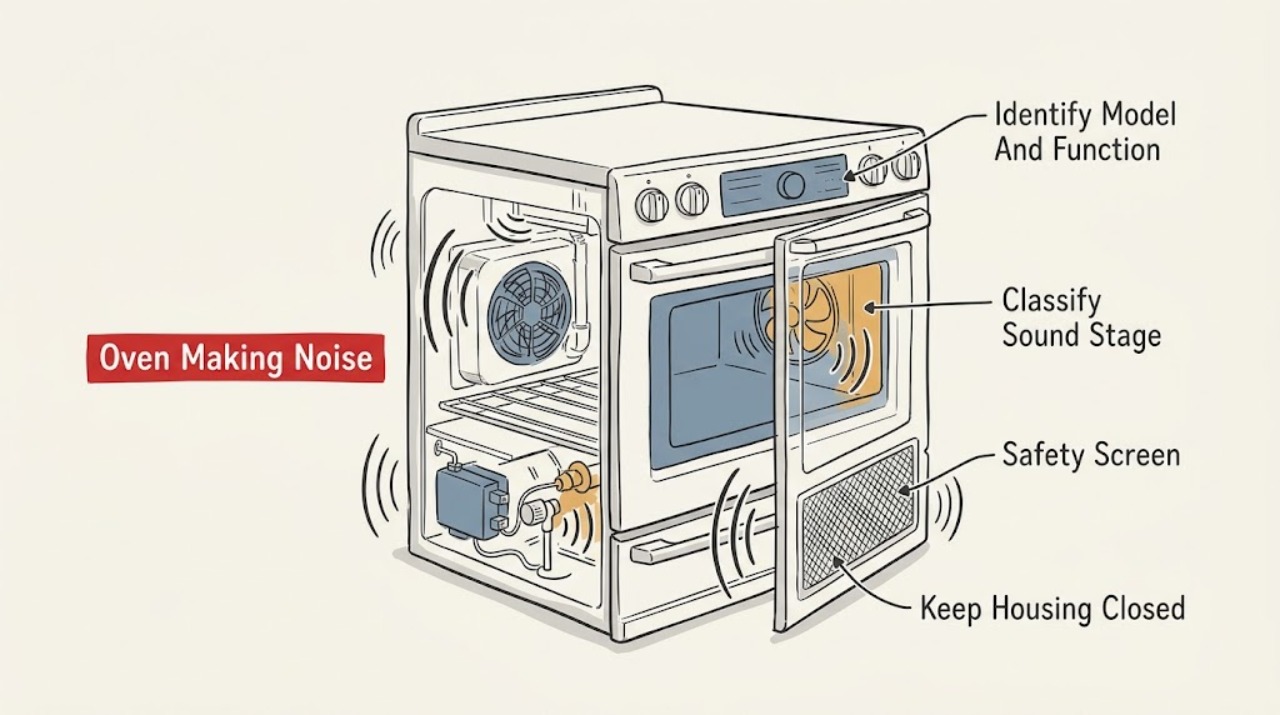
First record the exact Smeg model, oven or range type, fuel type, function, and when the noise occurs. A cooling fan that continues after the oven is switched off can be normal on Smeg models, and a fan-assisted mode will naturally move air; the model manual decides whether a click, hum, or short thermal ping is expected. A rattle can come from a loose rack or accessory, while a new scrape, grinding sound, repeated bang, electrical crackle, gas hiss, abnormal flame, smoke, burning smell, or uncontrolled heat is not a sound to test repeatedly. With the appliance cool and safe, make only ordinary-access observations and follow the exact manual. If the noise persists, worsens, comes from an internal area, or is accompanied by a gas, fire, electrical, door, or overheating symptom, stop using the oven and arrange qualified Smeg service.
Before you begin
Safety first
- This article supports model identification and ordinary-access observation only. Gas work, electrical diagnosis, fan or relay access, heating components, door hardware, panel removal, and internal part replacement belong to qualified service.
Work through in order
Diagnostic checks
Use only checks that match the exact appliance or system and its official guide.
-
Check 1
Stop the oven from a safe position and screen for fire, gas, electrical, heat, and mechanical hazards before listening more closely.
Expected result: Look and listen only from ordinary access for smoke, gas odor, abnormal flame, sustained hiss, electrical crackle or arcing, burning smell, water near electrical parts, a hot or discolored outlet, severe heat, broken glass, or a breaker that has opened.
Next step: Keep the oven off and arrange qualified appliance, electrical, or gas help when a hazard is present. If there is no hazard, record the model, fuel type, function, and sound stage.
Stop if: Do not keep operating, relight a gas appliance, touch wet electrical equipment, open a panel, or reset a breaker while a hazard remains.
Why this matters
Why: Any of these signs changes the task from noise classification to an immediate safety and qualified-service response. The absence of these signs permits only cool, external, model-guided observation.
-
Check 2
Record the exact Smeg model, whether it is a built-in oven or range, fuel type, selected cooking function, and whether the noise begins at start, during heating, during cooling, or after switch-off.
Expected result: Note whether the appliance has a convection fan, cooling outlet, gas burner or ignition, steam function, pyrolytic function, or another feature named in the manual; do not assume a feature exists because another Smeg model has it.
Next step: Open the exact model manual and compare its fan, cooling, cooking-function, and safety descriptions before running another normal cycle.
Stop if: Do not use another model's manual or remove trim to find the model or a component.
Why this matters
Why: The same fan, click, or heat-related sound can be normal in one Smeg configuration and a fault in another. An exact identity record also keeps gas-only and electric-only branches separate.
-
Check 3
From a safe position, classify the noise by sound and cycle stage without repeatedly starting the oven to reproduce it.
Expected result: Record whether it is a steady fan hum, a brief click at a control change, a short ping while heating or cooling, a loose-rack rattle, a scraping or grinding sound, a repeated bang, an electrical crackle, or a gas-like hiss; note whether it comes from the rear, vent, door, or lower control area.
Next step: Save a short recording from a safe distance and use the matching normal-sound, accessory, gas, or service branch below.
Stop if: Do not place hands or tools near a fan, heating element, burner, door hinge, or energized control area to locate the sound.
Why this matters
Why: A fan-stage hum or post-shutdown airflow can follow normal cooling, while a sound tied to a loose accessory, moving fan, gas ignition, or electrical symptom needs a different branch. Location and timing narrow the next check but do not identify an internal part.
-
Check 4
If the sound is a steady airflow hum that continues after switch-off, compare its duration and behavior with the exact Smeg manual and observe the vent externally without blocking it.
Expected result: Record whether the sound is smooth and gradually stops as the oven cools, whether airflow is present at the documented outlet, and whether the sound is instead scraping, pulsing, rattling, or getting louder.
Next step: Keep vents clear as the manual requires and monitor only a normal cooling period. If the sound is rough, worsening, obstructed, or persistent beyond the model's behavior, stop using the oven and request service.
Stop if: Do not insert objects into the vent, remove the fan cover, lubricate the fan, or run the oven with a damaged or obstructed cooling path.
Why this matters
Why: Smeg says the cooling fan may continue after switch-off to cool the oven, so smooth post-shutdown airflow can be normal. Scraping, vibration, a blocked outlet, an unusually loud fan, or a fan that never settles is not established as normal by that general guidance.
-
Check 5
With the oven cool and switched off, check that visible racks, trays, stones, guides, and the door are correctly seated, then compare a brief click or heat-related ping with the model manual.
Expected result: Record whether the rattle disappears when a loose visible accessory is reseated, whether the door closes without rubbing, and whether a click or ping occurs only at a documented mode change or while the cavity heats and cools.
Next step: Reseat only an obviously loose accessory as the manual permits and make one normal observation. If the noise remains or the door, guide, glass, or cavity is damaged, stop and request service.
Stop if: Do not force shelves, bend guides, remove the door, touch hot surfaces, or disassemble a fan, relay, thermostat, or heating assembly.
Why this matters
Why: A loose accessory can create a cabinet or rack rattle, while a brief switching or thermal sound may be a model-normal event only when the manual supports it. A repeated knock, rubbing door, metallic scrape, or sound that remains with accessories removed requires service assessment.
-
Check 6
If the Smeg model uses gas, treat any gas odor, sustained hiss, delayed ignition, repeated ignition clicking, or abnormal flame as a stop condition rather than a sound test.
Expected result: From a safe position, record whether the sound or odor occurs at ignition, while the burner is operating, after shutdown, or alongside smoke, soot, flame rollout, or unusual heat; do not move the range or inspect the gas connector.
Next step: Leave the area for a gas odor or uncontrolled flame and seek local gas or emergency help from outside or another safe location. Arrange qualified appliance service before further use.
Stop if: Do not operate switches or flames near a gas odor, attempt another ignition, adjust gas pressure, inspect gas fittings, or relight the appliance.
Why this matters
Why: A gas symptom can indicate a fuel or combustion hazard and cannot be safely distinguished from a harmless fan or relay sound by a generic oven page. Electric-only models should skip this branch.
-
Check 7
If the noise is an electrical crackle, repeated relay-like clicking with no normal function change, metal-on-metal grinding, or a sound accompanied by abnormal heat, observe only the external controls and appliance condition.
Expected result: Record whether the sound follows a control change, whether the oven heats continuously when it should not, whether the display or lights flicker, whether smoke or burning smell appears, or whether the breaker opens.
Next step: Keep the oven off and request qualified Smeg appliance or electrical service with the recording, model, function, and stage log.
Stop if: Do not open the control area, test live wiring, bypass a thermostat or safety device, or continue a cycle with smoke, burning smell, abnormal heat, arcing, or a tripped breaker.
Why this matters
Why: These symptoms can involve controls, wiring, heating, fan, or another internal assembly and cannot be safely diagnosed from sound alone. A control click is not automatically a failed relay, and a fan noise is not automatically a fan motor fault.
-
Check 8
After the safe fan, accessory, installation, and fuel-specific checks, decide whether the sound is genuinely resolved or remains abnormal.
Expected result: Choose resolved only when the sound matches the exact manual's normal cooling or function behavior and the oven has no movement, damage, heat, smoke, odor, gas symptom, electrical symptom, or performance change; otherwise record persistent or worsening noise.
Next step: If unresolved, keep the oven off and arrange qualified Smeg service. Provide the exact model, fuel type, sound recording, stage, function, and any safety observations.
Stop if: Do not keep running the oven to compare noise, order an internal part from the sound alone, or continue operation after a safety symptom.
Why this matters
Why: A sound that remains after external checks may come from an internal fan, relay, heating control, door, drive, or other assembly. The absence of a visible cause is a reason for service, not permission to remove a panel.
Use your observations
Decision map
Find the observation that best matches what you see, then follow the next safe action.
-
PATH 01Safety boundary
What you see
Smoke, burning smell, abnormal flame, gas odor, electrical crackle or arcing, severe heat, broken glass, water near electrical parts, or a breaker event is present.
Do this next
Keep the appliance off; leave for a gas odor or smoke and seek qualified gas, emergency, electrical, or appliance help from a safe location.
Why this path and its safety boundary
Why it matters: The oven is outside an ordinary noise diagnosis and may present a fire, gas, burn, or shock hazard.
Safety stop: Do not operate switches near gas odor, relight, reset repeatedly, or touch wet or damaged electrical equipment.
-
PATH 02Safety boundary
What you see
A smooth fan hum continues after switch-off and matches the exact Smeg model's documented cooling behavior, with no rubbing, vibration, odor, heat, or performance change.
Do this next
Keep the outlet clear as the manual requires and monitor whether the fan settles as the oven cools. Request service if it becomes rough, loud, obstructed, or persistent beyond the model behavior.
Why this path and its safety boundary
Why it matters: Smeg says the cooling fan may continue after switch-off to cool the oven; this is not by itself evidence of a failed fan.
Safety stop: Do not remove the fan cover or insert anything into the outlet.
-
PATH 03Safety boundary
What you see
A brief click or ping occurs only at a documented mode change or during ordinary heating or cooling, and the exact manual treats it as normal.
Do this next
Keep the model and function record; request service if the sound becomes repeated, loud, metallic, or is accompanied by abnormal heating or control behavior.
Why this path and its safety boundary
Why it matters: The sound may be a normal control or thermal event for that model, but a similar sound without the same timing is not confirmed normal.
Safety stop: Do not open controls to identify a relay or thermostat by sound.
-
PATH 04Safety boundary
What you see
A rattle changes or disappears after a visible rack, tray, stone, guide, or other accessory is seated according to the manual.
Do this next
Use the accessory only as the manual permits and monitor one normal use. Escalate when the rattle returns, the accessory is damaged, or the oven cavity or door is affected.
Why this path and its safety boundary
Why it matters: The loose accessory is a plausible noise source, but it does not explain a scrape, grind, door rub, or noise that remains with accessories removed.
Safety stop: Do not bend guides, force shelves, or run with a damaged or loose part that can contact a fan or heating surface.
-
PATH 05Safety boundary
What you see
A gas-equipped Smeg model has gas odor, sustained hiss, delayed ignition, repeated ignition noise, abnormal flame, smoke, or soot.
Do this next
Leave the area for gas odor or uncontrolled flame, avoid switches and ignition, and seek local gas or emergency help from a safe location. Arrange qualified service before use.
Why this path and its safety boundary
Why it matters: The symptom may indicate a gas or combustion hazard and cannot be cleared by a sound comparison.
Safety stop: Do not relight, adjust gas pressure, inspect the connector, or move the appliance.
-
PATH 06Safety boundary
What you see
Scraping, grinding, electrical crackle, repeated control clicking, deep vibration, or abnormal fan noise persists after safe external checks.
Do this next
Keep the oven off and request qualified Smeg appliance service with the sound recording and stage log.
Why this path and its safety boundary
Why it matters: An internal fan, control, heating, door, or other assembly may be involved, but sound alone cannot identify the part.
Safety stop: Do not remove panels, test energized parts, bypass a safety device, or order a part by sound alone.
Helpful context
Understand the symptom
Normal airflow can sound different from a fault
Smeg ovens can use cooling and convection fans, and some models continue cooling after the oven is switched off. Record whether the sound is a steady airflow hum, a brief click at start or stop, a short ping as a hot cavity cools, a rattle, a scrape, or a gas-like hiss. The point in the cycle matters: a sound only during cooling is a different branch from a sound that follows the fan while cooking or appears with a flame or electrical symptom.
Check the model before calling a normal sound abnormal
Smeg sells ovens, ranges, convection models, steam models, and gas or dual-fuel products with different fans, controls, and cooling systems. Use the model manual to confirm which fan, cooking function, and safety behavior apply. Do not use a product page for one model to declare another model's relay, fan, door, or thermal sound normal.
Use safe external observations only
With the oven switched off and cool, check that visible racks, trays, and accessories are seated and that the door closes normally. Observe the vent outlet without blocking it or inserting anything. A noise that changes with a loose accessory can be handled through the manual; a noise from behind a panel, a damaged door, or a moving fan needs service rather than cabinet access.
Gas symptoms are a separate stop condition
Only some Smeg ovens or ranges use gas. If a gas-equipped model produces a gas odor, sustained hiss, delayed ignition, abnormal flame, or repeated ignition noise, do not continue testing the oven. Leave the area and seek local gas or emergency help from a safe location; do not operate electrical switches or attempt to relight the appliance.
Safety boundary
Stop conditions
- Stop immediately for gas odor, abnormal flame, sustained hiss, smoke, burning smell, electrical crackle or arcing, severe heat, broken glass, water near electrical parts, or a breaker event.
- Do not operate switches near a gas odor, relight or repeatedly ignite a gas oven, adjust gas pressure, inspect a gas connector, or move the appliance.
- Do not insert objects into a vent, remove fan covers, open control or electrical panels, test energized wiring, or bypass a thermostat or safety device.
- Do not force the door, bend shelves or guides, touch hot surfaces, or continue operation with metal-on-metal noise, severe vibration, or a damaged accessory.
- Request qualified Smeg service when noise persists after exact-model external checks, is worsening or metallic, comes from behind a panel, or is accompanied by abnormal heating, control behavior, odor, smoke, gas, water, or electrical symptoms.
When checks do not resolve it
Need a professional?
Request qualified Smeg appliance service when an unusual noise persists after the exact model's cooling, accessory, and ordinary-access checks; when the sound is scraping, grinding, electrical, worsening, or accompanied by abnormal heat or control behavior; or whenever there is gas odor, abnormal flame, smoke, burning smell, water near electrical parts, broken glass, a leak, or a breaker event.
Safety scope: This article supports model identification and ordinary-access observation only. Gas work, electrical diagnosis, fan or relay access, heating components, door hardware, panel removal, and internal part replacement belong to qualified service.
Common questions
FAQ
Is it normal for a Smeg oven fan to keep running after switch-off?
Smeg says the cooling fan can continue operating after the oven is switched off to cool the appliance. Compare the sound and duration with the exact model manual. A rough, scraping, unusually loud, or never-settling fan needs service rather than lubrication or cover removal.
Why does my Smeg oven make a clicking or pinging sound?
Record whether it occurs only at a documented control change or while the cavity heats and cools. A brief model-documented switching or thermal sound may be normal, but repeated loud clicks, electrical crackle, smoke, abnormal heat, or a sound that continues outside that timing requires qualified service.
What causes a rattle in a Smeg oven?
A visible rack, tray, stone, guide, or other accessory can rattle if it is loose or incorrectly seated. With the oven cool and off, reseat only what the manual permits. If the rattle remains, becomes a scrape or grind, or involves the door or fan, stop and arrange service.
What should I do if my Smeg gas oven makes a hiss?
If the model uses gas and there is a gas odor, sustained hiss, delayed ignition, abnormal flame, smoke, or soot, stop using it and leave the area for a gas odor or uncontrolled flame. Do not operate switches, relight, adjust gas pressure, inspect the connector, or move the appliance; seek qualified help from a safe location.
When does Smeg oven noise need a technician?
Request service for persistent scraping, grinding, electrical crackle, worsening fan noise, deep vibration, repeated banging after safe checks, abnormal heating or control behavior, or any gas, smoke, burning, water, broken-glass, or breaker symptom.
Read the exact guide
Official sources
- FAQ CookersSmeg · Official Smeg cooker FAQ; it covers general cooker behavior and does not replace the exact model manual or local safety requirements.
- Oven FAQSmeg · Official Smeg USA oven FAQ; features and sound behavior vary by installed model, so the supplied model manual controls.
- CPSC News Feature: Getting Ready For Cold WeatherU.S. Consumer Product Safety Commission · General CPSC gas-appliance safety guidance used for the gas-odor stop boundary; it is not a Smeg product manual and does not diagnose an oven.
- OvensSmeg USA · Official Smeg USA oven family page used only to establish that Smeg has multiple oven configurations; it does not establish a sound as normal for an individual model.
Community feedback
Share a repair observation
Share a plain-text repair observation. Accepted observations are published automatically; this page may take a moment to update.