
On this page
Start here
Quick answer
A large cloud of steam when you crack open a Smeg SFRA9300X during a roast is consistent with this model's Thermoseal design: Smeg says Thermoseal maintains the cavity's atmospheric balance for succulent roasts, and an owner of this exact model reports substantial steam during a roast. That does not make every symptom normal. Let the roast finish or cool, open the door only from a safe position, and distinguish moisture and condensation from water leaking outside the cavity, a damaged seal, smoke, a burning smell, uncontrolled heat, or electrical trouble. If steam is the only symptom and the roast cooks normally, treat it as a moisture-retention characteristic. If the door, temperature control, airflow, or safety behavior is abnormal, stop using the oven and arrange qualified Smeg appliance service.
Before you begin
Safety first
- Owner checks are limited to reading the rating label, observing steam from a safe position, and inspecting cool, visible door and airflow conditions. Do not dismantle the built-in oven, remove the door or gasket, touch hot steam or surfaces, open electrical covers, bypass controls, block vents, pour water into the cavity, or use Vapour Clean as a diagnostic test.
Work through in order
Diagnostic checks
Use only checks that match the exact appliance or system and its official guide.
-
Check 1
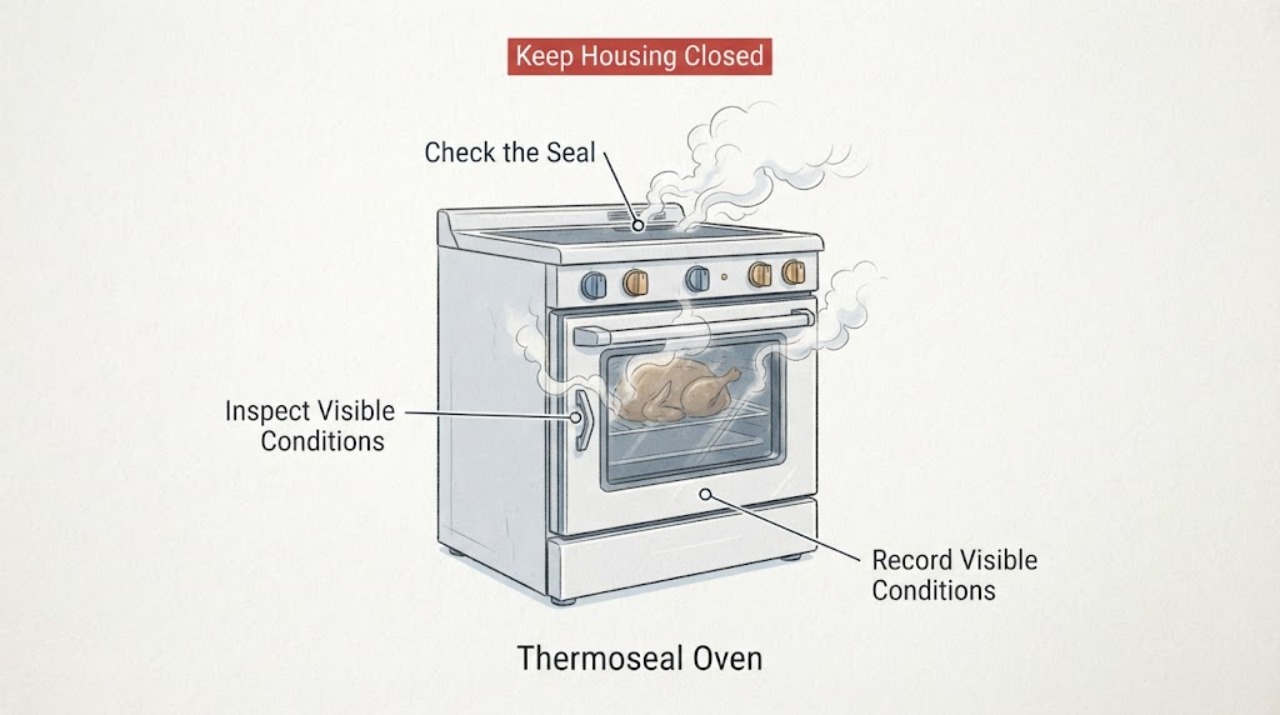
Confirm the identity before comparing the symptom: read the rating label and record SFRA9300X, the serial number, and the market or installation documentation. Note whether the product is the 90 cm Classic Thermoseal oven rather than a Smeg steam oven or another Thermoseal model.
Expected result: The label confirms SFRA9300X and the product documentation identifies the Thermoseal oven; only a partial model name is available; or the appliance is a different model or a dedicated steam oven.
Next step: Use the exact SFRA9300X documentation when the identity matches. If the identity is uncertain, stop making model-specific adjustments and obtain the correct manual or Smeg service identification before ordering parts or changing the cooking method.
Stop if: Do not move the built-in oven, remove trim, or open a cover to find the label while it is hot or energized.
Why this matters
Why: Thermoseal features and cooking behavior are model-specific. A different Smeg oven may have different door, vent, steam, or cleaning behavior, so a generic 'Smeg oven' comparison cannot establish a fault.
-
Check 2
During a normal roast, observe only from outside and record when the steam appears: while the food is cooking, when the door is cracked open, or after the cycle. Note whether the roast cooks normally, the steam is accompanied by ordinary condensation on the glass, and the moisture stays inside the cavity or on surfaces intended to collect it.
Expected result: A brief cloud appears when the door is opened during the roast, the food cooks normally, and there is no smoke, odor, heat-control problem, or water running outside the oven; or the moisture appears without opening the door or escapes onto cabinetry or controls.
Next step: For moisture-only behavior, keep the door closed as much as the recipe allows and treat the steam as a cooking characteristic. For external leakage, unexplained water, or moisture near controls, stop using the oven and arrange qualified inspection rather than trying to create more steam to test it.
Stop if: Do not put your face or hands in front of the opening, wipe hot glass or metal, or reach into the cavity while steam is escaping.
Why this matters
Why: The first pattern is consistent with the documented Thermoseal atmospheric-balance goal and the exact-model owner report, while the second pattern is not established as normal by those sources and may indicate a seal, drainage, installation, or other service issue.
-
Check 3
After the oven and tray are cool, inspect visible user-accessible conditions only: check that the door closes evenly, the visible gasket is not displaced or torn, the door glass has no new crack, and the external vent or air outlet is not covered by an object or foil. Do not remove the gasket or dismantle the door.
Expected result: The door and visible seal are intact and the external airflow path is clear; the door does not close evenly or the gasket/glass is visibly damaged; or an obstruction is present.
Next step: Remove only a loose, cool obstruction that the exact documentation permits. Keep the oven out of service for a damaged seal, glass, door, or inaccessible airflow path and ask service to assess the sealing and cooling system.
Stop if: Do not bend the door, pull out the gasket, remove glass panels, block vents, or continue a roast to test a damaged door.
Why this matters
Why: An intact door and clear visible outlet make a design-related moisture explanation more plausible, but they cannot prove that internal airflow or temperature control is healthy. A damaged seal, glass, or inaccessible obstruction can change heat and moisture behavior and needs model-matched service.
-
Check 4
Compare the moisture symptom with the selected roast function and temperature, then watch the normal control response from outside: note whether the oven reaches the selected setting, cycles normally, and stops heating when the function is turned off. Do not keep the door open or run a high-heat test solely to drive off steam.
Expected result: The selected roast function and temperature are appropriate, heating cycles normally, and the oven stops as commanded; or the oven overshoots, keeps heating after an off command, emits smoke or a burning smell, or shows electrical trouble.
Next step: For the normal pattern, follow the recipe and use a suitable roast method when a drier or crisper surface is desired. For uncontrolled heat, smoke, burning odor, hot wiring, sparks, or repeated electrical trips, switch off only if safe, keep clear, and arrange qualified appliance or electrical service.
Stop if: Do not bypass a control, repeatedly reset protection, probe live wiring, or continue cooking after smoke, arcing, burning odor, or failure to stop.
Why this matters
Why: Normal temperature control with moisture as the only complaint supports a Thermoseal cooking-characteristic explanation. Uncontrolled heat or a safety symptom is a separate appliance fault, not something to correct by venting steam through the door.
-
Check 5
If the desired result is a drier or crispier roast, change only one low-risk cooking variable on a known-safe oven: minimize unnecessary door opening, use the exact SFRA9300X function and temperature guidance, and compare the finished surface without adding water or using a cleaning cycle as a cooking test.
Expected result: The roast surface improves while the oven remains controllable and there is no external leak or safety warning; or the food remains unexpectedly wet across normal recipes, water accumulates outside the cavity, or the appliance develops a control or temperature symptom.
Next step: Keep the successful, model-supported setting and monitor one normal cycle. Stop using the oven and provide the service technician with the model, serial, function, temperature, roast size, photos of condensation or leakage, and the exact point at which steam appears when the pattern persists or broadens.
Stop if: Do not use sealed containers, cover vents, pour water into the cavity, or run Vapour Clean to troubleshoot cooking steam.
Why this matters
Why: A recipe or moisture-load effect can explain a soft surface even when the oven is functioning normally. Persistent abnormal moisture combined with leakage, a damaged seal, poor heating, or loss of control needs diagnosis rather than more recipe experiments.
Use your observations
Decision map
Find the observation that best matches what you see, then follow the next safe action.
-
PATH 01Next step
What you see
The exact SFRA9300X is confirmed, the steam appears mainly when the door is cracked during a roast, the roast cooks normally, and there is no external water, smoke, odor, uncontrolled heat, or electrical symptom.
Do this next
Treat it as expected moisture retention, limit door opening, protect yourself from the steam plume, and use a suitable documented cooking method if a drier surface is wanted.
Why this path and its safety boundary
Why it matters: This pattern is consistent with Thermoseal's stated atmospheric-balance purpose and the exact-model owner report. It is not by itself evidence that the oven is a steam oven or that a part has failed.
-
PATH 02Next step
What you see
Steam or water escapes while the door remains closed, runs onto cabinetry or controls, leaves abnormal pooling, or coincides with a displaced seal, cracked glass, or door that does not close evenly.
Do this next
Stop the oven after it is safe to do so, leave it out of service, and arrange qualified Smeg appliance inspection. Do not remove the gasket or attempt a door adjustment as a cooking workaround.
Why this path and its safety boundary
Why it matters: The symptom has crossed from moisture retention into a possible sealing, drainage, installation, or door-system issue that the product sheet does not diagnose remotely.
-
PATH 03Next step
What you see
The oven heats beyond the selected setting, continues heating after an off command, or produces smoke, burning odor, sparks, hot wiring, or repeated electrical trips in addition to the steam complaint.
Do this next
Stop using the appliance and obtain qualified appliance or electrical help; contact emergency services from a safe location for fire, smoke, or immediate danger. Do not rerun the roast to see whether the steam clears.
Why this path and its safety boundary
Why it matters: This is an overheating, fire, or electrical safety path rather than normal Thermoseal moisture behavior.
-
PATH 04Next step
What you see
The model identity is incomplete, the oven is a different Smeg platform, or the only evidence is a change in recipe result without a safety or leakage symptom.
Do this next
Recover the complete identity and use its exact documentation. If the model is confirmed but the result remains unacceptable, ask service to assess the door seal, cooling/airflow path, and temperature control before ordering a part.
Why this path and its safety boundary
Why it matters: A model-specific Thermoseal conclusion cannot be transferred to another appliance, and a recipe outcome alone does not establish a component fault.
Helpful context
Understand the symptom
Thermoseal is not the same as a dedicated steam oven, but the SFRA9300X product documentation says the design maintains the cavity's atmospheric balance and is intended to produce succulent roasts. A steam cloud released from a partly opened door can therefore be a moisture-retention result rather than an overheating fault. The exact model and the symptom pattern still matter.
The useful boundary is what happens with the moisture: ordinary condensation and a roast that cooks normally point toward expected cooking behavior; water escaping onto cabinets or controls, a door that will not seal, smoke, uncontrolled temperature, burning odor, or electrical warning points to a stop-and-service condition.
When checks do not resolve it
Need a professional?
Contact qualified Smeg appliance service for leakage, damaged sealing or glass, abnormal door alignment, inaccessible airflow concerns, persistent wet cooking with a normal recipe, uncontrolled heating, or any electrical or burning symptom. Treat smoke, sparks, fire, or immediate danger as an emergency.
Safety scope: Owner checks are limited to reading the rating label, observing steam from a safe position, and inspecting cool, visible door and airflow conditions. Do not dismantle the built-in oven, remove the door or gasket, touch hot steam or surfaces, open electrical covers, bypass controls, block vents, pour water into the cavity, or use Vapour Clean as a diagnostic test.
Have this ready
- Provide the complete SFRA9300X model and serial, market, selected function and temperature, roast size and recipe, whether the door was opened, when steam appeared, photos of condensation or external water after cooling, and any heating, odor, or electrical symptom.
Common questions
FAQ
Is a large cloud of steam during a roast automatically a fault on the Smeg SFRA9300X?
No. Smeg's SFRA9300X technical sheet says Thermoseal maintains the cavity's atmospheric balance for succulent roasts, and an owner of this exact model reports a large steam cloud when opening during a roast. Treat it as a likely moisture-retention characteristic only when the oven cooks normally and there is no external leak, damaged door, smoke, uncontrolled heat, odor, or electrical symptom.
Does Thermoseal mean the SFRA9300X is a steam oven?
Not from the evidence reviewed. The Smeg technical sheet describes Thermoseal as an atmospheric-balance cooking environment and separately lists Vapour Clean as a cleaning function. Do not add water or use a cleaning cycle as a way to change roast behavior.
When should I stop using the oven instead of adjusting the recipe?
Stop and arrange service if water escapes while the door is closed, the door or glass is damaged, the oven overheats or keeps heating after an off command, or steam is accompanied by smoke, burning odor, sparks, hot electrical parts, or repeated trips. Recipe changes are appropriate only when the oven remains safe and controllable and moisture is the only symptom.
How can I open the door more safely when steam may be present?
Keep your face and hands away from the opening, crack the door from the side, pause for the initial plume to dissipate, and use heat protection for any tray or food. Do not open a hot door fully toward yourself or reach into escaping steam; leave the oven closed and seek service if the steam is accompanied by a safety symptom.
Read the exact guide
Official sources
- Is it normal for Smeg thermoseal ovens to retain so much steam?Reddit r/Appliances · Opened the exact Reddit post. The author identifies the appliance as Smeg SFRA9300X and describes a large steam cloud when opening during a roast, moist roast results, and difficulty crisping food. The report is anecdotal and does not prove a defect or repair outcome.
- SFRA9300X 90CM CLASSIC THERMOSEAL OVENSmeg Australia · Opened the official Smeg Australia technical specification PDF for the exact SFRA9300X model. It identifies the oven as Thermoseal, describes atmospheric balance for roasts, and lists Cool Door technology and thermal protection.
Community feedback
Share a repair observation
Share a plain-text repair observation. Accepted observations are published automatically; this page may take a moment to update.