
On this page
Start here
Quick answer
Stop using the Smeg oven while dried pasta or another object may be in the fan path. Turn the controls off, keep the door closed if there is smoke, and let the oven cool; Smeg says its cooling fan can continue for about 20 minutes after switch-off. Once the cavity and fan have stopped and power is isolated at the accessible disconnect, look only from the cavity side. Remove an object only if it is fully loose and reachable without removing a guard or inserting tools into the fan. Smeg describes fan ovens as having the fan behind the rear panel, so pasta that has gone behind that panel is a service job rather than a reason to run the oven, start a cleaning cycle, or dismantle the appliance.
Before you begin
Safety first
- Do not reach into a moving or hot oven fan, remove the rear panel or guard, run the oven or a high-temperature cleaning program to burn away the object, bypass a safety device, or perform electrical testing.
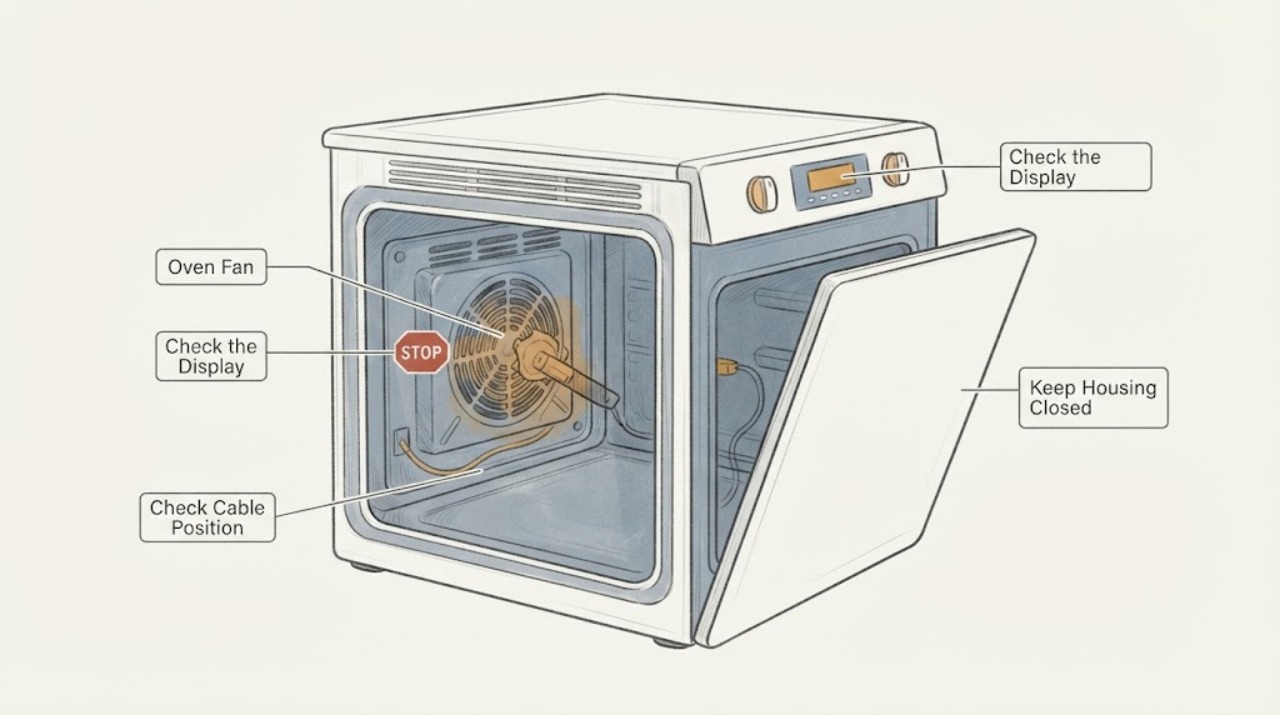
Work through in order
Diagnostic checks
Use only checks that match the exact appliance or system and its official guide.
-
Check 1
Turn the oven controls off and leave the door closed if there is smoke, a burning smell or visible flame. Do not reach into the cavity while the fan is moving; wait for the cooling fan to stop and for the oven to become cool before continuing.
Expected result: The fan stops after the cooling period, or it continues well after the oven is cool; smoke, a burning smell or flame is present.
Next step: If there is active smoke or flame, keep the door closed and use the home's fire-safety procedure; isolate power only if it can be done without approaching danger. Otherwise isolate power at the accessible switch or breaker and move to a visual check. Do not restart the oven to see whether the fan clears itself.
Why this matters
Why: Smeg says a cooling fan can continue for around 20 minutes after switch-off. Persistent noise after cooling, smoke or burning odor is not a safe condition for a user test and may mean that the object or another component needs service.
-
Check 2
With the cavity cool and power isolated, use a light to inspect the fan area from the normal oven cavity side. Do not remove the rear panel, fan guard or any wiring cover, and do not insert a knife, wire or other tool through the guard.
Expected result: The pasta is loose on the cavity side and fully reachable, or it is behind the guard / not visible / caught around the fan area.
Next step: Only remove a fully loose, reachable piece using the cool-oven cleaning method in the exact manual. If it is behind the guard or requires force, stop and request Smeg or qualified appliance service.
Why this matters
Why: A loose object that is plainly accessible is a cleaning question; an object behind the rear panel is in the guarded fan area Smeg describes for fan ovens and cannot be safely identified by looking through a gap.
-
Check 3
After the cool, power-isolated inspection, record whether the fan blade or guard shows visible scraping, deformation, melted food residue, a loose cover or grease that could catch fire. Do not turn the oven on to reproduce a noise.
Expected result: There is scraping, a bent or loose visible part, melted or charred residue, or no visible damage but the fan no longer sounds normal during later authorized use.
Next step: Leave the oven off and give the service provider the model, the object's location, when it entered the fan path and any smoke, smell or noise. Do not straighten a guard or order a fan part from the symptom alone.
Why this matters
Why: These observations cannot identify a motor, blade, guard or control failure from outside. They do show that continued operation could spread debris or heat an unknown material.
-
Check 4
Open Smeg's official manual-download page and enter the product code from the appliance label, selecting the language for the appliance. Compare the exact SNLK916MFA9 instructions before removing an accessory, roof liner or other internal item.
Expected result: The exact manual explicitly lists a removable item and a cool-oven cleaning method, or it does not authorize access to the fan area / the manual cannot be retrieved.
Next step: Follow only the exact manual's authorized cleaning steps. If the manual is unavailable or the object is in the fan assembly, keep the appliance isolated and use Smeg service rather than improvising access.
Why this matters
Why: Smeg's manual portal is the appropriate route for model-specific instructions. Its general FAQ says removable parts must be handled after cooling, but it does not authorize opening a guarded fan assembly.
-
Check 5
Prepare the full model and serial information, the object's location, whether the fan still runs after cooling, and any smoke, odor, scraping or visible damage for a service request.
Expected result: The object is inaccessible, the fan is noisy or obstructed, the oven smells burnt, smoke occurred, or the appliance cannot be safely inspected without panel removal.
Next step: Keep the oven off and arrange Smeg or qualified appliance service. Do not bypass a guard, run a high-temperature cleaning program with the object present, or perform electrical testing.
Why this matters
Why: The remaining decision is a guarded internal-access or safety issue, not a user-level cleaning task. Smeg directs owners to its service and support channels for appliance help.
Use your observations
Decision map
Find the observation that best matches what you see, then follow the next safe action.
-
PATH 01Next step
What you see
The oven is off, the cooling fan has stopped, and a loose piece of pasta is plainly reachable from the cool cavity without touching the guarded fan area.
Do this next
Remove only the reachable loose material using the exact manual's cool-oven cleaning method, then leave the oven off if any scraping, odor or hidden debris remains.
Why this path and its safety boundary
Why it matters: This is the limited user-accessible cleaning case; it does not establish that the fan assembly is clear if another piece has gone behind the panel.
-
PATH 02Next step
What you see
The pasta is behind the rear fan cover, wrapped around the fan, or cannot be reached without removing a panel or guard.
Do this next
Do not dismantle the rear panel or run the oven to dislodge it. Keep power isolated and arrange qualified service.
Why this path and its safety boundary
Why it matters: Smeg describes the fan in fan ovens as being behind the rear panel, so the remaining access is guarded and model-specific.
-
PATH 03Next step
What you see
The fan continues after the normal cooling period, scrapes, produces a burning smell, or smoke appeared when the appliance was used.
Do this next
Leave the oven off, isolate it if safe, and request appliance service. If there is active smoke or flame, keep the door closed and follow the home's fire-safety procedure.
Why this path and its safety boundary
Why it matters: The symptom has moved beyond a harmless loose food fragment; repeated operation could heat or spread an unknown obstruction.
-
PATH 04Next step
What you see
The manual portal returns the exact model instructions and they explicitly identify a cool, user-removable part, with no obstruction behind a guard.
Do this next
Follow the exact manual only; if the object's location or the required action is not explicitly covered, stop and use Smeg service.
Why this path and its safety boundary
Why it matters: A manual-authorized cleaning step may be appropriate for that named part, but the portal does not make a fan-cover removal or internal electrical repair user-safe.
Helpful context
Understand the symptom
Treat the fan path as a hot and guarded area
Dried pasta in the oven cavity is different from pasta that has fallen behind the rear fan cover. Smeg says fan ovens place the fan behind the rear panel, and its FAQ says the cooling fan may continue after the oven is switched off. That means a stopped heating element is not enough to make the area safe to touch. Wait for the cooling cycle and the cavity to cool before any visual check.
Use the model manual for cleaning access
Smeg's official manual portal requires the product code from the appliance label and a language selection. Use it to obtain the SNLK916MFA9 instructions before removing any accessory or attempting cleaning. A manual that does not explicitly authorize removal of a fan guard is not permission to remove it; a hidden object, scraping fan or burning smell should be left for Smeg service.
When checks do not resolve it
Need a professional?
Keep the oven off and request Smeg or qualified appliance service if the object is behind the fan guard, the fan scrapes or remains abnormal after cooling, smoke or burning odor occurred, or the only way to reach the object would be to remove a panel or guard.
Safety scope: Do not reach into a moving or hot oven fan, remove the rear panel or guard, run the oven or a high-temperature cleaning program to burn away the object, bypass a safety device, or perform electrical testing.
Have this ready
- Provide SNLK916MFA9 and serial information from the appliance label, the object's suspected location, whether the cooling fan stopped, and any smoke, odor, scraping or visible damage.
Common questions
FAQ
Can I run the Smeg oven to burn the dried pasta out of the fan?
No. Do not use cooking or a high-temperature cleaning program to dislodge or burn an object whose location is uncertain. Cool the oven, isolate power and use only the exact manual's authorized cleaning method; hidden or guarded debris needs service.
Why is the Smeg oven fan still running after I switch it off?
Smeg says the cooling fan can continue for around 20 minutes after switch-off to reduce the oven temperature. Wait for the fan to stop and the cavity to cool before inspection; continued noise after that point is a reason to stop use and seek service.
Can I remove the rear cover to get the pasta out?
Do not remove it based on the symptom alone. Smeg describes the fan behind the rear panel, and the official manual portal says to retrieve the exact product instructions. If the manual does not explicitly authorize that access, leave the oven isolated and arrange service.
What should I do if there was smoke or a burning smell?
Stop using the oven. Keep the door closed if smoke or flame is present, follow the home's fire-safety procedure, and isolate power only if it is safe to do so. Do not restart the oven to test whether the smell is gone; arrange qualified service after the appliance is safe and cool.
Read the exact guide
Official sources
- Oven FAQSMEG USA · Opened official Smeg oven FAQ. It supports the general Smeg-family safety boundary used here: the cooling fan may run after switch-off, fan ovens place the fan behind the rear panel, and removable cleaning parts are handled after cooling. It does not authorize removal of the SNLK916MFA9 rear fan cover.
- Smeg KlantenserviceSMEG Nederland BV · Opened the official Smeg Netherlands service page. It supports directing an inaccessible or guarded fan obstruction to Smeg service, not a part or DIY repair claim.
- User manualsSMEG USA · Opened the official Smeg manual portal. It requires the product code on the appliance label and a language selection; it is used to route the reader to the exact SNLK916MFA9 instructions rather than to infer a rear-panel procedure.
Community feedback
Share a repair observation
Share a plain-text repair observation. Accepted observations are published automatically; this page may take a moment to update.