
On this page
Start here
Quick answer
First note whether the sound is the normal cooling fan after cooking or a true grinding sound during a cooking function. Smeg says the cooling fan can run for around 20 minutes after switch-off, and its ventilated ovens use fan airflow to circulate heat. If the noise is harsh, new, metal-on-metal, accompanied by rubbing, smoke, burning odor, vibration or a fault, stop the oven, let it cool and isolate power only from a safe location. Do not remove the fan cover, reach into the cavity, run a test with panels removed or guess a fan part. Record the exact product code and use the model manual or qualified Smeg service.
Before you begin
Safety first
- Do not open the oven cabinet, remove the fan guard, touch wiring, perform energized testing, run the oven with panels removed or order a fan/motor/bearing based only on the Smeg brand. Keep the oven cool and isolate power from a safe location when hazardous symptoms occur.
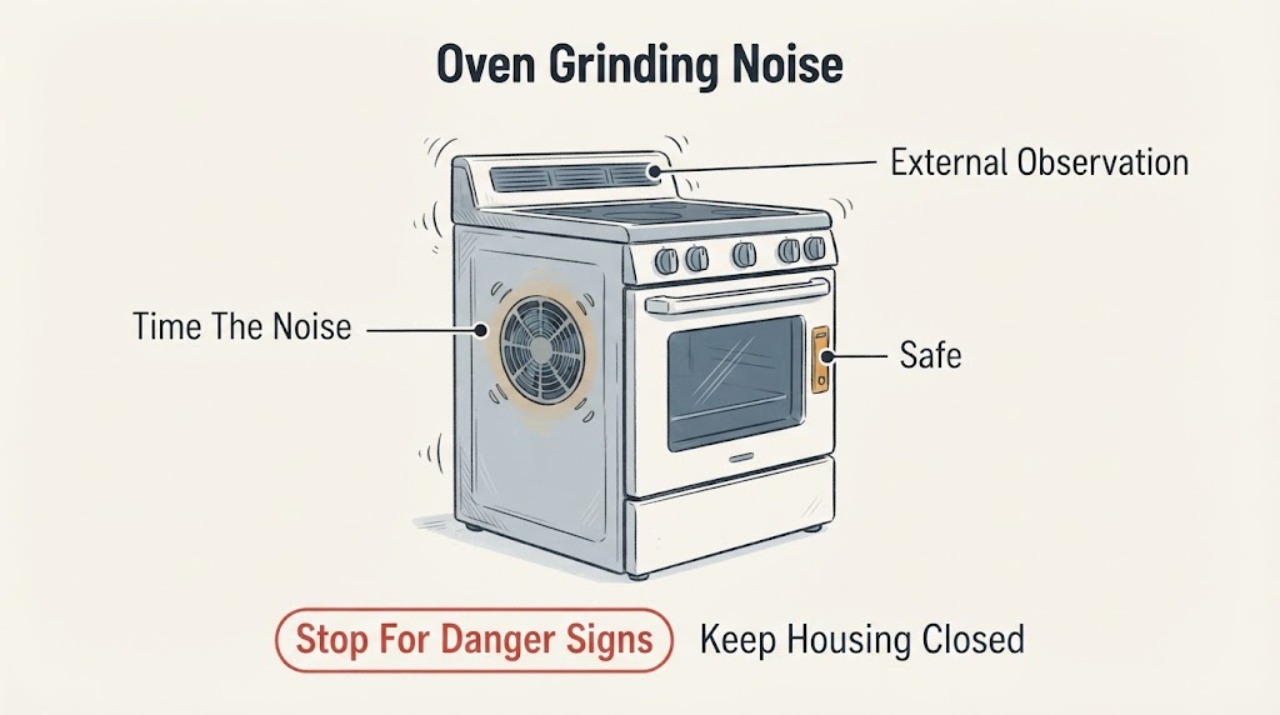
Work through in order
Diagnostic checks
Use only checks that match the exact appliance or system and its official guide.
-
Check 1
Record whether the sound occurs during cooking, only with a fan-assisted/convection function, or after the oven is switched off, and note how long it lasts.
Expected result: The sound is a smooth fan sound during cool-down, or it is a new grinding/scraping sound during operation or beyond the normal cool-down period.
Next step: Treat a smooth short cool-down fan as a documented operating behavior, but stop and escalate a grinding or persistent noise with the exact timing and function recorded.
Why this matters
Why: Smeg documents fan airflow for ventilated cooking and a cooling fan that may run for about 20 minutes after switch-off; those facts do not make a grinding sound normal.
-
Check 2
Stop the oven and allow it to cool if grinding is accompanied by rubbing, strong vibration, smoke, burning odor, abnormal heat or a fault indication.
Expected result: A hazardous sign is present, or the sound is the only symptom and the oven otherwise behaves normally.
Next step: Isolate power only from a safe location and arrange qualified service for hazardous signs; do not reproduce the event or open the oven.
Why this matters
Why: The public Smeg sources do not provide a universal diagnosis for grinding; hazardous accompanying signs make continued testing unsafe.
-
Check 3
With the oven cool and isolated, observe only the exterior, door, visible rack/tray position and any obvious impact or loose panel; do not remove a fan guard or reach inside openings.
Expected result: A rack/tray or exterior part is visibly displaced, or no external cause is visible.
Next step: Do not force or dismantle the part; photograph it and use the exact manual or qualified service for the model-specific decision.
Why this matters
Why: A visible external condition may explain contact or vibration, but no visible cause does not identify a fan, motor or bearing.
-
Check 4
Read the complete Smeg product code from the appliance label and retrieve the corresponding manual in Smeg's manual portal.
Expected result: The complete code is available, or the code is missing/unreadable.
Next step: Use the exact manual for any permitted user check; if the code is unavailable, provide photos and the appliance identity to Smeg service instead of using another model's procedure.
Why this matters
Why: Smeg's portal requires the product code to select the manual; fan layout, cooling behavior and access can vary by model.
-
Check 5
Give the servicer the product code, country, selected function, noise timing, cool-down duration and any vibration, odor, smoke or fault details.
Expected result: The grinding persists, returns during operation, or diagnosis would require fan-cover, cabinet or wiring access.
Next step: Keep the oven out of service and use Smeg or qualified appliance service; do not remove panels, test energized parts or substitute a fan/motor/bearing.
Why this matters
Why: No opened official source supplies a model-independent grinding-noise repair or component identification.
Use your observations
Decision map
Find the observation that best matches what you see, then follow the next safe action.
-
PATH 01Next step
What you see
The sound is a smooth fan sound only after cooking and stops within roughly the documented cool-down period.
Do this next
Record the model and compare the duration with its manual; arrange service if the sound changes to grinding, continues unusually long or is accompanied by heat or odor.
Why this path and its safety boundary
Why it matters: Smeg identifies post-shutdown cooling-fan operation as normal on its FAQ pages, although the exact model manual controls the behavior.
-
PATH 02Next step
What you see
The noise is grinding, scraping or metal-on-metal during a cooking function or while the fan is running.
Do this next
Stop using the oven, let it cool, avoid opening the fan area and arrange exact-model qualified service.
Why this path and its safety boundary
Why it matters: The official sources confirm fan operation but do not establish that this abnormal sound is normal or identify a component.
-
PATH 03Next step
What you see
A rack, tray or visible exterior part is displaced and the noise began after loading, impact or installation work.
Do this next
Keep the oven cool and do not force the part; photograph the condition and follow the exact model manual or service route.
Why this path and its safety boundary
Why it matters: A visible interference or vibration clue exists, but it does not prove damage to the fan or motor.
-
PATH 04Next step
What you see
The noise is accompanied by smoke, burning odor, abnormal heat, strong vibration, fault indication or a breaker trip.
Do this next
Stay clear, isolate power from a safe location and obtain qualified appliance service or emergency help as appropriate; do not reproduce the event.
Why this path and its safety boundary
Why it matters: This is a stop-use electrical, mechanical or fire-risk condition beyond a sound classification.
-
PATH 05Next step
What you see
The exact product code is missing or the proposed diagnosis requires removing a fan cover, panel or wiring.
Do this next
Do not copy another Smeg model's fan procedure or order a generic part; obtain the code and use qualified service.
Why this path and its safety boundary
Why it matters: Smeg's public manual route cannot establish the correct construction or safe repair from the brand name alone.
Helpful context
Understand the symptom
Separate normal cooling from grinding
Write down when the sound occurs: during a fan-assisted or convection function, only while the oven is hot, or after the controls are switched off. Smeg says a cooling fan can continue for around 20 minutes after switch-off, and that ventilated ovens use fan airflow to spread heat. A steady cool-down fan is therefore not automatically a fault; a new grinding, scraping or metal-on-metal sound needs a different safety decision.
Stop for hazardous noise symptoms
Stop the oven if the sound is harsh or worsening, or if it comes with rubbing, strong vibration, smoke, burning odor, abnormal heat or a fault indication. Let the oven cool and isolate power only from a safe location. Do not run another cycle to reproduce the noise and do not touch the fan, guard, wiring or heating area.
Make only a stopped external observation
When the oven is cool and isolated, look from outside for a displaced rack or tray, a door or panel that is visibly loose, or evidence of impact. Do not remove the rear fan cover, reach through openings or turn a shaft by hand. The public Smeg pages reviewed here do not identify a model-independent grinding-noise component or safe access sequence.
Retrieve the exact Smeg manual
Record the complete product code from the appliance label and use Smeg's manual portal. Smeg requires that product code to select the correct language and manual. Check the exact document for the oven's fan functions, cool-down behavior and any user-accessible cleaning or inspection; do not copy a procedure from a different Smeg oven.
Escalate a persistent grinding sound
Give Smeg or a qualified appliance servicer the product code, country, function selected, whether the noise continued after switch-off, and any vibration, odor, smoke or visible damage. If the noise remains after the normal cool-down window or returns during operation, keep the oven out of service until the exact model is assessed. Do not order a fan, motor or bearing from the brand name alone.
When checks do not resolve it
Need a professional?
Use the exact Smeg manual and qualified service for persistent grinding, uncertain fan behavior, visible damage, electrical/fire symptoms or any internal access.
Safety scope: Do not open the oven cabinet, remove the fan guard, touch wiring, perform energized testing, run the oven with panels removed or order a fan/motor/bearing based only on the Smeg brand. Keep the oven cool and isolate power from a safe location when hazardous symptoms occur.
Common questions
FAQ
Is it normal for a Smeg oven fan to run after switch-off?
Smeg says its oven cooling fan may continue for around 20 minutes after the oven is switched off. A smooth, time-limited cooling sound is different from a new grinding or scraping sound; the exact model manual controls the expected duration.
Does a grinding sound prove the Smeg fan motor or bearing is bad?
No. The opened Smeg sources confirm fan operation but do not identify a universal grinding-noise cause. Record when it occurs and obtain exact-model qualified service rather than naming a component from sound alone.
Can I remove the Smeg rear fan cover to check the noise?
Do not use a generic removal sequence. Smeg's manual portal requires the product code for the correct manual, and the public sources reviewed do not authorize a model-independent fan-cover or wiring procedure.
Read the exact guide
Official sources
- Range FAQ | SmegSmeg USA · Official Smeg USA range FAQ; not a model-specific repair manual.
- Ventilated ovens | Smeg.comSmeg S.p.A. · Official Smeg product-family description; not evidence for a particular model's noise or repair.
- Download Manuals | SmegSmeg USA · Official Smeg manual portal; requires the product code from the appliance label.
- FAQ Oven FAQ | SmegSmeg Canada · Official Smeg oven FAQ; country and exact model vary, so use the supplied model manual for final behavior.
Community feedback
Share a repair observation
Share a plain-text repair observation. Accepted observations are published automatically; this page may take a moment to update.