
On this page
Start here
Quick answer
When a Smeg washing machine will not drain, first note whether it stopped during wash, rinse, or spin and whether water remains in the drum. Smeg identifies a blocked filter or blocked drainage pump as possible causes of wet laundry, while its washing-machine range includes model-dependent drain programmes and an easy-access filter on some models. With the machine stopped and safe, check the drain hose and household standpipe for a visible kink or backup, then use the exact Smeg manual to decide whether the pump-filter inspection is suitable for your model. Do not open a filter with hot water, active leaking, or water near electrics. If the pump only hums, the filter is clear but water remains, an error returns, or electrical or flooding hazards appear, stop and arrange qualified appliance service.
Before you begin
Safety first
- This article supports ordinary-access observation and exact-manual controls only. Do not touch wet electrics, open a hot or uncontrolled filter area, dismantle panels, probe wiring, bypass interlocks, or continue a cycle after a hazard sign.
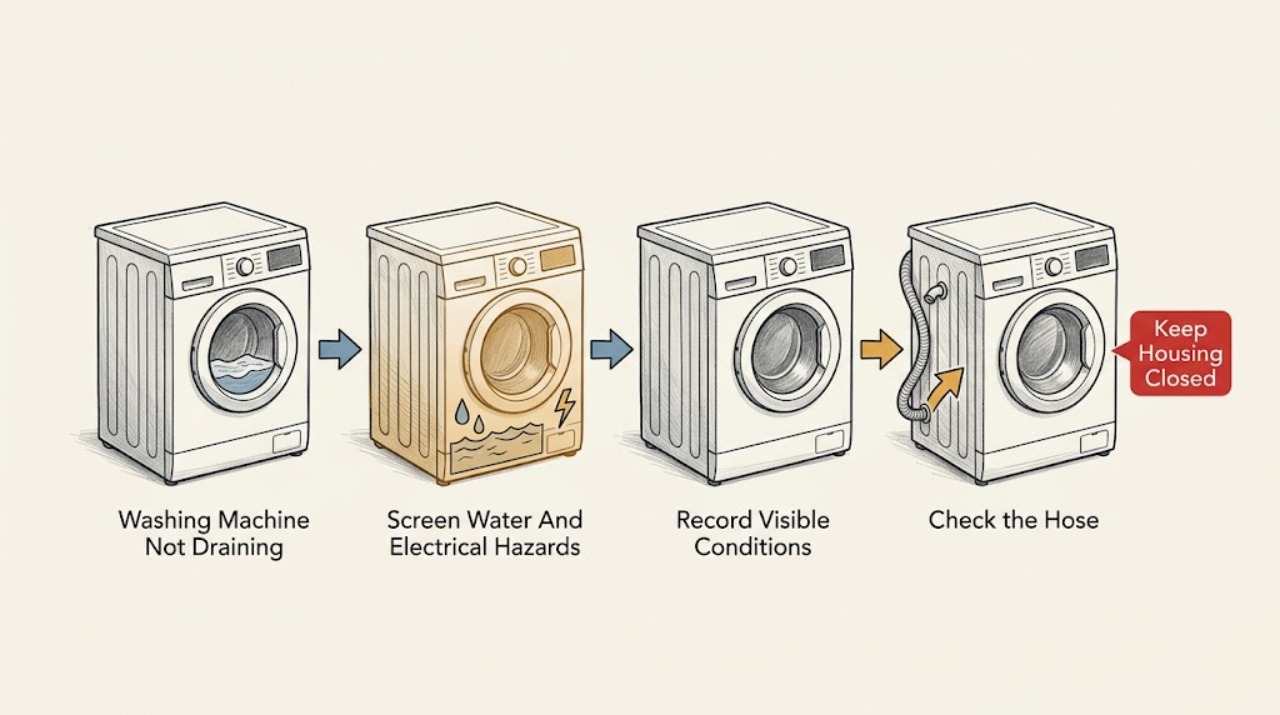
Work through in order
Diagnostic checks
Use only checks that match the exact appliance or system and its official guide.
-
Check 1
Before touching the Smeg washer, look from ordinary access for active leaking, pooled water near the plug or controls, a damaged cord, smoke, burning odor, sparks, an unusually hot cabinet, or a drum that is still moving.
Expected result: Record whether water is spreading, whether the water may be hot, whether the plug or cord is damaged, and whether smoke, odor, sparks, excessive heat, or motion is present.
Next step: Stop the cycle. If it can be done without touching wet electrics, close the water tap and isolate power at the normal dry disconnect; keep clear and arrange qualified appliance, electrical, plumbing, or emergency help as appropriate.
Stop if: Do not touch wet electrical parts, reach into the drum, open a wet filter area, or retry the cycle after a hazard sign.
Why this matters
Why: Water, heat, fire, electrical, and moving-drum hazards override a drain check. Continuing the programme or opening a wet service area could cause shock, burns, flooding, or injury.
-
Check 2
Without opening panels, record the Smeg product code, selected programme, point where it stopped, any complete error or pump symbol, whether the drum is spinning, and whether water is visible inside.
Expected result: A machine that reaches drain or spin but leaves water points toward the drain path; a machine that never starts a cycle may instead have a door, control, fill, or programme issue. A pump hum, silence, repeated clicking, or a returned code is useful evidence but is not a part diagnosis.
Next step: Use the exact Smeg manual for the recorded product code and follow the matching drain or error path; do not borrow a filter or reset procedure from another model.
Stop if: Do not keep restarting a machine that is full of water, leaking, hot, or showing an electrical warning.
Why this matters
Why: The failed stage separates a drain problem from a programme or supply problem, while the product code determines which Smeg drain, filter, and error instructions apply.
-
Check 3
After the cycle is stopped and the area is dry, inspect the visible drain hose without moving the appliance aggressively; look for a sharp kink, crushing, a hose end displaced from its support, or water backing up at the household standpipe or sink connection.
Expected result: A kink or crushed section can restrict flow. Water rising in the household drain when the washer discharges points to a plumbing restriction; a freely open standpipe with water still inside leaves the washer drain path as the next suspect.
Next step: Correct only a plainly visible hose-position problem without straining fittings, or arrange plumbing help for a backed-up household drain. If the external path is clear, continue only with the model manual's safe filter guidance.
Stop if: Do not pull a stacked or tightly fitted appliance, disconnect a pressurized hose, or work in pooled water near electricity.
Why this matters
Why: This check distinguishes a visible installation or household-drain problem from a blockage inside the appliance, without opening the washer.
-
Check 4
If there is no leak, heat, electrical damage, or moving-drum hazard and the controls respond, use the exact model manual to select its Drain, Pump, or Drain + Spin programme once, with the door closed and the area watched from a safe distance.
Expected result: Water may discharge normally, the pump may run without moving water, the machine may remain silent, or the same code may return. Note whether the water level falls and whether the programme completes.
Next step: If it drains, run no further test than the manual permits and monitor for recurrence. If it does not drain, stop and use only the exact manual's model-authorized filter procedure or arrange service.
Stop if: Do not repeat drain cycles indefinitely, run a full wash with standing water, or continue after a leak, smoke, odor, sparks, hot cabinet, or breaker trip.
Why this matters
Why: Successful draining points away from a completely blocked outlet but does not prove the system is healthy; humming without flow, silence, a repeated code, or an unchanged water level points toward a drain-path, pump, sensor, or control fault.
-
Check 5
Only when the exact Smeg manual identifies a user-accessible pump or filter procedure, the appliance is isolated at a dry disconnect, the drum is stopped, and residual water is cool and safely controlled, inspect that filter area as directed; otherwise leave it closed.
Expected result: The filter may contain lint, coins, fabric, or another obstruction; it may be clear; or water may flow unexpectedly, remain hot, or not be controllable with the manual's stated method.
Next step: Clean and refit the filter only exactly as the model manual directs, then try the documented drain check once. If the filter is clear or the problem returns, keep the appliance off and arrange service.
Stop if: Do not open the filter with hot or pressurized water, use tools to force a cap, reach into the pump, dismantle panels, or work with water near electricity.
Why this matters
Why: A removable obstruction can explain restricted flow, while a clear filter, inaccessible filter, uncontrolled water, or a pump that still will not move water requires model-specific service diagnosis rather than a guessed replacement.
-
Check 6
If the machine drains partially but stops before spin, record whether there is unusually heavy foam, an overloaded or badly distributed load, or a rinse-hold or no-spin setting shown on the display; do not add more detergent or force a spin.
Expected result: A changed result after the correct model programme, safe load redistribution, or the documented spin setting may indicate a cycle or load condition. Persistent water, a pump warning, or no flow after those conditions remain points back to the drain system.
Next step: Follow the exact manual for foam, rinse-hold, load, and Drain + Spin behavior. If water remains after the appropriate setting and safe drain path, stop troubleshooting and call service.
Stop if: Do not mix cleaning chemicals, pour unapproved chemicals into the washer, or continue a cycle with leaking water, hot water, smoke, odor, sparks, or electrical trips.
Why this matters
Why: Smeg notes that spin selection affects how wet laundry is, while anti-foam, variable-load, and programme behavior differ by model. A load symptom should not be used to dismiss standing water or a drain fault.
-
Check 7
Stop the diagnosis and prepare a service report when the Smeg washer still contains water after the external path and model-authorized checks, the pump is silent or only hums without flow, an error returns, or the appliance leaks or trips power.
Expected result: Provide the product code, programme and failed stage, water level and temperature, hose and standpipe observations, pump sound, filter result if the manual allowed it, displayed code, and any leak or electrical symptom.
Next step: Keep the appliance unused and arrange Smeg-authorized appliance service; use qualified plumbing or electrical help when the evidence points outside the washer.
Stop if: Do not run another wash, bypass a door or water-level interlock, open panels, or continue after smoke, burning odor, sparks, flooding, hot water, or repeated breaker trips.
Why this matters
Why: This information lets a qualified technician separate a household drain restriction from an internal hose, pump, water-level sensor, wiring, or control fault without unsafe user disassembly.
Use your observations
Decision map
Find the observation that best matches what you see, then follow the next safe action.
-
PATH 01Safety boundary
What you see
There is active leaking, water near electrics, hot water, smoke, burning odor, sparks, a damaged cord, an unusually hot cabinet, moving-drum access risk, or a repeated breaker trip.
Do this next
Stop the programme; if safe without touching wet electrics, close the water tap and isolate power at the normal disconnect, keep clear, and arrange qualified or emergency help.
Why this path and its safety boundary
Why it matters: This is not a routine drain-path check.
Safety stop: Do not touch wet electrical parts, open the filter, reach into the drum, or retry the appliance.
-
PATH 02Safety boundary
What you see
The visible hose is not kinked, but water backs up at the standpipe or sink connection when discharge is attempted.
Do this next
Stop using the washer and arrange qualified plumbing help; keep the washer off if water is pooling.
Why this path and its safety boundary
Why it matters: The household drain or installation may be restricting discharge rather than the washer pump alone.
Safety stop: Do not disconnect a full or pressurized hose into a wet electrical area.
-
PATH 03Safety boundary
What you see
A plainly visible drain-hose kink, crushing, or displaced hose end is found and there is no water or electrical hazard.
Do this next
Restore only the visible hose position without moving the appliance aggressively, then use the exact manual's drain programme once and observe the result.
Why this path and its safety boundary
Why it matters: The installation may be restricting flow.
Safety stop: Stop if fittings are strained, the hose is damaged, or water begins leaking.
-
PATH 04Safety boundary
What you see
The external path is clear, the machine is isolated and cool, and the exact Smeg manual explicitly covers a user-accessible pump or filter check.
Do this next
Follow only that manual's drain, container, filter, and refit sequence; then perform the documented drain check once.
Why this path and its safety boundary
Why it matters: A model-authorized filter inspection may distinguish a removable blockage from a deeper drain fault.
Safety stop: Do not improvise an emergency drain, force a cap, open a hot filter, or work near wet electrics.
-
PATH 05Safety boundary
What you see
The model-authorized filter is clear or cleaning it does not restore flow; the pump is silent or hums without moving water, or the error returns.
Do this next
Keep the washer off with water contained and arrange qualified Smeg appliance service; provide the failed stage and observations.
Why this path and its safety boundary
Why it matters: An internal hose, pump, sensor, wiring, control, or installation fault remains possible.
Safety stop: Do not dismantle panels, probe wiring, or order a pump solely from the symptom.
-
PATH 06Safety boundary
What you see
The washer drains partially but stops before spin, with heavy foam, a no-spin or rinse-hold setting, or an unusual load and no immediate safety hazard.
Do this next
Use the exact manual for foam, load, rinse-hold, and Drain + Spin behavior. If water remains afterward, treat it as a persistent no-drain fault.
Why this path and its safety boundary
Why it matters: A model-specific programme or load condition may be involved, but standing water still requires a drain-path decision.
Safety stop: Do not add chemicals, force spin, or continue a cycle after a leak, hot water, odor, smoke, sparks, or electrical trip.
-
PATH 07Safety boundary
What you see
Water remains after the safe external and model-authorized checks, or a drain error returns.
Do this next
Keep the washer unused and arrange Smeg-authorized appliance repair; use plumbing or electrical service when the evidence points to the home installation or supply.
Why this path and its safety boundary
Why it matters: The problem has reached the appliance-service boundary.
Safety stop: Do not keep retrying cycles, bypass interlocks, or open panels.
Helpful context
Understand the symptom
Start with the stage where draining failed
A machine that leaves water after rinse or spin has a different decision from one that never fills or stops with a display error. Record the exact programme, whether the drum turns, whether the pump hums, and whether the water level is visible through the door. Smeg lists a drain-related programme on product pages, but the name and button sequence are model-specific; use the product-code manual before choosing a programme or interpreting an error.
Check the external path before opening anything
With the cycle stopped, inspect only the visible hose behind the appliance for a sharp kink, crushing, or a hose end pushed into a backed-up standpipe. A household drain that rises or backs up can mimic a washer fault. Do not pull a stacked or tightly fitted appliance forward if doing so could strain hoses or power connections. A visible household drain backup is a plumbing branch; a clear external path with water still inside moves the diagnosis toward the washer drain path.
Pump and filter checks are model-specific
Smeg describes an easy-access filter on some washing machines and identifies a blocked filter or drainage pump as a possible cause. That does not make every filter location or emergency-drain method universal. Only after the appliance is unplugged or isolated at a dry, safe disconnect, the drum has stopped, and water is cool and controlled should you use the exact manual's pump-filter procedure. If the manual does not clearly cover the procedure, leave the water and filter area closed and call service.
A clear filter does not prove the pump is healthy
If the hose and model-authorized filter check are clear but the machine still will not drain, do not infer that a pump replacement is needed. A blocked internal hose, pump impeller problem, wiring, water-level sensing, control fault, or installation problem may require disassembly and testing. Persistent water, a recurring code, an unusual electrical smell, repeated breaker trips, or a leak is a stop-and-service condition.
When checks do not resolve it
Need a professional?
Arrange Smeg-authorized appliance service when water remains after the exact model's safe drain and filter steps, the pump is silent or hums without flow, a drain error returns, the filter is clear but the problem persists, or an internal hose, pump, sensor, wiring, or control fault is possible. Use qualified plumbing help for a backed-up household drain or unsafe hose installation. Request urgent help for flooding, water near electricity, smoke, burning odor, sparks, damaged wiring, an overheated cabinet, or repeated breaker trips.
Safety scope: This article supports ordinary-access observation and exact-manual controls only. Do not touch wet electrics, open a hot or uncontrolled filter area, dismantle panels, probe wiring, bypass interlocks, or continue a cycle after a hazard sign.
Common questions
FAQ
Why is my Smeg washing machine not draining?
Smeg identifies a blocked filter or drainage pump as possible causes when laundry remains wet. A kinked hose, backed-up household drain, programme setting, foam, or an internal pump, hose, sensor, or control fault can produce similar symptoms, so note the failed stage and use the exact model manual.
Can I run Drain or Drain + Spin on a Smeg washer?
Some Smeg models list a dedicated drain or Drain + Spin programme, but the control sequence and safety conditions vary. Use the exact product-code manual, keep the door closed, and stop if there is a leak, hot water, water near electricity, smoke, odor, sparks, or a breaker trip.
Should I clean the pump filter on my Smeg washing machine?
Only when the exact Smeg manual identifies a user-accessible filter and gives the drain and cleaning procedure for that model. Isolate the appliance safely, control cool residual water, and never open a hot, pressurized, leaking, or electrically wet filter area.
The filter is clear but my Smeg washer still will not drain. What next?
A clear filter does not rule out a blocked internal hose, pump, water-level sensor, wiring, control, or household drain. Keep the machine off if water remains, record whether the pump is silent or humming and any code, and arrange qualified appliance service rather than dismantling the washer.
Is it safe to keep trying cycles when water remains in the drum?
No. Do not keep retrying when water remains, the machine leaks, water is near electrical parts, the water may be hot, or smoke, burning odor, sparks, overheating, or breaker trips occur. Stop and isolate water or power only when safe, then arrange qualified help.
Read the exact guide
Official sources
- 8 kg Free-standing washing machine WNP84SEAIN1 SmegSmeg · Official product page showing a Drain + Spin programme, an easy-to-access filter, anti-foam and load systems for the listed model; other models may differ.
- Washing machines White WM24UWHSmeg · Official product page showing an easy-to-access filter, Drain and Spin programmes, and model-specific controls; other models may differ.
- Download ManualsSmeg · Official Smeg manual-download page for locating the exact appliance instructions by product code and region or language.
- FAQ Washing machines and dryersSmeg · Official FAQ covering door safety, leak protection, programme context, spin results, and blocked filter or drainage pump guidance.
Community feedback
Share a repair observation
Share a plain-text repair observation. Accepted observations are published automatically; this page may take a moment to update.