
On this page
Start here
Quick answer
A Speed Queen dryer odor may come from room air or a damp load, but a burning, melted-plastic, fuel, or electrical smell is a stop signal. Speed Queen guides say room odors can transfer to clothing, lint can restrict drying airflow, and the correct cycle and load matter; gas and electric models also have different heat and exhaust arrangements. Do not keep running the dryer to identify a dangerous smell. Turn it off, let it stop, and only when cool and safe check the load, lint filter, visible exhaust route, and model instructions. Leave the dryer off for smoke, scorching, gas odor, suspected carbon monoxide, arcing, hot connections, or a repeated trip.
Work through in order
Diagnostic checks
Use only checks that match the exact appliance or system and its official guide.
-
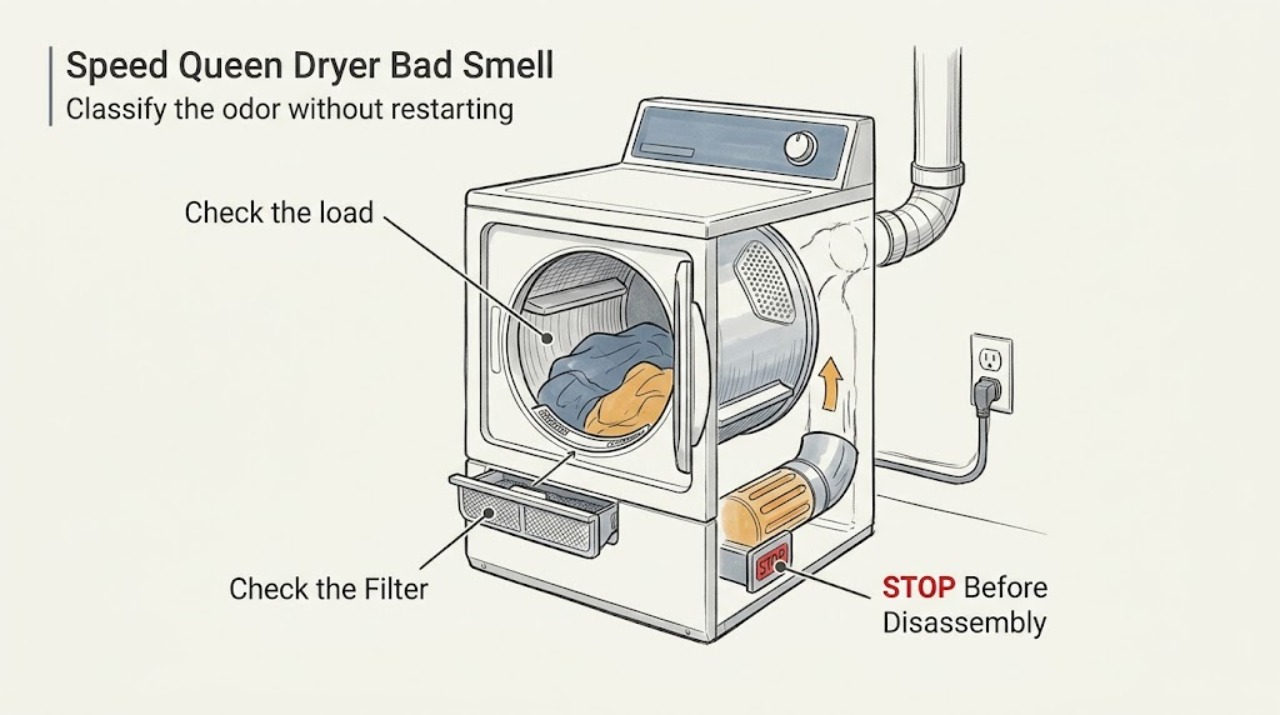
Classify the odor without restarting
With the dryer off and cool enough to approach, write down when the smell appeared: before starting, during heat, during cool-down, after the load ended, or only when the door opened. Describe whether it is on the clothes, in the laundry room, at the lint filter, near the exhaust outlet, or near the plug and controls. Record whether this was the first use, a newly washed load, or a repeated event.
Expected result: A room-only smell that transfers to the load supports an air-source issue. A damp or musty load suggests moisture or a delayed unload. A sharp chemical, rubber, scorched, electrical, or fuel odor, especially with heat damage or smoke, is not a normal laundry-room smell.
Next step: If the odor is burning, fuel-like, electrical, or accompanied by smoke or heat damage, stop and arrange qualified or emergency help. Otherwise continue only with the cool, non-invasive checks.
Why this matters
Why: Speed Queen notes that room odors can transfer to clothing as the dryer draws room air, but its safety guide also tells users not to operate a smoking or damaged dryer. Odor type and location select the safe branch.
-
Check the load for an odor source
Remove the load after the drum is stopped and inspect the fabric labels and items for oil, solvent, paint, cleaning chemical, rubber, plastic, or other residue. Separate any item with a persistent chemical or oily odor and do not put it back in the dryer. Check whether the smell follows one item or remains in the empty drum.
Expected result: An odor that follows one item can come from a product absorbed by the fabric, a coated print, rubber, or plastic. An odor that remains in the drum or returns across clean loads points to the dryer, lint path, or room air rather than one garment.
Next step: Keep contaminated or heat-damaged items out of the dryer and follow the care label or appropriate cleaning advice. If the empty drum or room still smells scorched or electrical, keep the dryer off and call service.
Why this matters
Why: Speed Queen safety instructions warn against drying items contaminated with flammable substances and against drying certain plastic or rubber-like materials. A load source should be removed, not heat-tested.
-
Clean and refit the user-accessible lint filter
When the dryer is cool, remove the lint filter, clear lint from the filter and its accessible recess, and refit it exactly as the model guide shows. Clean the filter after every load as directed. Do not operate without the filter, with a damaged filter, or with lint falling into an open air shaft; do not use a sharp tool or open the cabinet.
Expected result: A filter coated with lint or residue can restrict airflow and lengthen drying, while lint in the recess or exhaust path can carry a stale or hot smell. A clean, correctly fitted filter with a returning burning odor or abnormal heat points beyond routine filter care.
Next step: If there is no dangerous odor or damage, refit the dry filter and continue to the visible exhaust check. If lint is charred, the filter is damaged, or odor returns, stop and arrange service.
Why this matters
Why: Speed Queen states that lint reduces drying efficiency and prolongs time and warns against operating without the proper filter. Filter care reduces one common airflow cause but does not prove that an internal heat source is safe.
-
Check the exhaust and room-air conditions
From outside the appliance, check that the visible exhaust duct is not kinked or crushed and that the exterior hood or flap can open freely. Keep the area around the lint filter and exhaust opening clear. Do not disconnect the duct, reach into it, or clean an inaccessible interior section unless the exact guide or a qualified technician provides the procedure.
Expected result: Weak or absent exhaust flow, a blocked hood, or lint accumulation can trap heat and moisture and may create a hot or musty smell. A clear visible route does not rule out a hidden restriction or internal fan problem, especially if the dryer overheats or the odor is scorched.
Next step: If the visible route is blocked, keep the dryer off until it is safely corrected. If airflow is weak, the hood does not open, or odor and heat persist with a clear route, arrange qualified dryer-vent or appliance service.
Why this matters
Why: Speed Queen guides call for a clean lint filter and clear exhaust system and identify exhaust and room-air conditions as part of drying performance. Gas dryers require correct venting because combustion products must be directed safely outdoors.
-
Separate first-use, damp-room, and recurring odors
Note whether the smell was faint and limited to a new appliance or new materials, whether it was present in the laundry room before the cycle, and whether the load or drum was left damp for a long time. Do not use a long hot cycle to burn away an odor, and do not mask it with fragrance or cleaner.
Expected result: A faint first-use or room odor that fades without heat damage is different from a recurring smell on clean loads. A damp or musty smell that follows wet laundry points toward moisture or room ventilation. A sharp odor that grows with heat or leaves a mark on fabric is a stop condition.
Next step: Ventilate the room and correct a damp-load or load-size issue only when no safety symptom exists. Keep the dryer off for recurring sharp, scorched, chemical, or electrical odor.
Why this matters
Why: Speed Queen's guide says room odors can transfer to clothes and recommends room ventilation; it also warns that overloaded or unsuitable loads affect drying. These clues help separate the load and room from a dryer fault without unsafe testing.
-
Apply the gas or electric model branch
Use the model label and guide to identify whether the dryer is gas or electric. For a gas model, observe only that the supply valve and venting match the installation instructions; never test for a leak with a flame or adjust a burner. For an electric model, inspect only the dry, visible cord and connection for damage; do not open the terminal, heater, or control area.
Expected result: Fuel odor, a carbon-monoxide alarm, combustion concern, or an exhaust problem on a gas dryer requires immediate stop and qualified gas or emergency help. A hot plug, arcing, melted connection, or repeated trip on an electric dryer requires electrical or appliance service. Neither branch is a user heat test.
Next step: For any gas odor or CO concern, leave the area and do not operate switches or relight anything. For electrical heat, smoke, arcing, or repeated trips, disconnect only when safe and arrange qualified service.
Why this matters
Why: Speed Queen publishes separate gas and electric dryer configurations and requires qualified personnel for gas and electrical connections. CDC explains that carbon monoxide from fuel-burning appliances is odorless and requires proper venting and qualified service.
-
Use one safe confirmation only for a non-dangerous odor
Only when the odor was identified as a room or load issue, the filter and visible exhaust are clear, the dryer has no damage, and no safety symptom occurred, run one small compatible load nearby using the model's documented cycle and temperature. Stay present and stop at once if the odor changes, heat becomes abnormal, fabric scorches, smoke appears, or the plug or cabinet gets hot.
Expected result: If the smell is absent with a clean load and clear room air, the original source was likely external to the dryer. If the smell returns from the drum, exhaust, cabinet, or connection, or the cycle produces unusual heat, the fault remains unresolved.
Next step: Stop after one recurrence and provide the model, load, cycle, odor description, location, filter and exhaust findings, and any heat or display symptom to qualified service. Do not run further cycles to gather proof.
Why this matters
Why: A controlled run can confirm that a simple load or room correction changed the symptom, but it cannot validate an internal heater, motor, gas system, or control. Speed Queen directs recurring faults and unsafe conditions to service.
Use your observations
Decision map
Find the observation that best matches what you see, then follow the next safe action.
-
PATH 01Safety boundary
What you see
The odor is faint, follows the room or one item, and there is no scorching, smoke, abnormal heat, or equipment damage.
Do this next
Keep the dryer off if the smell recurs or becomes sharp, hot, chemical, electrical, or fuel-like.
Why this path and its safety boundary
Safety stop: An odor from the drum, cabinet, exhaust, plug, or a clean load belongs to the dryer or safety branch.
-
PATH 02Safety boundary
What you see
The lint filter, filter recess, visible exhaust duct, or exterior hood is dirty, blocked, kinked, or restricted.
Do this next
Stop and arrange qualified vent or appliance service for a returning hot or burning smell, weak exhaust, or damaged filter.
Why this path and its safety boundary
Safety stop: A clear visible path does not rule out an internal airflow, fan, heater, or temperature fault when odor or heat persists.
-
PATH 03Safety boundary
What you see
A gas-model dryer produces a fuel odor, a CO alarm sounds, or people have headache, dizziness, weakness, nausea, or confusion near the appliance.
Do this next
Do not relight, restart, or test the gas dryer after a fuel or CO event until qualified personnel clear it.
Why this path and its safety boundary
Safety stop: Continue only with non-invasive load, filter, room, and exhaust checks for a non-dangerous odor.
-
PATH 04Safety boundary
What you see
The odor is electrical or burnt plastic, or the cord, plug, outlet, cabinet, or controls are hot, discolored, arcing, or tripping protection.
Do this next
Do not reset protection repeatedly or operate with a damaged cord, plug, guard, or panel.
Why this path and its safety boundary
Safety stop: A faint non-dangerous room or load odor may proceed only to the single supervised confirmation branch.
-
PATH 05Safety boundary
What you see
The load contains oil, solvent, chemical residue, plastic, rubber-like material, or scorch marks.
Do this next
Stop for any fabric damage, smoke, or returning odor and arrange qualified service.
Why this path and its safety boundary
Safety stop: A clean load with a recurring odor points back to the room, airflow, heat source, or appliance.
-
PATH 06Safety boundary
What you see
The smell returns after one permitted filter, room, load, or visible exhaust correction.
Do this next
Do not continue running cycles to prove that the odor is intermittent.
Why this path and its safety boundary
Safety stop: Document the corrected room or load cause and keep the filter and exhaust maintained.
Helpful context
Understand the symptom
Do not label every dryer odor as lint. First classify when it began, whether it is on the clothes or in the room, and whether it smells damp, musty, chemical, rubber-like, scorched, electrical, or like fuel. Speed Queen sells both gas and electric dryers, and older and newer controls can use different filters, exhaust arrangements, and cycles. Record the model and serial label, but do not restart a dryer that has produced a dangerous smell just to collect more evidence.
Immediate safety boundary
Press Stop or open the door only if it is safe, and keep the dryer off for smoke, flame, scorching, melted fabric, burning or melted-plastic odor, visible arcing, a hot or discolored plug, repeated breaker trips, or an odor like fuel. For a suspected gas leak or carbon-monoxide alarm, leave the area, avoid switches and flames, and contact local emergency or gas support from a safe location. Do not run another cycle, bypass a guard, open the heater or gas controls, or use water on an energized appliance.
Safety boundary
Stop conditions
- Stop immediately for smoke, flame, scorching, melted fabric, burning or melted-plastic odor, visible arcing, a hot or damaged plug, repeated trips, or a cabinet that becomes abnormally hot.
- For a gas odor, carbon-monoxide alarm, or suspected combustion problem, leave the area and avoid switches or flames; use emergency or qualified gas support from a safe location.
- Do not run a dryer that is smoking, grinding, missing parts, or has removed guards; do not bypass the door switch, thermal protection, or another safety device.
- Do not dry items contaminated with oil, solvent, fuel, cleaning chemicals, plastic, or rubber-like materials, and do not open the heater, gas controls, motor, or electrical panels as an odor check.
Only after diagnosis
Potential parts
- lint filter or filter housing
Consider this category only if the exact model has a damaged filter or housing that a qualified diagnosis links to restricted airflow or lint escape.
Filter location and design vary by Speed Queen model; confirm the model and never operate without the correct filter. - exhaust blower or vent component
Consider this category only after qualified inspection confirms an internal airflow or blower fault beyond a blocked visible duct.
Gas and electric dryers and different generations use different airflow layouts; no generic fit is implied. - temperature or limit thermostat
Consider this category only when a qualified technician confirms incorrect temperature control after load, lint, exhaust, and venting causes are excluded.
Do not reset or replace a safety thermostat as a smell test; verify the exact model and qualified procedure. - heater or gas burner assembly
Consider this category only after qualified diagnosis identifies a heat-source fault and confirms whether the dryer is electric or gas.
Gas and electric heat sources are not interchangeable; do not open or adjust either system as a user check.
When checks do not resolve it
Need a professional?
Arrange qualified Speed Queen appliance service when a smell returns with a clean load, when the filter and visible exhaust are clear but heat or odor remains abnormal, or when the dryer has a damaged guard, motor, fan, heater, gas system, or control symptom. Use qualified vent service for a restricted exhaust path, qualified electrical service for a hot or damaged connection or repeated trip, and emergency or gas support for a fuel odor or carbon-monoxide concern.
Common questions
FAQ
Why does my Speed Queen dryer make clothes smell?
The source may be room air, a damp load, a contaminated item, or the dryer itself. Speed Queen says room odors can transfer to clothing. Remove suspicious items, ventilate the room, check the cool lint filter and visible exhaust, and stop for a recurring sharp, scorched, electrical, or fuel odor.
Is a new Speed Queen dryer smell normal?
A faint first-use smell that fades without smoke, scorching, abnormal heat, or equipment damage is different from a sharp or recurring odor. Do not run a long hot cycle to remove it; keep the dryer off and arrange service if the smell persists or grows.
Can lint cause a burning smell in a Speed Queen dryer?
Lint can restrict airflow and lengthen drying, which can contribute to heat buildup. Cool the dryer, clean and dry the correct filter, and check the visible exhaust route. If lint is charred or the burning smell returns, stop and call qualified service.
What should I do if my gas Speed Queen dryer smells like gas?
Stop using it and leave the area. Avoid switches, flames, and attempts to relight or test the dryer, then contact local emergency or qualified gas support from a safe location. A carbon-monoxide alarm or symptoms such as headache, dizziness, weakness, nausea, or confusion require fresh air and prompt emergency help.
Can I run my Speed Queen dryer once more to see whether the smell returns?
Only a single supervised run is reasonable after a clearly non-dangerous room or load source has been corrected and the filter and visible exhaust are clear. Never retest smoke, scorching, electrical odor, fuel odor, abnormal heat, arcing, or a repeated trip.
Read the exact guide
Official sources
- User's GuideSpeed Queen / Alliance Laundry Systems · Speed Queen dryer safety, flammable-load restrictions, lint and exhaust maintenance, gas or electric installation, and service boundaries
- Speed Queen | DryerSpeed Queen · Speed Queen dryer product support, manuals, service, and model resources
- User's GuideSpeed Queen / Alliance Laundry Systems · Speed Queen electric and gas dryer load, cycle, odor, lint, exhaust, and troubleshooting guidance
- Carbon Monoxide Poisoning BasicsCenters for Disease Control and Prevention · Carbon-monoxide hazards, symptoms, fuel-burning appliances, venting, and emergency response
Community feedback
Share a repair observation
Share a plain-text repair observation. Accepted observations are published automatically; this page may take a moment to update.