
On this page
Start here
Quick answer
First confirm that the Speed Queen dryer is set to a heated cycle rather than No Heat, Cool Down, or another air-only setting, and clean the lint filter. Then inspect the exhaust path from the outside for a crushed hose, blockage, or a hood flap that cannot move freely. The exact supply check depends on the dryer: an electric model may need both sides of its dedicated supply circuit, while a gas model needs its equipment and main gas valves available. Speed Queen's guide lists these as separate causes and says a failed electric heating element or gas solenoid requires professional service. Do not open the cabinet, access gas parts, test live voltage, or keep running a dryer that smells of gas, smoke, burning, scorched fabric, abnormal heat, arcing, or repeated breaker trips. If the settings, lint path, and safe external supply checks are normal but the drum remains cold, stop and arrange qualified service.
Work through in order
Diagnostic checks
Use only checks that match the exact appliance or system and its official guide.
-
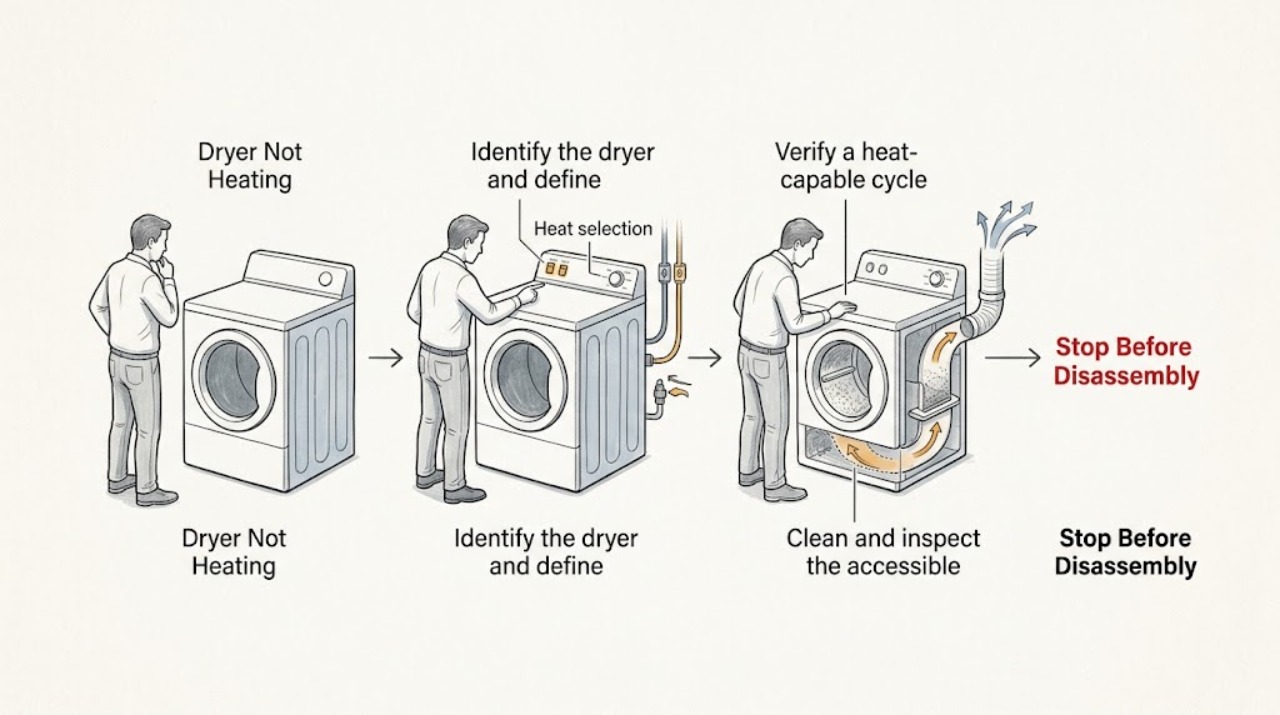
Identify the dryer and define the cold result
Record the complete Speed Queen model, whether the dryer is electric or gas, the selected cycle and temperature, and whether the drum tumbles. Note whether the complaint is no heat at all, intermittent heat, or clothes taking much longer to dry. Stop before testing if there is gas odor, smoke, burning smell, scorched fabric, abnormal cabinet heat, arcing, or a tripped breaker.
Expected result: The dryer tumbles with no heat; heat comes and goes; only an air or cooling cycle is cold; the dryer does not tumble; or a hazard symptom is present.
Next step: Use the matching cycle, supply, and airflow checks below only when no stop condition is present. Keep the dryer out of service for any hazard symptom.
Why this matters
Why: A cold air-only cycle is expected, while a heated cycle that tumbles but stays cold points toward settings, supply, airflow, or a heating system. No tumbling is a separate start or drive problem, and a hazard symptom ends the test.
-
Verify a heat-capable cycle and temperature
With the dryer empty or with a safe small load as the manual permits, confirm that the control is not set to No Heat, Cooling, Cool Down, Air Fluff, or a similar air-only selection. Select a documented heated cycle and temperature suitable for the fabric, then start one test. Do not keep running the dryer if fabric scorches or the cabinet becomes abnormally hot.
Expected result: The control was on an air-only setting; the heated selection starts and produces warmth; the selection is correct but the drum remains cold; or a display code appears.
Next step: If the cycle was the cause, monitor one normal load. If the setting is correct and there is no heat or a code returns, record the exact display and continue only with the safe external checks.
Why this matters
Why: Speed Queen lists No Heat and cooling selections as reasons a dryer may not heat. A correct heated selection with persistent cold air shifts the diagnosis to supply, airflow, thermal protection, or a heating component.
-
Clean and inspect the accessible lint and exhaust path
After the dryer is off, cool, and disconnected as the manual permits, clean the lint filter. From safe accessible points, look for a crushed or kinked exhaust duct and check the outside weather hood for lint or a flap that cannot move freely. Do not reach into the cabinet, remove internal panels, or operate the dryer with the lint filter absent.
Expected result: The lint filter is coated, the duct is restricted or kinked, the outside hood is blocked, or the accessible path is clear.
Next step: Correct only an obvious accessible lint or duct issue using the model guide, then make one safe test. If the path is damaged, inaccessible, repeatedly restricted, or the dryer overheats, stop and arrange service or qualified vent cleaning.
Why this matters
Why: Speed Queen says lint and restricted exhaust airflow can reduce drying performance and create a fire hazard. A clear accessible path makes a persistent no-heat symptom more likely to be a supply, control, safety, or heating-system fault.
-
Check the electric supply or gas availability by dryer type
For an electric dryer, look at the dedicated circuit's breaker or fuses without opening the dryer; some installations use two supply legs, so record whether one or both appear open. For a gas dryer, make only the safe external observation allowed by the model guide that the equipment and main gas valves were not visibly closed after installation or moving. Do not reset a repeatedly tripping circuit, adjust gas pressure, loosen fittings, or use an extension cord.
Expected result: An electric supply leg appears open; the electric supply appears normal; a gas valve is visibly closed or uncertain; or gas availability appears normal but there is still no heat.
Next step: Have a qualified electrician address an open or repeat-tripping circuit. For uncertain gas availability, stop and use qualified gas-appliance service. If supply appears normal, continue to the code and service handoff rather than accessing internal parts.
Why this matters
Why: Speed Queen identifies separate electric supply checks and gas-valve availability for the two dryer types. A normal external supply with no heat points toward airflow, thermal protection, ignition, an element, a solenoid, or controls and cannot be safely narrowed with live testing.
-
Capture an error or thermal symptom without opening the dryer
Write down the exact display code, indicator, and the point in the cycle when heat stops. Note whether the dryer restarts only after cooling, whether the exhaust becomes very hot, and whether the outside hood moves air. Do not remove a thermal device, access wiring, defeat a safety device, or repeat long cycles to reproduce overheating.
Expected result: No code is shown; a code returns; heat disappears after warm-up; the exhaust is weak or very hot; or the dryer has smoke, odor, scorching, arcing, or a breaker trip.
Next step: Stop for any smoke, odor, scorch, arc, abnormal heat, or trip. Otherwise give the exact code and observations to qualified service; use the model guide rather than guessing a component.
Why this matters
Why: A returning code or heat that cuts out can indicate thermal protection, airflow restriction, control, or a heating-system fault. Weak or excessively hot exhaust requires attention even if some warmth is present.
-
Escalate persistent no-heat after external checks
Record the model, fuel type, cycle and temperature, load, lint-filter condition, exhaust observations, supply result, code, and whether the drum tumbles. If a correctly selected heated cycle remains cold after one safe external check, stop using the dryer and request authorized Speed Queen service. Do not open the cabinet or attempt element, solenoid, igniter, thermostat, or wiring work.
Expected result: The dryer heats after a setting or accessible airflow correction; it remains cold; or a part or safety fault is suspected.
Next step: Monitor only a normal safe cycle after a clear external correction. For persistent no heat or any suspected internal fault, keep the dryer out of service and arrange qualified repair with the recorded evidence.
Why this matters
Why: A resolved setting or airflow issue is different from persistent no heat. Speed Queen notes that an electric element or gas solenoid fault requires professional handling, and other internal causes need model-specific diagnosis.
Use your observations
Decision map
Find the observation that best matches what you see, then follow the next safe action.
-
PATH 01Next step
What you see
The control is set to No Heat, Cooling, Cool Down, Air Fluff, or another air-only selection.
Do this next
Choose one documented heated cycle and temperature suitable for the load. If warmth is still absent, stop repeated testing and continue with service-oriented checks.
-
PATH 02Next step
What you see
The lint filter, exhaust duct, or outside hood is visibly restricted or the duct is crushed.
Do this next
With the dryer cool and disconnected as the guide allows, correct only the accessible lint or duct issue. Arrange qualified vent cleaning or service if the restriction is not safely accessible or heat remains abnormal.
-
PATH 03Next step
What you see
An electric dryer has an open supply leg or its breaker trips again.
Do this next
Keep the dryer out of service and arrange qualified electrical or appliance diagnosis. Do not repeatedly reset the circuit or open the dryer to test voltage.
-
PATH 04Next step
What you see
A gas dryer has an uncertain or visibly closed gas valve, or gas availability cannot be safely confirmed.
Do this next
Do not adjust the regulator, loosen a gas connection, or repeat ignition. Arrange qualified gas-appliance service; leave the area and seek emergency gas-safety help for persistent odor.
-
PATH 05Next step
What you see
The correct heated cycle, accessible airflow, and external supply appear normal but the dryer remains cold.
Do this next
Stop using the dryer and arrange authorized Speed Queen service for model-specific diagnosis of the element, solenoid, thermal system, igniter, control, or wiring.
-
PATH 06Next step
What you see
There is gas odor, smoke, burning or plastic smell, scorched clothing, abnormal heat, arcing, a damaged cord, or a repeat breaker trip.
Do this next
Stop the dryer immediately and do not restart it. If safe and dry, disconnect power without touching wet equipment; for gas odor or smoke, leave the area and obtain local emergency or gas-safety help from a safe location.
Helpful context
Understand the symptom
Not heating is not always a failed heater
A dryer can tumble normally while producing little or no heat because the selected cycle is air-only, the lint path is restricted, or one part of the supply path is unavailable. Electric and gas models also have different supply checks. Start with the model, cycle, and safe external observations before considering a component fault.
Use the exact Speed Queen guide
Speed Queen publishes manuals by model number, and controls and safety features vary across residential, stacked, and other configurations. Use the guide for the complete model and serial information to identify the correct heat settings and error meaning. Do not transfer a gas instruction to an electric dryer or assume that every model uses the same control labels.
Airflow is part of the heat diagnosis
The dryer needs a clear lint filter and exhaust path to move warm, moist air outside. A kinked duct, blocked outlet, or stuck exterior hood can reduce drying and create a heat-risk condition. Clean only accessible, cool, disconnected duct sections as the manual allows; internal lint removal and any repeated overheating belong to qualified service.
Safety boundary
Stop conditions
- Stop immediately for gas odor, smoke, burning or plastic smell, scorched clothing, abnormal cabinet or exhaust heat, arcing, visible cord damage, or a breaker that trips again.
- Do not run the dryer with the lint filter absent, defeat a safety device, open the cabinet, test live voltage, remove a thermal device, adjust gas pressure, or loosen gas fittings.
- Do not repeat long cycles to reproduce overheating, and do not continue ignition attempts when a gas dryer does not light normally.
- Stop after the correct setting, accessible lint and exhaust check, and safe external supply observation if the dryer remains cold; arrange qualified service.
Only after diagnosis
Potential parts
- electric heating element
Consider only when qualified diagnosis confirms an electric model has a heating-element fault after settings, airflow, and supply checks.
Confirm the complete model and manufacturer fit information; do not open the dryer or test the element while energized. - gas burner solenoid or ignition component
Relevant only when qualified gas-appliance diagnosis identifies an ignition or solenoid fault on the exact gas model.
Do not access gas components or repeat ignition tests; verify model fit through authorized service. - thermal protection component
Consider only when qualified diagnosis links a returning thermal or no-heat symptom to the model's thermal protection path after airflow is addressed.
Never defeat thermal protection; confirm the exact model and professional diagnosis before any replacement. - exhaust duct or vent component
Relevant only when inspection finds a damaged, crushed, or unsuitable exhaust path that cannot be corrected with safe accessible cleaning.
Follow the exact installation guide and use qualified vent service when the duct is concealed or unsafe to access.
When checks do not resolve it
Need a professional?
Arrange qualified Speed Queen appliance, electrical, gas-appliance, or vent service when the heated cycle and accessible lint path are correct but the dryer remains cold; when an electric supply leg is open or a breaker trips; when gas availability is uncertain; when a code returns; or whenever gas odor, smoke, scorch, abnormal heat, arcing, cord damage, or repeat tripping occurs. Provide the complete model number and recorded observations.
Common questions
FAQ
Why is my Speed Queen dryer running but not heating?
Check whether the cycle is No Heat, Cooling, Cool Down, or another air-only setting, then inspect the lint filter and accessible exhaust path. The supply check depends on whether the dryer is electric or gas. If those checks are normal and the drum remains cold, arrange qualified service.
Can one breaker or fuse affect an electric Speed Queen dryer's heat?
Some electric dryer installations have more than one supply leg, and Speed Queen's guide lists fuses or breakers as a no-heat check. Do not open the dryer or repeatedly reset a trip; have a qualified electrician or appliance technician diagnose the circuit.
What should I check on a gas Speed Queen dryer?
Confirm the exact model and make only a safe external observation that the equipment and main gas valves were not visibly closed after a move. Do not adjust a regulator, loosen a fitting, or repeat ignition. Gas odor or abnormal ignition requires immediate stopping and qualified help.
Can a clogged vent make a Speed Queen dryer stop heating?
A restricted lint filter, duct, or outside hood can reduce airflow and drying performance and can create a heat risk. Clean only cool, accessible sections as the model guide allows. Concealed restrictions, overheating, smoke, or scorching require qualified vent or appliance service.
What information should I give Speed Queen service?
Provide the complete model and serial information, electric or gas type, whether the drum tumbles, cycle and temperature, lint and exhaust observations, supply result, exact code, when heat stops, and any odor, smoke, scorch, abnormal heat, arcing, cord, or breaker symptom.
Read the exact guide
Official sources
- Speed Queen | Manuals & DownloadsSpeed Queen by Alliance Laundry Systems · Speed Queen washer and dryer model-number manuals and installation literature
- Speed Queen | SupportSpeed Queen by Alliance Laundry Systems · Speed Queen product manuals, service support, repair requests, and authorized servicer routing
- User's GuideSpeed Queen by Alliance Laundry Systems · Speed Queen electric and gas dryer user-guide troubleshooting and maintenance
- Speed Queen | How long does a dryer take? It depends on your load.Speed Queen by Alliance Laundry Systems · Speed Queen guidance on dryer settings, lint filters, exhaust airflow, and professional diagnosis of heating components
Community feedback
Share a repair observation
Share a plain-text repair observation. Accepted observations are published automatically; this page may take a moment to update.