
On this page
Start here
Quick answer
A Speed Queen dryer timer can advance slowly during an automatic cycle: the official ADE3TR/ADG3TR guide says the timer does not advance as quickly in automatic cycles as in Time Dry and that the load affects the advance rate. Compare the complaint with a model-appropriate Time Dry cycle, then check the selected heat setting, the external lint filter and exhaust path, and the correct power or gas supply for the dryer type. Heat turning on and off during a cycle is not by itself proof of a failed part, but a timer that does not advance in Time Dry, heat that never returns, a burning or gas odor, a repeatedly tripped breaker, or a motor that repeatedly overloads is a stop-use and qualified-service situation. Speed Queen controls and procedures vary by model, so do not open the cabinet or order a timer from the symptom alone.
Before you begin
Safety first
- Do not open the cabinet or console, bypass a door or control, adjust gas components, perform live electrical tests, or continue operation after burning/gas odor, scorching, repeated breaker trips, or recurring overload protection.
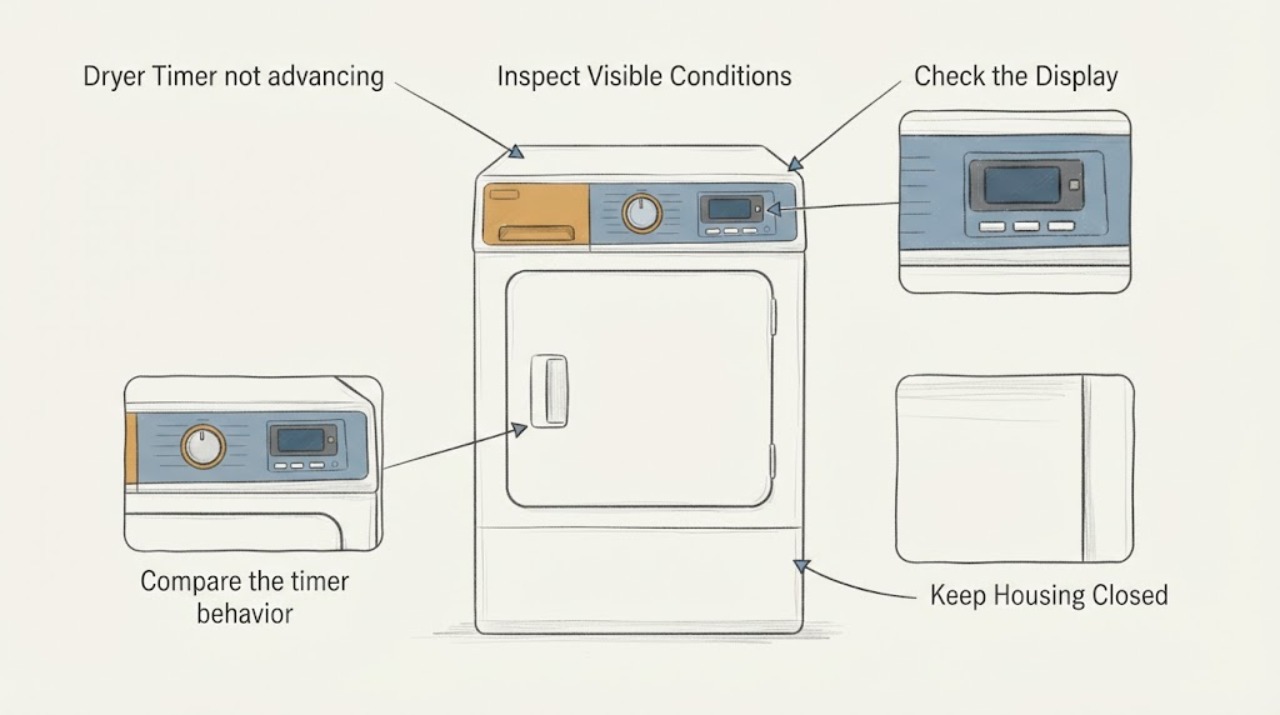
Work through in order
Diagnostic checks
Use only checks that match the exact appliance or system and its official guide.
-
Check 1
Record the full Speed Queen model, fuel type, control style, and selected cycle, then observe one load without repeatedly stopping and restarting it.
Expected result: The dryer has a mechanical timer knob or electronic controls, and the complaint occurs in Automatic, Time Dry, or both.
Next step: Use the exact model manual. If the complaint is only in Automatic, perform the timed-cycle comparison below; do not transfer a mechanical-timer procedure to a newer electronic model.
Why this matters
Why: Speed Queen uses different control families, and the official guide says Automatic cycles can advance more slowly than Time Dry; the assigned symptom does not identify one universal timer design.
-
Check 2
Compare the timer behavior with the exact model's supported Time Dry or manual-timed setting, using a normal load and the labeled heat setting.
Expected result: The timer advances in Time Dry but slowly in Automatic, or it fails to advance in both modes.
Next step: Keep the model and cycle result for service if both modes fail. Do not force the knob, bypass a control, or open the console.
Why this matters
Why: Slow Automatic advancement can be expected because load moisture and size affect the timer. Failure in both a supported timed cycle and Automatic is outside that normal explanation, but still does not identify a specific part.
-
Check 3
Verify that the control is not set to Cool Down, Cool Tumble, Extended Cooling, or No Heat; then check the household fuses or breakers for an electric dryer or the external gas-valve position for a gas dryer.
Expected result: A no-heat/cooling setting or supply issue is present, or the setting and external supply appear correct.
Next step: Correct only an obvious labeled setting or household supply issue. If heat is still absent or intermittent, stop at the qualified-service boundary.
Why this matters
Why: Speed Queen lists these settings and supply conditions among the first checks for no heat. A correct setting and supply leave several model-specific possibilities and do not prove a failed heater or timer.
-
Check 4
With the dryer stopped and cool, clean the lint filter and inspect the visible exhaust hose and outside weather hood for a kink, blockage, crushed section, or stuck flap.
Expected result: Airflow is visibly restricted, or the filter, hose, and hood appear clear.
Next step: Correct only an obvious external airflow restriction and recheck according to the manual. If the timer/heating symptom persists, do not remove panels.
Why this matters
Why: Speed Queen identifies the exhaust path and weather hood as no-heat or poor-drying checks; clear airflow does not rule in an internal component.
-
Check 5
Stop using the dryer if there is a burning or gas odor, visible scorching, repeated breaker trips, a motor-overload protector that cycles again after cooling, or heat that never returns.
Expected result: A hazard or repeated failure is present, or the dryer completes normally after the external checks.
Next step: Leave the dryer off, avoid cabinet access or repeated test cycles, and arrange an authorized Speed Queen service visit. Provide the model, fuel type, cycle, timer behavior, heating intervals, and any odor or breaker history.
Why this matters
Why: These observations need more than a setting check; Speed Queen directs repeated overload behavior and tool-required disassembly to service, and an odor or electrical interruption adds a fire or shock concern.
Use your observations
Decision map
Find the observation that best matches what you see, then follow the next safe action.
-
PATH 01Next step
What you see
The timer moves in Time Dry but appears slow only in Automatic, and the load eventually dries without a hazard.
Do this next
Use the model-appropriate Automatic setting and monitor the result; seek service only if the timed cycle also fails or another symptom appears.
Why this path and its safety boundary
Why it matters: The published Speed Queen guide says Automatic advancement depends on load size and moisture and is slower than Time Dry.
-
PATH 02Next step
What you see
The timer does not advance in a supported Time Dry/manual cycle, or the dryer stops advancing in both cycle families.
Do this next
Stop repeated testing and request model-specific qualified service; do not force the timer or open the console.
Why this path and its safety boundary
Why it matters: That behavior is outside the guide's stated normal Automatic-cycle explanation, but it does not identify whether the control, motor, or another part is responsible.
-
PATH 03Next step
What you see
Heat returns after an interval while the drum continues tumbling and the cycle advances, with no odor or breaker problem.
Do this next
Compare drying performance with the correct load and cycle, and check the lint filter/exhaust path. Escalate if heat never returns or drying remains abnormal.
Why this path and its safety boundary
Why it matters: Speed Queen documents heat-source on/off operation as a normal operating sound, so cycling alone is not proof of intermittent component failure.
-
PATH 04Next step
What you see
The dryer tumbles but heat is absent on a heat setting, or the heat symptom follows a tripped breaker, gas-supply concern, or blocked exhaust.
Do this next
Correct only the visible external condition supported by the manual. If the symptom remains, leave the dryer off and arrange qualified service.
Why this path and its safety boundary
Why it matters: A control setting, household supply, or airflow condition remains possible; the public guide does not authorize a user to diagnose internal heater or timer parts.
-
PATH 05Next step
What you see
There is a burning/gas odor, visible scorching, repeated breaker operation, or the motor overload protector cycles again after cooling.
Do this next
Stop use, isolate the dryer as appropriate, do not run another cycle or open the cabinet, and contact an authorized servicer.
Why this path and its safety boundary
Why it matters: This is a safety or repeated-failure signal rather than a normal timer observation.
Helpful context
Understand the symptom
Start by identifying which control family and cycle the dryer has. Speed Queen's published dryer information shows that some current DC5 and DR3 models use hybrid electronic knob controls, while older guides cover a mechanical timer knob. The exact model number, fuel type, and selected cycle determine which checks apply; a symptom reported as “the timer is stuck” is not enough to identify a failed timer.
Check whether the timer is only slow in Automatic
On the official ADE3TR/ADG3TR guide, the timer advances more slowly in Automatic cycles than in Time Dry, and the load's size and moisture affect how quickly it moves. Observe the cycle without repeatedly stopping or restarting it, then compare the behavior only with the model's own Time Dry or manual-timed setting. If the timer progresses in the timed cycle, the original observation may be normal automatic-cycle behavior rather than a stuck control.
Verify the selected heat setting and dryer type
Confirm that the control is not in Cool Down, Cool Tumble, Extended Cooling, or No Heat, using the labels and manual for the exact model. For an electric dryer, an owner can check whether the laundry-room fuses or circuit breakers are intact without opening the dryer. For a gas dryer, confirm only that the equipment and main gas valve are on; do not adjust gas components. A wrong cycle or missing supply can look like intermittent heat, while these checks do not prove a failed heater, thermostat, timer, or control.
Check airflow from the user-accessible side
Clean the lint filter as directed and inspect the visible exhaust hose and outside weather hood for a kink, blockage, a crushed section, or a flap that cannot move freely. Keep the dryer area clear of combustible materials. Restricted exhaust can affect drying and is a fire concern, but an external airflow check cannot identify an internal heater or timer component.
Separate normal heat cycling from loss of heat
During a controlled load, note whether heat returns after a cooling interval and whether the cycle continues advancing. Speed Queen's guide lists the heat source switching on and off as a normal operating sound, so an on/off pattern alone is not a diagnosis. If the drum tumbles but heat never returns, the timed cycle does not progress, or the result changes with a breaker, gas-supply, or airflow symptom, stop repeated testing and provide those observations to service instead of naming a part.
Know when to stop using the dryer
Stop and arrange qualified service for a timer that will not advance in a supported timed cycle, persistent loss of heat after the external checks, a burning or gas odor, repeated breaker trips, visible scorching, or an overload protector that cycles again after cooling. Speed Queen's guide states that tool-required disassembly belongs to a suitably qualified service person. Record the full model and serial information, fuel type, cycle, whether the drum tumbles, when heat disappears, and what the timer does; that is more useful than ordering a generic timer or heater.
When checks do not resolve it
Need a professional?
Arrange qualified Speed Queen service if the timer fails to advance in a supported timed cycle, heat never returns after the external checks, the symptom persists with a clear exhaust path and correct setting/supply, or any burning/gas odor, scorching, repeated breaker trip, or recurring overload protection occurs. Use the exact model manual and authorized servicer path because this page cannot select a compatible part or internal test procedure without the model.
Safety scope: Do not open the cabinet or console, bypass a door or control, adjust gas components, perform live electrical tests, or continue operation after burning/gas odor, scorching, repeated breaker trips, or recurring overload protection.
Have this ready
- Complete model and serial information, electric or gas type, control style, selected cycle, whether the drum tumbles, whether the timer advances in Automatic and Time Dry, when heat disappears, lint/exhaust observations, and any odor or breaker/overload history.
Common questions
FAQ
Is a Speed Queen dryer timer supposed to move slowly?
In the official ADE3TR/ADG3TR guide, yes: Automatic cycles advance more slowly than Time Dry, and the load size and moisture affect the rate. A timer that never advances in a supported timed cycle needs model-specific service.
Can intermittent heat be normal?
Heat-source on/off operation can be part of normal dryer operation, but no heat on the selected setting, heat that never returns, or a related odor, breaker, or airflow problem should not be treated as normal. Check only the external conditions the exact manual supports.
Should I replace the timer or heating element first?
No. Speed Queen controls vary by model, and the same symptom can involve a cycle setting, household supply, exhaust restriction, or another model-specific condition. Record the model and observations and have an authorized servicer identify the repair.
Can I open the dryer to test the timer?
The Speed Queen guide says tool-required disassembly must be performed by a suitably qualified service person. Keep the dryer out of service for persistent timer or heating failure and do not perform live electrical or gas testing.
Read the exact guide
Official sources
- Speed Queen DryerSpeed Queen / Alliance Laundry Systems · Current Speed Queen DC5 and DR3 dryer product-family overview and control variation
- User's Guide: ADEE9R / ADGE9R dryersSpeed Queen / Alliance Laundry Systems · Speed Queen ADEE9R and ADGE9R dryer guide showing a different control family and model-specific no-heat checks
- Contact UsSpeed Queen / Alliance Laundry Systems · Speed Queen homeowner support and authorized servicer path
- User's Guide: ADE3TR / ADG3TR dryersSpeed Queen / Alliance Laundry Systems · Speed Queen ADE3TR and ADG3TR dryer guide covering automatic and timed cycles, timer advancement, heating checks, exhaust, overload protection, maintenance, and service safety
Community feedback
Share a repair observation
Share a plain-text repair observation. Accepted observations are published automatically; this page may take a moment to update.