
On this page
Start here
Quick answer
For a Speed Queen washer-dryer, first confirm that the washer side—not the separate dryer drum—is the part that will not spin. A closed and latched loading door or lid, a selected spin-capable cycle, an unbalanced load, or water that has not drained can all prevent or limit spin. Stop the cycle and keep the appliance out of use for a leak, damaged cord, burning smell, abnormal noise, a lid or door that does not secure, or any need to bypass an interlock. Check the model's normal controls, load distribution, visible drain hose and receptacle only; do not reach into a moving tub, remove a wet pump trap, open panels, or diagnose a belt or motor by force. Speed Queen's model guide should determine the next step, and repeated failure needs qualified service.
Before you begin
Safety first
- This article covers normal controls, external load observation, visible drain-hose checks, and safe power awareness only. Do not bypass a lid or door interlock, reach into a moving tub, remove a wet pump trap, open panels, handle wiring, or operate a damaged or leaking appliance.
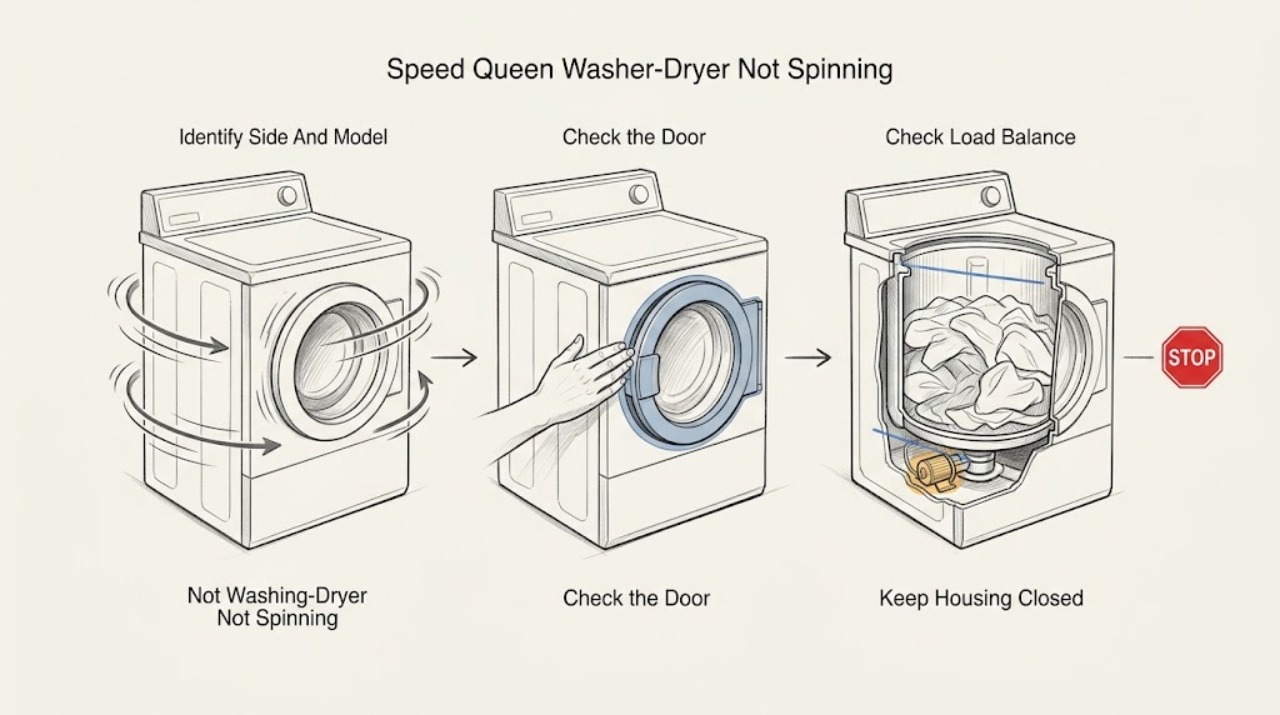
Work through in order
Diagnostic checks
Use only checks that match the exact appliance or system and its official guide.
-
Check 1
Confirm whether the washer tub or the separate dryer drum is not spinning, then record the Speed Queen model, cycle, load state, and point at which motion stops from a safe position.
Expected result: Note whether the washer fills, agitates or tumbles, drains, pauses, shows a code, leaves clothes wet, or never starts; record whether the dryer side is unaffected.
Next step: Use the model number to open the matching Speed Queen manual and follow only its washer troubleshooting section.
Stop if: Stop for a leak, smoke, burning odor, damaged cord, exposed wiring, an unsecured lid or door, or a tub or drum that continues moving when the safety control should stop it.
Why this matters
Why: A washer-side extraction problem follows the washer door, balance, drain, and drive path. A dryer-side drum problem is a different mechanism and must use its exact dryer manual.
-
Check 2
With the tub or drum stopped, close the washer loading door or lid fully, confirm the normal latch or lock engages, select the documented spin-capable cycle, and press Start/Pause once.
Expected result: Record whether the lock or lid indicator responds, the cycle begins, the control remains paused, or a door/lid message appears.
Next step: If the washer still does not start, check the dedicated outlet and household breaker only from a safe position, then stop if the controls or interlock remain abnormal.
Stop if: Never bypass or hold a lid or door switch, reach into a moving tub, or continue when the latch is damaged or the door cannot secure.
Why this matters
Why: A door or lid that is not fully secured can prevent spin as a safety function. A secured door with no response points toward control, power, or interlock diagnosis rather than a load-balance fix.
-
Check 3
When the washer is stopped and the door or lid can be opened normally, inspect the load distribution without reaching into a moving tub; redistribute a clearly bunched load according to the manual and do not overload the basket.
Expected result: Record whether clothing is gathered on one side, the load is unusually small or heavy, the washer rocks, or the machine pauses and then resumes a limited spin.
Next step: Run one ordinary spin-capable cycle with a suitable balanced load; if spin remains absent or the washer repeatedly becomes unbalanced, arrange service and check level only as the manual allows.
Stop if: Stop for violent movement, a rocking appliance, a damaged floor, a loose tub, a door or lid that will not secure, or any need to hold the safety switch closed.
Why this matters
Why: An uneven load can cause the control to limit or pause spin to protect the machine. A balanced load that still leaves the tub stationary points to drainage, interlock, control, or drive issues.
-
Check 4
If clothes remain wet or water remains in the washer, inspect the drain hose and drain receptacle from a dry, stable position for a visible kink, blockage, or overflow; do not open a pump trap or disconnect a hose containing water unless the exact manual gives a safe procedure you can perform.
Expected result: Record whether the drain hose is kinked, the receptacle is slow, water remains after the cycle, suds are excessive, or the pump makes an abnormal sound.
Next step: Keep the washer off if water remains or a leak is present and arrange service; do not choose a pump or trap part from the symptom alone.
Stop if: Do not remove a wet pump trap, tip or pull the appliance, handle sewage-like water, or work near water and electrical equipment.
Why this matters
Why: Water that cannot leave the washer can prevent or limit final spin. A clear visible hose with remaining water shifts the diagnosis to the pump, trap, drain installation, oversudsing, or control.
-
Check 5
From a safe position, confirm the washer's plug is fully seated in its intended outlet, the household breaker or fuse has not tripped, the control lock is not active, and the selected cycle is not paused; do not open the outlet, plug, panel, or appliance.
Expected result: Record whether the display or indicators return, the breaker trips again, the control accepts Start/Pause, or the washer remains silent after the door or lid is secured.
Next step: If the control and power remain abnormal, leave the appliance disconnected only as the manual permits and request qualified service with the model and observations.
Stop if: Do not repeatedly reset a tripping breaker, use an extension cord, access internal wiring, or touch a hot, scorched, wet, or damaged plug or outlet.
Why this matters
Why: A power, control-lock, or paused-cycle condition can prevent the cycle from reaching spin. A repeated trip, blank control, or failed interlock is an electrical or control service issue.
-
Check 6
After the door or lid, load, drainage, and safe power checks, classify the result without removing panels or testing the drive system: normal spin, limited spin, no spin with water present, no spin with an empty drained tub, or unsafe operation.
Expected result: Record the cycle, load and balance result, door or lid response, drain behavior, display codes, sound changes, breaker behavior, and any leak, odor, or movement.
Next step: Keep the washer out of use and request qualified Speed Queen service with the complete record; the technician can inspect the protected drive and pump areas safely.
Stop if: Do not open panels, remove a belt or pump trap, bypass the lid or door lock, reach into the tub, or continue operation with abnormal noise, heat, odor, water, or electrical symptoms.
Why this matters
Why: An empty drained tub that still will not spin points toward the interlock, control, motor, belt, or mechanical drive path. Speed Queen identifies a broken belt or pump obstruction as service-level possibilities in its guide.
Use your observations
Decision map
Find the observation that best matches what you see, then follow the next safe action.
-
PATH 01Safety boundary
What you see
The washer door or lid does not latch, the lock indicator does not respond, or a door/lid message remains.
Do this next
Stop at the external latch check and request model-specific service; keep the door or lid closed and do not force it.
Why this path and its safety boundary
Why it matters: The safety interlock or alignment may be preventing spin, and bypassing it creates an injury hazard.
Safety stop: Do not hold, tape, defeat, or disconnect the lid or door switch.
-
PATH 02Safety boundary
What you see
The washer pauses, limits spin, or leaves clothes wet while the load is visibly bunched or the appliance becomes unbalanced.
Do this next
Redistribute a suitable load and run one documented spin-capable cycle; arrange service if the imbalance or no-spin condition repeats.
Why this path and its safety boundary
Why it matters: Load distribution or leveling is more likely than a confirmed drive failure.
Safety stop: Stop for violent movement, a rocking washer, a loose tub, or a damaged floor or cabinet.
-
PATH 03Safety boundary
What you see
Water remains in the tub, the drain hose or receptacle is visibly restricted, or the washer leaves clothing saturated.
Do this next
Stop water use and request service when the visible hose or receptacle is not the clear cause; keep the appliance dry and do not open a wet pump area.
Why this path and its safety boundary
Why it matters: The washer may be limiting final spin because the drain path, pump trap, installation, or oversudsing condition is unresolved.
Safety stop: Do not remove a pump trap or hose holding water, tip the washer, or reach into contaminated or electrically unsafe water.
-
PATH 04Safety boundary
What you see
The door or lid secures, the load is suitable, the tub is drained, power and controls respond, but the washer remains stationary during a spin-capable cycle.
Do this next
Keep the washer out of use and request qualified Speed Queen service with the model, cycle, sounds, and observations.
Why this path and its safety boundary
Why it matters: An interlock, control, motor, belt, pump obstruction, or protected drive issue is possible; the exact model guide is required.
Safety stop: Do not remove panels, inspect or replace a belt, open the pump, or bypass an interlock as a homeowner test.
-
PATH 05Safety boundary
What you see
The washer leaks, smells hot or burnt, trips the breaker, has a damaged cord, exposes wiring, makes a grinding or electrical sound, or the tub does not stop as expected.
Do this next
Stop the cycle if safe, remove the appliance from use, keep people away, and contact qualified appliance or electrical service from a safe position.
Why this path and its safety boundary
Why it matters: The problem has crossed the ordinary user-check boundary and may involve electrical, water, moving-part, or fire risk.
Safety stop: Do not restore power repeatedly, reach into the tub, move the appliance while wet, or operate with a panel, guard, lid, or door part removed.
Helpful context
Understand the symptom
Identify which drum is supposed to spin
A stacked or combined washer-dryer has separate washer and dryer functions. This page addresses the washer's extraction spin: wet clothes remain in the washer tub, the washer stops after filling or washing, or the spin speed is limited. If the dryer drum is the part that will not rotate, stop using that side and use the exact dryer manual instead; dryer drive and heat systems are a different diagnosis. Record the model before choosing any procedure because Speed Queen provides manuals by model number.
Door, lid, load, and drainage are the safe first checks
The washer cannot safely spin unless its door or lid condition and interlock state are satisfied. A load can also be too small, too heavy, or shifted to one side; Speed Queen describes an unbalanced load as a reason spin speed may be limited. Water left in the tub shifts the decision toward the drain hose, drain receptacle, pump path, or oversudsing rather than a drive diagnosis. Do not bypass the lid or door safety device to watch the tub.
A persistent no-spin result needs model-specific service
If the door or lid secures, the controls start a spin-capable cycle, the load is reasonable, and water drains normally but the washer still will not spin, possible areas include the drive belt, motor, control, interlock, pump path, or a mechanical obstruction. The user guides identify some of these areas but do not make a universal diagnosis for every Speed Queen model. Keep the machine out of use and provide the model, cycle, water level, load behavior, sounds, and display information to a qualified servicer.
Only after diagnosis
Potential parts
- washer door or lid lock assembly
Consider this only when the exact model and qualified diagnosis identify a failed or damaged interlock after the door or lid and controls are otherwise correct.
Front-load door locks and top-load lid switches differ by series and revision; confirm the exact model before ordering and never bypass the safety device. - washer drain pump or foreign-object trap
Consider this only when water remains and qualified diagnosis identifies a blocked or failed pump path after the visible hose and receptacle are checked.
Pump, trap, access, and drainage designs vary by model; water containment and service instructions are required. - washer drive belt
Consider this only when a qualified servicer confirms a broken or worn belt on a model that uses one.
Drive design differs across top-load, front-load, and stacked products; do not infer a belt failure from no spin alone.
When checks do not resolve it
Need a professional?
Safety scope: This article covers normal controls, external load observation, visible drain-hose checks, and safe power awareness only. Do not bypass a lid or door interlock, reach into a moving tub, remove a wet pump trap, open panels, handle wiring, or operate a damaged or leaking appliance.
Common questions
FAQ
Why will my Speed Queen washer fill but not spin?
Check that the washer door or lid is fully secured, the cycle is started, the load is not bunched, and water is draining. A repeated no-spin result with a drained tub needs model-specific service for the interlock, control, belt, motor, or drive path.
Can an unbalanced load stop a Speed Queen washer from spinning?
Yes. Speed Queen says an unbalanced load can limit or pause spin. Redistribute a clearly bunched load only while the tub is stopped and the door or lid opens normally; repeated imbalance or violent movement needs service.
Why are my clothes wet after the Speed Queen spin cycle?
A limited spin, unbalanced load, remaining water, kinked drain hose, blocked receptacle, pump-path problem, or excess suds can leave clothes wet. Check only the visible hose and receptacle; do not open a wet pump area as a first step.
Can I bypass the Speed Queen lid or door lock to make it spin?
No. Speed Queen's guide requires the lid or door safety condition for spin and prohibits bypassing safety devices. Keep the washer out of use and request service when the interlock does not operate normally.
When should I call for Speed Queen washer service?
Request service when a balanced, drained washer still will not spin, a belt or pump issue is suspected, the door or lid will not secure, the machine leaks, the breaker trips, or there is abnormal noise, heat, odor, cord damage, or unsafe movement.
Read the exact guide
Official sources
- User's GuideSpeed Queen / Alliance Laundry Systems · Official Speed Queen front-load user guide for a documented model family; use the exact model guide for a particular machine.
- SupportSpeed Queen · Official Speed Queen support page; model-specific documentation and authorized service determine repair.
- Tricks your washer or dryer might be playing on you (and how to solve them!)Speed Queen · Official Speed Queen consumer guidance; exact access and repair procedures remain model-specific.
- Manuals & DownloadsSpeed Queen · Official Speed Queen support portal for residential and commercial products; model number is required to choose the correct document.
- User's GuideSpeed Queen / Alliance Laundry Systems · Official Speed Queen top-load user guide for a documented model family; top-load operation differs from front-load and stacked products.
Community feedback
Share a repair observation
Share a plain-text repair observation. Accepted observations are published automatically; this page may take a moment to update.