
On this page
Start here
Quick answer
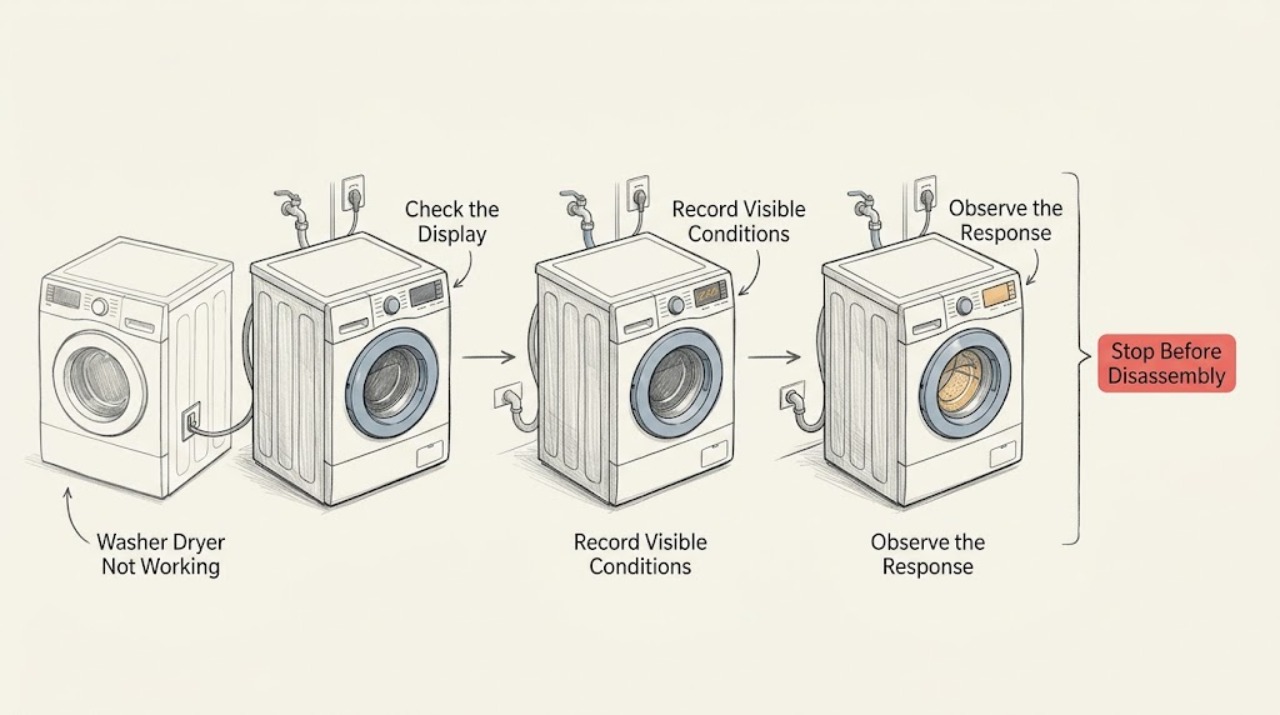
For a Speed Queen stacked washer-dryer that is not working, first decide whether the washer, dryer, or both units fail. If the display is dark, both sides are unresponsive, a burning smell or smoke is present, the cord or outlet is warm, water is near controls, or a breaker trips again, stop using the appliance and arrange qualified service. Otherwise, check that the door or lid is fully closed, Control Lock or Delay Start is not active, the selected cycle and start control are correct, the accessible water valves are open for the washer, and the dryer lint filter and exhaust path are clear. Test one side at a time without opening panels. A washer that fills but will not drain or spin points to a water, drain, door, load-balance, or control issue; a dryer that tumbles without heat points to its cycle, airflow, fuel or electrical heating path. Do not bypass an interlock, reach into a moving drum, test live wiring, handle gas fittings, or keep resetting a breaker. Use the exact model manual and arrange appliance service when the safe external checks do not restore operation.
Work through in order
Diagnostic checks
Use only checks that match the exact appliance or system and its official guide.
-
Check 1
Stop both units and inspect from a safe position for smoke, burning or gas odor, sparks, scorching, a warm or damaged cord or receptacle, water near the control area, or a breaker that trips again; do not restore power just to reproduce a hazard.
Expected result: A fire, gas, electrical, flooding, or severe overheating warning is present, or the appliance is dry, cool, and free of an obvious hazard.
Next step: For smoke, gas odor, sparking, scorching, water near controls, or repeated trips, leave the appliance off and use the appropriate emergency or qualified appliance/electrical service route. If safe, continue by recording whether one side or both sides are unresponsive.
Stop if: Stop for smoke, gas odor, exposed wiring, a wet control area, a warm or discolored outlet, a burning smell, or repeated breaker operation.
Why this matters
Why: A stacked appliance concentrates two moving appliances and their controls in one cabinet, so a shared supply or moisture hazard must be handled before separate washer or dryer tests.
-
Check 2
Record whether the display is dark or lit, which side fails, the exact cycle selected, and whether Control Lock, Delay Start, an error indication, or a door or lid message is shown; use the model number to retrieve the matching Speed Queen manual.
Expected result: Both sides are dark, only the washer fails, only the dryer fails, or the controls are lit but a lock, delay, or door state prevents starting.
Next step: Clear only a documented Control Lock or Delay Start state and close the relevant door or lid gently. If the display remains dark or an unknown indication persists, stop and arrange model-specific service rather than guessing at a reset.
Stop if: Stop for a broken latch, loose hinge, damaged control, repeated error, or any need to bypass an interlock or remove the central control panel.
Why this matters
Why: Both sides failing suggests shared power or control conditions, while one side failing narrows the check to that unit's interlock, cycle, water, drain, motor, airflow, or heat path.
-
Check 3
With both units stopped, check only the accessible plug, receptacle area, labeled breaker or fuse, and any clearly documented user reset; if permitted by the exact manual, switch the labeled breaker fully off and on once, without touching wiring or opening an enclosure.
Expected result: The outlet or cord is damaged, the breaker or fuse is operated, one side returns while the other remains dead, both sides remain dead, or the accessible supply appears normal.
Next step: Leave the appliance off for damaged hardware, a repeat trip, or a supply that remains uncertain. If one documented reset restores both sides with no hazard, monitor without repeated resets; if only one side returns or neither does, arrange appliance service.
Stop if: Stop for a damaged cord or receptacle, repeated breaker operation, buzzing, arcing, a warm outlet, or any need to measure live voltage or handle wiring.
Why this matters
Why: A shared supply can disable both washer and dryer, while a partial control or internal fault can affect only one side. A reset that operates again is evidence of a fault, not permission to continue resetting it.
-
Check 4
For a washer-side failure, remove loose items only when the tub is stopped, verify the accessible water valves are open, inspect hoses for kinks or leaks, and note whether the washer fills, drains, and reaches spin; do not reach into moving water or remove the pump cover unless the exact manual permits it.
Expected result: The washer does not fill, fills but will not drain, drains but will not spin, leaks, shows an unrecognized door state, or completes the cycle normally after an external correction.
Next step: Correct only an obvious valve, kink, or load condition permitted by the manual. For standing water, a leak, a door interlock issue, abnormal noise, or no spin after safe checks, leave the washer off and arrange appliance service.
Stop if: Stop for flooding, a hose leak, standing water near controls, a jammed or moving tub, a damaged latch, burning odor, or any need to open the lower cabinet or pump.
Why this matters
Why: The result separates supply and inlet issues from drain, door, load-balance, motor, or control issues. Water left in the tub or a leak is not fixed by repeatedly restarting the cycle.
-
Check 5
For a dryer-side failure, choose the correct documented heated cycle, close the door, clean the accessible lint filter, and inspect the visible exhaust connection and outside hood; observe whether the drum tumbles, airflow is present, and heat is produced without opening panels.
Expected result: The dryer does not start, tumbles without heat, has weak airflow, shows a lint or vent warning, stops early, or runs normally after an accessible filter or door correction.
Next step: Correct only loose lint, an accessible filter condition, or a documented cycle or door state. If airflow is weak, the duct is blocked, heat is absent, a gas odor occurs, or the dryer stops with an abnormal sound, leave it off and arrange qualified appliance service.
Stop if: Stop for smoke, burning or gas odor, scorching, a blocked or crushed exhaust, exposed wiring, repeated trips, or any need to open the heater, burner, motor, or control area.
Why this matters
Why: The result separates a cycle or door state from airflow, motor, heating, thermal, gas, or control faults. Tumble without heat is not proof that the heating part is safe to service at home.
-
Check 6
Record the model and serial information, which side failed, display messages, cycle and stage, power observations, water and drain behavior, dryer airflow and heat behavior, load condition, odors, noises, leaks, and any single documented reset before requesting service.
Expected result: The washer and dryer both work after a safe external correction, or one or both sides remain unreliable, dead, wet, noisy, cold, or unable to complete a cycle.
Next step: Keep the affected side off and arrange qualified appliance service for persistent or unsafe symptoms. Provide the exact model manual information and do not order or install an internal part from a generic symptom.
Stop if: Stop DIY work for panel removal, live electrical testing, gas service, motor or pump work, heater access, interlock bypass, or any repair beyond the exact user-maintenance instructions.
Why this matters
Why: A focused record lets the technician distinguish shared controls and supply from the washer's water or motion path and the dryer's airflow or heating path.
Use your observations
Decision map
Find the observation that best matches what you see, then follow the next safe action.
-
PATH 01Next step
What you see
Both sides are dark, the cord or outlet is damaged or warm, water is near controls, smoke or odor is present, or a breaker trips again.
Do this next
Arrange qualified service and follow the exact model guidance.
Why this path and its safety boundary
Why it matters: Leave the complete appliance off and arrange qualified appliance or electrical service. Do not repeatedly reset power or open the central controls.
-
PATH 02Next step
What you see
The display is lit but Control Lock, Delay Start, a door state, or an identified cycle instruction prevents the selected side from starting.
Do this next
Arrange qualified service and follow the exact model guidance.
Why this path and its safety boundary
Why it matters: Clear only the documented state and close the relevant door or lid. Persistent lock or control behavior needs model-specific service.
-
PATH 03Next step
What you see
The washer will not fill, leaves water, leaks, or stops before spin.
Do this next
Arrange qualified service and follow the exact model guidance.
Why this path and its safety boundary
Why it matters: Check only accessible valves, hoses, and a documented load condition. Leave it off for standing water, leaks, pump, door, motor, or control faults and arrange service.
-
PATH 04Next step
What you see
The washer fills and drains but will not spin or makes abnormal movement or noise.
Do this next
Arrange qualified service and follow the exact model guidance.
Why this path and its safety boundary
Why it matters: Do not reach into the tub or open the cabinet. Record the stage, load, and sound and arrange appliance service.
-
PATH 05Next step
What you see
The dryer tumbles without heat, has weak outside airflow, stops early, or shows a vent or lint concern.
Do this next
Arrange qualified service and follow the exact model guidance.
Why this path and its safety boundary
Why it matters: Clean only the accessible filter and inspect the visible exhaust path. Persistent no-heat or weak-flow symptoms need qualified dryer service and vent diagnosis.
-
PATH 06Next step
What you see
Both sides complete a suitable test cycle after a documented external correction, with no leak, odor, noise, heat, or power symptom.
Do this next
Arrange qualified service and follow the exact model guidance.
Why this path and its safety boundary
Why it matters: Monitor the next load and stop using the appliance if the failure returns. Keep the model and observations available for service.
Helpful context
Understand the symptom
Start by separating the failed side
A stacked unit shares a cabinet and control area but the washer and dryer have different doors, cycles, water paths, motors, and heating systems. Note whether the display is lit, whether the washer can fill or drain, and whether the dryer can tumble or produce heat. If both sides are dead, investigate only the accessible power and control state before treating either unit as an internal component failure.
Use the model manual for control states
Speed Queen models can have Control Lock, Delay Start, distinct washer and dryer cycle selectors, and model-specific start behavior. Confirm the exact model number through the manufacturer's document portal, then compare the display and button behavior with that guide. Do not repeatedly press Start, defeat a door interlock, or assume a code has the same meaning across models.
Washer checks are about water, drain, and motion
With the washer stopped, check that the accessible supply valves are open and hoses are not visibly kinked or leaking. A washer that fills but leaves water behind needs a drain-path or pump diagnosis; a washer that fills and drains but will not spin may have a door, load-balance, motor, or control issue. Do not reach into the tub while it moves or remove the pump or cabinet without model-specific qualified instructions.
Dryer checks are about airflow and heat
For the dryer, select a documented heated cycle, confirm the door closes, clean the accessible lint filter, and inspect the visible exhaust connection and outside hood without dismantling the stack. A dryer may tumble while its heating path is not operating. Gas heat, electrical heating, thermal protection, and internal wiring require qualified service when the safe cycle and airflow checks do not explain the symptom.
Only after diagnosis
Potential parts
Only after exact-model diagnosis confirms that the affected side's start or lock circuit has failed; never bypass an interlock.
Only after the fill, drain, or spin symptom is confirmed and a qualified technician identifies the failed component and any underlying leak or blockage.
Only after qualified diagnosis confirms the exact model and cause, including airflow and fuel safety; do not open or test these parts at home.
When checks do not resolve it
Need a professional?
Both washer and dryer are dark or unresponsive after the accessible supply and documented control checks., The cord, plug, receptacle, breaker, control area, or cabinet is warm, damaged, wet, scorched, or repeatedly trips., The washer leaks, floods, leaves standing water, will not drain or spin, or has a damaged door or abnormal movement., The dryer tumbles without heat, has weak or blocked exhaust, stops early, or has a burning or gas odor., A cycle state, error indication, interlock, motor, pump, heater, burner, capacitor, or control cannot be identified from the exact model manual., Repair would require bypassing an interlock, opening panels, measuring energized circuits, handling gas, reaching into a moving tub or drum, or replacing an internal part without diagnosis.
Common questions
FAQ
Why are both my Speed Queen washer and dryer not working?
Both sides failing points first to shared power, a control state, or the central control area, while one side failing points to that unit's own door, water, drain, motor, airflow, or heat path. Check only the accessible supply and documented control states before arranging service.
What should I check when the Speed Queen washer will not start?
Check the exact cycle and start behavior, door or lid closure, Control Lock or Delay Start, and accessible water supply. If the display is dark, the latch is damaged, the washer leaks, or it still will not start, leave it off and use model-specific service.
Why does the dryer run but not heat?
A dryer can tumble while the selected cycle, airflow, thermal protection, electrical heating path, or gas-heating path is not operating. Clean the accessible lint filter and inspect visible airflow only; no-heat symptoms that remain need qualified service.
Should I keep resetting the breaker for a stacked washer-dryer?
No. With both units stopped, use only the single documented reset allowed by the exact model instructions. A repeat trip, warm outlet, damaged cord, smell, or noise means leave the appliance off and arrange qualified service.
Can I open the cabinet to repair one side of the stack?
Do not open the cabinet, bypass an interlock, test energized wiring, reach into a moving tub or drum, or work on a heater, motor, pump, capacitor, or gas component unless the exact instructions and your qualifications support that work. Persistent faults need appliance service.
Read the exact guide
Official sources
- Speed Queen | Manuals & DownloadsSpeed Queen · Opened official Speed Queen support page; use the exact model document for control states and service limits.
- SF7 Stacked Washer-Dryer User ManualSpeed Queen · Opened official Speed Queen stacked washer-dryer manual; the exact model and regional installation instructions take precedence.
- Speed Queen | SF7008BESpeed Queen · Opened official Speed Queen product page for an SF7 stacked washer-dryer; it is an example of the combination design, not a substitute for the exact model page or manual.
Community feedback
Share a repair observation
Share a plain-text repair observation. Accepted observations are published automatically; this page may take a moment to update.