
On this page
Start here
Quick answer
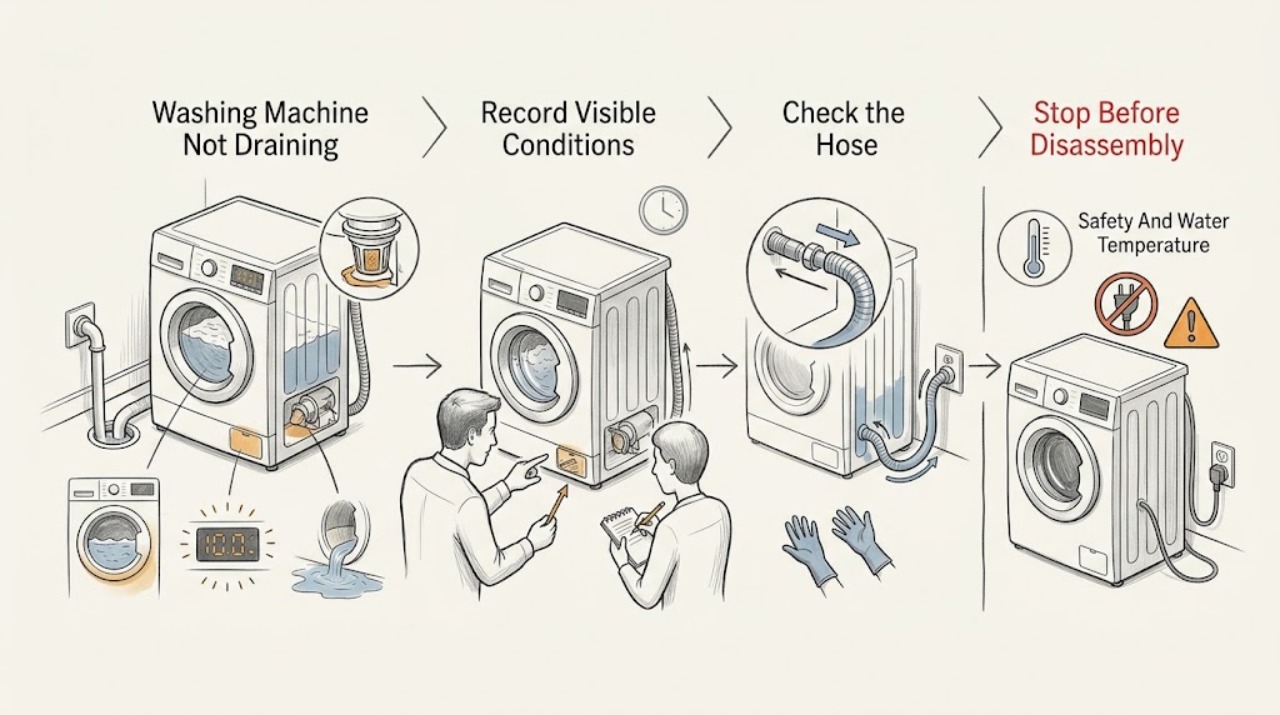
First record the programme stage and whether the washer has standing water, a humming pump, an overflow, or a locked door or lid. Stop for hot water, a wet electrical connection, a leak, smoke, burning odor, sparks, severe movement, or a repeated protection trip; close the water supply and isolate power only from a dry safe position. When the area is safe, inspect the visible drain hose and drain receptacle for a kink, displacement, blockage, or overflow, and check whether the household drain is the source. Use the exact Speed Queen model manual before opening a pump or foreign-object trap: some front-load models document a trap, while top-load and other configurations may not provide the same access. Excess detergent or suds can slow draining, and the door or lid may stay locked until water and temperature are safe. Do not force the lock, move the washer through water, or run repeated tests. If the external drain path is clear but water remains, the trap or pump cannot be accessed safely, or the washer still will not drain after one model-authorized check, arrange qualified service.
Work through in order
Diagnostic checks
Use only checks that match the exact appliance or system and its official guide.
-
Check 1
Stop the programme and stand on a dry surface; look at the washer, floor, plug, outlet, hoses, controls, and drum without touching a wet electrical connection or opening a panel.
Expected result: Record whether water is hot, the floor or outlet is wet, the washer is leaking, smoke or burning odor is present, sparks or unusual heat are visible, severe movement occurred, or a breaker or protection device tripped.
Next step: For any hazard, close the water supply if safely accessible, isolate power only from a dry safe position, keep clear, and arrange qualified appliance or electrical service. Otherwise continue without opening the appliance.
Stop if: Do not touch wet electrical parts, move the washer through water, operate a smoking or sparking washer, or repeatedly restore power after a trip.
Why this matters
Why: Hot water, water near electricity, smoke, odor, sparks, severe movement, and repeated trips make a routine drain check unsafe. A dry exterior does not prove the internal pump or wiring is safe.
-
Check 2
Read the complete Speed Queen model number and identify top-load or front-load configuration; record the selected programme, load, and stage at which draining stopped.
Expected result: Record whether the washer never starts draining, hums, pumps briefly then stops, drains slowly, leaves a full drum or basket, shows a code, or locks the door or lid.
Next step: Use the matching Speed Queen manual and follow only the branch for that configuration; preserve the exact code and stage for service.
Stop if: Do not borrow a pump-access or lock-release procedure from another Speed Queen model, and do not infer a failed pump from a hum alone.
Why this matters
Why: Stage and sound distinguish a drain-path problem from a control, door or lid, fill, balance, or electrical problem. Model identity controls whether a pump trap, filter, emergency release, or diagnostic procedure applies.
-
Check 3
From a dry, safe position, inspect the visible drain hose, its connection to the receptacle or standpipe, and the nearby floor for a kink, crush point, displacement, crack, blockage, or overflow without pulling the washer out.
Expected result: Record whether water backs up at the standpipe, the hose has moved, the hose is kinked or damaged, water flows from the hose end, or the visible drain path is dry.
Next step: Stop for a displaced, damaged, overflowing, or wet drain path and arrange plumbing or appliance service as appropriate. Do not disconnect a wet hose to look inside it.
Stop if: Do not move the washer, pull a wet hose from its connection, reach into the pump, or run another cycle with water near electricity.
Why this matters
Why: Speed Queen quick guides identify the drain hose, receptacle, securing strap, and correct installation as relevant to drainage. A household drain overflow can mimic an appliance failure; a dry external path leaves the pump, trap, or internal hose for model-specific diagnosis.
-
Check 4
Without disassembling the washer, observe whether the household standpipe, floor drain, or sink connection overflows when other safe plumbing is used, and compare its location with the washer hose end.
Expected result: Record whether the household drain backs up independently, only overflows during washer drain, or remains clear while water stays inside the washer.
Next step: Do not run the washer again if the drain overflows. Arrange plumbing service for the household path or appliance service when the washer retains water despite a clear external drain.
Stop if: Do not pour chemicals into the washer or household drain, disconnect wet plumbing, or use the washer to force a blocked drain clear.
Why this matters
Why: An independent household-drain backup requires plumbing attention. An overflow only during washer drain can still involve drain capacity, hose position, or an appliance restriction; water retained inside with a clear household drain points toward the washer drain path.
-
Check 5
Inspect the remaining water and load without reaching into moving parts; note whether there is unusually heavy foam, a very dense or unbalanced load, or detergent beyond the model's recommended amount.
Expected result: Record excessive suds, a load that is packed or uneven, no foam, or a normal load with clear water that remains after the drain stage.
Next step: Use the exact manual's load and detergent guidance and allow only the documented recovery or rinse procedure when no leak or safety hazard exists. Persistent standing water needs the drain-path branch.
Stop if: Do not add more detergent, run repeated high-speed cycles, handle hot suds, or continue if water is on the floor or near electricity.
Why this matters
Why: Speed Queen notes that too much detergent and excess suds can prevent timely draining, while load and balance conditions can alter the spin and drain sequence. Suds alone do not prove a pump failure.
-
Check 6
Observe the front door or top lid and its indicator without forcing it; if the exact manual permits, cancel the programme and wait for the documented safe unlock condition rather than pulling the handle.
Expected result: Record whether the door or lid remains locked because water or temperature is present, unlocks after the documented drain or cancel state, reports an interlock fault, or is visibly damaged or misaligned.
Next step: If water remains, use only the model-authorized drain or emergency procedure after safe isolation. If the lock remains after safe water removal or is damaged, arrange service.
Stop if: Do not pry, slam, tape, magnet, or otherwise bypass a door or lid lock, and do not open it against resistance or hot water.
Why this matters
Why: A lock can be a safety response to standing water or heat, or it can be the reason the cycle cannot complete. It does not identify the drain component by itself.
-
Check 7
Only if the exact Speed Queen front-load manual documents a foreign-object trap or pump access, confirm electrical disconnection, prepare a container and cloth, and follow that procedure exactly; do not open an unknown access panel.
Expected result: Record whether the model has the documented trap, water remains in the pump, the trap is blocked, the cap or seal is damaged, the impeller area has a foreign object, or no trap access is provided.
Next step: If the model procedure is clear and the area is dry, perform only that documented maintenance once. If water is uncontrolled, the trap cannot seal, or access is not documented, stop and arrange service.
Stop if: Do not open a pump with power connected, reach into an unknown opening, remove additional panels, or proceed with hot or uncontrolled water.
Why this matters
Why: The Speed Queen front-load guide says the pump can contain water and a trap may collect foreign objects. A blockage or damaged cap can prevent draining, but this is not a universal top-load or stacked-washer step.
-
Check 8
If the exact manual identifies a user-cleanable lint or drain filter, inspect and clean it only after power is disconnected and residual water is safely contained; if no such filter is documented, skip this step.
Expected result: Record whether the filter is blocked by lint or a foreign object, damaged, absent on this model, or clean while the washer still retains water.
Next step: Reinstall the filter or cap exactly as the manual shows. If the washer still will not drain, stop and arrange service with the model and filter result.
Stop if: Do not use sharp tools, open an undocumented filter, loosen a wet fitting, or reconnect power while water remains near electrical parts.
Why this matters
Why: A model-specific filter can restrict the drain path, but forcing a filter or opening a non-user-serviceable component can release water or damage the pump. A clean filter does not rule out a pump or internal hose fault.
-
Check 9
Only when the external drain path is clear, the washer is dry and intact, no hot water or hazard is present, and the manual authorizes it, perform one cancel, drain, rinse, or power-recovery action while remaining nearby.
Expected result: Record whether water exits normally, the pump hums without flow, the same code returns, the door or lid remains locked, the washer leaks, or protection trips.
Next step: Stop after one failed recovery and provide the stage, sound, water level, and code to qualified service. Do not repeat the cycle to obtain a different result.
Stop if: Do not perform a recovery action with water near electricity, hot water, a damaged hose or lock, smoke, odor, sparks, severe movement, or an active leak.
Why this matters
Why: Normal drainage after a documented external correction supports a hose, suds, load, or transient control condition. Humming without flow, recurring code, leak, lockout, or a trip leaves a pump, trap, valve, control, or wiring fault possible.
-
Check 10
Prepare the complete model, configuration, programme stage, water level and temperature, first wet point, drain-hose and household-drain result, suds or load observation, door or lid state, trap or filter result if applicable, sound, code, and safety symptoms for qualified service.
Expected result: The washer still contains water after the visible drain path and one model-authorized check, the pump or trap is inaccessible or cannot seal, the door or lid remains locked, or the problem is accompanied by a leak, heat, odor, smoke, noise, severe movement, or a protection trip.
Next step: Keep the washer out of use and arrange Speed Queen appliance service; arrange plumbing service for a household drain or standpipe problem and electrical service when household wiring or protection is affected.
Stop if: Do not remove panels, tilt or pull out the appliance, access the motor or pump while energized, make internal measurements, or choose a part from the symptom alone.
Why this matters
Why: A pump, foreign-object trap, internal hose, valve, control, interlock, tub, or household drain fault remains possible and cannot be identified safely from the outside.
Use your observations
Decision map
Find the observation that best matches what you see, then follow the next safe action.
-
PATH 01Safety boundary
What you see
Water is near the plug, receptacle, cord, controls, or a wet floor around electricity, or smoke, burning odor, sparks, hot connections, or repeated protection trips occur.
Do this next
Close the water supply if safely accessible, isolate power only from a dry safe position, keep clear, and arrange qualified appliance or electrical service.
Why this path and its safety boundary
Why it matters: The no-drain symptom is an immediate water, shock, or fire safety issue.
Safety stop: Do not touch wet electrical parts, move the washer, restore power, or run another drain cycle.
-
PATH 02Safety boundary
What you see
The standpipe, floor drain, or sink connection backs up independently or overflows when the washer attempts to drain.
Do this next
Keep the washer off and arrange plumbing assessment; do not use the washer to force the blockage clear.
Why this path and its safety boundary
Why it matters: The household drain capacity or plumbing path may be blocking discharge.
Safety stop: Do not pour drain chemicals into the washer or household drain and do not disconnect wet plumbing.
-
PATH 03Safety boundary
What you see
The first drain-stage problem is at a visibly kinked, crushed, displaced, cracked, or overflowing drain hose or receptacle.
Do this next
Stop use, document the condition, and arrange service or plumbing help without loosening a wet connection; follow the exact installation manual for any safe external correction.
Why this path and its safety boundary
Why it matters: The external drain installation can restrict flow or spill water before the pump path is evaluated.
Safety stop: Do not move the washer through water, pull out the hose while wet, or run repeated cycles.
-
PATH 04Safety boundary
What you see
The washer has excessive suds or a dense, uneven load and no leak or electrical hazard is present.
Do this next
Use the exact manual's detergent, load, rinse, or recovery instruction once; if water remains, follow the drain-path or service branch.
Why this path and its safety boundary
Why it matters: Detergent or load conditions may be delaying the drain or spin sequence.
Safety stop: Do not add more detergent, run repeated cycles, or handle hot suds.
-
PATH 05Safety boundary
What you see
The door or lid remains locked while water or heat is present, or the lock state prevents the programme from completing.
Do this next
Use only the exact model-authorized cancel, drain, or emergency procedure after safe isolation; arrange service if the lock remains after safe water removal.
Why this path and its safety boundary
Why it matters: The lock may be responding to an unsafe water or temperature condition, or the interlock may have a fault.
Safety stop: Do not pry, force, tape, magnet, or bypass the lock, and do not open it against hot or standing water.
-
PATH 06Safety boundary
What you see
The exact model documents a pump trap or filter and it is blocked, damaged, full of water, or cannot be reseated.
Do this next
Only after power disconnection and safe water containment, follow the matching manual once; stop and arrange service if access or sealing is not clear.
Why this path and its safety boundary
Why it matters: A model-specific obstruction or sealing fault can stop drainage.
Safety stop: Do not open an unknown access point, run with the cap or filter loose, or reconnect power while water is near electrics.
-
PATH 07Safety boundary
What you see
The external drain path is clear but the washer hums, pumps briefly without flow, or retains water after one authorized check.
Do this next
Keep the washer off and arrange qualified appliance service with the sound, water level, stage, and model recorded.
Why this path and its safety boundary
Why it matters: A pump obstruction, failed pump, internal hose, control, or wiring fault remains possible.
Safety stop: Do not access the pump or motor while energized, repeatedly restart it, or guess a pump replacement from the hum.
-
PATH 08Safety boundary
What you see
The washer still will not drain after the visible hose and household-drain checks and one model-authorized recovery, or the model does not document safe pump access.
Do this next
Keep the washer isolated and arrange Speed Queen appliance service with the complete evidence.
Why this path and its safety boundary
Why it matters: The remaining fault is model-specific and may involve concealed components or a safety lockout.
Safety stop: Do not remove panels, tilt or pull out the washer, enter service mode, or substitute parts based only on the symptom.
Helpful context
Understand the symptom
Start with the stage, not the pump
A washer that stops with water during the drain portion of a cycle is different from one that never filled, pauses while balancing a load, or finishes with only a small amount below the visible basket. Note the exact stage, sound, water level, and display before changing anything. Speed Queen's official guidance identifies the drain hose, pump, foreign objects, lint filters where fitted, and excess suds as separate paths, so a single generic pump diagnosis is not reliable.
Top-load and front-load access differs
Record the complete Speed Queen model and whether it is top-load or front-load. The front-load user guide documents a pump foreign-object trap that may contain water and requires power disconnection before access. A top-load quick guide emphasizes the fill hoses, drain hose and receptacle, level installation, lid, and model documentation. Never remove a panel or pump cover unless the matching manual explicitly describes it and the appliance is safely isolated.
A locked door or lid can be a consequence
A front-load door may remain locked when water or temperature is high, and some top-load controls require the lid state before a cycle can advance. Do not pry or bypass the lock. If the drum contains hot or standing water, use only the exact cancel, drain, or emergency procedure in the matching manual after safe isolation. A lock that remains closed after the water is safely removed is a service clue, not a reason to force it.
Water on the floor ends the home check
Speed Queen's front-load guide says to call for service for water of any amount on the floor. Keep the washer out of use for a wet outlet, uncontrolled water, a damaged hose, smoke, burning odor, abnormal noise, or repeated protection trip. A service handoff should include the model, programme stage, water level, first wet point, hose and drain observations, pump or trap status if applicable, and any code or safety symptom.
Safety boundary
Stop conditions
- Stop immediately for hot water, water near a plug, receptacle, cord, controls, or a wet floor around electricity; isolate power only from a dry safe position and do not touch wet electrical parts.
- Stop for smoke, burning odor, sparks, hot or discolored connections, damaged wiring or hose, severe movement, uncontrolled water, or a repeated breaker or protection trip.
- Do not move, tilt, pull out, or dismantle the washer to find a blockage; do not remove panels or access the pump, motor, tub, valve, or wiring as a first check.
- Do not force, pry, tape, magnet, or bypass a door or lid lock, and do not open it against hot or standing water.
- Do not disconnect a wet or pressurized hose, run repeated drain cycles, add drain chemicals or detergent to clear the fault, or select a replacement part solely from the symptom.
Only after diagnosis
Potential parts
- drain hose assembly
Consider only when the exact model has a cracked, displaced, or otherwise failed drain hose and qualified diagnosis confirms it as the source or restriction.
Confirm the complete Speed Queen model and drain routing; do not disconnect a wet or pressurized hose as a first check. - drain pump or foreign-object trap
Consider only when model-specific evidence shows a blocked, damaged, or failed pump or trap after safe external checks.
Confirm model and service diagnosis; do not access or replace a pump while connected to power or with uncontrolled water present. - door or lid lock assembly
Consider only when the washer has safely drained but the exact model still cannot recognize or release the door or lid and diagnosis identifies the interlock.
Confirm top-load or front-load model and fitment; never bypass the safety lock. - drain filter or lint filter
Consider only when the exact manual identifies a replaceable filter and diagnosis finds it damaged or unable to seal after proper cleaning.
Not every model has the same user-accessible filter; confirm the model manual before selecting or removing one.
When checks do not resolve it
Need a professional?
Arrange Speed Queen appliance service when water remains after the visible drain-hose and household-drain checks, the pump, trap, or filter is blocked or inaccessible, the door or lid remains locked, or the problem returns after one model-authorized recovery. Call immediately for any water on the floor, water near electricity, hot water that cannot be handled safely, a damaged hose, smoke, burning odor, sparks, severe movement, abnormal noise, or a repeated protection trip. Arrange plumbing service for a household drain or standpipe backup and electrical service for a household connection or protection fault.
Common questions
FAQ
Why is my Speed Queen washer not draining?
Record the programme stage, water level, and sound first. Check only the visible drain hose and household drain for kinks, displacement, blockage, or overflow. Excess suds, a model-specific pump trap, and a door or lid lockout can also matter. If water remains after one model-authorized check, arrange service.
Can a kinked drain hose stop a Speed Queen washer from draining?
Yes. Speed Queen's official guidance identifies a clogged or kinked drain hose as a possible cause. Inspect it from a dry, safe position without pulling the washer out or disconnecting a wet hose. Stop for water on the floor and arrange service.
Can too much detergent make a Speed Queen washer drain slowly?
Yes. Excess detergent can create suds that delay draining. Record the foam and follow the exact model's detergent or rinse guidance once when there is no leak or safety hazard. Persistent standing water is still a drain-path service issue.
Can I clean the pump filter on my Speed Queen washer?
Only if the exact model manual documents a user-accessible pump trap or filter. Disconnect power, contain residual water, and follow that procedure exactly. Some configurations do not provide the same access; do not remove an unknown panel or open a wet pump.
Why is my Speed Queen washer door or lid locked with water inside?
The lock may be protecting you from standing or hot water, or the interlock may have a fault. Use only the exact model's cancel, drain, or emergency procedure after safe isolation. Never force or bypass the lock. If it remains locked after safe water removal, arrange service.
Read the exact guide
Official sources
- Tricks your washer or dryer might be playing on you (and how to solve them!)Speed Queen · Speed Queen washers when water remains or drainage is slow; confirm the exact model for access and repair
- Quick Consumer ManualSpeed Queen · Top-load Speed Queen washers when checking visible drain installation; confirm the exact model
- Quick Consumer ManualSpeed Queen · Front-load Speed Queen washers when checking visible drain installation; confirm the exact model
- SupportSpeed Queen · Speed Queen washers when the exact manual or service path is needed
- User’s GuideSpeed Queen · Use as a model reference for front-load drainage and safety boundaries while confirming the user's exact Speed Queen model
Community feedback
Share a repair observation
Share a plain-text repair observation. Accepted observations are published automatically; this page may take a moment to update.