
On this page
Start here
Quick answer
A Speed Queen washer may refuse to spin because it still detects water, cannot confirm that the door or lid is locked, has an unbalanced or oversudsed load, is paused by the selected cycle, or has a drive or control fault. First record the exact model, display message, cycle stage, and whether the tub is empty. From a dry, stable position, check the visible drain path and door or lid, then correct the load or cycle setting only while the washer is stopped. A repeated lock, drain, motor, belt, pressure, control, leak, electrical, or severe-noise symptom needs model-specific service; never bypass a lock or open the cabinet for a live test.
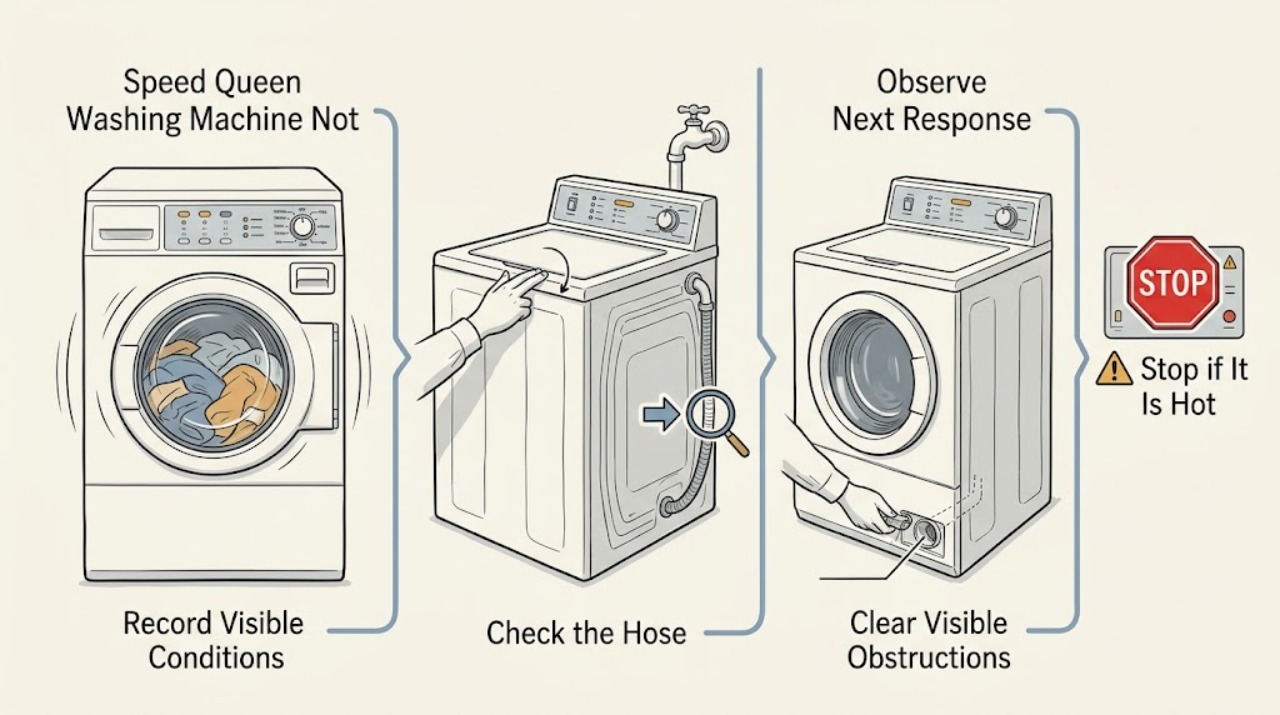
Work through in order
Diagnostic checks
Use only checks that match the exact appliance or system and its official guide.
-
Check 1
Record the exact Speed Queen model, front-load or top-load layout, displayed code, selected cycle, and the stage at which spinning stops. With the washer idle, note whether water remains in the tub and whether the drum or tub can be seen to turn during an ordinary safe start without reaching into it.
Expected result: The display may show a door, lid, drain, fill, overflow, pressure, unbalance, or suds condition; the tub may be empty, partly full, or full, and the failure may happen before draining, after draining, or at final spin.
Next step: Use the branch below that matches the observed stage and retain the exact code and model for any service request. Do not interpret an unlisted code from a different Speed Queen platform.
Stop if: Stop immediately if the washer leaks, moves violently, smells hot or burned, sparks, or trips electrical protection.
Why this matters
Why: The stage changes the decision path. Water remaining points first to a drain interlock; a door or lid message points to the lock path; a clean drain followed by no movement points toward load, cycle, drive, motor, or control evidence.
-
Check 2
If water remains, leave the controls alone and inspect only the visible drain hose and its receptacle for a kink, crushing, obvious blockage, or overflow from a dry position. Follow the exact model guide for a user-accessible pump trap only when the guide describes that operation and the appliance is safely isolated; never reach into standing water or open a wet electrical area.
Expected result: A restricted hose, blocked receptacle, or pump-trap warning can accompany a full tub or a drain error. The hose path may look clear while the error persists, or the tub may drain normally when the washer is later run under the exact manual procedure.
Next step: After the safe, model-approved drain check, use only the documented drain or spin test once. If water remains, the code returns, or draining is not safe, stop using the washer and request service with the code and water level recorded.
Stop if: Stop for a leak, sewage-like or contaminated water, water near a plug or outlet, a hot appliance, or any need to remove a panel or work on internal wiring.
Why this matters
Why: The washer commonly will not permit high-speed spinning while it senses retained water. A clear visible path with repeated drain errors can indicate a pump, pressure-sensing, wiring, or control fault rather than a spin setting problem.
-
Check 3
Check the door on a front-load model or the lid on a top-load model for a trapped garment, visible obstruction, misalignment, or a lock indicator that does not change after the door or lid is closed normally. Press the documented Start or Pause control once; never slam, force, or bypass the lock.
Expected result: The control may show a door or lid not locked message, remain paused, or proceed to fill and tumble after the closure is corrected. A door or lid that looks closed but repeatedly fails to lock is a different result from clothing caught at the opening.
Next step: Remove only a plainly visible item from the seal or opening while the washer is stopped. If the lock message returns, the opening is damaged, or the door or lid cannot close without force, leave the washer unused and arrange model-specific service.
Stop if: Stop if glass, the lid, hinge, latch, seal, or lock area is cracked, loose, hot, wet with active leakage, or requires cabinet access.
Why this matters
Why: The safety interlock is intended to prevent spinning with an open door or lid. Repeated lock or unlock errors after a clean, undamaged closure point to a lock, alignment, harness, or control issue that should not be diagnosed by defeating the switch.
-
Check 4
With the washer stopped and the door or lid safely open, redistribute a tightly packed, single-heavy, or tangled load and remove only obvious loose objects. Use the cycle's documented spin or rinse-and-spin option with a suitable load; use the detergent quantity and low-sudsing detergent class specified for the model.
Expected result: The washer may resume a faster spin after the load is spread out, while an unbalance or suds indication may return, the tub may repeatedly pause and rebalance, or the load may still be wet even though water has drained.
Next step: If a smaller, evenly distributed load completes the documented spin cycle, keep the original load and detergent as the likely trigger. If the same symptom occurs with a balanced load and correct detergent, continue to the cycle and service branches rather than repeatedly restarting it.
Stop if: Stop if the appliance walks, strikes cabinets, produces metal-on-metal noise, leaks, becomes unusually hot, or emits smoke or a burning odor.
Why this matters
Why: An unbalanced load can limit or interrupt spin to reduce movement. Excess suds can also extend a cycle or interfere with rinsing and speed; these results do not prove a belt or motor failure.
-
Check 5
Review the selected programme, spin-speed option, delay, control lock, and any reduced-spin or no-spin setting shown by the exact model guide. If the machine was recently installed or moved, check level and firm support from the floor; check transport hardware only through the exact installation instructions, without moving a loaded appliance or removing an unidentified part.
Expected result: A low-spin or no-spin option, an active control lock, a delayed cycle, a normal sensing or suds pause, an unlevel cabinet, or an installation-related instruction may explain the behavior. The same controls may differ between front-load and top-load models.
Next step: Correct only a clearly identified setting or a plainly visible, manual-approved external leveling issue, then run one documented test. If the setting is correct and the washer still does not spin, preserve the model and stage details for service.
Stop if: Stop if correcting the installation requires lifting, tilting, cabinet removal, contact with a damaged cord, or access to internal electrical or drive parts.
Why this matters
Why: A programme can finish without the high-speed action expected by the user, while poor leveling can trigger repeated balance protection. Transport hardware and installation details are model-specific and should never be guessed from a different manual.
-
Check 6
After the external checks, perform at most one model-documented power clear or cancellation sequence, with the controls dry and the washer stable. Observe whether it drains and spins normally on the next suitable empty or small-load test; do not repeatedly reset a fault or run a test with the cabinet open.
Expected result: A single reset may clear a transient power, door, drain, or control state, while a repeated code, no movement with an empty balanced tub, abnormal hum, grinding, leak, or immediate protective trip remains.
Next step: Stop testing and give the technician the exact model, code, cycle, water state, load, sounds, and what changed after the one reset. Do not open the cabinet, bypass the door or lid interlock, or test energized wiring.
Stop if: Stop immediately for smoke, burning smell, sparks, a hot cord or outlet, repeated electrical trips, active leakage, or severe mechanical impact.
Why this matters
Why: A temporary clear does not establish that a motor, belt, pump, lock, pressure sensor, control, or wiring fault is repaired. No spin after a clear and a safe balanced test is evidence for professional diagnosis, especially when the manual lists an internal drive or service condition.
Use your observations
Decision map
Find the observation that best matches what you see, then follow the next safe action.
-
PATH 01Next step
What you see
The tub is not empty, a drain error appears, or the washer stops before draining.
Do this next
Use the safe visible drain-path check and only the exact manual's user-accessible trap procedure. A clear path with a repeated error needs service for the pump, pressure sensing, or control path.
-
PATH 02Next step
What you see
A door or lid code remains, the lock indicator does not change, or closure requires force.
Do this next
Stop forcing it and do not bypass the interlock. A plainly visible obstruction may be removed while stopped; a repeated lock fault or damaged closure needs service.
-
PATH 03Next step
What you see
The washer pauses to rebalance, shows an unbalance or suds indication, or spins only slowly with wet clothing.
Do this next
Redistribute the load and correct detergent use once, then use the documented spin option. If the result repeats with a balanced load and correct detergent, escalate rather than adding chemicals or repeatedly restarting.
-
PATH 04Next step
What you see
The cycle is still sensing, filling, draining, cooling, or controlling suds, or a reduced-spin option is selected.
Do this next
Allow the documented stage to finish, review the exact model's cycle and speed option, and run one suitable test. Do not treat a normal pause as proof of a failed drive.
-
PATH 05Next step
What you see
The tub is empty, the lock and drain paths are normal, the load is balanced, and the washer still will not spin, or it makes grinding, humming, scraping, or repeated clicking sounds.
Do this next
Stop using it and arrange qualified appliance service for the drive belt, motor, pump, pressure system, control, lock, or wiring as applicable to the exact model. Do not infer a failed part from sound alone or open the cabinet as a household test.
Helpful context
Understand the symptom
Start with the symptom, not a guessed part
“Not spinning” can mean the drum or tub never turns, a slow final spin leaves clothes wet, or the washer pauses before spinning. Front-load and top-load Speed Queen platforms use different door or lid arrangements and different error displays, so record the full model from the rating label before applying a control sequence. A pause during sensing, filling, draining, or suds control can be intentional; a persistent pause after the expected stage is a clue, not proof of a failed motor.
Keep the checks external and controlled
Only inspect controls, hoses, the visible door or lid, the load, and other parts that the exact manual identifies as user accessible. Keep hands clear of a moving tub, do not force a locked door or lid, and do not remove panels, defeat an interlock, probe energized wiring, or replace an internal component as a household test. If water, heat, smoke, burning odor, sparks, or a repeatedly tripping protective device is present, stop and arrange qualified help.
Safety boundary
Stop conditions
- Stop the cycle and keep clear if there is smoke, a burning or melting odor, visible sparks, a hot cord or outlet, or a protective device that trips again.
- Do not operate or unplug from a wet position; isolate power only when it can be done without contact with water, and arrange qualified help for the electrical condition.
- Stop for active leakage, water near electrical parts, very hot water or steam, a cracked door or lid, violent movement, or severe metal-on-metal noise.
- Never bypass the door or lid interlock, reach into a moving tub, remove the cabinet, or probe energized wiring.
Only after diagnosis
Potential parts
- drain pump assembly
Consider only if the exact model's drain path is clear but a repeated drain condition leaves water and prevents the spin interlock from clearing.
Confirm the full model and the manufacturer's fit information before ordering or fitting any part. - door or lid lock assembly
Consider only if the closure is undamaged and a repeatable lock or unlock condition remains after the visible closure check.
Front-load and top-load platforms differ; confirm exact model fit with the manufacturer or qualified technician. - drive belt or drive assembly
Consider only after service diagnosis finds no drain, lock, load, or cycle cause and confirms a drive-system symptom for the exact model.
Do not infer fit from brand alone; the technician should identify the correct assembly for the exact model. - motor or control module
Consider only after a qualified diagnosis links no-spin behavior to the motor or control path rather than the drain, lock, balance, or programme.
Electrical and control parts require exact model verification and professional installation.
When checks do not resolve it
Need a professional?
Call a qualified appliance technician when a drain or lock error returns after the model-approved external checks, when a balanced load and correct cycle still produce no spin, or when an internal belt, motor, pump, pressure, control, or wiring fault is suspected. Provide the exact model, display code, programme and stage, whether water remained, the load condition, and any sound or electrical symptom.
Have this ready
- Exact model and serial information, front-load or top-load layout, full display code, selected programme and stage, water level, load and detergent details, recent movement or installation, and any leak, sound, heat, odor, or electrical event.
Common questions
FAQ
Why does my Speed Queen washer fill and drain but not spin?
The most useful split is whether the tub is empty when the spin stage is reached. Retained water keeps the drain interlock active; an empty tub shifts attention to the door or lid lock, load balance, selected cycle, and then a drive or control fault. Record the exact model and code because front-load and top-load guides differ.
Can an unbalanced load stop a Speed Queen washer from spinning?
Yes. The front-load guide describes an unbalanced load as a reason spin may be limited or interrupted. Redistribute the load while stopped and use the documented spin option once; a repeat with a balanced load needs further diagnosis.
Should I bypass the lid or door lock to make the washer spin?
No. The lock is a safety interlock. Do not bypass it, force the closure, reach into a moving tub, or open the cabinet for a live test. A repeat lock condition or damaged closure belongs with qualified service.
When is a no-spin problem a service call?
Arrange service when safe drain, closure, load, and cycle checks do not restore spin, when an error returns, or when there is a leak, severe noise, burning odor, smoke, sparks, heat at the cord or outlet, or repeated electrical tripping. Give the technician the model, code, cycle stage, water state, and symptom details.
Read the exact guide
Official sources
- User's GuideSpeed Queen / Alliance Laundry Systems · Use for the documented AWNA62 top-load platform or as a clearly labeled example only; confirm the reader's exact model.
- User's GuideSpeed Queen / Alliance Laundry Systems · Use for the documented AFNE9B front-load platform or as a clearly labeled example only; confirm the reader's exact model.
- Speed Queen | Manuals & DownloadsSpeed Queen / Alliance Laundry Systems · Use the exact model number to select the applicable Speed Queen washer guide.
Community feedback
Share a repair observation
Share a plain-text repair observation. Accepted observations are published automatically; this page may take a moment to update.