
On this page
Start here
Quick answer
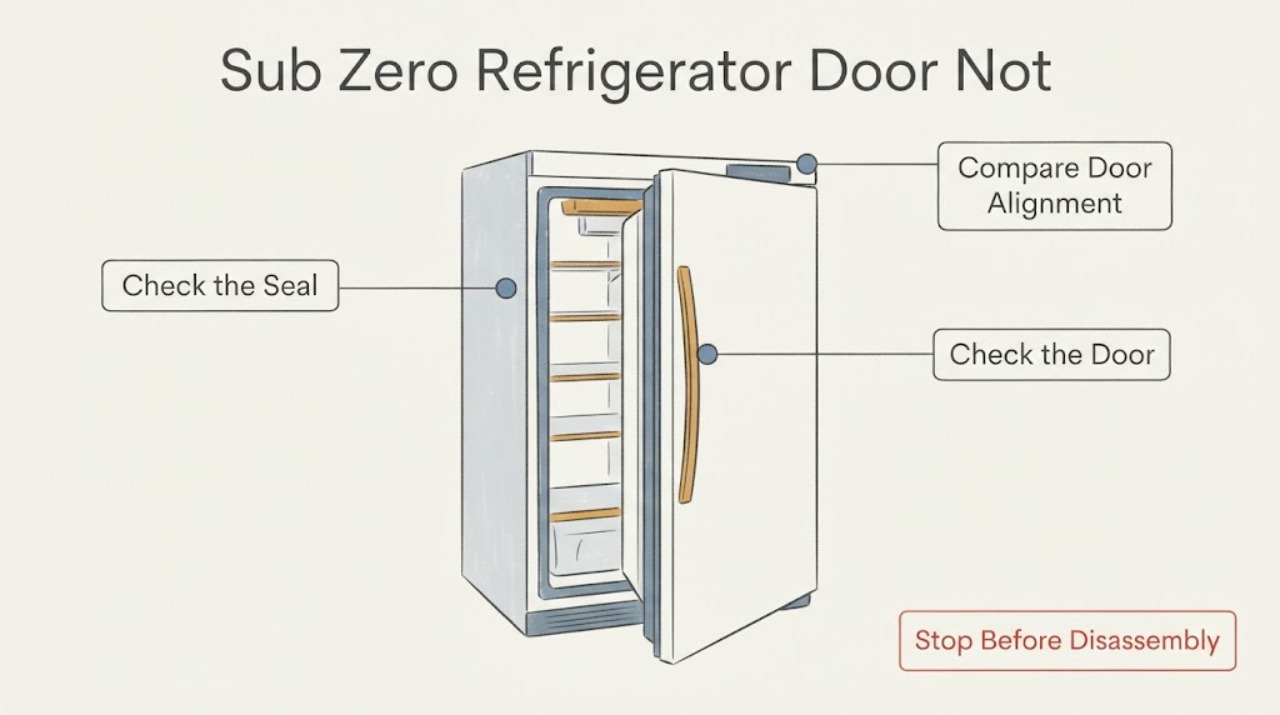
Start with the refrigerator door path, not the hinge adjustment. Remove food, shelves, drawers, or trim that prevent the Sub-Zero door from reaching the frame, and check that the door liner, shelves, and drawers are seated and not bulging or damaged. Inspect the gasket for dirt, tears, cracks, or distortion and look at the hinge area for an obstruction or visible damage without loosening hardware. A new installation that is not level can also prevent proper closing. If the door still will not close or stay shut, the gasket is damaged, the hinge or cam is cracked, or the unit needs leveling, leave the refrigerator in service only as safely possible and contact Sub-Zero Factory Certified Service or a certified installer; do not force the door or replace structural parts by appearance.
Before you begin
Safety first
- Stop user adjustment for a torn or cracked gasket, cracked or missing hinge hardware, a door that must be forced, a unit that is unstable or out of level, or any need to remove trim, pull out an integrated refrigerator, loosen hinges, or replace a closure component.
Work through in order
Diagnostic checks
Use only checks that match the exact appliance or system and its official guide.
-
Check 1
Identify the Sub-Zero refrigerator series from the serial tag or product documentation and describe the exact closing symptom: the door stops before the frame, closes only with force, pops back open, or closes but does not stay sealed.
Expected result: The model or series is known and the obstruction, spring-back, or seal pattern is clear, or the model cannot be read safely.
Next step: Continue with the matching visual checks without loosening hardware. If the model cannot be read, use the serial-tag location guidance or give the unknown model to Factory Certified Service rather than guessing a series-specific adjustment.
Why this matters
Why: Sub-Zero lists model-specific shelves, hinge cams, closure mechanisms, and installation details. The symptom determines whether to inspect door contents and gaskets or escalate directly for hinge and alignment diagnosis.
-
Check 2
Open the door only as far as it operates normally and remove or reposition visible food, containers, shelves, drawers, or trim that block the door's travel. Confirm each removable shelf, drawer, and door shelf is fully seated, closed, and not cracked, torn, or bulging.
Expected result: The door closes after an item or shelf is corrected, or it still stops short or springs open with the interior clear.
Next step: Run one gentle close without forcing it. If it still will not close, do not remove more interior parts or apply force; continue to the gasket and hinge observation.
Why this matters
Why: A corrected door path supports an obstruction or mis-seated interior component. A clear path shifts attention to the gasket, hinge clearance, installation level, or a model-specific closing mechanism.
-
Check 3
Inspect the gasket around the inner door for sticky residue, dirt, folds, displacement, tears, cracks, or bulges, and inspect the visible hinge path for anything blocking it. Clean only accessible gasket residue with a suitable soft cloth and do not lubricate, bend, or pull the gasket or hinge.
Expected result: The gasket is dirty but intact, visibly torn or distorted, or the hinge path has a visible obstruction or damaged component.
Next step: Remove only a loose obstruction. Leave a damaged gasket or hinge untouched and contact Factory Certified Service; do not order a gasket or hinge part until the exact model is confirmed.
Why this matters
Why: A clean intact gasket may restore a seal when residue was preventing contact. A torn gasket or cracked, chipped, missing, or damaged hinge component requires service-level replacement and can prevent the door from closing or sealing.
-
Check 4
For a new installation or a door that shifted after cabinet work, observe whether the cabinet and door appear out of level and whether the door alignment changes across its travel. Do not pull out an integrated unit or adjust leveling or hinge hardware yourself.
Expected result: The problem began after installation or the door appears misaligned, or the refrigerator has been in place and level but recently developed the problem.
Next step: Have a certified installer check a new installation. For an existing unit, arrange Factory Certified Service if the clear door path and gasket checks do not restore closing.
Why this matters
Why: Sub-Zero says an incorrectly leveled new installation can cause closing problems, while an established unit with a new symptom may have a gasket, hinge, cam, or closure fault. Visual alignment alone cannot identify which part is responsible.
Use your observations
Decision map
Find the observation that best matches what you see, then follow the next safe action.
-
PATH 01Next step
What you see
The door closes normally after a container, shelf, drawer, or trim piece is repositioned and the gasket makes continuous contact with the frame.
Do this next
Keep the interior arrangement from blocking the door and monitor whether it stays shut. Request service if the problem returns with a clear path.
Why this path and its safety boundary
Why it matters: The closing problem was consistent with a blocked travel path or mis-seated interior component rather than a confirmed hinge failure.
-
PATH 02Next step
What you see
The interior is clear, but the door pops back open, will not stay shut, or the gasket is torn, cracked, folded, or bulging.
Do this next
Do not force or tape the door shut. Contact Factory Certified Service for model-specific gasket or hinge diagnosis and replacement.
Why this path and its safety boundary
Why it matters: A sealing, closure, gasket, or hinge problem is more likely than a simple obstruction; the door may not maintain proper cooling even when nearly closed.
-
PATH 03Next step
What you see
The issue started after installation or cabinetry work, and the door appears out of alignment or the unit is not level.
Do this next
Contact the certified installer or Factory Certified Service to verify installation and leveling. Do not move the unit or loosen hinges.
Why this path and its safety boundary
Why it matters: Installation leveling or trim interference is more likely than a sudden interior obstruction, especially on built-in or dual installations.
-
PATH 04Next step
What you see
The path, interior components, and gasket look correct, but the door still stops short or the hinge has cracks, missing screws, damaged plates, or broken cams.
Do this next
Arrange Factory Certified Service and keep the door from being repeatedly forced. Provide the series, serial information, and the exact closing pattern.
Why this path and its safety boundary
Why it matters: A model-specific hinge or closure mechanism fault remains possible and cannot be safely resolved by a generic adjustment.
Helpful context
Understand the symptom
Separate a blocked door from a sealing or hinge fault
A Sub-Zero refrigerator door that stops short, springs back open, or closes but does not stay shut can have different causes. The official guidance begins with the door's travel path and the placement of food, shelves, drawers, and trim. It then moves to the gasket, hinge clearance, hinge condition, and installation level. Identify which pattern you see before attempting any adjustment.
Use the gasket as a visible sealing check
The gasket is the rubber seal around the inside edge of the door. Sub-Zero advises keeping it clean and says a ripped, torn, or cracked gasket should be replaced by a service technician. A gasket that is folded, bulging, or displaced can block travel or leave a cooling leak even when the door looks almost closed.
Treat hinge and installation work as model-specific
Sub-Zero identifies model-specific hinge cams, closure mechanisms, dual-installation trim, and leveling as possible factors. Do not assume that a hinge or cam from another series is interchangeable, and do not loosen hinge hardware to make the door line up. A certified installer or Factory Certified Service should handle leveling, damaged hinge components, and persistent sealing problems.
When checks do not resolve it
Need a professional?
Contact Factory Certified Service when the door remains difficult to close after the clear-path and visual gasket checks, will not stay shut, has a damaged gasket or hinge, or the installation needs leveling or model-specific trim diagnosis.
Safety scope: Stop user adjustment for a torn or cracked gasket, cracked or missing hinge hardware, a door that must be forced, a unit that is unstable or out of level, or any need to remove trim, pull out an integrated refrigerator, loosen hinges, or replace a closure component.
Have this ready
- Provide the Sub-Zero series and serial information, whether the unit is new or established, whether the door stops or springs open, what was blocking the path, gasket condition, hinge observations, and whether cabinet or trim work preceded the problem.
Common questions
FAQ
Why does my Sub-Zero refrigerator door keep popping open?
Check for food, shelves, drawers, gasket distortion, hinge obstructions, and installation or trim interference. If the path is clear and the door still pops open, a gasket, hinge, cam, or closure problem needs Factory Certified Service.
Can I adjust the hinge on my Sub-Zero refrigerator door?
Do not loosen or replace hinge hardware based on appearance. Sub-Zero lists model-specific cams and hinge components and recommends a service technician for damaged hinge parts; a certified installer should check leveling on a new installation.
When does a Sub-Zero door gasket need service?
A gasket that is ripped, torn, cracked, folded, displaced, or bulging can prevent a proper seal. Sub-Zero recommends that a service technician complete gasket replacement after the exact model is identified.
What should I check if my new Sub-Zero refrigerator door will not close?
Check for packaging, food, shelves, drawers, trim, or other obstructions and verify the installation is level. If the door remains misaligned, contact the certified installer or Factory Certified Service instead of moving the unit or loosening hinges.
Read the exact guide
Official sources
- Sub-Zero Door or Drawer Opens by Itself | Quick AnswersSub-Zero · Sub-Zero refrigerator door spring-back, obstruction, gasket, hinge, cam, leveling, trim, and service guidance
- Sub Zero Door Gasket Replacement | How to GuideSub-Zero · Sub-Zero refrigerator gasket condition, cleaning, model identification, and technician replacement guidance
- Sub Zero Door Difficult to Close | How to GuideSub-Zero · Sub-Zero refrigerator door obstruction, gasket, hinge, installation, model-specific closing, and service guidance
Community feedback
Share a repair observation
Share a plain-text repair observation. Accepted observations are published automatically; this page may take a moment to update.