
On this page
Start here
Quick answer
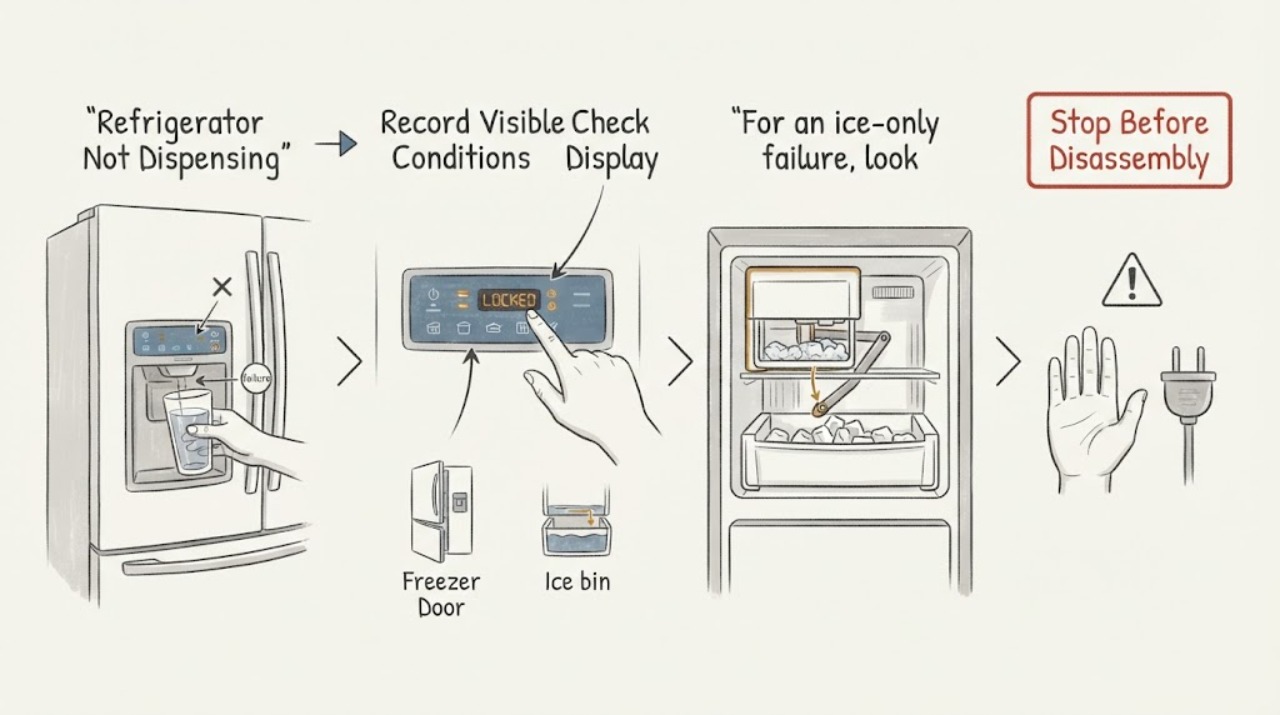
When a Sub-Zero refrigerator will not dispense ice or water, first identify which outlet fails and whether the dispenser is locked or the freezer door is open. For an ice-only failure, check for ice in the bin, clumping, correct bin seating, and free auger movement where the model permits that external check. For a water-only failure on a newly installed or first-use Classic unit, follow the model's tank-priming procedure. An empty ice bin is a no-ice-production problem rather than proof of a dispenser failure. If the lock will not clear, the auger or valve only clicks or grinds, water leaks, or the dispenser still fails after these model-appropriate checks, stop and arrange Factory Certified Service.
Work through in order
Diagnostic checks
Use only checks that match the exact appliance or system and its official guide.
-
Check 1
Press the requested dispenser control once and record whether the failure is ice, water, or both. Also record whether the display and interior lights work, whether the freezer door is fully closed, and whether a lock icon or other status indication is present.
Expected result: Only ice fails, only water fails, both fail, or the dispenser does not respond at all; the freezer door is closed or open; and a lock indication is present or absent.
Next step: Continue with the matching ice or water check below. If the freezer door cannot close or the area is wet near electrical parts, stop using the dispenser and arrange service.
Why this matters
Why: An ice-only failure points toward the ice bin and auger path. A water-only failure points toward the water path or model-specific priming. Both functions failing together makes a locked dispenser, open freezer door, or shared control/power condition more likely.
-
Check 2
If the display shows a dispenser lock or the controls do not respond, use the unlock procedure for the exact Sub-Zero series and model. On a Classic unit, verify the documented lock indicator and model-specific unlock control rather than guessing a button combination.
Expected result: The lock indication clears and the control responds, or the lock remains active or the control remains unresponsive.
Next step: Test the originally failed outlet once after the correct unlock. If the lock cannot be cleared, stop repeated button presses and contact Factory Certified Service.
Why this matters
Why: A cleared lock explains a no-dispense symptom without requiring an ice-bin or water-valve diagnosis. A lock that will not clear remains a control or service issue; the Classic lock page also identifies a power cycle and service path when unlocking fails.
-
Check 3
For an ice-only failure, look in the freezer ice bin before changing any settings. Check that ice is present, not frozen into a solid mass, and that the bin is seated in its normal position. If the model's user-accessible procedure allows it, remove the bin and turn the metal auger by hand to check for free movement; do not force it.
Expected result: The bin is empty, ice is clumped or jammed, the bin is misseated, the auger turns freely, or the auger will not turn freely.
Next step: If the bin is empty, follow the no-ice-production guidance for the exact model. If ice is clumped, use only the model's documented removal and handling procedure. If the bin is seated and the auger path still will not move freely, stop and arrange service.
Why this matters
Why: An empty bin indicates that ice production needs its own diagnosis. Clumped ice or a misseated bin can block delivery even when ice was made. A freely turning auger makes a simple mechanical jam less likely; resistance or damage makes the bin/auger path more likely.
-
Check 4
For a Classic ice or bulk-ice complaint, close the freezer door completely and press the documented ICE or bulk-ice control while observing the chute. The Classic operation guidance says dispensing should begin within the documented short response window; record whether there is motor or auger sound, no sound, or a clicking or grinding sound.
Expected result: Ice dispenses after the door is closed, the control responds but no ice exits, the auger is silent, or the mechanism clicks or grinds.
Next step: Use the exact model manual for any documented external reset or operation check. Do not remove covers or test live wiring; persistent silence, grinding, or no output requires Factory Certified Service.
Why this matters
Why: A door-state correction identifies an interlock condition. Ice in the bin with no output after a correctly seated bin shifts suspicion to the dispenser drive or control path. Clicking or grinding is not enough to identify a replaceable part safely.
-
Check 5
For a water-only failure on a newly installed or first-use Classic built-in, verify the model's water tank has been primed as documented: after the specified wait, hold the water key for the documented purge interval and observe whether water begins to flow. Check the dispenser lock and any model-specific Sabbath Mode status only when the exact model documentation includes them.
Expected result: Water begins flowing after priming, water still does not flow while ice or bulk ice works, or the model is not a documented Classic first-use configuration.
Next step: Follow the matching model manual for filter, supply, and water-path checks. If water leaks, the valve repeatedly clicks, or no flow remains after the documented external procedure, stop and arrange service.
Why this matters
Why: Water restored by priming indicates air in the new installation's tank path rather than a proven failed valve. Water that remains absent while another dispenser function works needs model-specific water-path or service diagnosis. A different series cannot be assigned the Classic priming sequence from this symptom alone.
Use your observations
Decision map
Find the observation that best matches what you see, then follow the next safe action.
-
PATH 01Next step
What you see
Both ice and water fail, the freezer door is open, or the lock indication is active.
Do this next
Close the freezer door and clear the lock using the exact model procedure, then test once. If the lock remains or the controls remain unresponsive, use Factory Certified Service.
Why this path and its safety boundary
Why it matters: The shared dispenser state is more likely than two unrelated delivery-path failures. Classic built-in guidance specifically requires the freezer door to be closed, and the lock disables ice and water output.
-
PATH 02Next step
What you see
Ice fails but water works, and the bin contains ice that is clumped, the bin is not seated, or the auger will not turn freely.
Do this next
Use the model's documented bin removal and ice handling procedure; do not force the auger or dismantle the dispenser. Arrange service if the bin cannot seat or the auger remains restricted.
Why this path and its safety boundary
Why it matters: The symptom is localized to ice storage or the mechanical delivery path, rather than proving that the refrigerator cannot make ice.
-
PATH 03Next step
What you see
The ice bin is empty even though the user describes no ice from the dispenser.
Do this next
Switch to the exact model's no-ice-production guidance and return to dispenser diagnosis only after ice is actually present in the bin.
Why this path and its safety boundary
Why it matters: There is no stored ice to deliver, so an ice-maker production or harvest problem is a separate first question from a dispenser jam.
-
PATH 04Next step
What you see
Water alone fails after the dispenser is unlocked and the door is closed; on a newly installed Classic unit, the documented priming attempt did not restore flow.
Do this next
Stop at visible, model-documented checks and arrange Factory Certified Service, especially for leaks or repeated valve clicking.
Why this path and its safety boundary
Why it matters: The shared lock and door conditions are less likely, while a model-specific supply, filter, valve, tank, or control problem remains possible. The public guidance does not justify selecting one component from the symptom alone.
-
PATH 05Next step
What you see
The bin is seated, ice is loose, the door is closed, the lock is cleared, or the water tank is correctly primed, but the dispenser still produces no output or only clicks or grinds.
Do this next
Stop repeated operation and book Factory Certified Service. Keep the exact model and the recorded outlet, sound, and display behavior for the technician.
Why this path and its safety boundary
Why it matters: The remaining fault is inside the dispenser drive, valve, control, or related wiring, and the available symptom does not identify a safe universal replacement part.
Helpful context
Understand the symptom
A refrigerator that will not dispense is a delivery-path symptom, so preserve whether the failed request is ice, water, or both. Sub-Zero's external ice guidance asks you to check the dispenser lock, ice in the freezer bin, ice frozen together, bin installation, and whether the metal auger turns freely. That path is different from diagnosing an empty ice maker.
Classic built-in models have additional documented conditions: the freezer door must be closed for ice or bulk ice dispensing, a first-use water tank may need to be primed, and the exact lock or Sabbath Mode behavior is model dependent. Do not apply a Classic-specific button sequence to an unidentified Sub-Zero model.
When checks do not resolve it
Need a professional?
Factory Certified Service is appropriate when the dispenser remains inoperative after the exact model's external checks, when the lock will not clear, when the auger or valve clicks or grinds without dispensing, when a bin or chute is damaged, or when a water leak or internal electrical diagnosis is involved. The symptom alone does not establish a compatible auger, valve, motor, or control part.
Common questions
FAQ
Why are both the ice and water dispensers not working on my Sub-Zero refrigerator?
Check whether the dispenser is locked and whether the freezer door is fully closed before diagnosing separate ice and water components. A lock or door interlock can affect both functions; use the exact model procedure and arrange service if the controls stay unresponsive.
Why does the ice dispenser fail when there is ice in the bin?
Inspect for ice frozen together, an incorrectly seated bin, or an auger that does not turn freely through the model-approved external check. If those conditions are clear but the auger is silent, clicks, grinds, or still produces no ice, the dispenser needs service rather than a guessed part.
Is no ice from the dispenser the same as a Sub-Zero ice maker that makes no ice?
No. An empty bin means there is no ice available to dispense and sends you to the model's ice-production diagnosis. Ice present in a properly seated bin with no delivery is a dispenser-path symptom.
How do I fix a Sub-Zero water dispenser that will not flow after installation?
For a newly installed or first-use Classic built-in, follow the exact documented tank-priming wait and purge procedure. If water still does not flow, or there is a leak or repeated valve clicking, stop and use Factory Certified Service; do not assume the same sequence applies to another series.
Read the exact guide
Official sources
- Sub-Zero Classic Series (BI) Ice Dispenser OperationSub-Zero · Sub-Zero Classic BI internal and external ice/bulk-ice operation, freezer-door interlock, ICE control response, and service boundary
- Sub-Zero External Ice Dispenser Not WorkingSub-Zero · Sub-Zero refrigerator external ice dispenser symptoms, ice bin, clumped ice, bin seating, auger check, and service boundary
- Sub-Zero Classic Series (BI) Dispenser Lock OperationSub-Zero · Sub-Zero Classic BI dispenser lock indication, lock behavior, model-specific unlock operation, and service escalation
- Sub-Zero Ice Maker Does Not Make IceSub-Zero · Sub-Zero refrigerator distinction between ice-production failure and an ice dispenser with ice available
- Sub-Zero Classic Series (BI, CL) External Ice or Water Dispenser Does Not WorkSub-Zero · Sub-Zero Classic BI and CL external ice or water dispenser symptoms, water tank priming, lock, Sabbath Mode, and service guidance
Community feedback
Share a repair observation
Share a plain-text repair observation. Accepted observations are published automatically; this page may take a moment to update.