
On this page
Start here
Quick answer
A small amount of condensation after frequent door openings can be normal in a Sub-Zero wine storage unit, but recurring frost or a thick ice layer calls for a sequence of checks. Confirm the door or drawer closes fully, inspect the gasket, verify the condenser is clean, and confirm the wine-storage setpoint for the exact control type. If frost is heavy, use only the model's documented defrost method; do not scrape the evaporator or disturb the sealed system. A torn gasket, service indicator, frost that returns after defrosting, water leakage, or a unit that does not hold its setpoint needs Factory Certified Service.
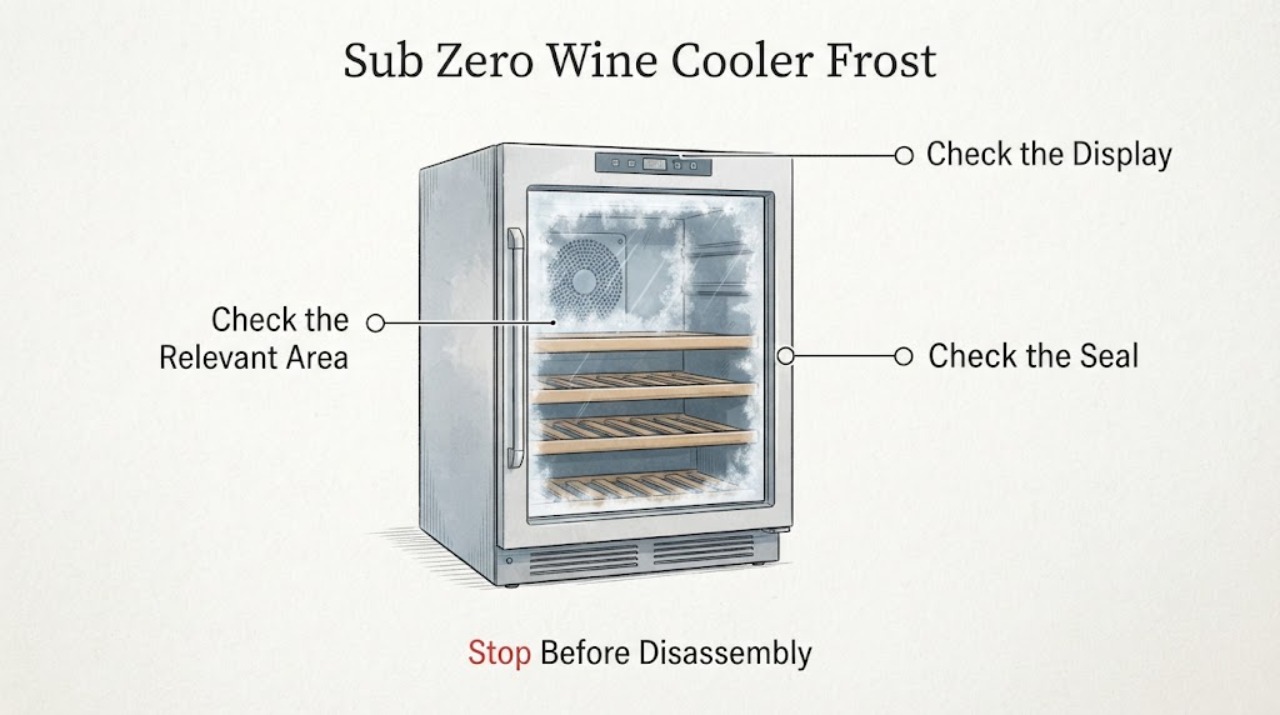
Work through in order
Diagnostic checks
Use only checks that match the exact appliance or system and its official guide.
-
Check 1
Map the frost pattern before changing settings: inspect the visible back wall, evaporator or fan cover area, shelves, drawers, bottle labels, and door gasket, and note whether the frost is light condensation, a localized patch, or heavy ice.
Expected result: Only bottle surfaces or shelving fog, frost is concentrated at the back or evaporator area, the gasket edge is icing, or heavy ice covers a large area or restricts storage.
Next step: Continue with the door-seal and condenser checks for light or localized frost. If the buildup is heavy or blocks storage, stop scraping and use only the exact model's documented defrost method or contact service.
Why this matters
Why: Sub-Zero says some condensation is normal after the door is open, while persistent frost can be associated with door air leakage, a gasket, condenser condition, or an internal cooling or defrost issue. The location changes which model-specific path is relevant.
-
Check 2
Check that the wine cooler door or drawer closes completely and inspect the full gasket for a tear, rip, crack, dry spot, deformation, or debris that prevents contact. Remove only visible items that obstruct closure and clean and dry the gasket as the model guide permits.
Expected result: The door or drawer was left ajar, an item blocks closure, the gasket has visible damage or a gap, or the seal looks intact and the door closes normally.
Next step: Correct the visible obstruction and monitor one normal cooling period. If the gasket is damaged or frost returns despite a complete seal, arrange Factory Certified Service; Sub-Zero recommends technician replacement of wine-storage gaskets.
Why this matters
Why: Sub-Zero wine-storage guidance connects an open door, poor closure, or damaged gasket with moisture and frost. A clean, intact seal makes an air-leak explanation less likely, but does not rule out a drain, control, or defrost fault.
-
Check 3
Verify the wine-storage temperature control and units using the exact model manual. On electronic wine-storage controls, compare the displayed setting with the model's supported range of 34°F–65°F; on a numbered dial, use the model guidance of 4–6 only where it applies.
Expected result: The setting is outside the exact model's range, the dial is at a colder position than its guidance, the displayed units are misunderstood, or the setting is appropriate but frost persists.
Next step: Correct only the setting permitted by the exact guide and allow 24 hours for the unit to respond. Do not repeatedly move the control or assume the number is the measured wine temperature; if frost remains, continue to the maintenance and service checks.
Why this matters
Why: Sub-Zero states that Wine Storage products use temperature ranges different from ordinary refrigerator sections and that controls vary by product family. A correct setpoint with continued frost shifts concern toward sealing, airflow, condenser, drain, or internal control behavior.
-
Check 4
Inspect the accessible condenser area and clean it only by the product's documented method if maintenance is overdue. After cleaning or another visible correction, keep the door closed and allow the wine unit time to stabilize before judging the frost.
Expected result: The condenser has not been cleaned within the model guidance period, the area is visibly obstructed or dirty, or the condenser is clean while frost continues.
Next step: Complete only the documented user cleaning and monitor for the specified response period. If the unit still builds frost or a service indicator remains, stop further maintenance experiments and request service.
Why this matters
Why: Sub-Zero lists a clean condenser as a basic Wine Storage operating check and says a unit may run longer in warm or humid conditions. Cleaning can address a maintenance condition but cannot confirm that a fan, thermostat, sensor, or sealed system is healthy.
-
Check 5
If frost is heavy, check the exact Use and Care Guide for its manual-defrost instruction and follow that procedure without scraping, prying, heating the evaporator, or disconnecting a drain component. If the guide does not provide a safe user procedure, leave the unit closed and arrange service.
Expected result: The model guide provides a defrost procedure, frost melts but returns, frost blocks airflow or storage, or water appears beneath or inside the wine unit.
Next step: Use the documented procedure once and dry any accessible water as directed. If frost returns, the unit leaks, or the guide does not cover the situation, contact Factory Certified Service rather than opening panels or the sealed system.
Why this matters
Why: Sub-Zero wine-storage material directs heavy icing to the model's defrost instructions and treats returning frost, gasket leakage, drain trouble, or water accumulation as reasons for service. Melting a symptom does not identify the cause.
-
Check 6
Check the control panel for a service indicator or error and observe whether the wine cooler continues running abnormally or fails to hold its setpoint after the door, gasket, condenser, and model-specific frost checks.
Expected result: A service indicator flashes, an error appears, the compressor or fan continues after the control is turned off where the model supports that check, or the frost clears and stays gone after the documented correction.
Next step: For a service indicator, recurring frost, or abnormal runtime, record the model and serial information and schedule Factory Certified Service. If the frost stays gone, keep monitoring the gasket, condenser, and door-opening pattern.
Why this matters
Why: Sub-Zero identifies persistent service indicators, abnormal operation, and a cooling issue that remains after basic checks as conditions a Factory Certified technician must diagnose. A frost-free period after correction supports a maintenance or sealing cause but is not proof of a permanent repair.
Use your observations
Decision map
Find the observation that best matches what you see, then follow the next safe action.
-
PATH 01Next step
What you see
Only temporary bottle or shelf fog appears after the wine-storage door has been open, and it clears when the door stays closed.
Do this next
Keep the door closed during normal operation and monitor. If moisture becomes excessive or turns into recurring ice, inspect the gasket and condenser and arrange service if those checks do not resolve it.
Why this path and its safety boundary
Why it matters: Sub-Zero describes this pattern as normal condensation rather than evidence of a frost-producing failure.
-
PATH 02Next step
What you see
Frost is concentrated at the gasket or door edge, and the door was ajar, obstructed, or has a torn or uneven seal.
Do this next
Remove the visible obstruction and clean and dry the gasket if applicable. Have a technician replace a damaged wine-storage gasket and recheck the frost if it returns.
Why this path and its safety boundary
Why it matters: Air entering through incomplete closure or a damaged gasket is more likely than a temperature-setting-only problem.
-
PATH 03Next step
What you see
The condenser is dirty or overdue for maintenance, and frost or excessive runtime improves after the documented cleaning and stabilization period.
Do this next
Maintain the condenser on the model schedule and monitor. If frost returns with a clean condenser, request Factory Certified Service.
Why this path and its safety boundary
Why it matters: The observed change is consistent with a condenser-maintenance condition, but it does not prove that an internal fan or sealed system is sound.
-
PATH 04Next step
What you see
Frost is heavy, blocks storage or airflow, returns after the exact model's documented defrost, or is accompanied by water beneath or inside the wine unit.
Do this next
Stop scraping or improvised heating, keep panels closed, and arrange service. Follow a manual defrost only when the exact model documents it and stop if the problem recurs.
Why this path and its safety boundary
Why it matters: The symptom has crossed from a simple condensation check into a possible drain, defrost, gasket, or cooling fault.
-
PATH 05Next step
What you see
A service indicator or error remains, the unit does not hold its permitted wine-storage setpoint, or it continues abnormal operation after the control check.
Do this next
Record the complete model and serial information, frost location, settings, and checks performed, then contact Factory Certified Service. Do not open the refrigeration system or select a component from frost alone.
Why this path and its safety boundary
Why it matters: Sub-Zero places persistent service indications and unresolved cooling behavior beyond ordinary customer troubleshooting; a sensor, thermostat, fan, drain, or sealed-system diagnosis may be required.
Helpful context
Understand the symptom
Frost buildup in a Sub-Zero wine cooler is different from a brief fog on bottles. Note where frost appears—on the back wall, evaporator area, shelf, drawer, or gasket—and whether it is a thin patch or thick enough to restrict storage. Also record the control setting, whether the door was left ajar, room humidity, and any service indicator.
Sub-Zero identifies door sealing, condenser condition, temperature control, and defrost or drain behavior as separate diagnostic paths. Wine Storage models have their own temperature ranges and control types, so use the exact model's Use and Care Guide before applying a series-specific number or defrost procedure.
Keep the ice removal boundary safe. Do not chip frost with a knife, pry at the evaporator, pour liquid into a drain, or open the refrigeration system. If heavy frost needs manual defrosting, follow the exact model instructions or arrange service; a recurrence after a documented defrost is evidence for professional diagnosis.
Only after diagnosis
Potential parts
- wine-storage door or drawer gasket
Consider a gasket only when inspection confirms a rip, tear, crack, deformation, or a seal that remains incomplete after visible obstructions are removed.
Sub-Zero wine-storage gasket fit varies by series and model; use the complete model and have a technician confirm replacement. - wine-storage temperature sensor or thermostat
Consider this class only when service confirms persistent frost or temperature control failure after correct settings, condenser condition, and door sealing are verified.
Do not choose a sensor or thermostat from frost location alone; confirm the exact model and approved part information through qualified service. - wine-storage fan or defrost component
Consider this class only when a technician diagnoses a fan, defrost, drain, or related internal fault after frost returns following the documented user checks.
Internal cooling and defrost components are model-specific and require professional diagnosis and installation.
When checks do not resolve it
Need a professional?
Provide the complete Wine Storage model and serial information, frost location and thickness, whether the door or drawer was left ajar, gasket condition, control type and setpoint with units, condenser maintenance date, service or error indication, whether water is present, and what changed after the model-specific correction or defrost.
Common questions
FAQ
Is a little condensation normal in a Sub-Zero wine cooler?
Sub-Zero says some condensation can occur after the door is open or left open, especially in warm climates, and can clear when the door stays closed. Recurring frost or excessive moisture calls for condenser and gasket checks.
What causes frost buildup in a Sub-Zero Wine Storage unit?
Check incomplete door closure, a damaged gasket, overdue condenser maintenance, the model's temperature setting, and any service indicator. Heavy or returning frost can involve a drain, defrost, fan, control, or sealed-system issue that needs service.
Can I scrape the ice from my Sub-Zero wine cooler?
Do not scrape or pry at the evaporator or use improvised tools. For heavy frost, follow the exact model's documented defrost method; if it is not documented or the frost returns, contact Factory Certified Service.
What temperature should a Sub-Zero wine cooler be set to?
Wine Storage controls vary. Sub-Zero lists an electronic range of 34°F–65°F and dial guidance of 4–6 on its Wine Storage troubleshooting page, but the exact model guide controls the applicable range and setting.
When should I call Sub-Zero service for frost?
Call when frost is heavy or returns, the gasket is damaged, water accumulates, a service indicator or error appears, or the unit does not hold its permitted setpoint after the documented checks.
Read the exact guide
Official sources
- Ice or Frost on Back Wall of RefrigeratorSub-Zero Group, Inc. · Official Sub-Zero frost guidance that explicitly includes 400 Series Wine Storage in its model-specific drain references; use the exact Wine Storage guide for detailed procedures.
- Sub-Zero Warm Wine Storage TroubleshootingSub-Zero Group, Inc. · Official Sub-Zero Wine Storage troubleshooting page; temperature ranges, control types, 24-hour stabilization, condenser, door, and service checks are scoped to Wine Storage units.
- Extremely Cold Temperature on DisplaySub-Zero Group, Inc. · Official Sub-Zero refrigeration display guidance relevant when a Wine Storage control shows an unexpectedly extreme value or the unit continues operating after the control check.
- Excessive Moisture or Condensation in Wine StorageSub-Zero Group, Inc. · Official Sub-Zero Wine Storage support page explaining normal short-term condensation and escalation for excessive moisture, gasket, and condenser conditions.
- Wine Storage Use & Care GuideSub-Zero Group, Inc. · Official Sub-Zero Wine Storage Use and Care Guide; the cited troubleshooting page covers frost, condensation, ice buildup, door or drawer closure, gasket condition, condenser, and service.
- Sub-Zero Door Gasket ReplacementSub-Zero Group, Inc. · Official Sub-Zero gasket guidance covering refrigerator, freezer, and Wine Storage doors and recommending technician completion of gasket replacement.
Community feedback
Share a repair observation
Share a plain-text repair observation. Accepted observations are published automatically; this page may take a moment to update.