
On this page
Start here
Quick answer
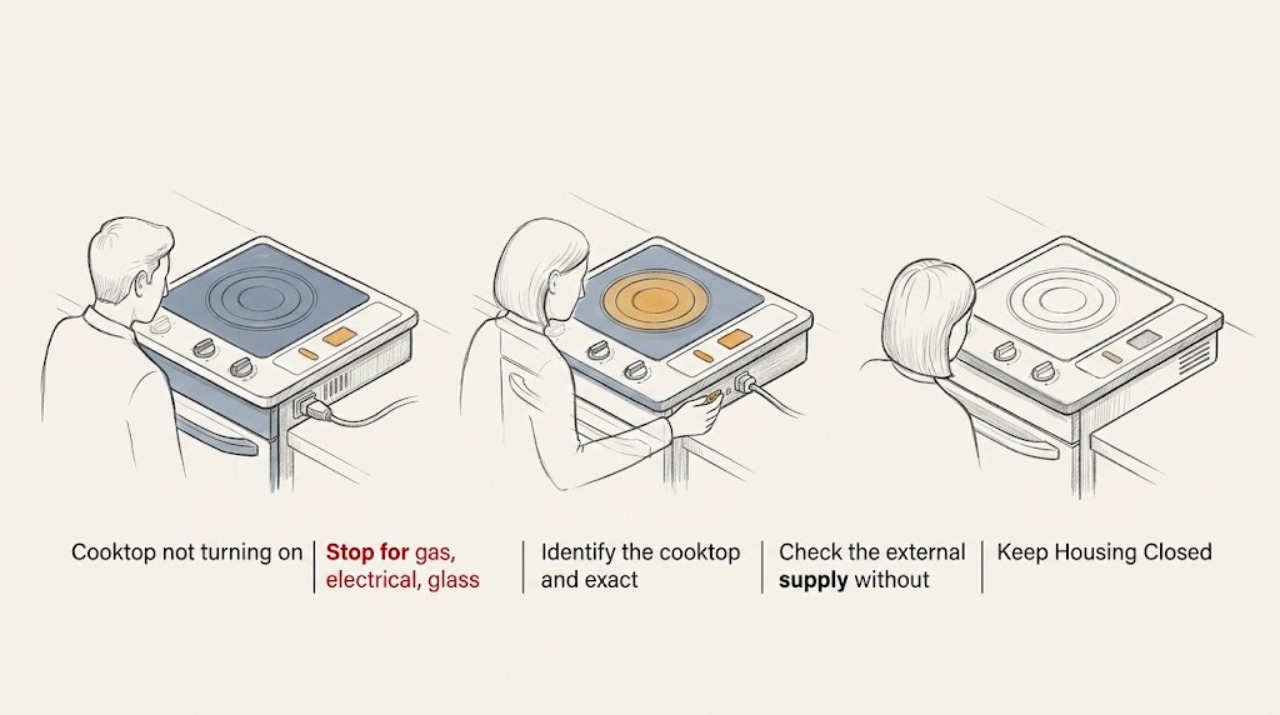
Do not assume a Thermador cooktop is gas, electric, or induction from the symptom alone. First stop for gas odor, persistent sparking, a cracked glass surface, water on or inside the controls, smoke, an arc, a hot or damaged cord, or a repeated breaker trip; leave or switch off power only when it can be done safely and arrange qualified service. If there is no hazard, identify the exact model and cooktop type from its rating label or owner manual, then check the external supply, any accessible main switch, the household breaker or fuse, and whether the control panel responds. A gas model may need a qualified check of gas supply and burner position; an electric model may have a power or fuse issue; an induction model may show a control response but not heat because of cookware or a mode setting. Use only the exact Thermador manual for a lock, error, or reset instruction. If a safe external check does not restore operation, do not remove the glass, open the cabinet, probe wiring, adjust gas parts, or bypass an interlock—book an authorized Thermador servicer or qualified electrician.
Before you begin
Safety first
- Stop immediately for gas odor, hissing, smoke, fire, persistent sparking, an arc, a hot or damaged connection, a cracked glass surface, wet controls, or repeated breaker trips. Do not use flames, probe wiring, open the cooktop, adjust gas parts, bypass an interlock, or continue after an unresolved hazard.
Work through in order
Diagnostic checks
Use only checks that match the exact appliance or system and its official guide.
-
Stop for gas, electrical, glass, or water hazards
Before trying to turn the Thermador cooktop on again, look from a safe position for gas odor or hissing, persistent clicking or sparking, smoke, an arc, a hot or damaged cord, a repeated breaker trip, a cracked or fractured glass surface, or water entering the controls.
Expected result: Classify the situation as no visible hazard, suspected gas leak, electrical arcing/overheating, cracked glass, wet controls or spill, or a breaker that trips again.
Next step: For gas odor or hissing, leave immediately and call 911 or the gas utility from outside. For smoke, fire, arc, hot damage, cracked glass, or repeat trips, stop using the cooktop and arrange emergency, electrical, or qualified appliance service. For a spill, keep the cooktop off and follow the exact manual's drying and cleaning instructions.
Stop if: Do not relight a gas burner, keep clicking a gas igniter, touch wet controls, operate a cracked surface, reset a repeatedly tripping breaker, use a flame to test, open the appliance, or handle exposed wiring.
Why this matters
Why: A no-start symptom is secondary to a fire, shock, gas, cut, or water-damage risk. Thermador says a fractured or cracked electric cooktop is no longer usable and the fuse should be switched off to prevent electric shock.
-
Identify the cooktop and exact manual
Only from a safe, dry location, record the Thermador model number and identify whether the surface is gas, electric radiant, or induction using the rating label, controls, and official owner-manual portal; do not infer the type from a dark display alone.
Expected result: Record the exact model, whether there are gas burner caps and knobs, radiant zones, or induction controls, whether the panel is blank or lit, and whether a code or lock indicator is displayed.
Next step: Open the exact Thermador manual and support page for the model before changing a setting or attempting a reset. If the model cannot be identified safely, give the servicer photos and the information available without removing anything.
Stop if: Do not remove the cooktop, rating label, glass, control panel, or a burner assembly to identify the model or type.
Why this matters
Why: The same no-turn-on wording leads to different checks. Gas supply and ignition apply only to a gas cooktop; cookware detection applies only to induction; a fuse or breaker and control supply can affect electric or induction models.
-
Check the external supply without probing it
With no hazard and the area dry, visually check any accessible power connection and the cooktop's accessible main switch, then look at the household fuse or breaker for an obvious open state; do not remove covers or test the outlet with improvised wiring.
Expected result: Record whether the panel is blank, the main switch is off, the home has a power outage, the fuse or breaker is open, or the external supply appears normal.
Next step: If power is absent at the home or outlet, contact a qualified electrician or utility. If one breaker has clearly tripped and there is no hazard, follow the home's instructions for one reset; if it trips again, leave it off and arrange service. If power and the panel are normal, continue to the type-specific response branch.
Stop if: Do not repeatedly reset a breaker, replace a fuse with a different rating, use a damaged cord, remove an electrical cover, or perform a live voltage test.
Why this matters
Why: Thermador lists an unplugged appliance, switched-off main switch, power failure, no power at the socket, and a blown fuse or tripped breaker as possible electric or induction no-start causes. A normal-looking supply does not prove the cooktop's internal circuit is safe or functional.
-
Use the correct control branch only after the panel is safe
If the cooktop is identified and the panel is dry and safe, follow the exact manual to check a control lock or main-control sequence; then observe the relevant zone without forcing it: gas models may show a click or no ignition, electric models may show a zone indicator without heat, and induction models may show cookware-not-detected or a flashing setting.
Expected result: Record whether the panel responds, all zones are affected or only one, a gas igniter clicks with no flame, an electric zone indicator remains off, an induction pan is not recognized, or an error code appears.
Next step: For a lock or mode, use only the model-manual procedure. For gas ignition with any gas odor, stop and use the gas-emergency branch. For induction cookware or an exact displayed code, follow only the model instructions; if the zone remains unavailable, arrange service.
Stop if: Do not repeatedly ignite gas, hold a gas knob open to test, bridge a control, scrape wet controls, bypass a lock, use incompatible improvised cookware to force a test, or dismantle the surface.
Why this matters
Why: A responsive panel with one affected zone is not the same as a completely dead cooktop. Thermador's gas guidance discusses burner positioning and ignition behavior; its induction guidance discusses selecting the correct zone and cookware suitability; its electric guidance directs an error display to the owner manual.
-
Escalate when safe external checks do not restore operation
If the supply, manual-supported controls, and safe type-specific observations do not restore the Thermador cooktop, stop troubleshooting and request an authorized Thermador servicer or qualified electrician; keep the cooktop off when the symptom followed an overheat, fault, moisture event, arc, gas issue, or repeat trip.
Expected result: Give the technician the exact model and type, panel state, all-zone versus one-zone symptom, breaker/fuse history, displayed code, gas click/no-flame behavior if applicable, cookware indication if induction, and any hazard signs.
Next step: Ask the professional to identify the failed circuit or component, verify the household supply and installation, and state what safety test or all-clear is required before reuse. Preserve the manual and do not alter the appliance while waiting.
Stop if: Do not remove glass or panels, adjust gas parts, access terminal blocks, test live wiring, bypass an interlock, or resume use after a temporary reset if the cause remains unexplained.
Why this matters
Why: The remaining cause may be an internal control, ignition, heating element, sensor, interlock, wiring, or installation fault. The symptom alone cannot select a safe replacement part or authorize cabinet access.
Use your observations
Decision map
Find the observation that best matches what you see, then follow the next safe action.
-
PATH 01Safety boundary
What you see
There is gas odor, hissing, smoke, fire, persistent sparking, an electrical arc, a hot or damaged connection, or a breaker that trips again.
Do this next
Leave a gas-odor area and call 911 or the gas utility from outside. For smoke, fire, arc, or electrical damage, use emergency or qualified electrical/appliance service and keep the cooktop off.
Why this path and its safety boundary
Why it matters: This is an immediate gas, fire, or shock boundary; the cooktop's no-start symptom is not safe to investigate further.
Safety stop: Do not touch switches, phones, controls, valves, plugs, flames, or exposed wiring in a gas-odor area; do not keep resetting the breaker.
-
PATH 02Safety boundary
What you see
The cooktop has a crack or fracture, or liquid has entered the controls or electrical area.
Do this next
Keep the cooktop off. For a cracked electric surface, switch off the fuse as Thermador directs if this can be done safely; for any uncertain type or inaccessible panel, arrange qualified service and do not clean or disassemble it.
Why this path and its safety boundary
Why it matters: A cracked Thermador electric cooktop is no longer usable, and moisture can create a control or shock risk.
Safety stop: Do not cook on cracked glass, touch wet controls, apply heat to dry the appliance, or remove the glass or control panel.
-
PATH 03Safety boundary
What you see
The entire control panel is blank or no control responds, with no visible hazard.
Do this next
Identify the model, check the accessible supply and breaker once, and arrange an electrician or authorized servicer if power is absent or the panel remains dead.
Why this path and its safety boundary
Why it matters: An external supply, main switch, fuse/breaker, power connection, or internal control issue is more likely than a single heating-zone or cookware issue.
Safety stop: Do not probe the outlet, remove covers, repeatedly reset the breaker, or apply a model-specific reset from memory.
-
PATH 04Safety boundary
What you see
The cooktop is confirmed gas, the controls respond, but a burner clicks without lighting or will not ignite.
Do this next
If any gas odor is present or the burner fails to light promptly, turn the controls off if safely reachable, leave, and call gas emergency or qualified service from outside. Without odor and after the appliance is cool, provide the model and burner symptom to an authorized servicer rather than dismantling it.
Why this path and its safety boundary
Why it matters: Burner positioning, supply status, a wet or dirty igniter, wiring, or another gas-appliance fault may be involved; the no-flame symptom does not authorize repeated ignition.
Safety stop: Do not hold the knob open, use a match or lighter, adjust the regulator, remove gas tubing, or retry when gas may have accumulated.
-
PATH 05Safety boundary
What you see
The cooktop is confirmed induction, the panel responds, but a zone flashes, does not detect the pan, or does not heat.
Do this next
Follow the exact model manual for zone selection, cookware detection, control lock, and any displayed code. If the correct model-supported observation does not restore heating, arrange service.
Why this path and its safety boundary
Why it matters: The selected zone, cookware size or suitability, control mode, or an error may be involved; this is not the same as a dead cooktop.
Safety stop: Do not force a cookware test with damaged or unstable cookware, bypass a control lock, open the cooktop, or continue after overheating, a crack, or an electrical warning.
-
PATH 06Safety boundary
What you see
The cooktop is confirmed electric radiant, the controls respond, but one or more zones do not heat or an error is displayed.
Do this next
Record the exact display and use the Thermador owner manual or official support page. If the code returns, the surface remains unavailable, or the supply is abnormal, contact an authorized servicer or electrician.
Why this path and its safety boundary
Why it matters: A zone control, element, sensor, supply, or fault condition may be involved; an error code must be interpreted for the exact model.
Safety stop: Do not remove the glass, test the element with live power, bypass a sensor, or keep operating a cracked or overheated surface.
Helpful context
Understand the symptom
Start with the symptom, not the assumed technology
A Thermador cooktop can be gas, radiant electric, or induction, and “not turning on” can mean a blank display, no burner ignition, no heat from a zone, or a control lock or fault message. Check the model information and manual before choosing a branch. A gas-only action such as checking a burner cap or gas supply does not apply to an induction surface, while an induction cookware check does not explain a gas burner with no flame.
Remove hazards before pressing controls again
Do not troubleshoot through a gas odor, persistent sparking, smoke, an arc, a hot or damaged cord, a repeated breaker trip, or a cracked glass surface. Leave a gas-odor area and call emergency or gas service from a safe location. Thermador says a fractured or cracked electric cooktop is no longer usable and the fuse should be switched off to prevent electric shock. Water or spilled liquid around controls should be left to dry with power off as directed by the model manual; do not spray cleaner into the controls or open the appliance.
A blank panel and a zone that will not heat are different failures
If the entire panel is dark or no control acknowledges a touch, start with the external supply and control lock/manual branch. If the panel lights but one zone does not heat, the model-specific gas, electric, or induction branch is more useful. On induction models, cookware detection and the selected zone can matter; on gas models, burner positioning and ignition behavior can matter. If a fault code appears, record it exactly and use the model manual rather than guessing what a letter or number means.
Stop at safe external diagnosis
Thermador's support pages direct owners to an electrician or authorized servicer when power is absent, a fuse or breaker issue persists, an error is not resolved by the model instructions, or gas-appliance repair requires dismantling. Do not remove the glass, lift the cooktop, access terminal blocks, adjust a regulator, bypass a safety interlock, or perform live voltage or gas tests. A qualified professional can distinguish an installation or household-supply fault from an internal control, ignition, heating, or sensor fault.
When checks do not resolve it
Need a professional?
Safety scope: Stop immediately for gas odor, hissing, smoke, fire, persistent sparking, an arc, a hot or damaged connection, a cracked glass surface, wet controls, or repeated breaker trips. Do not use flames, probe wiring, open the cooktop, adjust gas parts, bypass an interlock, or continue after an unresolved hazard.
Common questions
FAQ
Why will my Thermador cooktop not turn on at all?
First screen for hazards, then identify the model and type. If the whole panel is blank, check the accessible main switch and household breaker or fuse once without probing or opening the appliance. Thermador lists power interruption, no supply at the socket, and a tripped fuse or breaker as possible causes for electric and induction cooktops; persistent problems need qualified service.
How do I know whether my Thermador cooktop is gas, electric, or induction?
Use the rating label, exact model number, and Thermador's owner-manual lookup. Do not infer the type from a dark panel or assume that a no-start symptom has the same cause across technologies.
What if my Thermador gas cooktop clicks but will not light?
Do not keep trying to ignite it. If you smell gas or hear hissing, leave and call gas emergency service from outside. If there is no odor and the cooktop is cool, provide the exact model and burner behavior to a qualified servicer; do not adjust gas parts or dismantle the appliance.
What if only one induction zone will not heat?
After confirming the surface is induction, use the exact manual to check that the intended zone is selected and that the cookware-detection message or flashing setting is understood. If the correct model-supported check does not restore heating, arrange service rather than opening the cooktop.
Can I use a cracked Thermador glass cooktop?
No. Thermador says a fractured or cracked electric cooktop is no longer usable and the fuse should be switched off to prevent electric shock. Keep the surface off and arrange qualified service; do not try to seal or repair the glass yourself.
Should I keep resetting the breaker if the cooktop will not start?
No. If there is one clear trip and no hazard, follow the home's instructions for one reset. If it trips again, leave it off and arrange qualified electrical or appliance service. Repeated trips indicate an unresolved fault or overload, not a normal reset condition.
What does a Thermador cooktop error code mean?
Record the exact code and use the official page or owner manual for the exact model. Similar-looking codes can indicate different conditions on electric and induction models. If the code returns, is unlisted, or is associated with overheating or an abnormal supply, keep the cooktop off and call a qualified servicer.
Read the exact guide
Official sources
- Electric Cooktops - Cleaning & CareThermador · Thermador's official electric-cooktop care guidance; the installed model and local electrical requirements apply.
- Induction Cooktops - TroubleshootingThermador · Thermador's official induction-cooktop guidance; exact model instructions and local electrical requirements control.
- Induction Cooktops - Error CodesThermador · Thermador's official induction error-code guidance; exact model and local electrical requirements control.
- Pipeline Leak Recognition and What to DoU.S. Department of Transportation, Pipeline and Hazardous Materials Safety Administration · Federal public gas-leak response guidance; local gas-utility and emergency instructions control an incident.
- Electric Cooktops - TroubleshootingThermador · Thermador's official electric-cooktop guidance; exact model instructions and local electrical requirements control.
- Gas Cooktops & Rangetops - TroubleshootingThermador · Thermador's official gas-cooktop and rangetop guidance; local gas utility and exact model manual control incident-specific safety.
- Search for Owner ManualsThermador · Thermador's official manual lookup; model-specific instructions and local requirements control.
Community feedback
Share a repair observation
Share a plain-text repair observation. Accepted observations are published automatically; this page may take a moment to update.