
On this page
Start here
Quick answer
Do not use a Thermador gas oven with a cracked, loose, or shattered door pane. Turn the oven off, keep people away from the glass, and let the appliance cool completely without trying to remove the door or clean shards from the assembly. Do not run self-cleaning or relight the oven. Identify the complete model or E-number and have Thermador or an authorized service provider confirm the correct glass assembly and inspect the door before use; a parts-page match by appearance alone is not enough.
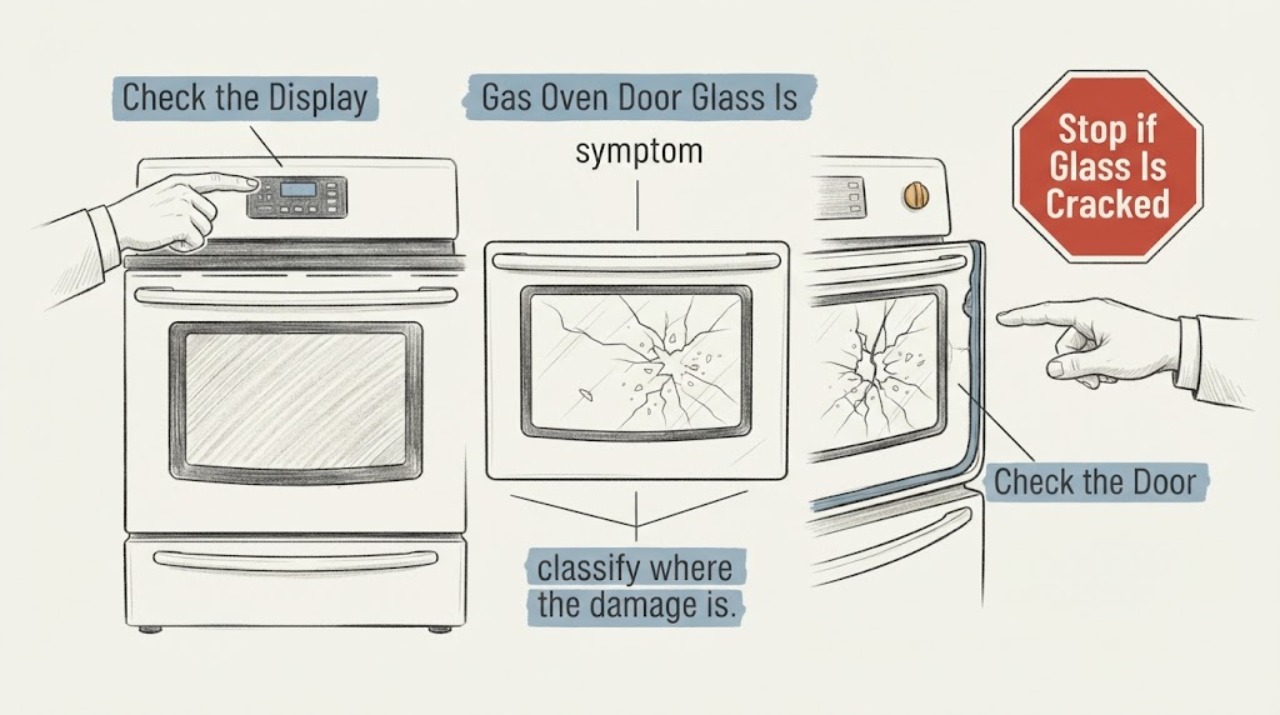
Work through in order
Diagnostic checks
Use only checks that match the exact appliance or system and its official guide.
-
Check 1
Turn the Thermador oven off from its normal control and keep the gas oven unused. If the glass is hot, do not touch it; keep children, pets, and other people away and wait for the complete door and surrounding area to cool.
Expected result: The pane is cracked, shattered, loose in its frame, missing pieces, or the door no longer sits or closes normally.
Next step: Keep the appliance out of service and arrange Thermador or authorized service inspection before using any oven function.
Stop if: Do not open and close the door repeatedly, apply pressure to the pane, or try to hold it in place with tape or an adhesive.
Why this matters
Why: The door assembly is no longer a known safe barrier for oven heat and gas operation. A working display or cooktop does not clear damaged oven glass.
-
Check 2
From outside the cooled appliance, classify where the damage is without removing any trim or pane: outer glass, inner glass, edge or frame, loose fragments in the cavity, or glass on the floor.
Expected result: Only a surface crack is visible, a pane is loose or missing, fragments are inside the cavity, or the door frame, hinge, seal, or latch is also damaged.
Next step: Photograph the damage from a safe distance and give the description to service. Do not handle loose pieces or disassemble the door to identify the pane.
Stop if: Do not touch shards with bare hands, run a cleaning cycle, or test the oven to see whether the glass holds.
Why this matters
Why: The visible pattern does not establish whether the inner heat barrier, door structure, seal, hinge, or latch remains serviceable. Different panes and door assemblies can look similar but are not interchangeable.
-
Check 3
After the appliance is fully cool, check only the surrounding area for an obvious external hazard such as glass on a walking surface, a door that is sagging, or a panel that could fall. Keep the area isolated rather than moving the range or door.
Expected result: Glass is on the floor or in the oven, the door is unstable or will not latch, the frame is bent, or the area is clear but the pane remains damaged.
Next step: Keep people away, leave the oven off, and arrange service. If a shard creates an immediate injury risk, restrict access and follow local safe cleanup or emergency guidance rather than reaching into the door assembly.
Stop if: Do not remove the door, hinge clips, inner cover, or fragments from inside the assembly.
Why this matters
Why: Loose glass and an unstable door require controlled service handling. A clear floor does not make a cracked door safe for heating, and the damage may extend behind the visible pane.
-
Check 4
Find the complete Thermador model or E-number from the rating plate or existing documentation without moving or dismantling the appliance, then use Thermador's manual and support resources for that exact appliance.
Expected result: The full model or E-number is available, only a partial number is available, or the number cannot be read safely.
Next step: Give the full number to Thermador or the authorized servicer. If it cannot be obtained safely, provide photographs and the visible product information and let service identify the appliance.
Stop if: Do not buy or install a pane based only on a similar model name, dimensions, photograph, or seller cross-reference.
Why this matters
Why: Thermador's parts system requires an E-number to check appliance compatibility, and its owner support area provides model-specific manuals and service resources. A generic glass-door listing cannot confirm fit for an unidentified gas oven.
-
Check 5
Tell service whether the break appeared during cooking, after a spill or cleaning event, during self-cleaning, after impact, or without an observed cause; also report any gas odor, smoke, abnormal flame, heat escaping at the door, or control warning.
Expected result: The damage is accompanied by gas odor, smoke, abnormal combustion, uncontrolled heat, a carbon-monoxide alarm, or no additional symptom.
Next step: For a gas odor or combustion emergency, do not operate switches or appliances; leave the area and contact the local gas emergency service from a safe location. Otherwise keep the oven off and schedule qualified Thermador service.
Stop if: Do not relight burners, use self-cleaning, or attempt a heat test while the glass or door assembly is damaged.
Why this matters
Why: Gas odor, smoke, abnormal combustion, or a safety alarm is an emergency boundary rather than a glass-replacement diagnosis. With no additional hazard, the broken door still requires inspection before operation.
Use your observations
Decision map
Find the observation that best matches what you see, then follow the next safe action.
-
PATH 01Next step
What you see
The door pane has any crack, missing piece, loose section, or visible break, even if the oven still powers on and the door appears to close.
Do this next
Keep the gas oven out of service and arrange qualified Thermador inspection; do not run Bake, Broil, or self-cleaning.
Why this path and its safety boundary
Why it matters: The door assembly cannot be cleared by a visual check alone. The exact pane, seals, frame, hinges, and door construction must be confirmed before heat is applied.
-
PATH 02Next step
What you see
The glass is shattered, fragments are loose, the door is sagging or will not latch, or the frame, hinge, or seal is visibly damaged.
Do this next
Restrict access, do not touch or move the door, and contact an authorized servicer. Seek urgent help for an immediate injury hazard.
Why this path and its safety boundary
Why it matters: This is a higher-risk door-assembly condition with loose material or compromised support. Handling the door or fragments can cause injury and may worsen hidden damage.
-
PATH 03Next step
What you see
There is a gas odor, smoke, abnormal flame, uncontrolled heat, or a carbon-monoxide alarm alongside the broken glass.
Do this next
Do not operate electrical switches or appliances in the affected area. Leave immediately and contact the local gas emergency service or emergency help from a safe location.
Why this path and its safety boundary
Why it matters: The symptom has crossed into a gas, combustion, fire, or carbon-monoxide emergency and cannot be handled as a parts replacement.
-
PATH 04Next step
What you see
The pane is damaged but the area is cool, no other hazard is present, and the complete Thermador model or E-number is available.
Do this next
Use Thermador owner support or an authorized servicer to inspect the assembly and confirm the correct part and installation route before reuse.
Why this path and its safety boundary
Why it matters: Service has the information needed to check the correct manual and door-glass compatibility, but the model number does not make owner replacement safe.
Helpful context
Understand the symptom
Treat broken oven glass as a stop condition
A cracked or shattered door pane changes the safety situation even if the burners and controls still work. Switch the oven off and keep the door and surrounding area undisturbed until it is fully cool. Do not use heat or self-cleaning to test the door, because the exact model manual and a qualified inspection are needed before the oven returns to service.
Identify the pane without disassembling the door
From a safe position, note whether the damage is on the outer viewing surface, the inner pane, the edge or frame, or whether pieces have fallen into the cavity or onto the floor. Do not press the glass, lift a loose pane, remove trim, or take the door apart. Thermador's parts page requires the appliance model or E-number to check compatibility, so the appearance or dimensions of a replacement pane are not sufficient.
Give service the damage pattern and model
Record the complete model or E-number, the location and extent of the break, whether the door closes and latches normally, whether glass is loose or missing, and whether the break followed impact, a spill, cleaning, or a self-cleaning cycle. Thermador provides owner support, manuals, safety information, and servicer resources; the technician can verify the full door assembly and surrounding seals before approving use.
When checks do not resolve it
Need a professional?
Do not use a Thermador gas oven with damaged door glass. Contact qualified or authorized service for inspection and exact part confirmation. Leave the area and contact the local gas emergency service from a safe location for gas odor, smoke, abnormal flame, uncontrolled heat, or a carbon-monoxide alarm.
Common questions
FAQ
Can I still use the Thermador oven if only the outer glass is cracked?
Do not assume that an outer-only crack is safe. Keep the oven off and have the complete door assembly inspected, because the visible pane does not establish the condition of the inner glass, frame, seal, or hinges.
Can I run self-cleaning to see whether the door glass is stable?
No. Do not use self-cleaning or another heat cycle with broken, loose, or cracked glass. Thermador says to follow the exact owner manual for self-cleaning and to keep the door and vents in the required condition; damaged glass needs service inspection first.
Can I order a replacement Thermador glass pane by matching the picture?
No. Thermador's glass-door parts page requires the appliance model or E-number to check compatibility. Let Thermador or an authorized servicer confirm the pane or complete door assembly for the exact oven.
What should I do if glass fell inside the oven?
Keep the oven off and do not reach into the door or cavity to retrieve fragments. Restrict access until the appliance is cool and arrange qualified service to handle the glass and inspect hidden door damage.
What if the broken glass is accompanied by a gas smell?
Treat the gas smell as an emergency. Do not operate lights, switches, or appliances in the affected area. Leave and contact the local gas emergency service from a safe location; do not return the oven to use until it has been professionally assessed.
Read the exact guide
Official sources
- 00486969 Glass DoorThermador / BSH Home Appliances Corp · Opened official Thermador parts page showing a glass-door component and requiring the appliance model or E-number to check compatibility. The listed part is not asserted to fit the reader's unidentified oven.
- How to Clean Your OvenThermador / BSH Home Appliances Corp · Opened official Thermador oven-care page. It supports cool handling, exact owner-manual use, and keeping the door and vents in the documented condition; it does not authorize repair of broken glass.
- Thermador Repair Terms and Safety ConcernsThermador / BSH Home Appliances Corp · Opened official Thermador repair-safety PDF. Its warning applies to Thermador appliance repair and parts work generally; exact door construction and part fit remain model-specific.
- Customer Support, Service, Repair & PartsThermador / BSH Home Appliances Corp · Opened official Thermador Owner Support page. It provides the model-specific support and servicer entry points needed after a damaged-door report.
Community feedback
Share a repair observation
Share a plain-text repair observation. Accepted observations are published automatically; this page may take a moment to update.