
On this page
Start here
Quick answer
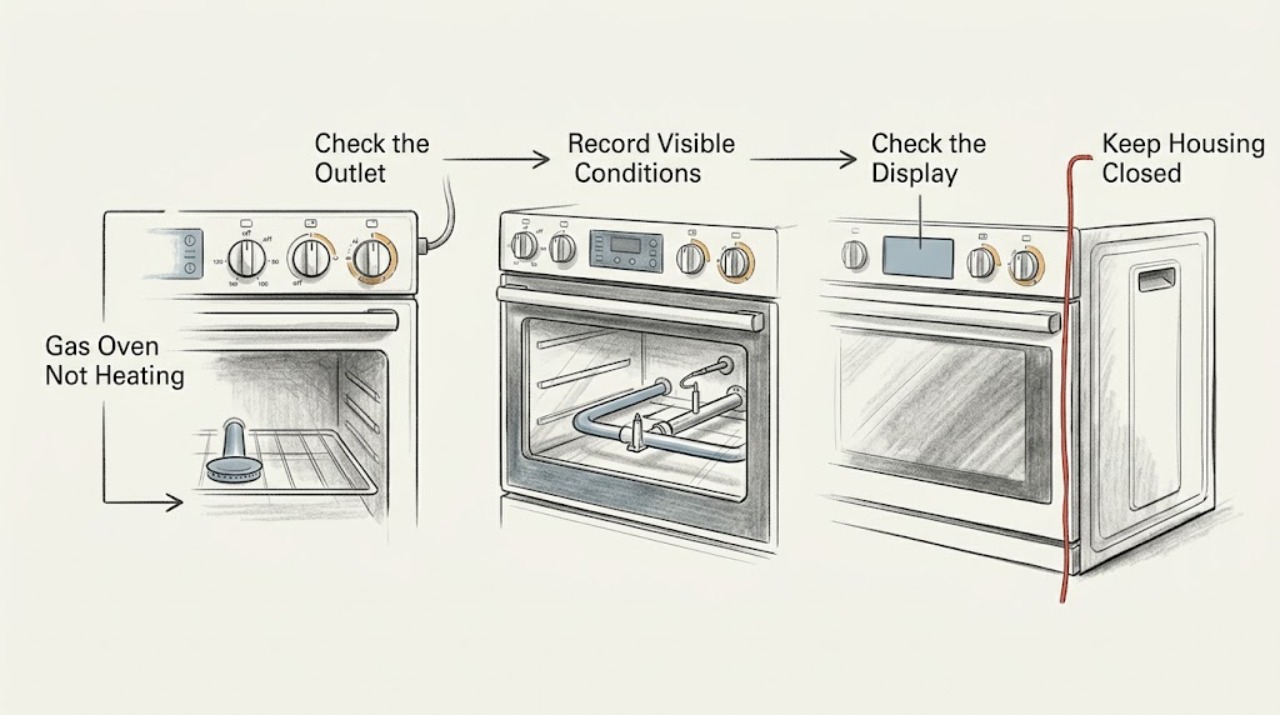
A Thermador gas oven that does not heat may be in the wrong mode or timer state, may lack electrical or gas supply, or may have an oven-specific ignition, burner, flame-sensing, or temperature-control fault. Record the exact model, display, selected mode and temperature, then make one normal start request while observing from outside. Thermador notes that warm air or steam from a vent can be normal during cooling and that opening the door repeatedly lengthens preheating, but an oven that never lights, lights late, shows an abnormal flame, or keeps producing heat after an off command needs service. Stop for gas odor, delayed ignition or a bang, yellow or sooty flame, smoke, a CO alarm or symptoms, arcing, burning odor, a hot connection, or repeated breaker trips; do not open the appliance or adjust gas components.
Work through in order
Diagnostic checks
Use only checks that match the exact appliance or system and its official guide.
-
Check 1
Before troubleshooting, check from a safe position for gas odor, smoke, fire, a carbon-monoxide alarm or symptoms, an ignition bang, an abnormal flame, electrical arcing, a burning-insulation smell, or a hot or damaged plug/outlet.
Expected result: Any warning sign is present, or the oven cannot be stopped with its normal control.
Next step: Stop using the range. If gas is suspected, do not operate switches or create a flame; leave by a safe route and contact the gas supplier or emergency services from a safe location. For smoke, fire, or electrical danger, leave and contact emergency services. Do not return or reuse the appliance until it is declared safe.
Stop if: Gas odor, delayed ignition/bang, abnormal flame, smoke, CO warning or symptoms, arcing, burning odor, hot connection, or repeated tripping means stop immediately; do not relight or reset repeatedly.
Why this matters
Why: This is a gas, combustion, carbon-monoxide, fire, burn, or electrical hazard rather than a routine no-heat setting problem.
-
Check 2
With the oven cool and no hazard present, record the exact model and serial, the selected cooking mode and temperature, timer or delayed-start state, any exact display message, and whether the symptom occurs at start, during preheat, or after the oven has already been hot.
Expected result: The identity and operating sequence are clear, including whether the display acknowledges a heat request.
Next step: Use the exact owner's manual or Thermador support path for the recorded model and message. Keep the oven off if it heats without a request or a fault returns.
Stop if: Stop if recording requires moving the range, touching hot parts, removing a cover, or continuing while a gas, smoke, CO, or electrical warning exists.
Why this matters
Why: This separates a control or timer state from an ignition or heating fault and prevents applying an error explanation from another Thermador family.
-
Check 3
Confirm that the oven is set to a heating mode supported by the exact model, with a target temperature above the current temperature, and that a timer, delayed start, control lock, demonstration state, or self-clean state is not preventing a normal bake request.
Expected result: One normal documented start produces the expected preheat/ignition indication, or the controls acknowledge the request but the cavity stays cold.
Next step: Allow one normal preheat with the door closed; Thermador notes that frequent door opening lengthens preheating. If the oven still does not heat, stop repeated restarts and continue only with external supply observations.
Stop if: Stop if the oven ignores an off command, the display or controls behave erratically, a fault returns, or any gas, smoke, flame, or electrical warning appears.
Why this matters
Why: A mode or control state can mimic a failed oven. If the command is accepted but no heat follows, supply and ignition checks become more relevant.
-
Check 4
Without moving the appliance or opening any compartment, check the accessible household supplies: confirm the appliance's electrical connection is seated and its breaker is on, and confirm the gas shutoff is in its normal open position only when there is no gas odor and local instructions permit that external observation.
Expected result: The breaker is off, the receptacle or plug is hot/damaged, the gas supply is interrupted, or the accessible supplies appear normal.
Next step: For a simple one-time breaker state with no odor, damage, moisture, or repeated trip, follow the home's normal reset procedure once. Otherwise arrange qualified appliance, gas, or electrical service. Do not use an adapter or extension cord, adjust pressure, disconnect a fitting, or probe live wiring.
Stop if: Stop for gas odor, hot/damaged plug or outlet, wet electrical parts, arcing, an uncertain gas valve/fitting, or a repeated breaker trip.
Why this matters
Why: A gas oven may need electricity for controls and ignition as well as fuel for the burner. A damaged electrical connection or uncertain gas fitting is a safety issue, not a DIY adjustment.
-
Check 5
From outside the oven, make one normal bake request and listen or look only for the expected ignition sequence: prompt ignition activity, a stable normal flame where visible, and a transition toward preheat. Do not put hands or tools near the burner.
Expected result: There is no ignition response; ignition activity occurs but no stable flame appears; the flame lights and goes out; or ignition is delayed, noisy, yellow, sooty, or outside the intended burner area.
Next step: Stop the attempt for absent, unstable, delayed, noisy, yellow, or sooty combustion. Do not hold a control open, relight repeatedly, clean inside the burner path, or adjust an orifice, regulator, valve, or safety device.
Stop if: Any delayed ignition, bang, burn-back, abnormal flame, smoke, soot, gas odor, or inability to shut down normally requires qualified gas-appliance service and no reuse until cleared.
Why this matters
Why: The pattern narrows the issue toward electrical ignition, gas delivery, the burner, flame sensing, a safety valve, or combustion, but it does not identify a safe replacement part by itself.
-
Check 6
When completely cool, inspect only visible user-accessible conditions: make sure the oven vent and air passages are not covered, the door closes normally, the visible gasket is intact, and foil or loose objects are not blocking openings or trapping heat.
Expected result: A vent is blocked, foil covers an opening, the door does not close, or the gasket is damaged; or the visible door and airflow are normal.
Next step: Remove only a loose, cool, user-accessible obstruction that the exact manual permits. Leave the appliance off and arrange service for a damaged gasket, door, inaccessible airflow path, or continuing no-heat symptom.
Stop if: Do not remove the gasket, dismantle the door, cover vents with foil, reach into a hot area, or open the appliance.
Why this matters
Why: A blocked vent or damaged door system can affect heat retention, cooling, and safe operation, but a visual check cannot prove an internal burner, sensor, relay, or control fault.
-
Check 7
If the display shows an error, capture the complete code, model, stage, and whether the control is beeping. Follow only the exact Thermador page or manual's single reset instruction for that code, after the oven is cool and no safety warning exists.
Expected result: The code clears and a normal heating cycle completes, or the code returns, is not listed, or the oven remains cold.
Next step: Turn the oven off and arrange qualified service with the code and observations. Thermador's error-code guidance directs service when a code continues or is not listed.
Stop if: Do not repeat resets, bypass a lockout, operate through a persistent fault, or remove panels for gas or electrical measurements.
Why this matters
Why: A one-time reset may clear a transient control state; a returning or unlisted code requires model-specific diagnosis rather than a guessed component or cross-model explanation.
Use your observations
Decision map
Find the observation that best matches what you see, then follow the next safe action.
-
PATH 01Next step
What you see
The selected mode is valid, the oven cycles normally, and only warm air or steam comes from the vent during or after cooking
Do this next
Keep the vent clear and allow the model-specific cool-down; arrange service if the oven becomes unsafe, stops respecting the setting, or the symptom changes.
Why this path and its safety boundary
Why it matters: Normal cooling airflow is more likely than a no-heat fault
-
PATH 02Next step
What you see
The oven never acknowledges a valid heating request or the controls show a timer, lock, mode, or display state that blocks heating
Do this next
Follow the exact model instructions for the state and make one normal start attempt; escalate if the state returns or heat does not begin.
Why this path and its safety boundary
Why it matters: A control-state issue is more likely
-
PATH 03Next step
What you see
Electrical supply is interrupted but there is no damage or hazard and a single normal reset restores the display
Do this next
Make one normal heating request and observe the sequence; a repeat trip or hot/damaged connection requires qualified service.
Why this path and its safety boundary
Why it matters: A supply interruption may have prevented ignition
-
PATH 04Next step
What you see
The cooktop or other gas appliance works but the oven has no ignition response or no stable oven flame
Do this next
Leave internal diagnosis to qualified gas-appliance service; do not use cooktop operation to justify opening the oven or adjusting gas components.
Why this path and its safety boundary
Why it matters: An oven-specific ignition, burner, control, flame-sensing, or safety-circuit issue remains possible
-
PATH 05Next step
What you see
The gas flame is delayed, noisy, yellow/sooty, unstable, outside its intended area, or repeatedly goes out
Do this next
Stop, avoid relighting, isolate gas only if safely accessible, and contact qualified gas-appliance service; do not reuse until cleared.
Why this path and its safety boundary
Why it matters: Unsafe combustion or gas-control behavior
-
PATH 06Next step
What you see
Smoke, fire, CO alarm or symptoms, gas odor, arcing, burning odor, hot connection, wet electrical parts, or repeated trips occur
Do this next
Leave or isolate the hazard as appropriate, contact emergency, gas, or electrical professionals from a safe location, and do not return or reuse until cleared.
Why this path and its safety boundary
Why it matters: Emergency or high-risk condition
Helpful context
Understand the symptom
What a cold Thermador gas oven can indicate
A gas oven still commonly needs electricity for its controls, ignition, fan, or safety circuitry. A working display or cooktop therefore does not prove that the oven burner is receiving a valid ignition sequence. Thermador's public support pages cover several oven and range families, so use the exact model manual for the controls, heating modes, error messages, and any model-specific reset.
Use the preheat behavior as evidence
The useful distinction is not simply whether the cavity feels warm. Note whether the selected mode is active, whether ignition begins promptly, whether a stable normal flame appears where the model makes it visible, and whether the oven cycles near the requested setting. Thermador says warm air or steam at the vent may be part of cooling, while an oven that remains cold or cannot be shut down is a different problem.
Keep gas and electrical work professional
Do not remove panels, probe energized wiring, alter a regulator or orifice, bypass a flame-safety control, or repeatedly relight a gas burner. If the checks point to an internal ignition, burner, valve, sensor, or control fault, give the technician the observed sequence and model information instead of selecting a part from the symptom alone.
Only after diagnosis
Potential parts
- gas oven igniter
Consider only if qualified diagnosis for the exact model identifies an ignition response or igniter-performance fault.
Confirm the complete Thermador model, gas configuration, and manufacturer fit information before selecting a part. - oven burner or flame-safety component
Consider only after qualified service confirms a burner, flame-sensing, or gas-safety component fault rather than a supply or control issue.
Gas components are model- and configuration-dependent; do not substitute by appearance or symptom alone. - oven temperature sensor or thermostat
Consider only when the burner lights normally but qualified diagnosis identifies a temperature-sensing or control problem.
Verify the exact model documentation and diagnosis before ordering or installing any temperature-control component.
Common questions
FAQ
Is warm air from a Thermador oven vent a fault?
Not necessarily. Thermador says warm air or steam can come from the vent as part of cooling. It becomes concerning when the oven does not heat in a valid mode, produces smoke or abnormal combustion, or continues heating after shutdown.
Why can a Thermador gas oven need electricity?
Gas provides the cooking fuel, but the controls and automatic ignition may still need electrical power. A working display or cooktop does not prove the oven's ignition and burner circuit is operating.
Should I keep relighting a Thermador oven that does not heat?
No. Make one normal, model-authorized start attempt. If ignition is delayed, bangs, produces an abnormal flame, or leaves a gas odor, stop and arrange qualified gas-appliance service rather than repeating the attempt.
What should I do if a Thermador oven error code returns?
Record the complete code and model, follow only the exact Thermador reset instruction once, and turn the oven off if the code returns or is not listed. Do not apply another model's code explanation or bypass a lockout.
When does a no-heat Thermador gas oven need a technician?
Arrange qualified service when controls and accessible supplies are normal but ignition or preheat still fails, a fault returns, the flame is unstable, or diagnosis would require panels, gas fittings, live wiring, or a safety-device bypass.
Read the exact guide
Official sources
- Gas Cooktops & Rangetops - TroubleshootingThermador · Official Thermador gas-appliance guidance, primarily for cooktops/rangetops; gas safety boundaries are relevant but oven controls remain model-specific.
- Oven Troubleshooting for Ranges | SupportThermador · Official Thermador range-oven support; exact model manual controls model-specific behavior.
- Error Codes | Ovens SupportThermador · Official Thermador oven error-code page; codes must not be generalized across models.
- Guidelines for Cleaning Safely After a DisasterCenters for Disease Control and Prevention · General public safety guidance; local emergency, gas-supplier, and electrical instructions apply.
- Guide to Home Wiring HazardsU.S. Consumer Product Safety Commission · General household electrical safety guidance, not a Thermador repair manual.
Community feedback
Share a repair observation
Share a plain-text repair observation. Accepted observations are published automatically; this page may take a moment to update.