
On this page
Start here
Quick answer
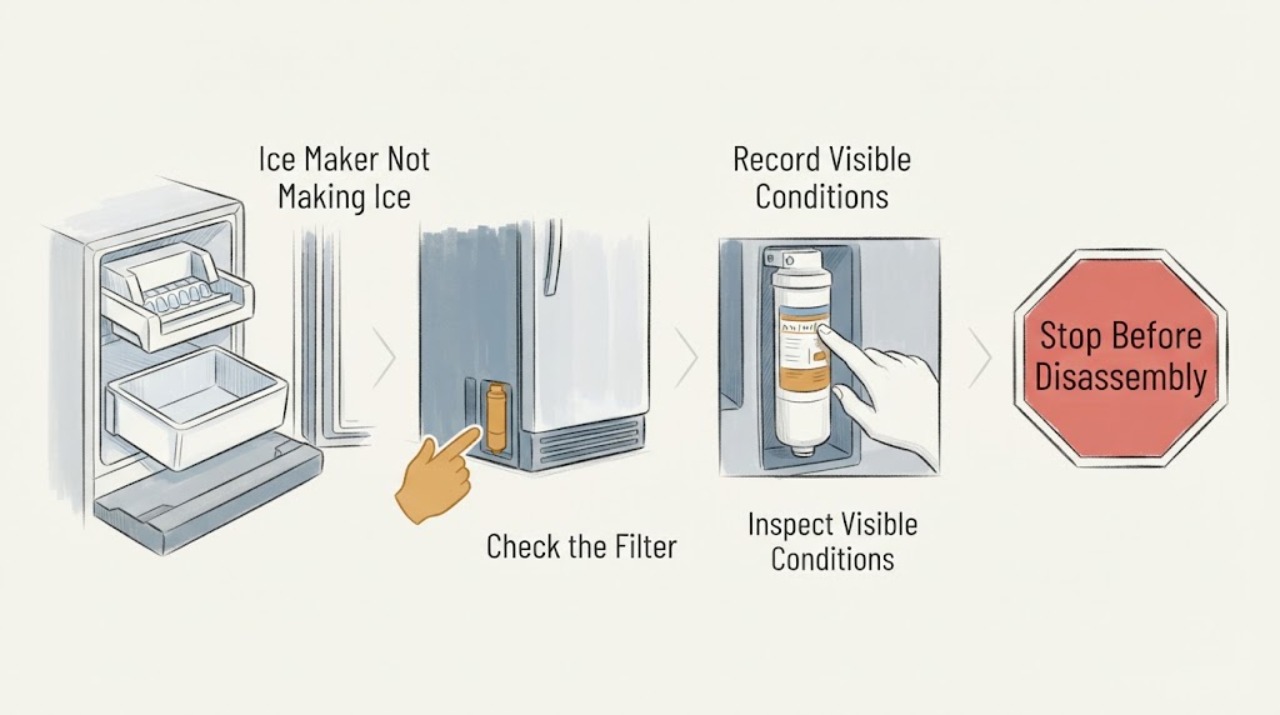
When a Thermador ice maker is not making ice, first confirm that it is on, the freezer is cold enough, the ice bin is seated, and the water path and filter are not restricted. A newly switched-on unit may need about 24 hours to begin producing and up to 72 hours for full production. Check only accessible controls, the bin, visible ice, and the water connection; do not reach into a moving mechanism or make live pressure or electrical tests. If production does not return after the documented checks, or there is a leak, damaged cord, burning odor, smoke, or repeated breaker trip, arrange qualified Thermador service.
Work through in order
Diagnostic checks
Use only checks that match the exact appliance or system and its official guide.
-
Check 1
Check the ice-maker control or display using the exact Thermador owner manual. Confirm that ice making is enabled and note any filter, temperature, bin, or error indication.
Expected result: The ice maker is off, a warning is shown, or the setting is on with no indication.
Next step: Turn it on or clear a documented indication once as the manual describes. Do not guess at a hidden service sequence.
Why this matters
Why: An off setting or model-specific warning can stop production without identifying an internal failed part. An active setting with no warning moves attention to cooling, water, bin seating, and sensor checks.
-
Check 2
Record when the ice maker was powered on or last emptied, and keep the freezer closed while it stabilizes. Compare the elapsed time with Thermador's approximately 24-hour start and 72-hour full-production guidance.
Expected result: The unit is within the startup period, has passed it with no cubes, or makes some cubes but remains below normal output after cooling.
Next step: Allow the documented period only when the freezer is operating normally. If no production returns, continue with the water and bin checks rather than repeatedly cycling power.
Why this matters
Why: Startup or a large recent draw can explain a temporary absence. No production after the stated period makes a water, temperature, bin, filter, sensor, or service issue more likely.
-
Check 3
With the ice maker stopped, remove and reseat the accessible ice bin as the manual shows. Look for a loose cube jamming the level-sensing arm and remove only accessible ice with a blunt plastic tool; never use a sharp or pointed object.
Expected result: A cube is jammed at the sensing arm, the bin is not seated, an ice shovel is left in the bin, or the bin and sensor area are clear.
Next step: Correct only the accessible bin or ice condition and observe one production period. Arrange service if the arm cannot be cleared safely or production remains absent.
Why this matters
Why: Thermador says a jammed arm, a shovel interfering with the sensor, or an incorrectly inserted built-in bin can stop production. A clear and correctly seated bin makes water, temperature, filter, or internal diagnosis more likely.
-
Check 4
Inspect the accessible water filter and filter cap for correct model fit and full rotation, then look at the visible water connection for a closed valve or kink. Shut off water before touching a connection and do not test pressure yourself.
Expected result: The filter is old, blocked, or mis-seated; the shutoff is closed or line kinked; or the filter and visible line are normal.
Next step: Replace or reseat only the model-confirmed filter and straighten a visible kink after safely shutting off water. Use a qualified person for pressure checks, leaks, or line replacement.
Why this matters
Why: Thermador identifies an incorrectly installed or blocked filter, closed valve, and kinked water line as water-delivery problems. A clear path does not prove adequate pressure or an intact inlet valve.
-
Check 5
Check the freezer temperature and cooling behavior against the owner manual without changing several settings at once. Note whether the freezer is warm, has heavy frost, or cools normally while the ice maker remains inactive.
Expected result: The freezer is too warm or unstable, heavy frost is visible, or temperature and cooling appear normal.
Next step: Use the manual to select the documented freezer setting and allow stabilization. Do not remove covers or attempt to bypass a sensor; arrange service if cooling or ice production remains abnormal.
Why this matters
Why: Thermador lists a warm freezer as a cause of poor ice production. Normal cooling with no ice shifts attention to the control, bin sensor, water path, or an internal ice-maker fault.
-
Check 6
After one controlled retest, record whether the ice maker fills, freezes, ejects, and stores ice, and whether the refrigerator has normal water dispensing. Stop for water near electrical parts, smoke, a burning odor, a damaged cord, or repeated breaker trips.
Expected result: Ice production resumes, water dispensing is also weak, the freezer is cold but no ice cycle occurs, or a safety symptom appears.
Next step: Monitor only normal production. Otherwise stop repeated testing, keep the appliance safe, and contact qualified Thermador service with the model, timing, display state, temperature, bin, and water observations.
Why this matters
Why: A resumed cycle supports an accessible setting, bin, filter, or startup condition. Weak water plus no ice points toward shared water delivery; a cold freezer with no cycle needs model-specific ice-maker diagnosis.
Use your observations
Decision map
Find the observation that best matches what you see, then follow the next safe action.
-
PATH 01Next step
What you see
The ice maker was just enabled or the freezer was recently restored, and less than approximately 24 hours have passed.
Do this next
Keep the freezer closed and allow stabilization before judging production.
Why this path and its safety boundary
Why it matters: Thermador's startup guidance allows a delay before the first ice; full output can take up to 72 hours.
-
PATH 02Next step
What you see
A bin sensor arm is jammed, an ice shovel is in the bin, or a built-in bin is not seated, and production returns after the accessible condition is corrected.
Do this next
Keep the bin correctly seated and clear of tools; arrange service if the condition recurs or cannot be cleared without reaching the mechanism.
Why this path and its safety boundary
Why it matters: The bin-level detection condition was more likely than a failed ice-maker assembly.
-
PATH 03Next step
What you see
The freezer is warm, the filter or visible water path is restricted, or water dispensing is also weak.
Do this next
Correct only the model-approved setting, filter, valve, or visible kink; use qualified help for pressure, leaks, or persistent failure.
Why this path and its safety boundary
Why it matters: Cooling or shared water delivery is more likely than an isolated ejector problem.
-
PATH 04Next step
What you see
The freezer is cold, the bin and visible water path are normal, and no ice cycle occurs after the documented startup period.
Do this next
Stop repeated cycling and arrange qualified Thermador service with the recorded observations.
Why this path and its safety boundary
Why it matters: An internal control, sensor, valve, motor, or ice-maker fault becomes more likely, but the symptom does not identify a user-replaceable part.
-
PATH 05Next step
What you see
Smoke, burning odor, a hot or damaged cord, water near electrical parts, or repeated breaker trips occurs.
Do this next
Stop using the refrigerator and disconnect power only if safe to reach. Contact qualified appliance or electrical service.
Why this path and its safety boundary
Why it matters: This is an immediate appliance and electrical safety boundary.
Helpful context
Understand the symptom
What Thermador says to check first
Thermador's refrigerator guidance names several distinct causes: an ice cube can jam the arm that senses bin level, an ice shovel can interfere with that sensor, the ice maker can be off, the freezer can be too warm, water pressure can be low, and a filter can be blocked or incorrectly fitted. On built-in units, the ice bin must be inserted correctly to activate its detection switch. These checks change the next step without proving that a particular valve, motor, or sensor has failed.
Allow the unit to cool before judging output
Thermador says a recently powered ice maker may take approximately 24 hours to start producing and 72 hours to reach full production, after which its stated output is 70 to 120 cubes per 24 hours. Keep the freezer closed while it stabilizes and use the model manual for temperature controls. Do not dismantle the ice maker or use a sharp object to clear a jam.
When checks do not resolve it
Need a professional?
Arrange qualified Thermador service when ice production remains absent after the documented startup, control, bin, filter, water, and temperature checks; when pressure, leaks, or internal components need diagnosis; or when cooling is abnormal. Do not order a valve, sensor, motor, or ice-maker assembly from the symptom alone. Stop for smoke, burning odor, damaged cord, water near electricity, or repeated breaker trips.
Common questions
FAQ
How long does a Thermador ice maker take to start making ice?
Thermador says it may take approximately 24 hours to begin producing after power is switched on, and up to 72 hours to reach full production.
Can a jammed ice cube stop a Thermador ice maker?
Yes. Thermador identifies a cube jammed in the level-sensing arm as one cause. Use only a blunt plastic tool as directed and never use a sharp object.
Does the water filter affect Thermador ice production?
A blocked or incorrectly installed filter can restrict water delivery. Check correct fit and rotation for the model, then use qualified help for pressure or leaks.
When does a Thermador ice maker need service?
Use service when the freezer is cold and the bin, filter, and visible water path are normal but no cycle occurs after startup, or when leaks and electrical symptoms appear.
Read the exact guide
Official sources
- Refrigeration - Troubleshooting GuideThermador · Thermador refrigerator and ice-maker production troubleshooting
- Refrigeration - Parts & AccessoriesThermador · Thermador model-based filter and replacement-part lookup
- Owner Support ResourcesThermador · Thermador owner manuals, model-specific guidance, service, and safety resources
Community feedback
Share a repair observation
Share a plain-text repair observation. Accepted observations are published automatically; this page may take a moment to update.