
On this page
Start here
Quick answer
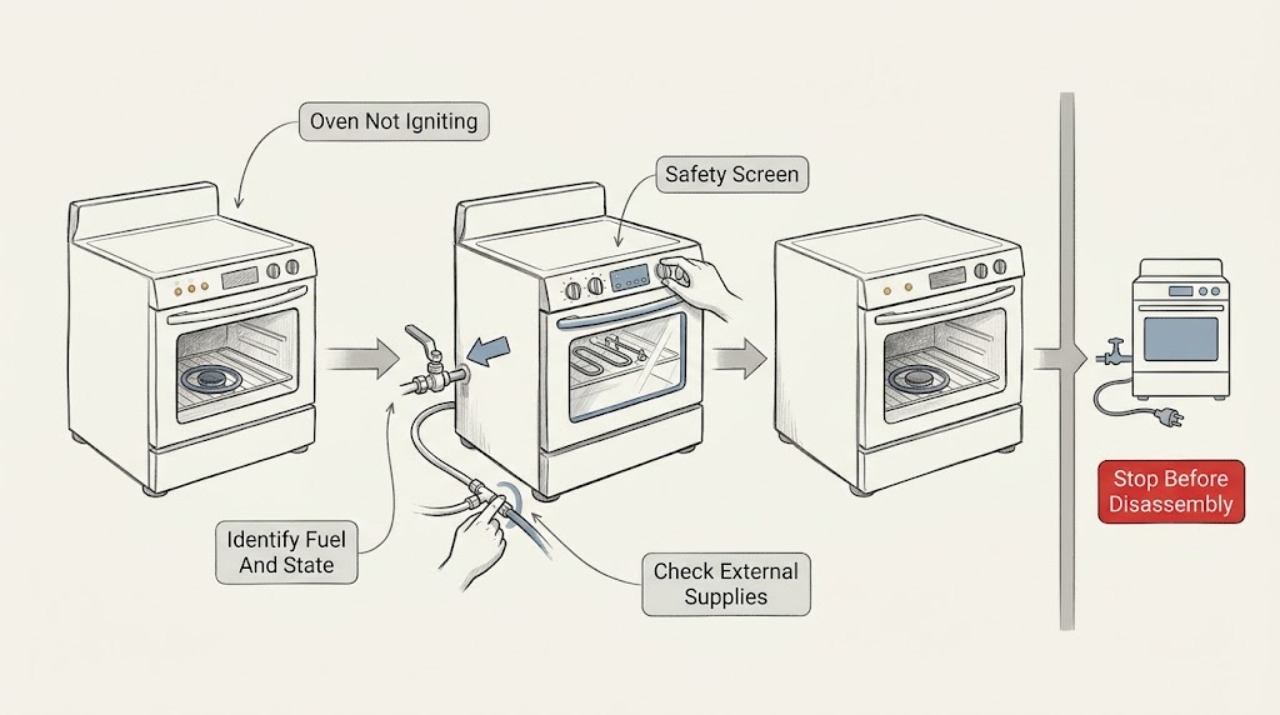
First identify whether the Thermador appliance is gas, electric, or a dual-fuel range with an oven, because an electric oven does not use a gas igniter. Record the model, selected mode, display state, and exact response: no power, no click or glow, click or glow without flame, a flame that goes out, or a delayed ignition. Check only external controls and supply conditions covered by the model manual. If you smell gas, hear a delayed whoosh or bang, see an abnormal flame, detect smoke or carbon-monoxide symptoms, or see electrical arcing, stop immediately: avoid flames and electrical switches, leave the area, and contact emergency or gas-utility support from a safe location. Do not repeatedly ignite the oven or open its panels.
Work through in order
Diagnostic checks
Use only checks that match the exact appliance or system and its official guide.
-
Check 1
Before another start attempt, assess from a safe position for gas odor, a delayed whoosh or bang, abnormal flame, smoke, carbon-monoxide alarm or symptoms, electrical sparks or arcing, a hot cord or outlet, water near electrics, or a repeated circuit trip.
Expected result: No immediate hazard is present, or a gas, fire, combustion, or electrical warning is present.
Next step: If any warning is present, do not operate the appliance. Avoid flames and electrical switches, leave by a safe route, and contact emergency or gas-utility support from a safe location. Otherwise continue without opening the oven.
Stop if: Do not attempt ignition when gas odor, delayed ignition, abnormal flame, smoke, arcing, or carbon-monoxide symptoms are present.
Why this matters
Why: A hazard changes the task to emergency safety; only a hazard-free appliance may proceed to low-risk identification checks.
-
Check 2
With the appliance cool and hazard-free, record the full model, fuel arrangement, display message, selected mode, requested temperature, timer or delay state, lock indicator, and whether the control panel has power. Confirm the fuel type from the rating information or matching Thermador manual.
Expected result: The appliance is gas, electric, or dual-fuel; the display is dark, locked, delayed, or showing an error; or the model and fuel cannot be confirmed.
Next step: Use the exact model documentation to interpret the state and select the correct cooking mode. If the fuel or model cannot be confirmed, stop and arrange model-specific support rather than guessing.
Stop if: Do not bypass a lock, force a control, or continue if the panel is wet, cracked, sparking, or repeatedly trips the circuit.
Why this matters
Why: Fuel type determines whether an ignition sequence is relevant. A dark, locked, delayed, or error state can prevent heating without proving that a burner or element has failed.
-
Check 3
Check only externally and without dismantling: verify the oven's normal power indication and accessible isolator state, and on a gas or dual-fuel model verify the accessible gas shutoff position only as the installation instructions describe. Do not move the range or manipulate internal piping or wiring.
Expected result: Power is absent, the household supply appears normal, the gas supply is clearly closed, or the supply condition cannot be confirmed safely.
Next step: Restore only a clearly interrupted normal supply through a safe, accessible control and only when the manual permits it. Have an uncertain gas or electrical installation checked by a qualified professional.
Stop if: Stop for gas odor, damaged connector, water near electrics, a hot outlet, smoke, arcing, or a repeated trip.
Why this matters
Why: No power can prevent electronic controls or ignition; a closed or uncertain fuel supply can prevent a gas flame; neither observation identifies an internal component by itself.
-
Check 4
If the model manual permits one normal start and no hazard is present, make one controlled observation without extending the attempt. For a gas or dual-fuel oven, note no response, click or spark, glow, flame, brief flame-out, persistent odor, or delayed ignition. For an electric oven, note whether the selected mode shows an active heating indication but no heat response.
Expected result: The gas oven gives no response; responds without a flame; lights briefly and goes out; or produces delayed ignition. An electric oven shows a normal command but no heat response.
Next step: Stop after the single observation, record the result, and use the matching manual or service route. For odor, delayed ignition, abnormal flame, smoke, or arcing, follow the emergency branch immediately.
Stop if: Do not relight, hold a control longer, or repeat the attempt after a bang, delayed ignition, abnormal flame, gas odor, smoke, or arcing.
Why this matters
Why: No response points toward power, controls, or the ignition command. A gas response without flame points toward fuel, burner, igniter, or safety controls. A brief flame-out or electric no-heat condition needs model-specific service diagnosis; delayed ignition or odor is unsafe to repeat.
-
Check 5
After the appliance is cool and safely isolated if required, inspect only visible, accessible areas for a wet control surface, food residue at an accessible burner opening on a gas model, a visibly displaced user-removable piece identified by the manual, or a door that does not close normally. Do not insert tools into ports or remove gas or electrical components.
Expected result: Moisture or residue is visible, a manual-identified user-removable piece is visibly mispositioned, the door does not close normally, or the visible area is clean and correctly positioned.
Next step: Follow only the exact manual's cleaning, drying, and positioning instructions, then make no more than the documented follow-up check. Otherwise record the finding for service.
Stop if: Do not scrape gas ports, spray into the appliance, dismantle a burner or igniter, or continue when a component is damaged.
Why this matters
Why: Moisture, residue, a displaced accessible piece, or a door-state issue can interfere with a start sequence; a clear exterior with continued failure points toward professional diagnosis.
-
Check 6
Only when the oven is cool, dry, hazard-free, and the exact manual documents a power reset, perform that reset once through the normal accessible control or isolator. Leave the oven idle and observe whether the display or heating fault returns; do not use the reset as an ignition test.
Expected result: The control returns to idle and remains normal, or the no-ignition condition, error, trip, odor, smoke, or abnormal flame returns.
Next step: Do not repeat the reset. Keep the oven unused and provide the technician with the model, fuel type, display, start response, supply observations, and reset result.
Stop if: Stop immediately for smoke, gas odor, burning smell, abnormal flame, arcing, water near electrics, a hot cord or outlet, or a circuit trip.
Why this matters
Why: A stable idle state may clear a temporary control state, but recurrence confirms that continued testing is not a repair for an ignition, heating, fuel, sensor, or control fault.
Use your observations
Decision map
Find the observation that best matches what you see, then follow the next safe action.
-
PATH 01Next step
What you see
The fuel arrangement or model cannot be confirmed
Do this next
Record the rating information and obtain the exact Thermador manual or model-specific support before testing.
Why this path and its safety boundary
Why it matters: The word ignition does not identify whether gas or electric troubleshooting applies.
-
PATH 02Next step
What you see
The display is dark, a lock or delay is active, or the controls do not respond
Do this next
Use only the documented lock, delay, mode, or normal supply check. If the panel remains dead or unresponsive, arrange qualified service.
Why this path and its safety boundary
Why it matters: Power or control state may prevent the start command.
-
PATH 03Next step
What you see
A gas model clicks or glows but produces no flame
Do this next
Stop after the controlled observation, do not repeat ignition, and arrange qualified gas-appliance service unless the manual identifies a clearly safe external correction.
Why this path and its safety boundary
Why it matters: Fuel delivery, burner condition, igniter position, or a safety control may need diagnosis.
-
PATH 04Next step
What you see
An electric model accepts a normal mode but does not produce heat
Do this next
Keep the oven unused after the model-specific external checks and arrange service for element, sensor, control, or wiring diagnosis. Do not open panels or measure live circuits.
Why this path and its safety boundary
Why it matters: The symptom is a heating or control fault rather than a gas ignition fault.
-
PATH 05Next step
What you see
Gas odor persists, ignition is delayed, there is a bang, abnormal flame, smoke, a gas alarm, or carbon-monoxide symptoms
Do this next
Do not operate lights, appliances, phones, or other switches in the affected area. Leave immediately and contact emergency or gas-utility support from outside; do not return until professionals say it is safe.
Why this path and its safety boundary
Why it matters: Treat this as a gas or combustion emergency, not a routine start failure.
Helpful context
Understand the symptom
Confirm what kind of oven needs to ignite
People often use “ignite” for any oven that will not begin heating. A gas oven has a fuel-and-ignition sequence; an electric oven has heating elements and a control sequence instead. Thermador also sells gas, electric, and dual-fuel products. Read the rating information and the exact manual before interpreting a click, glow, flame, or lack of heat. Do not infer the fuel type from the appearance of the range alone.
The first response changes the next check
No display or no control response points toward power, lock, or control state. A gas model that clicks or glows without a flame points toward a fuel, burner, igniter, or safety-control diagnosis. A flame that lights and goes out is different from no ignition. An electric model that shows an active mode but produces no heat needs model-specific element, sensor, or control diagnosis. A delayed whoosh, persistent gas odor, smoke, or abnormal flame is not a test result to repeat.
Use the exact Thermador support path
Thermador's support pages provide manuals, owner resources, error-code information, and service routes. Controls and ignition behavior vary by model and fuel arrangement. Record the model and the complete display message, then use that model's documentation. Do not substitute a procedure from a different Thermador range, oven, or cooktop.
Safety boundary
Stop conditions
- Stop immediately for persistent gas odor, delayed ignition, a bang, abnormal or unstable flame, smoke, a carbon-monoxide alarm or symptoms, electrical sparks or arcing, a hot cord or outlet, water near electrical parts, or repeated circuit trips.
- Do not relight repeatedly, search for a leak, open the gas circuit, remove covers, bypass a safety device, or make live electrical measurements.
- If one documented external correction or reset does not restore safe heating or ignition, leave the oven unused until qualified service diagnoses it.
Only after diagnosis
Potential parts
- gas oven igniter or ignition electrode
Only consider this class after a qualified diagnosis confirms that a gas model calls for ignition but its ignition component does not produce the expected response.
Confirm the exact model, fuel arrangement, and diagnosis before sourcing a part. - heating element or temperature sensor
Only consider this class if an electric model has a valid heat command but a qualified diagnosis finds an element or sensing fault.
Do not infer compatibility from the symptom; use exact model parts information and professional diagnosis. - oven control or gas valve
Only consider this class when a qualified technician identifies a control or fuel-valve fault after safe external checks.
Gas and electrical components are model-specific and require qualified installation.
When checks do not resolve it
Need a professional?
Arrange qualified Thermador service when the model is confirmed but the oven has no response, a gas model clicks or glows without a flame, a flame lights and goes out, an electric model does not heat, a code persists, or internal ignition, fuel, sensor, element, control, or wiring diagnosis would be required. For gas odor, delayed ignition, abnormal flame, smoke, carbon-monoxide symptoms, or active fire, leave first and contact local emergency or gas-utility support from a safe location.
Have this ready
- Complete Thermador model and serial information
- Fuel arrangement and exact cooking mode
- Display message, lock or timer state, and power indication
- Whether there was no response, a click, a glow, a flame, a brief flame-out, or no electric heat
- Any odor, delayed ignition, smoke, carbon-monoxide alarm, spark, circuit trip, and result of one documented reset
Common questions
FAQ
How do I know whether my Thermador oven is gas or electric?
Use the rating information and the exact model manual rather than appearance alone. A gas or dual-fuel model has a fuel-and-ignition sequence; an electric oven uses heating elements and does not need a gas igniter.
What does it mean if a Thermador gas oven clicks but does not light?
A click shows an ignition response, not a successful flame. Stop after one controlled observation and arrange model-specific service if there is no flame; do not keep trying, especially if gas odor or delayed ignition occurs.
What if the oven lights and then goes out?
Do not repeatedly relight it. Record whether the flame was brief or delayed, keep the oven unused, and arrange qualified service for fuel-control, sensing, ignition, or combustion diagnosis.
What should I do if I smell gas while the oven will not ignite?
Do not operate lights, appliances, phones, or other switches in the affected area. Leave immediately and contact emergency or gas-utility support from outside. Do not return or test the oven until professionals say it is safe.
Read the exact guide
Official sources
- Oven Troubleshooting for Ranges | Support | ThermadorThermador · Thermador ovens and ovens integrated into ranges; verify exact model and fuel arrangement
- NFPA Educational Messages: 2026 Edition Desk Reference for the Fire Service and Fire and Life Safety EducatorsNational Fire Protection Association · General home fuel-gas emergency safety; not a Thermador repair manual
- Service Assistance - PRG304GH/16 | THERMADOR USThermador · Official example of Thermador gas-appliance support; use the user's exact model page for applicability
Community feedback
Share a repair observation
Share a plain-text repair observation. Accepted observations are published automatically; this page may take a moment to update.