
On this page
Start here
Quick answer
First separate a gas-safety event from a normal ignition fault. If you smell gas, hear hissing, see smoke or sparks, or cannot tell whether gas is flowing, stop immediately, leave the area, avoid flames and electrical switches, and contact the gas supplier or emergency service from a safe location. If there is no gas odor or other hazard, observe whether the affected burner clicks, whether other burners work, and whether the burner cap is seated and dry. Viking's gas cooktop documentation describes electric spark ignition and directs users with no clicking to turn the control off and check only the accessible plug, fuse, or breaker; persistent no-ignition, continuous sparking, or an abnormal flame needs qualified service rather than repeated relighting.
Before you begin
Safety first
- Do not retry ignition in a suspected gas condition, manually light, move the cooktop, open gas or live electrical compartments, adjust gas pressure, use a flame to test for leaks, or bypass an ignition or safety control.
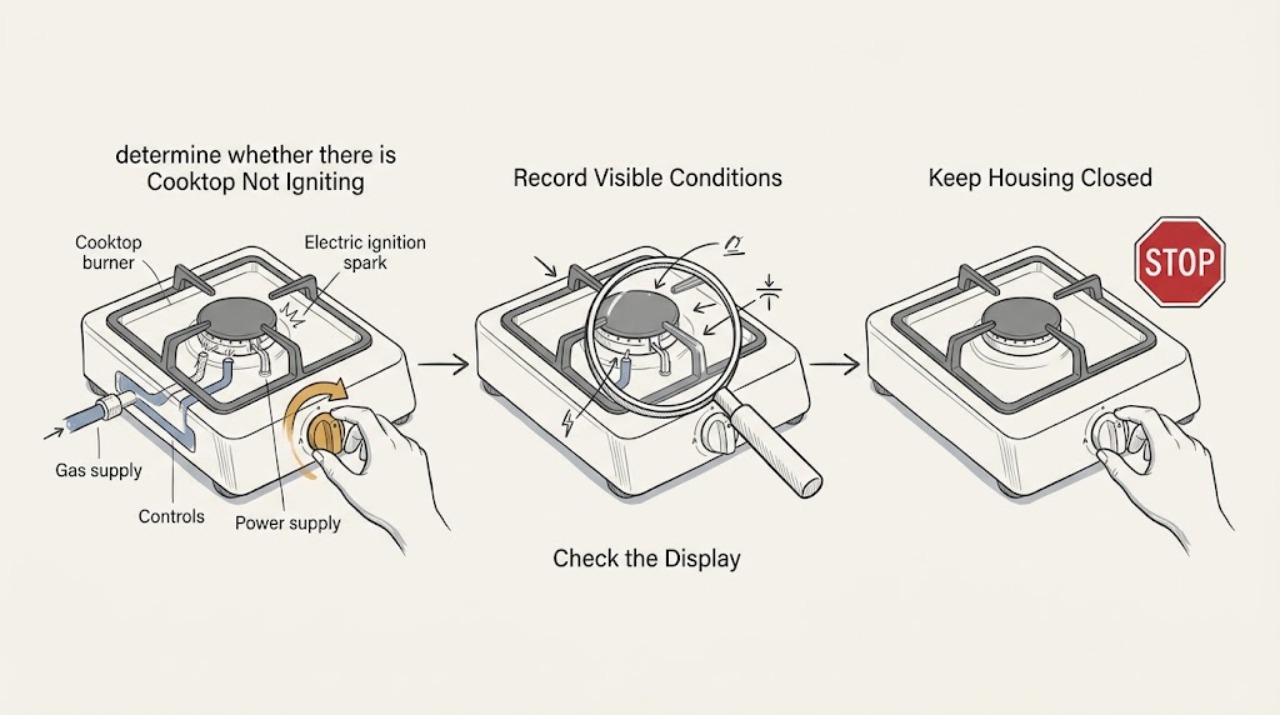
Work through in order
Diagnostic checks
Use only checks that match the exact appliance or system and its official guide.
-
Check 1
Before touching a control, determine whether there is a fuel-like odor, hissing, smoke, visible flame outside the burner, sparks, or an uncertain gas condition. If any is present, stop and leave; do not try another ignition.
Expected result: The area is hazard-free with no gas odor, hissing, smoke, sparks, or uncertainty, or one of those warning signs is present.
Next step: For any warning sign, leave and contact the gas supplier or local emergency service from a safe location. Only if the area is cleared and hazard-free may you continue with external observations.
Stop if: Stop immediately for any renewed gas odor, hissing, smoke, flame outside the burner, sparks, or physical/electrical damage.
Why this matters
Why: A gas or fire hazard must be handled before troubleshooting. A no-ignition symptom does not make repeated gas flow or an ignition test safe.
-
Check 2
With the controls off, identify whether the appliance is a gas cooktop with burner grates and gas valves, or an induction/radiant model with a glass surface and electronic zones; record the model from a safe, accessible label if available.
Expected result: The appliance has gas burners and a gas shutoff, or it has induction/radiant zones and no gas burner assembly; the model or fuel type is known or unknown.
Next step: Use the matching Viking owner's manual. If the fuel type is uncertain, do not operate the appliance and ask qualified service to identify it.
Stop if: Stop if identifying the type would require moving the cooktop, removing panels, opening a gas connection, or exposing wiring.
Why this matters
Why: A gas cooktop's no-ignition path involves gas flow and spark ignition, while induction/radiant models do not ignite a flame. Applying the wrong model procedure can create a hazard.
-
Check 3
Only when the gas area is confirmed safe and the exact manual permits a normal control observation, note whether the affected burner produces the normal ignition click, whether other burners click, and whether a flame appears without delay. Do not hold the control on while gas accumulates.
Expected result: No burner clicks, all burners click but the affected burner has no flame, only one burner fails, the igniter clicks continuously after a flame appears, or an ignition produces an abnormal flame.
Next step: Turn the control off. For no click, proceed only to the accessible power check. For a single burner or clicking-without-flame, allow the area to remain off and arrange qualified inspection if the safe external checks do not resolve it.
Stop if: Stop after one controlled observation; never cycle the knob repeatedly, manually light the burner, or continue if gas odor or abnormal flame appears.
Why this matters
Why: No click suggests the power or shared ignition path; clicking without flame suggests gas delivery, burner alignment/moisture, or an internal fault; continuous clicking or an abnormal flame requires stopping rather than repeated attempts.
-
Check 4
If there was no ignition click and there is no gas or fire hazard, turn all cooktop controls off and check only the accessible plug, household fuse, or circuit breaker as described by the exact Viking installation instructions. Do not remove a cover or probe wiring.
Expected result: The plug is not seated, a fuse is open, a breaker is tripped, or accessible power appears normal while the igniters remain silent.
Next step: Correct only an obvious accessible connection or one safe breaker/fuse condition allowed by the manual. If a breaker trips again, power is uncertain, or the igniters stay silent, keep the cooktop off and arrange qualified service.
Stop if: Stop for repeated trips, hot or damaged wiring, a scorched plug, exposed conductors, moisture near electricity, or any need to open the appliance.
Why this matters
Why: Viking identifies connection, fuse, and breaker status as possible reasons for no igniter click. A normal accessible supply shifts the fault toward the ignition/control circuit but does not prove which component failed.
-
Check 5
With all controls off and the burner cool, inspect only the visible burner cap and grate position. If the model manual allows user cleaning, let moisture dry fully and remove only visible spill residue without enlarging ports or disturbing gas fittings.
Expected result: The cap is visibly tilted, the burner is wet or dirty, ports have visible residue, or the burner appears correctly seated but still will not light; no gas odor is present.
Next step: Correct only the visible placement or cleaning step explicitly supported by the exact manual, allow the burner to dry, and arrange service if the fault persists. Do not use a flame to test for leaks or poke/reshape a port.
Stop if: Stop if the burner is damaged, a fitting is loose, the area smells of gas, the flame is yellow/noisy/lifting, or cleaning would require removing gas parts.
Why this matters
Why: A cap that is not seated or a wet/obstructed visible burner can interfere with flame formation, but the observation cannot rule out a gas valve, igniter, supply, or control fault.
-
Check 6
Arrange qualified Viking appliance or gas service when no ignition remains after the safe external checks, when a burner clicks without flame, when one burner repeatedly fails, or when clicking continues after ignition. Give the technician the exact model and symptom sequence.
Expected result: The fault is resolved by an allowed external correction, or it remains, returns, or is accompanied by continuous sparking, delayed ignition, abnormal flame, odor, or an electrical trip.
Next step: Keep the cooktop out of service and provide the model, fuel type, affected burner, click pattern, power observation, visible burner condition, and any gas/fire warning to qualified service. Follow the professional's restart clearance.
Stop if: Do not bypass ignition safeguards, adjust gas pressure, manually relight after suspected gas accumulation, open panels, or keep operating an appliance with an unresolved fault.
Why this matters
Why: A persistent or hazardous ignition symptom may involve gas supply, valve, igniter, burner, grounding, control, or wiring. The symptom alone is not enough to select a replacement part safely.
Use your observations
Decision map
Find the observation that best matches what you see, then follow the next safe action.
-
PATH 01Next step
What you see
Gas odor, hissing, smoke, sparks, or uncertainty about gas flow is present.
Do this next
Leave, avoid flames, electrical switches, and phone use inside, and contact the gas supplier or emergency service from a safe location.
Why this path and its safety boundary
Why it matters: This is an immediate gas or fire safety stop, not a normal ignition troubleshooting branch.
-
PATH 02Next step
What you see
No burner produces the expected click and no gas or fire hazard is present.
Do this next
Turn controls off and check only the accessible plug, fuse, or breaker. Persistent silence requires qualified service.
Why this path and its safety boundary
Why it matters: The accessible electrical supply or a shared ignition/control path is more relevant than a single burner port.
-
PATH 03Next step
What you see
The igniter clicks but the affected burner does not produce a flame, with no odor or other emergency sign.
Do this next
Turn the control off, perform only the allowed cool, visible cap/moisture check, and arrange qualified service if it persists.
Why this path and its safety boundary
Why it matters: Gas delivery, visible burner condition, or the appliance ignition path may need diagnosis; do not keep supplying gas while testing.
-
PATH 04Next step
What you see
Other burners work but one Viking burner repeatedly fails to ignite.
Do this next
With controls off and the burner cool, follow the exact manual's visible cleaning/seating instruction once; persistent failure needs service.
Why this path and its safety boundary
Why it matters: A localized cap, moisture, port, igniter, valve, or burner-path issue is possible, but the exact part is not established.
-
PATH 05Next step
What you see
Igniters continue sparking after flame ignition, or the burner does not settle into normal operation.
Do this next
Turn the control off. If the behavior continues or gas odor or abnormal flame appears, isolate the hazard only as directed by qualified personnel and arrange service.
Why this path and its safety boundary
Why it matters: Stop using that burner; continuous sparking can indicate moisture, grounding/polarity, control, or ignition trouble.
-
PATH 06Next step
What you see
A burner lights with a large, distorted, yellow, noisy, lifting, or otherwise abnormal flame.
Do this next
Turn the control off if it is safe, keep the cooktop out of service, and request qualified gas-appliance service. Leave immediately for odor, hissing, smoke, or fire.
Why this path and its safety boundary
Why it matters: Stop cooking; the flame or gas/air condition needs qualified evaluation rather than adjustment by guesswork.
-
PATH 07Next step
What you see
The plug, fuse, or breaker is abnormal, or a breaker trips again after a reset.
Do this next
Do not repeatedly reset or open the cooktop. Keep it off and arrange qualified electrical or appliance diagnosis.
Why this path and its safety boundary
Why it matters: The ignition circuit or household supply may be unsafe or uncertain.
Helpful context
Understand the symptom
Do the gas-safety screen before any ignition check
A burner that does not light can leave gas unburned, so do not keep turning the knob while trying to diagnose it. A fuel-like odor, hissing, smoke, sparks, or an uncertain gas condition changes the response to evacuation and qualified help. If none of those hazards is present, you can make a few external observations with all controls off, but you should not open gas or live electrical compartments.
No click and no flame are different symptoms
Viking's automatic electric spark system should produce a clicking sound when a burner is commanded on. No click points first toward the electrical ignition path or its accessible supply; clicking without a flame points toward gas supply, burner alignment, moisture, contamination, or an internal fault. These observations narrow the service handoff but do not identify a part for a do-it-yourself replacement.
Keep model differences in the decision
Viking has gas, induction, and other cooktop families, and controls and ignition details vary by model. This page addresses a gas-style no-ignition symptom while explicitly separating electric or induction behavior. Use the exact owner's manual for a model-specific control sequence; do not treat a gas burner instruction as an instruction for an induction or radiant model.
Safety boundary
Stop conditions
- Any gas odor, hissing, suspected unburned gas, or uncertainty about whether gas is flowing.
- Smoke, fire, sparks, scorching, burning-electrical odor, exposed wiring, or a hot or damaged plug or connection.
- Continuous sparking, delayed ignition, no flame after gas flow, or a large, yellow, distorted, noisy, or lifting flame.
- A breaker trips again, power is uncertain, or diagnosis would require opening live electrical or gas compartments.
- Moving the cooktop, disconnecting a connector, adjusting gas pressure, using an open flame to test, bypassing an ignition safeguard, or manually relighting after gas may have accumulated.
When checks do not resolve it
Need a professional?
Leave and contact the gas supplier or emergency service from a safe location for gas odor, hissing, suspected unburned gas, smoke, or fire., Arrange qualified Viking appliance or gas service for persistent no-ignition, clicking-without-flame, continuous sparking, a repeated one-burner failure, or an abnormal flame., Use qualified electrical or appliance service for repeated breaker trips, damaged wiring, scorched connections, or an unexplained no-click condition., Provide the exact model, fuel type, affected burner, click pattern, visible burner condition, and any emergency responder instructions.
Safety scope: Do not retry ignition in a suspected gas condition, manually light, move the cooktop, open gas or live electrical compartments, adjust gas pressure, use a flame to test for leaks, or bypass an ignition or safety control.
Common questions
FAQ
Why is my Viking cooktop not igniting but still clicking?
Clicking means the electric ignition path is attempting to spark, but the burner may still have a gas-supply, visible cap/moisture, burner-path, or internal fault. Turn the control off, never keep feeding gas while testing, and arrange qualified service if a safe external check does not resolve it.
What if my Viking cooktop makes no clicking sound at all?
With every control off and no gas or fire hazard, check only the accessible plug, fuse, or breaker as the Viking manual describes. If power is normal or a breaker trips again, do not open the cooktop; request qualified electrical or appliance service.
Can I light a Viking burner with a match if the igniter fails?
Do not use a manual-lighting workaround while diagnosing a no-ignition fault, especially if gas may have accumulated or the model instructions are unknown. Stop for any gas odor and obtain qualified guidance for the exact model.
Why does the Viking igniter keep clicking after the flame starts?
Continuous clicking can be associated with moisture, grounding or polarity, control, or ignition trouble, and the exact cause is model-specific. Turn the control off and arrange service; stop immediately for gas odor, abnormal flame, smoke, or sparks.
What should I do if the Viking burner lights with a yellow or distorted flame?
Stop using that burner and arrange qualified gas-appliance service. Do not adjust gas pressure or keep testing; leave immediately for gas odor, hissing, smoke, or fire.
What should I do if I smell gas while the Viking cooktop will not ignite?
Stop immediately, leave the building, avoid flames and electrical switches, and contact the gas supplier or emergency service from a safe location. Do not retry ignition or use a phone inside.
Read the exact guide
Official sources
- Certain Older Gas Connectors May Be DangerousU.S. Consumer Product Safety Commission · CPSC gas-safety guidance for suspected appliance leaks; it is not a Viking model-specific ignition manual.
- Viking Use & Care ManualViking Range Corporation · Official Viking manual for a built-in gas-rangetop family; exact model documentation controls for a particular cooktop.
- Viking Range | 36"W. Gas CooktopViking Range, LLC · Official product page for a Viking gas-cooktop family; it supports identifying gas and spark-ignition architecture but not every model's troubleshooting sequence.
Community feedback
Share a repair observation
Share a plain-text repair observation. Accepted observations are published automatically; this page may take a moment to update.