
On this page
Start here
Quick answer
A Viking oven that will not start should first be separated into a completely blank appliance and an appliance with a display that will not begin a cycle. Record the exact model, oven or range configuration, fuel type, display or error state, and whether the problem appears at mode selection, Start, preheat, or ignition. Check the normal mode, temperature, clock, delay, control-lock, door, and visible power status without opening the appliance. Gas-supply and ignition checks apply only to gas or dual-fuel models; electric ovens use a different heating path. If there is gas odor, delayed ignition or a boom, abnormal flame, carbon-monoxide alarm or symptoms, smoke, arcing, uncontrolled heat, a hot or damaged outlet, or a repeated breaker trip, stop immediately. Use at most one model-authorized reset when the oven is dry and safe; if it remains inactive, leave it off and arrange qualified Viking service.
Before you begin
Safety first
- This article supports identity checks, normal controls, visible power observation, one brief manual-authorized start observation, and one exact-manual reset only. It does not authorize manual lighting, gas work, live electrical testing, panel removal, lock bypass, appliance movement, or parts replacement.
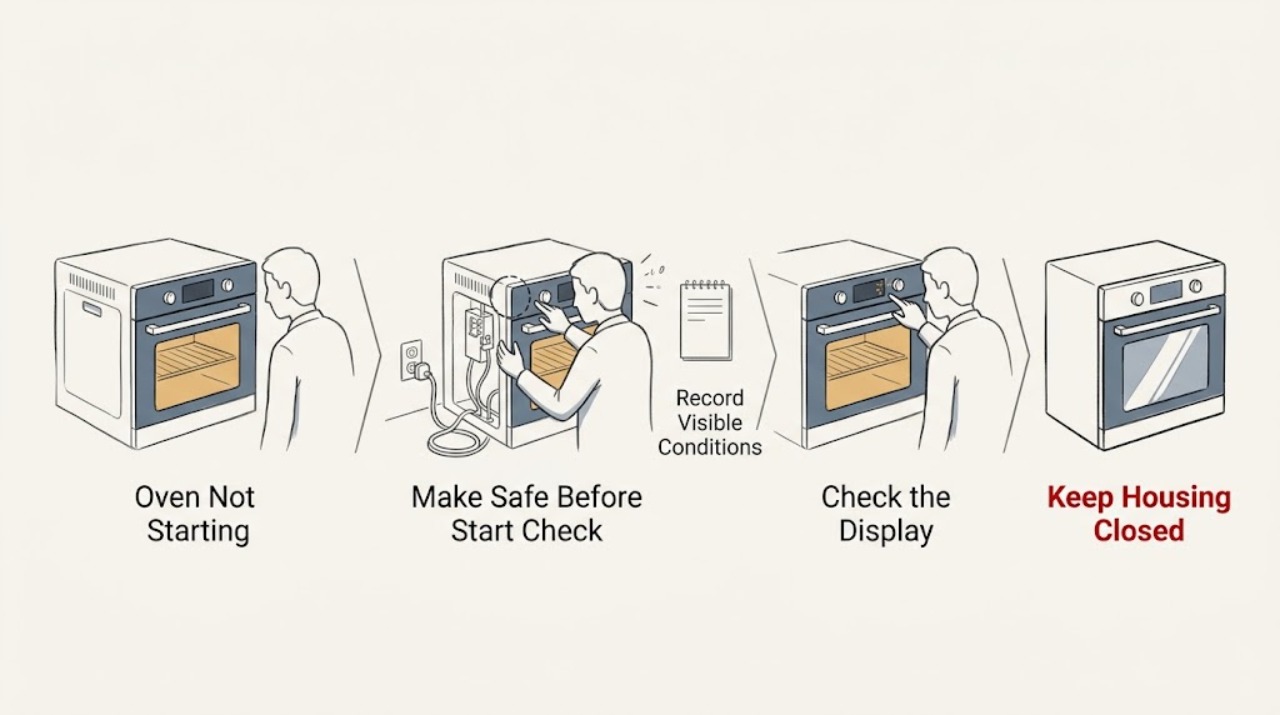
Work through in order
Diagnostic checks
Use only checks that match the exact appliance or system and its official guide.
-
Check 1
Stop using the oven and assess from a safe position for gas odor, smoke, fire, carbon-monoxide alarm or symptoms, delayed ignition or a boom, abnormal flame, electrical arc, uncontrolled heat, a hot or damaged cord or outlet, water near electrical parts, or a tripped breaker.
Expected result: The oven is simply inactive with no hazard signs, or one of the gas, combustion, fire, heat, or electrical warning signs is present.
Next step: For a hazard, follow the matching stop condition and do not try to start the oven. If the area is quiet and safe, record the display and controls before continuing.
Stop if: Do not operate switches or flames in a suspected gas leak, touch wet electrical equipment, or re-energize an oven with smoke, arcing, uncontrolled heat, or visible damage.
Why this matters
Why: A quiet start failure permits limited user-control checks. A hazard is not a normal start problem and requires immediate isolation and emergency or qualified-service response.
-
Check 2
Record the Viking model or product identifier, whether the appliance is a wall oven or a range oven, electric, gas, or dual-fuel configuration, the display state, every error code or indicator, and the point at which the start attempt stops.
Expected result: The model, fuel type, appliance category, and operating stage are confirmed, or one of them can only be obtained by moving or opening the appliance.
Next step: Use the exact identity in Viking's documentation archive and keep a photo or transcription of the display for service. If identity cannot be confirmed safely, stop at documentation and service.
Stop if: Do not pull out a built-in oven, move a range, remove panels, or disturb gas or electrical connections to obtain a model number.
Why this matters
Why: Viking has multiple oven and range families with different controls and heating paths. Without the identity, a reset, code explanation, or gas-versus-electric diagnosis would be guesswork.
-
Check 3
From a dry, safe position, note whether the display and interior-light or control indicators are completely blank, intermittently rebooting, or powered but unresponsive; note any recent outage or breaker event without repeatedly toggling the circuit.
Expected result: The oven has no visible power, the display reboots, the display is powered but controls do not respond, or the controls appear normal.
Next step: Check only the home's normal visible breaker and outlet status when there is no hazard. Leave a blank, unstable, or repeatedly tripping oven off for qualified electrical or Viking service.
Stop if: Do not test live terminals, hold a breaker on, replace a fuse with a larger rating, remove an electrical cover, or continue after a hot outlet, burning odor, arc, or repeat trip.
Why this matters
Why: A blank or unstable display points toward supply or control diagnosis. A powered but locked or unresponsive control points toward settings, control state, door interlock, or a fault code rather than a gas or heating test.
-
Check 4
Using only normal user controls and the exact Viking manual, confirm the intended Bake, Broil, or other applicable mode, temperature, clock requirement, Start action, delay or timed-start state, control lock, showroom or demonstration state if the model documents one, and normal door position.
Expected result: The control accepts a mode and temperature, a lock/delay/clock state blocks Start, a code appears, the door is not recognized as closed, or the display remains inactive.
Next step: Follow the exact manual's low-risk user procedure for the identified setting. If the control remains inactive, the door state is abnormal, or a code returns, leave the oven off and arrange service.
Stop if: Do not bypass a door or control lock, force the door, repeatedly cycle power, or select a long heat or self-clean cycle merely to test Start.
Why this matters
Why: A mode, clock, delay, lock, showroom state, or door condition can prevent a cycle request. A code or unresponsive control requires model-specific documentation; it does not identify a part by itself.
-
Check 5
With the oven cool and the door or range controls accessible normally, confirm that the door closes and latches as designed, the selected mode remains displayed, and no heating or flame begins without a normal command; do not disassemble the latch or reach into the cavity.
Expected result: The door is not recognized as closed, the oven starts then cancels, the oven begins heating unexpectedly, or the door and controls behave normally but no heat request begins.
Next step: Leave the oven off and arrange Viking service for an abnormal latch, unexpected heating, or a start request that does not progress. Do not reproduce unexpected heating.
Stop if: Do not bypass or defeat a door switch, operate with a damaged seal or glass, touch hot elements or flame, or continue after unexpected heat, smoke, or a burning odor.
Why this matters
Why: A door or latch interlock can inhibit a start sequence. Unexpected heating is a safety fault. A normal door and control response with no start moves the diagnosis toward power, fuel, ignition, heating, or control service.
-
Check 6
Only for a confirmed gas or dual-fuel model, and only when there is no gas odor or other hazard, note whether other gas appliances have normal supply if that observation is already safe; confirm only the normal user-accessible control position. Do not manipulate a connector, regulator, meter, hidden valve, or appliance position.
Expected result: Other gas appliances also lack supply, other appliances work normally, or supply status cannot be established without touching gas equipment or moving the oven.
Next step: For a wider interruption, contact the gas supplier or qualified service. For normal supply elsewhere, proceed only to one brief model-authorized ignition observation; if supply cannot be safely assessed, arrange service.
Stop if: Do not relight an appliance as a test, look for a leak, adjust gas pressure, move the appliance, or touch a gas connector or hidden shutoff.
Why this matters
Why: A wider supply interruption points outside the oven. Normal supply elsewhere makes an oven-specific control or ignition issue more plausible, but it does not prove a valve, igniter, or burner failure.
-
Check 7
Only after the exact manual permits ordinary operation and all safety checks are clear, make one brief start attempt using the normal controls and observe from outside the cavity; do not manually light a gas oven, repeat the attempt, or run a long cooking or cleaning cycle.
Expected result: An electric oven shows no heat request, a gas oven gives no ignition sign, gas clicks without flame, a flame lights then goes out, ignition is delayed, or the oven begins heating normally.
Next step: Turn the oven off. Record the exact result and arrange qualified Viking service for no-start, no-ignition, flame-out, or abnormal heating; a normal result does not justify extended testing if the failure returns.
Stop if: Stop immediately for gas odor, delayed ignition, a pop or boom, abnormal flame, smoke, carbon-monoxide alarm or symptoms, arcing, uncontrolled heat, or a repeat breaker trip. Never use a match or lighter.
Why this matters
Why: The result separates a no-request symptom from an ignition or heating-path symptom, but it does not identify an internal part. Clicking without flame, flame-out, delayed ignition, or abnormal heat requires service and no further testing.
-
Check 8
Only if the appliance is dry, cool, free of hazard signs, and the exact Viking manual authorizes a user reset for the recorded state, perform one normal reset; do not open the appliance or use repeated breaker cycling as a repair.
Expected result: The display and controls return normally, the same no-start condition returns, a code reappears, or the oven behaves unexpectedly after the reset.
Next step: Record the before-and-after state. If the fault returns or the oven behaves abnormally, keep it off and provide the model, fuel type, code, stage, and reset result to Viking service.
Stop if: Do not repeat resets, hold a breaker on, re-energize after a trip, or continue with unexpected heat, smoke, odor, arcing, or a damaged cord or outlet.
Why this matters
Why: A reset can clear a transient control state but cannot prove that a door, sensor, heating element, ignition system, gas supply, or control fault is repaired.
-
Check 9
Prepare a service note with the Viking model, oven or range category, fuel type, display or code, mode and temperature, clock/lock/delay state, door result, visible power state, gas or electric observation, one reset result, and every safety symptom; add a photo only when safe.
Expected result: The identity and failure timeline are complete, or the model, fuel type, code, or start behavior remains unknown.
Next step: Use Viking's official support and documentation route or a qualified appliance service provider. State which facts are unknown rather than naming a failed part.
Stop if: Do not order or replace a control board, igniter, valve, sensor, element, fuse, or burner from the symptom alone, and do not open the oven to confirm a suspected part.
Why this matters
Why: A precise record lets a qualified technician use the correct Viking documentation and distinguish power, control, door, gas, ignition, heating, and safety-system paths without repeated hazardous testing.
Use your observations
Decision map
Find the observation that best matches what you see, then follow the next safe action.
-
PATH 01Safety boundary
What you see
Gas odor, smoke, fire, a delayed ignition or boom, abnormal flame, carbon-monoxide alarm or symptoms, or suspected gas leak is present.
Do this next
Do not operate switches, flames, phones, or electrical equipment in the area. Leave by foot and contact emergency or gas services from a safe location.
Why this path and its safety boundary
Why it matters: This is an immediate gas, combustion, or fire safety problem, not a normal start troubleshooting path.
Safety stop: Do not look for the leak, relight the oven, move the appliance, or re-enter until the appropriate professional says it is safe.
-
PATH 02Safety boundary
What you see
The display is blank or rebooting, a breaker trips again, there is arcing, a hot or damaged outlet or cord, water near electrical parts, or heat begins without a normal command.
Do this next
Keep the oven off and arrange qualified electrical or Viking service. Do not reproduce the symptom.
Why this path and its safety boundary
Why it matters: The oven has an electrical or control-safety boundary that cannot be resolved by repeated Start attempts.
Safety stop: Do not test live wiring, hold a breaker on, remove covers, or continue after visible electrical damage.
-
PATH 03Safety boundary
What you see
The display and indicators remain blank or unstable, or the oven has power but controls will not respond after normal settings are checked.
Do this next
Use only visible normal power checks and the exact Viking manual. Leave the oven off and arrange qualified service if power does not remain stable or controls remain inactive.
Why this path and its safety boundary
Why it matters: The start request cannot be separated safely between supply, control, lock, and model-specific fault paths.
Safety stop: Do not remove electrical panels, test terminals, or repeatedly cycle power.
-
PATH 04Safety boundary
What you see
The display is powered but a clock, delay, control lock, showroom state, mode, Start action, or door/latch condition prevents the cycle from beginning.
Do this next
Follow the exact model manual's normal control or latch procedure. If the state cannot be cleared or returns, arrange service.
Why this path and its safety boundary
Why it matters: The oven may be waiting for a documented user action rather than failing to heat.
Safety stop: Do not bypass locks, force the door, or start a high-heat cycle to test a setting.
-
PATH 05Safety boundary
What you see
A confirmed gas or dual-fuel oven receives a normal start request but gives no ignition sign, clicks without a flame, loses the flame, or ignites late.
Do this next
Turn the oven off, make no further ignition attempts, and arrange qualified Viking service with the exact sequence and fuel configuration.
Why this path and its safety boundary
Why it matters: Gas supply, ignition, flame sensing, combustion, or a safety control may be involved; the observation does not identify a replaceable part.
Safety stop: Stop immediately for odor, delayed ignition, a pop or boom, abnormal flame, smoke, or carbon-monoxide symptoms; never manually light the oven.
-
PATH 06Safety boundary
What you see
An electric or dual-fuel oven accepts the intended mode and Start command but does not begin the expected heating or repeatedly cancels without a setting explanation.
Do this next
Leave the oven off and arrange qualified Viking service; provide the exact model, mode, display state, and one brief observation.
Why this path and its safety boundary
Why it matters: Power delivery, control, door sensing, temperature sensing, heating elements, or another model-specific safety path needs diagnosis.
Safety stop: Do not run a long cooking or self-clean cycle, test live terminals, or replace an element or fuse from the symptom alone.
-
PATH 07Safety boundary
What you see
One safe, model-authorized reset does not restore normal Start behavior, the same code or condition returns, or the oven behaves unexpectedly.
Do this next
Keep the oven off and give Viking service the model, fuel type, code, operating stage, settings, and reset result.
Why this path and its safety boundary
Why it matters: The problem is not established as a transient control state and requires model-specific service.
Safety stop: Do not repeat resets, bypass safety devices, or open the oven to continue testing.
Helpful context
Understand the symptom
Blank display and inactive controls are different problems
If the display and indicators are completely blank, begin with visible power and do not assume the oven itself is the cause. If the display is lit but Start does nothing, check the mode, clock, delay, control lock, door state, and exact manual. Viking's documentation archive covers several oven and range families, including gas, dual-fuel, and electric models, so a procedure for one product cannot be transferred to another.
Fuel type determines which observations are relevant
On an electric oven, a normal control request with no heat points toward power, control, door, sensor, or heating-system diagnosis. On a gas or dual-fuel model, a normal control request may be followed by an ignition sequence, but a gas valve, flame, or ignition symptom must not be tested by manual lighting or repeated attempts. Confirm the fuel configuration from the rating label or manual without moving the appliance.
Use the model manual and preserve the failure state
Record any code, flashing indicator, unusual beep, selected mode, temperature, and operating stage before resetting. Viking's support center and documentation archive are the appropriate sources for the exact manual and service route. A cleared display after one authorized reset is not proof that the oven is safe to cook with; recurring inactivity, unexpected heat, or a code requires service.
Safety boundary
Stop conditions
- Stop immediately for gas odor, smoke, fire, carbon-monoxide alarm or symptoms, delayed ignition, a pop or boom, abnormal flame, electrical arcing, uncontrolled heating, water near electrical parts, a hot or damaged cord or outlet, or a repeated breaker trip.
- If gas is suspected, leave the area by foot and contact emergency or gas services from a safe location; do not operate switches, phones, flames, or electrical equipment in the affected area.
- Do not manually light a gas oven, repeat ignition tests, look for a leak, move the appliance, adjust gas pressure, test live wiring, remove panels, or bypass a door or control safety.
- Do not force a door, run a long cooking or self-clean cycle to reproduce the problem, or hold a breaker on after it trips.
- Leave the oven off and arrange qualified Viking service when the display is blank or unstable, Start remains inactive after settings are checked, a code returns, no heat or ignition occurs after one safe observation, or the fuel and model cannot be confirmed.
When checks do not resolve it
Need a professional?
Arrange qualified Viking appliance service when the oven remains blank or unresponsive, the same code or no-start condition returns after one model-authorized reset, the door or controls behave abnormally, an electric oven accepts a heat request but does not heat, or a gas oven gives no ignition, loses its flame, or ignites abnormally. Use emergency or gas-service channels from a safe location for gas odor, fire, smoke, delayed ignition, abnormal flame, or suspected carbon-monoxide exposure.
Safety scope: This article supports identity checks, normal controls, visible power observation, one brief manual-authorized start observation, and one exact-manual reset only. It does not authorize manual lighting, gas work, live electrical testing, panel removal, lock bypass, appliance movement, or parts replacement.
Common questions
FAQ
Why is my Viking oven completely blank?
A blank display points first toward visible power or control-supply symptoms, while a lit display that will not Start points toward settings, lock, door, or model-specific control behavior. Note the display and breaker history without testing live wiring or repeatedly cycling power.
Why does my Viking oven have power but not start?
Check the exact manual's mode, temperature, clock, delay, control-lock or showroom state, Start action, and door/latch requirements. If the controls remain inactive, a code returns, or the door behaves abnormally, leave the oven off and arrange service.
Does a Viking gas oven require a different check from an electric oven?
Yes. Gas or dual-fuel models add supply and ignition behavior, while electric ovens use a heating-element path. Confirm the fuel configuration and model before interpreting a no-start symptom, and never manually light or disassemble a gas oven.
Can I reset my Viking oven?
Only when the appliance is cool, dry, free of hazard signs, and the exact Viking manual authorizes a reset for the recorded state. Perform one reset, record the result, and stop if the condition returns or the oven behaves unexpectedly.
When is a Viking oven that will not start an emergency?
Gas odor, smoke, fire, delayed ignition or a boom, abnormal flame, carbon-monoxide alarm or symptoms, arcing, uncontrolled heat, water near electrical parts, a hot or damaged outlet, or a repeated breaker trip requires an immediate stop. Leave the area when gas or fire is suspected and contact the appropriate service from a safe location.
Read the exact guide
Official sources
- Certain Older Gas Connectors May Be DangerousU.S. Consumer Product Safety Commission · U.S. CPSC consumer gas-appliance safety guidance; local gas and emergency procedures also apply.
- Viking Range, LLC | Support and Docs | DocumentationViking Range, LLC · Official Viking documentation archive; the exact model's manual controls the applicable start, fuel, lock, and reset procedure.
- Viking Range, LLC | Support and Docs | Support CenterViking Range, LLC · Official Viking support center for owner troubleshooting and service pathways.
Community feedback
Share a repair observation
Share a plain-text repair observation. Accepted observations are published automatically; this page may take a moment to update.