
On this page
Start here
Quick answer
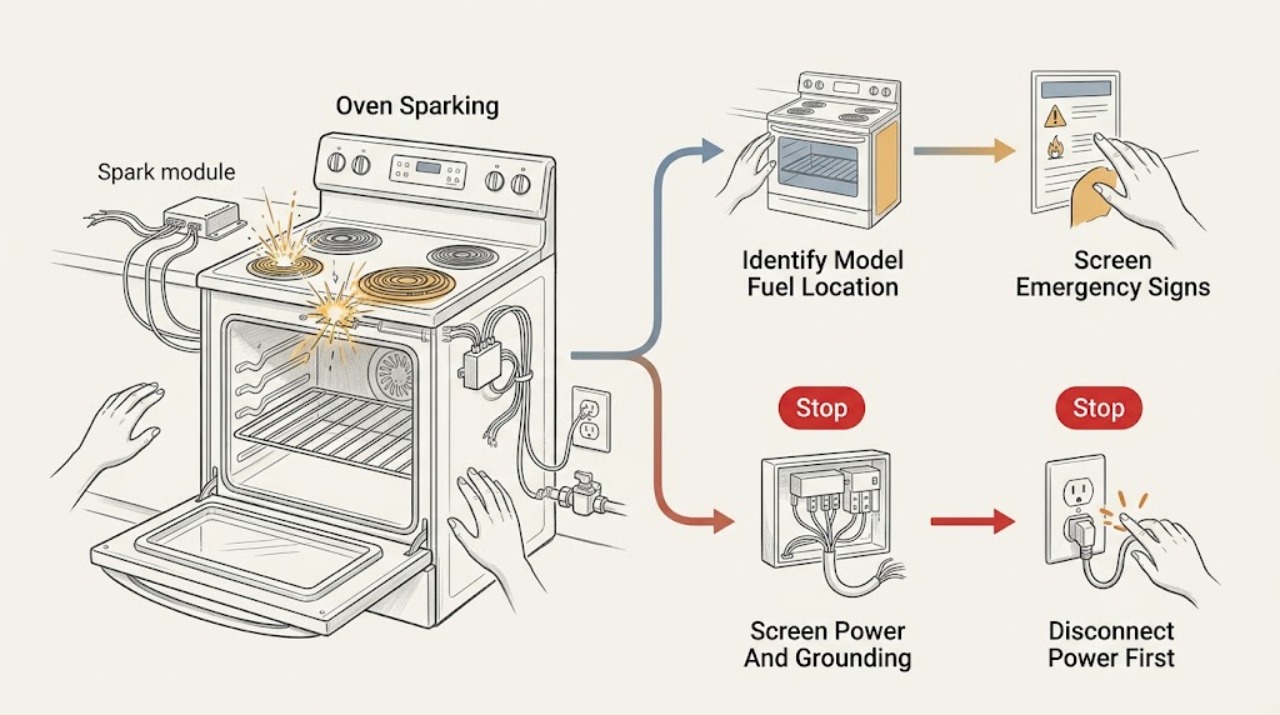
A brief click or visible spark can be part of normal burner ignition on some Viking gas or dual-fuel models, but sparking anywhere else or sparking that continues after a flame appears is not a safe user-level test. First identify the exact model, fuel configuration, oven cavity, and location of the spark. Stop immediately for gas odor, continuous clicking with no flame, delayed ignition, a whoosh or boom, abnormal flame, smoke, soot, burning plastic smell, arcing, a hot outlet or cord, uncontrolled heat, or a repeated circuit trip. Turn the oven off; if gas odor is strong or persistent, leave without operating switches or ignition sources and contact the gas utility or emergency service from a safe location. Do not open panels, scrape an igniter, adjust gas parts, relight repeatedly, or keep testing an electrical arc.
Work through in order
Diagnostic checks
Use only checks that match the exact appliance or system and its official guide.
-
Check 1
From a safe position, record the Viking model and serial information, whether the appliance is gas, electric, or dual-fuel, the oven cavity, selected mode, and where the spark appears; do not open a hot door or panel to see it more closely.
Expected result: The spark is at a gas burner electrode, at an electric heating element or wiring area, at the control or outlet, or the location is uncertain.
Next step: Use the exact model documentation and follow the location-specific branch. If the spark location is uncertain, keep the oven off and request authorized service.
Stop if: Do not move the range, remove covers, or approach the spark if there is gas odor, smoke, heat, or an alarm.
Why this matters
Why: A gas electrode may spark during a limited ignition event, while an arc at an element, wire, control, outlet, or cavity surface is an electrical fault clue. Fuel and cavity identity determine which Viking manual applies.
-
Check 2
Before any normal-use check, note whether gas odor, hissing, a delayed whoosh or boom, abnormal flame, soot, smoke, burning plastic smell, carbon-monoxide alarm, or illness is present; do not operate the oven or electrical switches to confirm it.
Expected result: There is no emergency sign, or there is strong or persistent gas odor, delayed ignition, a boom, abnormal flame, smoke, soot, an alarm, headache, dizziness, nausea, confusion, or breathing difficulty.
Next step: For any emergency sign, leave immediately, avoid switches and ignition sources, and contact the gas utility or emergency service from a safe location. Do not re-enter or reuse the oven until cleared.
Stop if: Do not light anything, search for a leak, move the range, relight it, open the door during a delayed event, or stay nearby to listen.
Why this matters
Why: These signs can indicate fuel accumulation, combustion trouble, fire, or carbon-monoxide exposure rather than a harmless spark. Carbon monoxide has no reliable odor, so an alarm or symptoms are urgent even if the room does not smell of gas.
-
Check 3
If no gas or combustion danger is present, note whether the display and indicators have normal power, whether a circuit has tripped, and whether sparking begins when a control or heating mode is selected; do not reset a repeatedly tripping circuit or perform energized checks.
Expected result: The display is blank, the circuit trips, a hot or scorched connection is visible, sparking occurs at the outlet or cord, or power and controls appear normal.
Next step: Stop use and isolate power only from a dry safe position. Arrange qualified appliance or electrical service for any electrical sign, and do not restart to compare modes.
Stop if: Do not touch a wet outlet, cord, terminal, control, or panel, and do not bypass a breaker or use a damaged connection.
Why this matters
Why: A blank display, hot connection, outlet arc, or repeat trip points to an electrical service issue. Normal controls do not make a visible arc safe; a gas igniter still depends on proper electrical supply and grounding.
-
Check 4
Only if the exact gas-model manual supports normal operation and no hazard sign is present, record whether the spark occurs only during one start request at the burner electrode and whether a stable flame follows; do not repeat the request.
Expected result: A brief electrode spark is followed by stable flame, clicking continues with no flame, clicking continues after flame, or the spark is accompanied by a delayed whoosh, boom, odor, soot, or abnormal flame.
Next step: Turn the oven off. For no flame or continuous clicking, keep it off and arrange qualified service; for delay, boom, odor, soot, or abnormal flame, leave if needed and contact the gas utility or emergency service from safety.
Stop if: Do not relight repeatedly, look under a burner, adjust gas controls, scrape an electrode, or open the door during a delayed ignition.
Why this matters
Why: A limited ignition spark may be normal for the documented gas system. Clicking without flame, continuous clicking after flame, delayed ignition, or abnormal combustion can involve supply, igniter, moisture, grounding, polarity, burner, valve, or control faults.
-
Check 5
After the oven is fully cool and power is safely isolated when appropriate, inspect only visible racks, cavity surfaces, liners, foil, spills, and the vent area; remove only a loose cool item without touching fixed elements, electrodes, wires, or covers.
Expected result: Foil or a foreign object touches a heating element, cleaner or moisture is visible, a spill is present, the vent is blocked, or soot, melted material, damaged insulation, or an exposed conductor is visible.
Next step: Follow only the exact Viking manual's cool-surface cleaning guidance. Keep the oven off and request service for any fixed-part damage, exposed conductor, soot, melted material, or recurring spark.
Stop if: Do not scrape an igniter or element, remove a baffle, use foil as a liner, spray cleaner near electrical parts, or clean while the oven is hot.
Why this matters
Why: Foil, moisture, cleaner residue, spills, and foreign material can contribute to arcing or unsafe heat. Soot, melted material, damaged insulation, or an exposed conductor is beyond ordinary cleaning and needs service.
-
Check 6
From outside the appliance and only after it is off, record whether the arc is at the cavity element, lamp area, control surface, cord, outlet, or nearby metal; do not open the oven, touch the area, or turn power back on for a closer view.
Expected result: The arc is isolated to a visible element or control area, appears at the outlet or cord, occurs with moisture, or cannot be safely localized.
Next step: Keep power isolated when safe and arrange qualified appliance or electrical service. Do not use the oven until wet equipment is inspected, dry, and cleared.
Stop if: Do not touch the arc, stand in water to isolate power, use a meter on live parts, or reset the circuit to reproduce it.
Why this matters
Why: An arc at an element, control, cord, or outlet can indicate damaged insulation, wiring, moisture, or an installation fault. An unknown location is not safe to diagnose by repeated operation.
-
Check 7
Record any complete display code, fuel configuration, cavity, mode, spark location, whether a flame appeared, and whether the event began after cleaning, a spill, installation, a power event, or a fuel conversion; do not clear the issue by repeated starts.
Expected result: The code clears after a documented single reset and no spark returns, the code or spark returns, or no code is shown but sparking continues.
Next step: Keep the oven off and give the record to authorized service. Follow gas-utility or emergency instructions first for gas odor, delayed ignition, abnormal flame, or combustion symptoms.
Stop if: Do not replace an igniter, spark module, element, valve, or control without qualified diagnosis and exact model confirmation.
Why this matters
Why: A returning code or persistent spark requires model-specific diagnosis. Moisture, grounding, polarity, burner, igniter, valve, element, wiring, control, or outlet faults cannot be selected from the visible spark alone.
-
Check 8
Keep the oven out of use and provide the authorized servicer with model and serial information, fuel type, cavity, mode, spark location, timing, sound, flame, odor, smoke, heat, and circuit observations made from a safe position.
Expected result: The event is reproducible only in one mode, follows a burner start, follows a heating element, occurs when idle, or cannot be safely reproduced.
Next step: Keep the appliance isolated until qualified service corrects the cause and confirms safe operation. Use the gas utility or emergency responder first for a gas or combustion event.
Stop if: Do not dismantle the oven, adjust gas pressure, bypass a safety device, or reconnect power after an arc or wet-equipment event.
Why this matters
Why: Stage and location help service separate normal gas-electrode behavior from a burner or igniter fault, and separate an electrical arc from a control or power problem. A fault that cannot be safely reproduced should not be chased by repeated operation.
Use your observations
Decision map
Find the observation that best matches what you see, then follow the next safe action.
-
PATH 01Next step
What you see
A gas burner electrode sparks briefly during one normal start and a stable flame follows without odor, delay, smoke, soot, or abnormal flame.
Do this next
Treat it as potentially normal for the documented Viking gas system, do not repeat the start merely to confirm it, and stop use if the spark continues or the event changes.
-
PATH 02Next step
What you see
The igniter clicks or sparks but no flame appears after one normal request.
Do this next
Turn the oven off and keep it off. Arrange qualified gas-appliance service; do not relight repeatedly, inspect the burner, or adjust gas controls.
-
PATH 03Next step
What you see
Sparking or clicking continues after flame ignition, or returns repeatedly without a normal control event.
Do this next
Turn the oven off and arrange qualified service. The documented Viking troubleshooting path can involve moisture, grounding, polarity, burner ports, or control issues; do not dismantle or keep testing.
-
PATH 04Next step
What you see
A gas spark is followed by a delayed whoosh, boom, flash, gas odor, soot, smoke, or abnormal flame.
Do this next
Stop immediately. Leave if odor or combustion danger is present, avoid switches and ignition sources, and contact the gas utility or emergency service from a safe location. Do not reuse the oven until qualified service clears it.
-
PATH 05Next step
What you see
Sparking occurs at a heating element, control, cord, outlet, cavity surface, or nearby metal rather than only at a gas electrode.
Do this next
Stop use and isolate power only from a dry safe position. Arrange qualified appliance or electrical service and do not reset or restart to reproduce the arc.
-
PATH 06Next step
What you see
The oven is cool and a visible spill, cleaner residue, moisture, foil, packaging, or loose foreign item is near the spark area.
Do this next
Keep the oven off, remove only a plainly accessible cool loose item without touching fixed parts, and follow the exact manual's cleaning and drying guidance. Request service for recurring sparks or fixed-part contamination.
-
PATH 07Next step
What you see
The display is abnormal, a breaker trips, a cord or outlet is hot, or an electrical connection is wet, scorched, or sparking.
Do this next
Keep clear and isolate power only from a dry safe position. Contact qualified electrical or appliance service and do not restore power until inspection and drying are complete.
-
PATH 08Next step
What you see
The spark location or cause remains uncertain, or sparking returns after safe control and visible checks.
Do this next
Keep the oven off and request authorized service with the exact model, fuel type, cavity, mode, code, and safe event record. Do not guess at a part or procedure.
Helpful context
Understand the symptom
Location and timing determine whether a spark is expected
A spark at a gas burner electrode during one ignition event is different from an arc at a heating element, wiring, control, outlet, or metal cavity surface. A gas igniter that keeps clicking after flame appears can indicate moisture, grounding, polarity, burner, or control trouble in the applicable Viking family. A spark with no flame can let gas accumulate, so do not repeat the start.
Do not treat a visible spark as a cleaning invitation
Turn the oven off and let it cool before any ordinary visible cleaning. Do not scrape or reposition fixed electrodes, remove an element, lift a baffle, use foil as a liner, or spray cleaner near an igniter or control. Water, cleaner residue, and damaged insulation can change both shock and ignition risk.
Gas odor and electrical arcing override all diagnosis
Strong or persistent gas odor, delayed ignition, a boom, abnormal flame, smoke, or a carbon-monoxide alarm requires immediate stop and a safe-location call to the appropriate utility or emergency service. For an electrical arc, burning odor, hot connection, or repeat trip, isolate power only from a dry safe position and arrange qualified service.
Only after diagnosis
Potential parts
- gas oven igniter or electrode
Consider only after qualified gas-appliance diagnosis links no flame or abnormal ignition to the exact model's igniter or electrode.
Match the exact Viking model, cavity, and fuel configuration. Do not touch, reposition, or replace the electrode after a gas-odor or delayed-ignition event by guesswork. - spark module or ignition control
Consider only after qualified diagnosis confirms continuous sparking or failed ignition is caused by the model-specific spark module or control.
Confirm exact model and wiring arrangement before ordering or fitting. Internal ignition work is not a user-level repair. - heating element or damaged wiring
Consider only when qualified electrical diagnosis finds that an arc at the element or wiring is the confirmed cause.
Use exact model and cavity information and qualified installation. A visible spark does not prove an element or wire is the failed part.
When checks do not resolve it
Need a professional?
Contact authorized Viking service for continuous or abnormal gas-electrode sparking, no flame after one safe request, any spark at an element, wire, control, outlet, or cavity, a returning code, or any spark that cannot be safely localized. Use gas-utility or emergency assistance first for gas odor, delayed ignition, boom, abnormal flame, smoke, carbon-monoxide alarm, or symptoms.
Have this ready
- Provide model and serial information, gas, electric, or dual-fuel identity, oven cavity, selected mode, spark location, timing, sound, whether a flame appeared, and safe observations of odor, smoke, soot, heat, moisture, power, or circuit behavior.
Common questions
FAQ
Is a spark normal in a Viking gas oven?
A brief spark or click at a gas burner electrode can be normal during one ignition event for an applicable model. Sparking at an element, control, outlet, cord, or cavity surface, or continued clicking after flame appears, is not a normal user test.
What should I do if my Viking oven sparks but does not light?
Turn the oven off after one safe start request and keep it off. Do not relight repeatedly or inspect the burner. Arrange qualified gas-appliance service; a delayed whoosh, boom, gas odor, abnormal flame, or smoke requires immediate stop and safe-location assistance.
Why does the Viking igniter keep sparking after the flame starts?
For the documented Viking range family, troubleshooting can involve moisture, grounding, polarity, burner ports, or controls. The symptom does not identify a part. Turn the oven off and arrange qualified service rather than scraping the igniter or continuing to operate it.
What if the spark is inside my electric Viking oven?
Stop using it and isolate power only from a dry safe position. A spark at an element, wire, control, outlet, or cavity surface can indicate an electrical fault. Do not touch the area, remove panels, reset the circuit to reproduce it, or restore power before qualified inspection.
When should I stop using a Viking oven that is sparking?
Stop for gas odor, continuous clicking without flame, delayed ignition, a boom or flash, abnormal flame, smoke, soot, burning odor, carbon-monoxide alarm or symptoms, electrical arcing, hot connections, uncontrolled heat, or repeat circuit trips. Keep the oven off and use qualified service, with gas-utility or emergency help first for gas events.
Read the exact guide
Official sources
- USE + CARE MANUALViking Range, LLC · Use the troubleshooting distinctions only for the documented Viking range family or after confirming the exact model manual.
- F1220O EN: Viking Use & Care Manual Freestanding Gas RangesViking Range Corporation · Use for the documented freestanding gas-range family and as general safety context only when the reader confirms a comparable fuel system.
- GAS RANGE DELAYED IGNITIONS Tests and Examinations of RangesU.S. Consumer Product Safety Commission · General gas-oven safety evidence, not a Viking-specific diagnosis or recall notice.
- F20813D EN:Layout 1.qxdViking Range, LLC · Use for the documented built-in electric oven family and to distinguish electric models from gas ignition systems.
Community feedback
Share a repair observation
Share a plain-text repair observation. Accepted observations are published automatically; this page may take a moment to update.