
On this page
Start here
Quick answer
For a bad smell in a Viking refrigerator, first locate whether the odor is from spoiled food, a spill, the ice/water area, or the cabinet and drain area. Remove questionable food, clean accessible shelves, bins, gaskets, and the odor source according to the exact manual, and check that doors seal. If the odor is chemical, burning, electrical, or persists after cleaning, stop using the appliance and arrange Viking service.
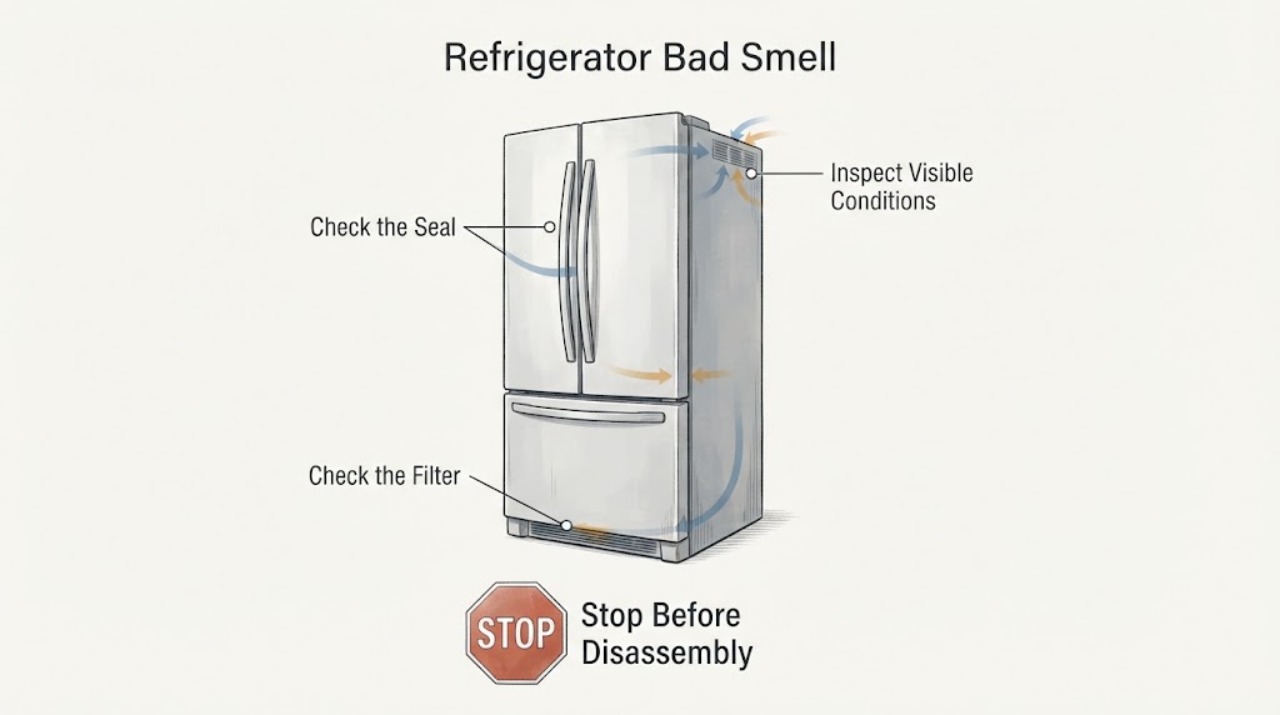
Work through in order
Diagnostic checks
Use only checks that match the exact appliance or system and its official guide.
-
Check 1
Remove expired, leaking, or strongly odor-producing food and inspect sealed containers, bins, shelves, and the ice bin without touching unknown residue with bare hands.
Expected result: The odor follows one item, is strongest in a bin/ice area, or remains after suspect food is removed.
Next step: Discard or isolate the source safely and clean accessible surfaces using the Viking manual. Continue only if the smell remains.
Why this matters
Why: A food or spill source is more likely when the smell follows a container or location. Persistence after removal means the source may be a gasket, drain, hidden spill, or another component.
-
Check 2
Turn the refrigerator controls off and unplug it when safe before cleaning accessible shelves, bins, gaskets, and interior walls. Use only the cleaner and dilution specified by the model manual; do not spray controls or vents.
Expected result: The odor improves after cleaning, the smell returns, or there is residue in an inaccessible drain/air channel.
Next step: Dry the accessible area and monitor with doors closed. Do not remove panels or pour liquid into an unknown opening; call service for a persistent hidden-source odor.
Why this matters
Why: Improvement supports a surface source but does not prove it was the only source. A hidden or inaccessible residue needs model-specific service or cleaning instructions.
-
Check 3
Check whether the refrigerator is cooling normally and whether doors and gaskets seal. Look for condensation, standing water, frost, or a warm cabinet; do not move an integrated unit.
Expected result: Cooling and seals are normal, or the odor accompanies warm food, leaks, frost, or a door that stays open.
Next step: Correct only an accessible closure or food-placement issue. Arrange service for leaks, damaged seals, or persistent temperature/odor problems.
Why this matters
Why: A bad seal, leak, or temperature problem can accelerate food spoilage and create repeat odor. A normal temperature and seal make a localized spill or ice-bin source more likely.
-
Check 4
Inspect the accessible rear/ventilation area for dust or blocked airflow only if the model permits access, keeping power disconnected. Do not open the sealed system or disturb tubing.
Expected result: The condenser/vent area is dusty or blocked, the area is inaccessible, or the smell resembles burning plastic/chemicals.
Next step: Clean only the user-accessible area as the manual allows. For chemical, burning, smoke, or inaccessible conditions, stop use and seek qualified service.
Why this matters
Why: Restricted ventilation can warm the cabinet and worsen odor; a burning or chemical smell is not a food-cleaning problem and requires immediate escalation.
-
Check 5
Record the model and serial number, odor location, food history, cleaning performed, temperature, and any water/ice symptoms. Retrieve the exact Viking manual.
Expected result: The model guide identifies a matching cleaning or filter/ice procedure; the model is unknown; or the odor persists after a complete accessible cleaning.
Next step: Give the record to Viking support and keep the refrigerator out of use if the odor is electrical, chemical, or accompanied by heat.
Why this matters
Why: Model identity controls odor-related components and cleaning steps. Persistent odor without an accessible source needs diagnosis rather than a guessed filter, drain, or fan part.
Use your observations
Decision map
Find the observation that best matches what you see, then follow the next safe action.
-
PATH 01Next step
What you see
The smell follows spoiled food, a spill, or one container and improves after removal and cleaning.
Do this next
Dry the cleaned area, monitor, and recheck the original location; use the manual for any recurring drain or ice-bin instruction.
Why this path and its safety boundary
Why it matters: The source is most consistent with food-contact contamination rather than a confirmed appliance failure.
-
PATH 02Next step
What you see
Odor remains in the drain, vent, ice bin, or another inaccessible area, or returns after cleaning.
Do this next
Stop pouring liquids or removing panels and arrange Viking service with the odor location and model.
Why this path and its safety boundary
Why it matters: A hidden spill, drain, filter, airflow, or component issue remains possible and is model-specific.
-
PATH 03Next step
What you see
The odor appears with warm food, condensation, leaks, frost, or a door that does not seal.
Do this next
Address only an accessible closure issue and arrange service for leaks, frost, or persistent temperature problems.
Why this path and its safety boundary
Why it matters: Cooling or sealing trouble may be creating repeated spoilage and cannot be solved by deodorizer alone.
-
PATH 04Next step
What you see
The smell is burning, chemical, solvent-like, or accompanied by smoke, heat, sparks, or damaged wiring.
Do this next
Stop use, disconnect only if safe, ventilate as appropriate, and obtain qualified appliance or electrical help.
Why this path and its safety boundary
Why it matters: This is an immediate electrical or appliance safety boundary.
Helpful context
Understand the symptom
“Bad smell” is a location-and-material problem before it is a parts diagnosis. Compare the odor in the fresh-food compartment, freezer, drain area, and ice bin; note whether it follows a particular food or appears with warm cabinet temperature, leaks, or electrical symptoms.
Viking models differ in airflow and preservation features, so do not pour cleaners into drains or remove panels based on a generic refrigerator procedure. Keep cleaning to accessible food-contact surfaces and use the model manual for water, ice, and odor-control components.
When checks do not resolve it
Need a professional?
Arrange Viking service when odor returns after accessible cleaning, originates in an inaccessible drain/vent/ice area, accompanies temperature or leak symptoms, or the exact manual does not match. Provide model, odor description and location, food/spill history, cleaning steps, and temperature observations. Do not buy a filter or part from odor alone.
Common questions
FAQ
What is the first thing to check for a bad smell in a Viking refrigerator?
Check expired food, leaking containers, shelves, bins, gaskets, and the ice area, then clean accessible surfaces according to the exact manual. Track where the smell is strongest.
Why does the smell return after I clean the Viking refrigerator?
A hidden spill, drain, ice-bin area, poor door seal, or temperature problem may remain. Do not pour cleaner into unknown openings; arrange model-specific service if it persists.
Is a burning smell from a Viking refrigerator a normal food odor?
No. Burning, chemical odor, smoke, sparks, or abnormal heat require stopping use and qualified service or electrical help.
Read the exact guide
Official sources
- Support CenterViking Range, LLC · Viking authorized product support and service routing.
- Built-in All RefrigeratorViking Range, LLC · Official Viking refrigerator product feature page showing model-specific airflow/odor features and documentation.
- F20398A.qxdViking Range, LLC · Opened Viking refrigerator troubleshooting material covering odor, controls, doors, cooling, and cleaning scope; exact model must be confirmed.
Community feedback
Share a repair observation
Share a plain-text repair observation. Accepted observations are published automatically; this page may take a moment to update.