
On this page
Start here
Quick answer
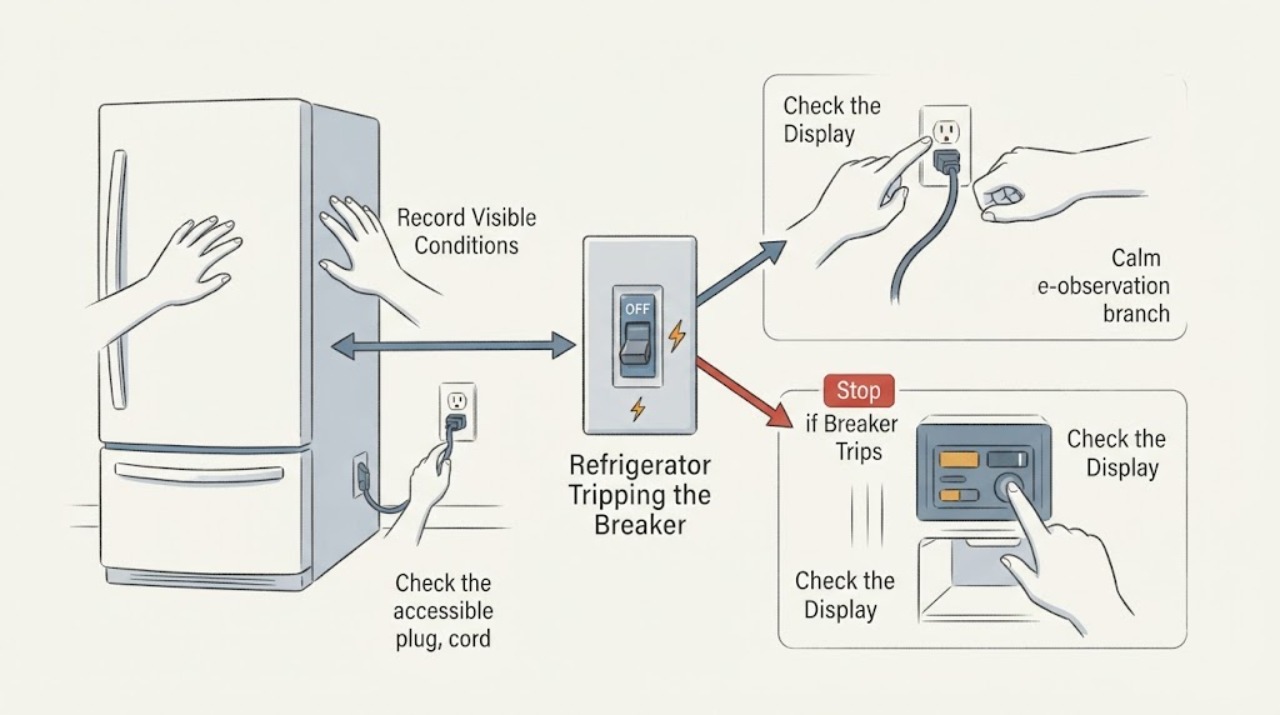
If a Viking refrigerator trips the household breaker, do not keep resetting it. Note whether the trip is immediate, occurs when the compressor starts, or follows a power interruption; check the accessible plug, outlet, control setting, and any error indication without opening wiring. Viking guidance requires a grounded three-prong supply and sends a continuing breaker problem to an electrician or service; a repeat trip, hot connection, odor, smoke, or sparks is a stop condition.
Work through in order
Diagnostic checks
Use only checks that match the exact appliance or system and its official guide.
-
Check 1
From a safe position, record whether the breaker trips immediately, when the compressor/fan starts, after a power outage, or at random. Note whether the display and interior light lose power.
Expected result: The trip is immediate/repeatable, follows startup, follows a power event, or the refrigerator remains powered.
Next step: Do not recreate the trip repeatedly. Continue only with the accessible plug/outlet and control observations.
Why this matters
Why: A repeatable trip is an unresolved supply or product fault; timing helps the technician but does not identify a part. A dead display with a dead outlet needs electrical evaluation.
-
Check 2
Check the accessible plug, cord, and receptacle for secure connection, visible damage, heat, scorching, or moisture. Do not pull the refrigerator out of built-in cabinetry or perform electrical tests.
Expected result: The connection is damaged/hot, the outlet has no power, or the connection appears sound.
Next step: Stop using the appliance and call a qualified electrician or service. Do not restore power as a test when damage is present.
Why this matters
Why: Heat or damage is an immediate electrical hazard. A dead outlet can be a household circuit issue; a sound connection with repeated trips leaves a product fault possible.
-
Check 3
Confirm the controls are on and note any display code, while leaving all wiring and panels untouched.
Expected result: Controls are Off, a fault indication appears, or controls are normal but the breaker trips.
Next step: Use only the exact manual for a user-selectable setting. Arrange service for a recurring trip or code.
Why this matters
Why: An Off control can explain no cooling but not a breaker trip. A code narrows model-specific diagnosis; normal controls with a trip support a supply/product service boundary.
-
Check 4
Check whether the refrigerator is plugged into a grounded three-prong outlet without an extension cord or adapter, and whether the installation was recently changed.
Expected result: The unit uses an extension/adapter, the outlet grounding is uncertain, the installation is new, or the arrangement matches the manual.
Next step: Do not alter breaker size or bypass grounding. Have a qualified electrician verify the installation and use service for a product-side fault.
Why this matters
Why: Viking warns against ungrounded or improvised connections and treats continuing breaker problems as an electrician issue. A correct installation does not rule out an appliance fault.
-
Check 5
Record model/serial information, breaker behavior, outlet result, control state, recent installation or power event, and any odor or sound. Retrieve the exact Viking guide.
Expected result: The breaker holds after one safe restoration, trips again, or the model information is unavailable.
Next step: Keep the refrigerator off when safe and arrange Viking service/electrical evaluation with the complete record.
Why this matters
Why: A single recovery does not prove repair; another trip needs diagnosis. Model information is needed for control and installation instructions.
Use your observations
Decision map
Find the observation that best matches what you see, then follow the next safe action.
-
PATH 01Next step
What you see
The breaker trips immediately or again when the refrigerator starts, with no visible household-outlet damage.
Do this next
Stop resetting and arrange Viking service; have an electrician assess the circuit if the outlet/breaker is suspect.
Why this path and its safety boundary
Why it matters: A product electrical/load issue or circuit problem is more likely than a one-time interruption, but no component can be named safely.
-
PATH 02Next step
What you see
The outlet is shared, ungrounded, uses an extension/adapter, or was changed during a recent installation.
Do this next
Use a qualified electrician; do not install a larger breaker or bypass grounding.
Why this path and its safety boundary
Why it matters: Installation or circuit conditions are plausible contributors and must be corrected under electrical code.
-
PATH 03Next step
What you see
The breaker is stable but the refrigerator controls are Off or show a model-specific code.
Do this next
Follow the exact guide once and arrange service if the code or no-cooling condition returns.
Why this path and its safety boundary
Why it matters: The control state or code may explain the no-operation symptom, but does not authorize internal repair.
-
PATH 04Next step
What you see
The plug/cord is hot, scorched, wet, damaged, or accompanied by smoke, sparks, or burning odor.
Do this next
Do not touch or restore power as a test; isolate only if safe and obtain qualified electrical or appliance help.
Why this path and its safety boundary
Why it matters: This is an immediate electrical safety boundary.
Helpful context
Understand the symptom
A breaker trip identifies an interrupted circuit, not a failed compressor or control board. Record the timing and whether the refrigerator display, lights, fan, and cooling recover. A trip at startup and a dead outlet lead to different next steps.
Keep the refrigerator on its intended grounded outlet and do not use an extension cord, adapter, larger breaker, or bypass. Use the model manual for controls and have installation or electrical work done by a qualified professional.
When checks do not resolve it
Need a professional?
Arrange Viking service for any repeat breaker trip, immediate trip at startup, persistent no-power condition with a sound outlet, or recurring control code. Use a qualified electrician for the household circuit, grounding, outlet, or breaker. Provide model, timing, control state, outlet result, and recent installation/power history; do not guess at a compressor or control part.
Common questions
FAQ
Should I keep resetting a Viking refrigerator breaker?
No. Record the timing and any display behavior. If the breaker trips again, stop resetting and use Viking service or a qualified electrician.
Can an extension cord cause a Viking refrigerator breaker problem?
Viking warns against extension cords and adapters. Keep the refrigerator on its intended grounded outlet and have an electrician correct the installation.
What information helps diagnose a Viking refrigerator breaker trip?
Give the model, whether the trip is immediate or startup-related, whether the display/lights go dark, outlet/cord observations, any code, and recent power or installation changes.
Read the exact guide
Official sources
- TroubleshootingViking Range, LLC · Viking refrigerator electrical and no-operation troubleshooting, including breaker, grounded outlet, controls, new-install recovery, and electrician boundary.
Community feedback
Share a repair observation
Share a plain-text repair observation. Accepted observations are published automatically; this page may take a moment to update.