
On this page
Start here
Quick answer
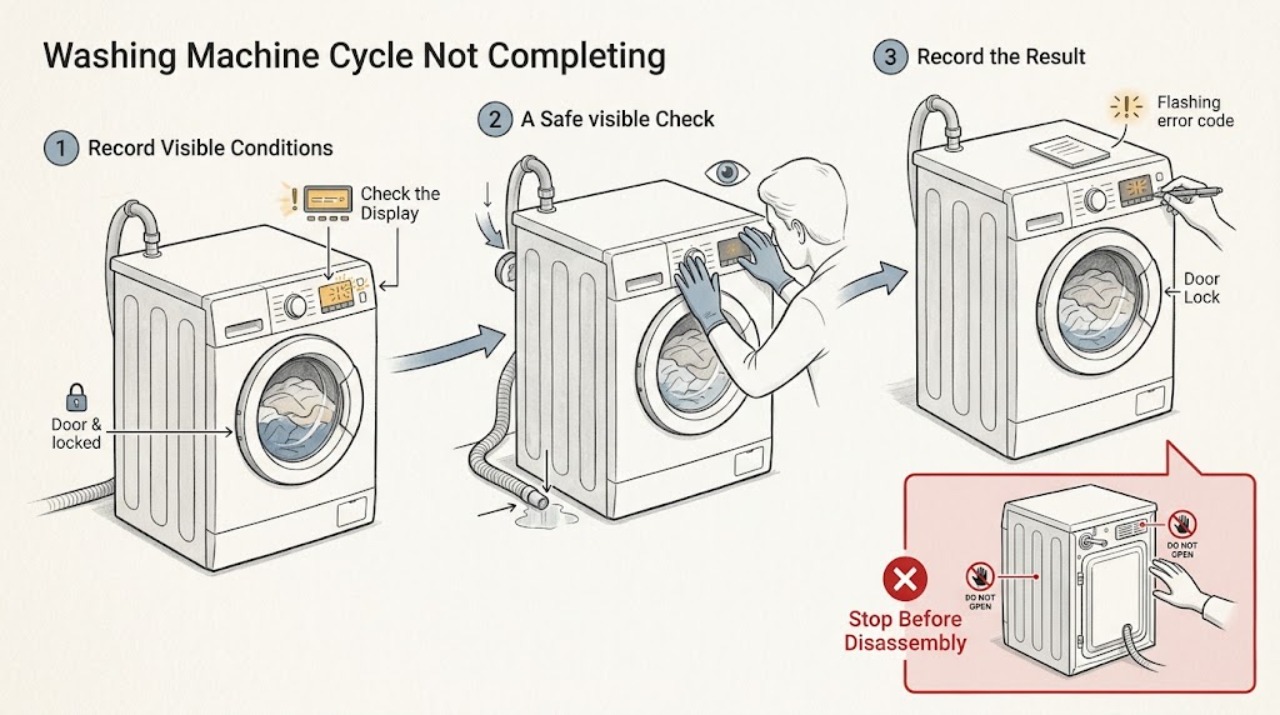
A washer that does not complete a cycle may be paused normally, waiting for water, unable to drain, balancing a load, blocked by a door or lid lock, slowed by excess suds, or reporting a model-specific fault. Record the exact stage where it stops, the display or light pattern, water level, and whether the drum moves. Check the selected program and visible hose or load conditions only when the area is dry and safe. Use the exact owner's manual for codes, filter access, and any reset. Stop for hot or contaminated water, a leak near electrical parts, uncontrolled filling, violent movement, smoke, burning odor, visible arcing, or a repeated electrical trip. Do not tilt the washer, force a locked door or lid, open internal panels, or perform live electrical testing.
Before you begin
Safety first
- A technician should diagnose the supply, lock, drain, pump, motor, control, heater, and suspension paths before selecting any replacement component.
Work through in order
Diagnostic checks
Use only checks that match the exact appliance or system and its official guide.
-
Check 1
Record the exact program, options, displayed time, light or symbol pattern, and the stage where the cycle stops: fill, wash, rinse, drain, spin, or end. Note whether the timer changes, whether the drum moves, and whether water or foam is visible.
Expected result: A short pause between stages can be normal on some washers. A timer that remains held during a long balance or suds response, standing water, a repeated code, or no progress after the expected stage are different clues.
Next step: Continue to the matching branch below and keep the exact display text for the manual or technician. Stop before opening the door or lid if it is locked, hot, or holding water.
Why this matters
Why: The stopping stage determines whether to check water supply, program state, drain, load balance, lock, or error guidance first; it does not identify a failed part.
-
Check 2
Wait through the model's normal pause without manually advancing a timer or repeatedly pressing controls. Watch from outside for a drain pump stage, a brief balance routine, or an estimated-time adjustment; do not treat a silent pause as permission to open the appliance.
Expected result: Some top-load designs can pause before pumping out and spinning, while a difficult-to-balance or sudsy load can extend the displayed time. A pause that never resolves, repeats every cycle, or ends with an error is not a normal one-off pause.
Next step: If the cycle resumes and completes, note the stage and load conditions. If it remains stopped, record the water level and display, then continue without forcing the timer or door.
Why this matters
Why: A normal inter-stage pause can explain an apparently incomplete cycle. Repeated or indefinite stopping moves the diagnosis to drain, load, foam, lock, or service branches.
-
Check 3
If the washer has not started or stops before filling, check the selected program, delay or pause state, and any control-lock indicator. From outside, confirm the door or lid is fully closed and not blocked by clothing; use only the exact manual's release or start sequence.
Expected result: A lock indicator, an open door or lid, a paused control, or a program with no active cycle can prevent progress. If the door or lid latches and the washer still will not fill or start, an error or water-supply branch is more likely.
Next step: If the latch will not engage, the lock remains active, or the door or lid is damaged, keep the washer out of use and arrange service. Do not force or bypass the interlock.
Why this matters
Why: The control and interlock state is a prerequisite for filling and tumbling; do not infer a motor fault from a washer that never receives a valid start command.
-
Check 4
If the washer stops while filling or never takes enough water, check from a dry, safe position that the household water supply is available and the visible inlet hose is not sharply kinked. Do not disconnect a pressurized hose or handle a wet connection.
Expected result: No fill, slow fill, a closed supply, a kinked hose, or a water-supply indication points to the inlet branch. If the washer fills and later stops with water remaining, use the drain branch instead.
Next step: If water cannot be stopped, a hose or connection is damaged, the area is wet, or the water-related indication returns, stop and arrange qualified service. Do not open internal valves.
Why this matters
Why: Filling and draining are separate stages; confusing them can lead to the wrong check or a guessed valve or pump replacement.
-
Check 5
If water remains or the cycle stops at drain, inspect the visible drain hose and household outlet from outside for a sharp kink, crushing, or backup. Only inspect a pump or filter if the exact manual identifies an accessible user procedure and the appliance can be isolated from power from a dry, safe position.
Expected result: Standing water, slow outlet flow, a kinked hose, a drain indication, or an accessible blocked filter can prevent rinse or spin completion. A clear visible hose does not exclude an internal pump or plumbing fault.
Next step: If water is hot, contaminated, near electrical parts, or cannot be contained, stop. If the manual gives no safe filter step or the fault persists, keep the washer out of use and arrange service; do not tilt it or force the door.
Why this matters
Why: The washer may require completed draining before it can continue; a cycle-not-completing symptom can originate in the drain path rather than the timer or motor.
-
Check 6
If the cycle stalls near rinse or spin, wait for the basket to stop and redistribute a single bulky, overloaded, or tightly tangled load within the manual's limit. Note visible excess suds and do not add more detergent. Do not reach into a moving basket.
Expected result: A load gathered on one side can cause shaking, reduced spin, repeated balance attempts, and a longer cycle. Excess suds can also reduce spin or add rinses. A balanced ordinary load that still stops points elsewhere.
Next step: Use one suitable test only when there is no leak, hot water, unusual noise, or electrical symptom. Stop if the washer walks, bangs, scrapes, smokes, smells burnt, or trips again.
Why this matters
Why: Load sensing and suds management can deliberately delay or limit the final spin; success after a safe redistribution supports a load condition, not a confirmed part failure.
-
Check 7
From outside, check whether the cabinet rocks, the floor flexes, or the washer has moved from its installed position. If it is newly installed, compare the installation and shipping-material requirements with the exact manual; do not tilt or dismantle the appliance.
Expected result: An unstable floor, an unlevel cabinet, or installation material left in place can cause vibration and prevent a safe spin or cycle completion. A stable washer with the same symptom needs a different branch.
Next step: Correct only a simple external, manual-authorized leveling issue. If movement persists, impact occurred, or internal suspension or drive parts are suspected, stop and arrange service.
Why this matters
Why: Movement and installation clues separate a balance or setup issue from a persistent drain, lock, control, motor, or suspension fault.
-
Check 8
Write down every code, the model number, cycle and options, water status, and whether the problem occurs with an empty or normal load. Compare the exact code only with the model manual; do not borrow an explanation from another brand or model. If the manual authorizes one reset, follow that procedure once from a dry, safe position.
Expected result: A recurring code, a stop across more than one safe program, or a failure with an empty drum after safe external checks indicates a model-specific fault. A single cleared interruption may not return.
Next step: Arrange qualified appliance service if the code returns or the cycle still will not complete. Do not repeat a reset after a trip, smoke, burning odor, leak, or other stop condition.
Why this matters
Why: Codes and reset controls are not universal. The record gives a technician enough context to distinguish a supply, lock, drain, control, motor, heater, or suspension issue without guessing.
Use your observations
Decision map
Find the observation that best matches what you see, then follow the next safe action.
-
PATH 01Next step
What you see
The washer pauses briefly between stages, the timer is an estimate, and it resumes without an error or hazard.
Do this next
If the cycle completes, record the stage and load. If the pause repeats indefinitely or ends in an error, continue to the relevant drain, balance, or code branch.
Why this path and its safety boundary
Why it matters: Observe the normal pause and do not manually advance the timer or interrupt the door or lid interlock.
-
PATH 02Next step
What you see
The display is blank or controls do not respond, or the washer stops after a power interruption.
Do this next
Use qualified electrical service for the supply and appliance service for a washer-only failure. Stop immediately for smoke, heat damage, burning odor, arcing, or a repeated trip.
Why this path and its safety boundary
Why it matters: Only from a dry, safe position, separate an outlet or supply issue from a washer-only control issue; do not perform live testing or repeatedly restore power.
-
PATH 03Next step
What you see
The washer will not start, the door or lid will not latch, or a lock or pause indicator remains active.
Do this next
If the lock or latch remains faulty, keep the washer out of use and arrange service, especially if water or heat is present.
Why this path and its safety boundary
Why it matters: Check only visible closure obstructions and the exact manual's control-lock or start guidance; do not force or bypass the interlock.
-
PATH 04Next step
What you see
The washer stops during fill or shows a water-supply indication.
Do this next
If the supply cannot be stopped, a connection is damaged, or the indication returns, stop and arrange qualified service.
Why this path and its safety boundary
Why it matters: Use the safe visible inlet-supply branch, keeping pressurized connections and internal valves under manual or technician control.
-
PATH 05Next step
What you see
Water remains, the washer stops at drain, or rinse and spin never begin.
Do this next
Hot or contaminated water, water near electrical parts, an inaccessible blockage, or a persistent drain problem requires stopping and service without tilting the appliance.
Why this path and its safety boundary
Why it matters: Treat draining as the first decision. Check only the visible hose, household outlet, and any exact-manual filter procedure that is safe and accessible.
-
PATH 06Next step
What you see
The washer stalls near spin, retries, shows balance behavior, or adds time with a single bulky, overloaded, or sudsy load.
Do this next
If a balanced ordinary load still fails, or the cabinet walks, bangs, or grinds, stop and arrange service.
Why this path and its safety boundary
Why it matters: Wait for the basket to stop, correct the load or detergent amount within the manual's limits, and check stable external support.
-
PATH 07Next step
What you see
The cycle still does not complete after the appropriate safe checks, or an exact code returns.
Do this next
Provide the model, code or lights, stage, water status, load result, and any sound or movement to a qualified appliance technician.
Why this path and its safety boundary
Why it matters: Treat the failure as model-specific rather than borrowing a code meaning or ordering a guessed part.
-
PATH 08Next step
What you see
There is hot water, uncontrolled filling, a leak near electrical parts, violent movement, metal scraping, smoke, burning odor, visible arcing, or a repeated electrical trip.
Do this next
Use appropriate emergency support for active smoke or fire and qualified electrical or appliance service once the area is safe.
Why this path and its safety boundary
Why it matters: Stop all user testing and keep people away from the hazard; do not touch wet electrical equipment, force the door, or restore power repeatedly.
Helpful context
Understand the symptom
Begin with the point of interruption, not the part you suspect. Note whether the washer stops during filling, washing, rinsing, draining, or spinning; whether the timer is paused or advancing; whether the drum or basket moves; whether water remains; and whether any light, symbol, or code is shown. Some machines pause while sensing, heating, balancing, or pumping out, so a short pause alone is not proof of a fault.
The checks below are intentionally brand-neutral. They use only controls, visible hoses, the load, the door or lid, the floor, and any access procedure explicitly given by the exact manual. Do not reach into a moving drum, force a locked door, tilt the appliance, open an electrical panel, or dismantle a pump, motor, heater, or control.
A result should change your next decision: a normal pause needs observation, a drain problem needs a drain branch, an unbalanced load needs a safe redistribution, and a repeat failure with an empty or balanced load needs service. Never keep retrying when a safety stop condition is present.
Safety boundary
Stop conditions
- Stop if hot or contaminated water is present, cannot be contained, or is near the cord, outlet, controls, or other electrical parts.
- Stop if the washer is filling continuously and the water supply cannot be safely stopped from a dry position.
- Stop if the cabinet walks, bangs surrounding structures, vibrates violently, or produces metal-scraping or grinding sounds.
- Stop immediately for smoke, burning odor, visible arc, melted material, unusual heat, or a repeated electrical trip; do not run another test.
- Do not force or bypass a door or lid lock, reach into a moving drum, tilt the washer, open an electrical panel, or dismantle internal plumbing, pump, motor, heater, bearing, or suspension parts.
- Stop using the appliance if a leak persists, an error returns, or the cycle remains incomplete after the safe model-authorized checks.
Only after diagnosis
Potential parts
- door or lid lock assembly
Consider only if the visible closure area is clear but the latch will not engage or a lock fault is confirmed for the exact model.
Confirm the complete model and manufacturer fit information before selecting a component. - inlet valve or drain pump component
Consider only after a persistent fill or drain fault is confirmed and service information identifies the applicable component.
Valve, pump, filter access, and hose layouts vary by model; do not infer fit from a broad symptom. - motor, control, or suspension component
Consider only when safe checks show a repeat empty-drum, movement, motor, or control symptom and a technician confirms the cause.
A qualified technician should identify the failure and verify model fit before any component is ordered.
When checks do not resolve it
Need a professional?
A fill, wash, rinse, drain, spin, control, lock, or error branch remains after safe external checks, or any stop condition is present.
Safety scope: A technician should diagnose the supply, lock, drain, pump, motor, control, heater, and suspension paths before selecting any replacement component.
Have this ready
- Complete model number, exact display or light pattern, program and options, stopping stage, timer behavior, water status, door or lid state, load result, and any sound, movement, heat, smell, or leak location.
Common questions
FAQ
Why does my washing machine stop before the cycle is complete?
It may be pausing normally, waiting for water, unable to drain, correcting a load imbalance, responding to excess suds, waiting for a door or lid lock, or showing a model-specific error. Record the stopping stage and exact display before choosing a branch.
How long can a washer pause between cycles?
The pause depends on the model and stage. Some washers pause before pumping out or spinning, and balancing or suds control can extend the estimate. If the pause repeats indefinitely or ends in an error, use the drain, load, or service branch rather than manually advancing controls.
Why does my washer stop with water still inside?
A kinked drain hose, blocked outlet, accessible filter issue, pump fault, or error state can prevent the next stage. Check only visible drainage and exact-manual procedures from a dry, safe position; do not force the door, handle hot water, or tilt the machine.
Can too much detergent make a washing-machine cycle take too long?
Yes. Excess suds can cause extra rinsing or reduced spin on some models. Follow the detergent and load guidance in the exact manual, do not add more product, and arrange service if the condition persists or a code returns.
When should I stop using a washing machine that will not complete its cycle?
Stop for hot or uncontrolled water, a leak near electrical parts, severe movement, metal scraping, smoke, burning odor, visible arcing, melted material, or a repeated electrical trip. Do not run another test; use emergency support for active smoke or fire and qualified service when safe.
Read the exact guide
Official sources
- Stops Mid Cycle- WasherWhirlpool Product Help · Manufacturer troubleshooting context for washer pauses, cycle interruption, imbalance, vibration, reduced spin, and service escalation
- Frequently Asked Questions About GE WashersGE Appliances · Manufacturer troubleshooting context for mid-cycle stops, spin, drain, fill, leaks, controls, leveling, load balance, and model-specific support
- Clothes WashersENERGY STAR · Government-backed clothes-washer product and maintenance context, including model-specific manufacturer instructions
- Top Load Washer - Does Not SpinGE Appliances · Manufacturer troubleshooting context for inter-stage pauses, lid state, leveling, load balance, drain-and-spin, and service
- Cycle Time is Not Advancing - Front Load WasherWhirlpool Product Help · Manufacturer troubleshooting context for estimated cycle time, load balance, heating time, excessive suds, and model-specific cycle behavior
- Washing machine will not finish a programmeBosch · Manufacturer troubleshooting context for an incomplete washing-machine program, drain pump, drain hose, leakage check, and service guidance
- How to Reset a WasherWhirlpool Product Help · Manufacturer troubleshooting context for incomplete cycles, temporary control interruptions, control lock, and model-specific reset guidance
Community feedback
Share a repair observation
Share a plain-text repair observation. Accepted observations are published automatically; this page may take a moment to update.