
On this page
Start here
Quick answer
A Westinghouse oven smell is only potentially normal when it is a mild, short-lived first-use odor that follows the exact model's run-in instructions and decreases. A food or grease smell can come from a spill or residue, while a chemical smell may follow an unsuitable cleaner. A rotten-egg or persistent gas smell, sharp burning-plastic or electrical odor, smoke, abnormal flame, arcing, or overheating is not a cleaning problem: stop using the oven and do not relight or repeat the test. First note whether the odor occurs with the oven off, during a cooking or grill mode, after a spill or cleaning, or only on a new appliance. Confirm the exact model and fuel type, use only its Westinghouse manual, and arrange qualified service when the cause is not clearly low-risk.
Before you begin
Safety first
- Keep the oven off for gas, smoke, fire, electrical, abnormal-flame, uncontrolled-heat, moisture, or repeated-breaker symptoms. Do not relight, operate switches during a suspected gas leak, open panels, perform live measurements, bypass safety controls, or run another cleaning cycle until the hazard is cleared.
Work through in order
Diagnostic checks
Use only checks that match the exact appliance or system and its official guide.
-
Check 1
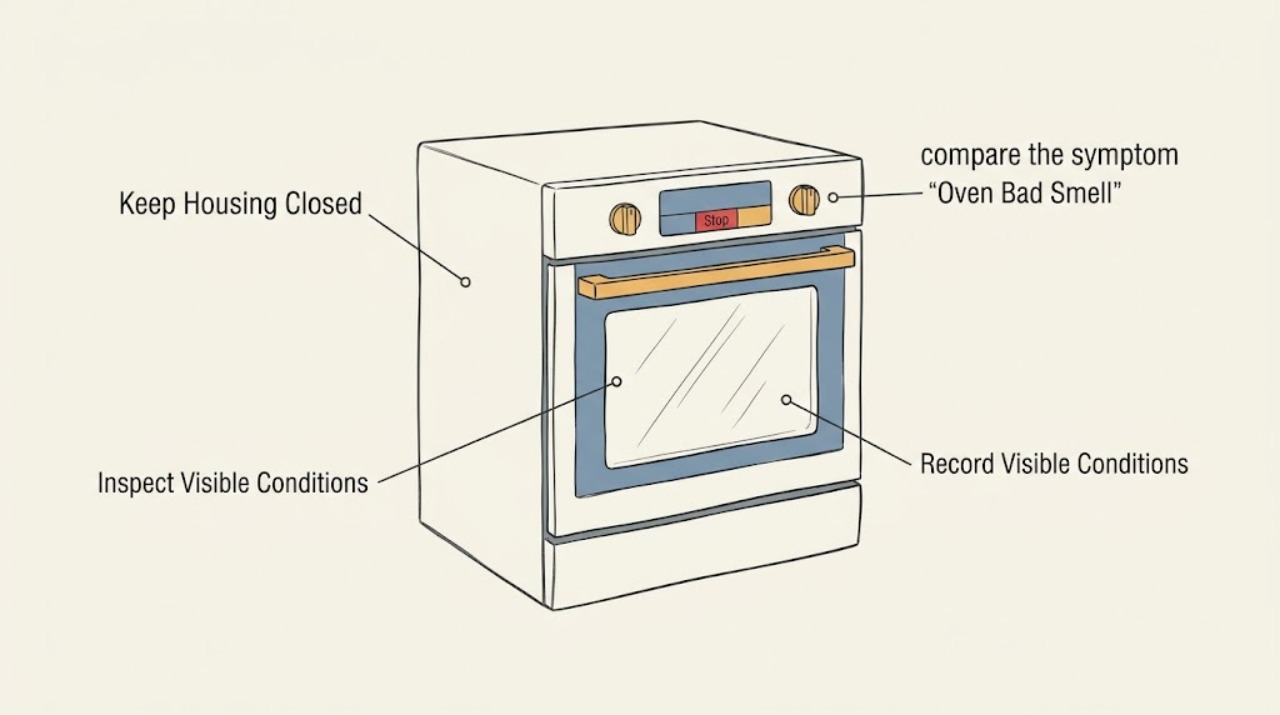
Turn the oven controls off and observe from a safe position. Record whether the smell is gas-like, sharp electrical or plastic-like, smoky, chemical, greasy, or merely a mild new-appliance odor. Also note smoke, visible flame, arcing, a hot control or outlet, a breaker trip, or an oven that continues heating after shutoff.
Expected result: There is a gas odor or hissing, delayed ignition or a bang, abnormal flame, increasing smoke, arcing, a hot or melting connection, repeated breaker trip, or uncontrolled heating.
Next step: Stop immediately. For suspected gas, do not light anything or operate switches; leave by a safe route and contact local gas or emergency service from outside. For smoke or fire, leave if it continues and contact emergency services. For electrical symptoms, keep the oven off and arrange qualified service.
Stop if: Do not relight, reset, open panels, or repeat a heating test after a hazardous odor, smoke, abnormal flame, arcing, repeated trip, or uncontrolled heating.
Why this matters
Why: This is a gas, fire, electrical, or runaway-heat hazard rather than ordinary residue or first-use burn-off.
-
Check 2
Identify the exact Westinghouse model and fuel type from the data plate or owner documents. Record whether the oven is new, whether the smell began after a spill or cleaning, which mode was selected, whether the oven was preheating or self-cleaning if fitted, and whether the smell occurs with the controls off.
Expected result: The model is electric, gas, or otherwise uncertain; the smell is limited to first operation, follows food or cleaner use, occurs only in a grill or oven mode, or persists while the oven is off.
Next step: Use Westinghouse support to locate the manual for that model and keep the oven off until the fuel type and safety instructions are clear. Do not apply another model's gas, cleaning, or self-clean guidance.
Why this matters
Why: The correct manual controls the run-in and cleaning advice; an odor while off or a fuel-type uncertainty makes a routine burn-off explanation unsafe.
-
Check 3
If the oven is new or has just had an approved first-use process, compare the symptom with the exact Westinghouse manual. Confirm that packaging, stickers, leaflets, and protective materials have been removed, then follow only the documented run-in and ventilation procedure after the oven is safe to operate.
Expected result: The odor is mild, occurs only while the new oven heats, there is no gas or electrical smell, no abnormal flame or smoke, and the odor decreases after cooling; or it is strong, worsening, persistent, or accompanied by unusual smoke.
Next step: For a documented low-risk first-use odor, ventilate as the manual directs and allow the oven to cool. If the odor persists, worsens, affects people or pets, or the manual does not describe the process for this model, stop use and arrange service.
Why this matters
Why: A short-lived protective-oil or insulation odor can be documented for some Westinghouse models, but a persistent or worsening odor is not proven normal by the appliance's age.
-
Check 4
When the oven is fully cool and no hazard sign is present, inspect the cavity, racks, grill area, door edge, vent, and floor for spilled grease, burned food, foil, plastic, packaging, or cleaner residue. Do not scrape an element, block the vent, spray a hot surface, or mix cleaning products.
Expected result: A visible spill or foreign material is at the odor location, the smell began after cleaning, the vent is obstructed, or the cavity is clean but the odor returns whenever heat is applied.
Next step: Remove only loose residue and clean only with the cool-surface method and products allowed by the exact Westinghouse manual. Keep the vent clear. Stop and request service if the smell returns, becomes sharp or smoky, or cannot be identified as residue.
Stop if: Do not use a caustic or abrasive cleaner, steam or water near controls, metal scraper on door glass, or an oven cleaner not approved by the exact manual.
Why this matters
Why: Food, grease, packaging, or cleaner residue may explain a low-risk odor, but a clean cavity with a returning heat-related odor raises an unresolved heating, insulation, wiring, ignition, or control concern.
-
Check 5
If the smell resembles gas, note only whether it occurs while the oven is off, during ignition, or after a failed ignition. Do not make another ignition attempt, manually light the oven, search for a leak, or disassemble a burner, valve, or gas connection.
Expected result: The smell persists while off, follows a failed ignition, is accompanied by hissing, delayed ignition, an abnormal flame, or cannot be confidently distinguished from a food or cleaner odor.
Next step: Do not touch electrical switches, use a phone inside, or create a flame. Leave the building and contact local gas or emergency service from a safe location; obtain qualified appliance service before reuse.
Why this matters
Why: Unburned gas or a gas-safety fault cannot be ruled out by smell alone; delayed or abnormal ignition can create a fire or explosion hazard.
-
Check 6
If the smell is sharp, electrical, plastic-like, or associated with smoke, inspect only the accessible plug, cord, outlet, and surrounding cabinet from a dry safe position. Do not pull out a hard-wired oven, remove covers, touch a hot or damaged connection, or reset a repeatedly tripping breaker.
Expected result: The outlet or cord is hot or discolored, moisture is present, a breaker trips again, the smell comes from the control or wiring area, or the odor returns when heat is applied despite normal-looking accessible power.
Next step: Leave the oven off. If power can be isolated from a dry safe position without approaching a hazard, isolate it; otherwise keep clear. Arrange qualified electrical or appliance service and do not perform a live test.
Stop if: Stop for smoke, arcing, a hot outlet, damaged insulation, moisture near controls, or repeated breaker trips.
Why this matters
Why: A connection, heating circuit, insulation, or control fault may cause shock or fire and cannot be confirmed safely by an external inspection.
-
Check 7
Prepare a service handoff if the smell persists after the model-approved low-risk cleaning or run-in process, returns in more than one mode, appears with the oven off, or cannot be safely reproduced. Record the exact model and serial information, fuel type, mode, timing, visible residue, smoke or flame behavior, control response, and breaker history.
Expected result: A qualified technician is needed to distinguish residue from an internal heating, insulation, ignition, wiring, vent, or control fault.
Next step: Keep the oven off and give the technician the manual-family information and your observations. Ask for model-specific diagnosis before selecting any component.
Stop if: Do not continue cooking, run repeated empty cycles, start self-clean to mask the smell, or perform internal disassembly.
Why this matters
Why: An odor alone does not identify a replaceable part, and continuing to heat the appliance to reproduce it can increase risk.
Use your observations
Decision map
Find the observation that best matches what you see, then follow the next safe action.
-
PATH 01Next step
What you see
The odor is mild, occurs only during the first few uses of a new Westinghouse oven, has no gas, smoke, electrical, or abnormal-flame symptom, and decreases after cooling.
Do this next
Follow the exact model's run-in and ventilation directions. Stop and request service if the odor persists, worsens, or produces unusual smoke.
Why this path and its safety boundary
Why it matters: A documented first-operation protective-oil or insulation odor is possible for some models.
-
PATH 02Next step
What you see
The smell follows a spill, burned food, packaging, foil, or a cleaner and is localized to a cool, visibly contaminated cavity.
Do this next
Clean only cool surfaces using the exact Westinghouse manual's permitted method, keep the vent clear, and stop if smoke, scorching, or a sharp odor returns.
Why this path and its safety boundary
Why it matters: Food, grease, packaging, or cleaner residue is more likely than an internal fault, but cleaning compatibility is model-specific.
-
PATH 03Next step
What you see
The odor is persistent while the oven is off, resembles gas, or follows a failed or delayed ignition, hissing, a bang, or an abnormal flame.
Do this next
Do not operate switches or flames. Leave and contact local gas or emergency service from a safe location, then obtain qualified appliance service before reuse.
Why this path and its safety boundary
Why it matters: Treat it as a possible gas emergency; do not try to diagnose it by relighting or searching for a leak.
-
PATH 04Next step
What you see
The smell is electrical, scorched, plastic-like, or accompanied by smoke, arcing, a hot outlet, moisture, or a breaker trip.
Do this next
Stop using the oven, isolate power only if this can be done from a dry safe location, and arrange qualified appliance or electrical inspection. Do not re-energize until it is cleared.
Why this path and its safety boundary
Why it matters: A fire or shock hazard is possible; ordinary cleaning and repeated testing are unsafe.
-
PATH 05Next step
What you see
The cavity is clean, the odor returns with heat or in multiple modes, or the exact model manual does not support a first-use explanation.
Do this next
Keep the oven off and request Westinghouse or qualified appliance service. Provide the model, fuel type, mode, timing, odor description, and safety observations.
Why this path and its safety boundary
Why it matters: A heating, ignition, vent, insulation, wiring, or control fault remains possible and cannot be identified safely from smell alone.
Helpful context
Understand the symptom
Classify the smell before cleaning
“Bad smell” is not one fault. A new Westinghouse oven may have a documented first-use burn-off, a cooking spill may smoke, and a cleaner or melted packaging may create a chemical odor. Gas and electrical odors have different stop rules. Record the exact smell, when it starts, the selected mode, whether the oven is electric or gas, whether smoke or flame is present, and whether the smell remains after the controls are off.
Only a confirmed low-risk residue can be cleaned
When the oven is cool and there is no gas odor, smoke, arcing, sharp electrical smell, or uncontrolled heat, inspect for food, grease, foil, plastic, packaging, or cleaner residue. Remove only loose residue and clean only the surfaces and products permitted by the exact Westinghouse manual. Do not block the vent, spray a hot cavity, mix cleaners, or use abrasive tools on door glass or enamel.
Gas, smoke, and electrical smells are stop conditions
A persistent gas smell, hissing, delayed ignition, abnormal flame, smoke that is increasing, an electrical or melting-plastic smell, arcing, a hot outlet, or repeated breaker trips requires the oven to remain off. For suspected gas, do not operate electrical switches or flames; leave and contact local emergency or gas service from a safe location. For fire or smoke, leave if the hazard continues and obtain emergency help.
Use the exact model manual for run-in and service
Westinghouse publishes manuals for different oven and cooker families. A run-in temperature, timer setting, grill-door position, cleaning method, and gas procedure from one model may not apply to another. If a first-use odor does not decrease after the model's documented process, or if the smell returns from a clean cavity, stop using the oven and arrange qualified Westinghouse or appliance service.
Safety boundary
Stop conditions
- Stop immediately for persistent gas odor, hissing, delayed ignition, a bang, abnormal or unstable flame, smoke, flame outside the normal burner area, or carbon-monoxide concern. Do not relight or repeat the test.
- For suspected gas, do not operate electrical switches, use a phone inside, light matches, smoke, or search for a leak. Leave by a safe route and contact local gas or emergency service from outside.
- Stop for arcing, exposed or hot wiring, a hot or discolored plug or outlet, moisture near electrical equipment, repeated breaker trips, or a sharp burning-plastic smell. Do not open panels or perform a live test.
- Do not touch hot elements, steam, glass, or the door until cool. Do not use caustic cleaners, mix products, force the door, run repeated empty cycles, or use self-clean to conceal an unresolved odor.
Only after diagnosis
Potential parts
- heating element or ignition component
Consider only after a qualified diagnosis confirms stable supply and identifies the model-specific heating or ignition stage as the cause of the odor.
Confirm the exact Westinghouse model, fuel type, and approved fitment in the manufacturer's documentation before selecting any part. - temperature sensor, thermostat, or control
Relevant only when a qualified technician identifies a temperature-control, sensor, relay, or control fault after ruling out residue and settings.
Do not assume cross-model compatibility; exact model service information controls diagnosis and fit. - door seal or door switch
Consider only when the technician confirms that a damaged seal or door interlock contributes to abnormal heat, venting, or operation.
Verify the exact model and approved service procedure; do not use the oven with damaged glass or bypass a door interlock.
When checks do not resolve it
Need a professional?
Request Westinghouse or qualified appliance service for a persistent or recurring odor, an odor that returns after approved cleaning or first-use run-in, any smell from the control or wiring area, an odor with a breaker trip or abnormal heating, any failed or abnormal gas ignition, or any uncertainty about whether the smell is gas.
Safety scope: Keep the oven off for gas, smoke, fire, electrical, abnormal-flame, uncontrolled-heat, moisture, or repeated-breaker symptoms. Do not relight, operate switches during a suspected gas leak, open panels, perform live measurements, bypass safety controls, or run another cleaning cycle until the hazard is cleared.
Common questions
FAQ
Is a smell from a new Westinghouse oven normal?
Some Westinghouse manuals document a mild first-operation odor from protective oils or insulation and give a model-specific run-in and ventilation process. It should decrease. Gas, electrical, melting-plastic, worsening, or unusually smoky odors are not normal burn-off; stop using the oven and arrange the appropriate emergency or qualified service response.
Could food or cleaner residue cause a Westinghouse oven smell?
Yes, a spill, grease, burned food, packaging, foil, or cleaner residue can create an odor. Wait until the oven is fully cool, remove only loose residue, and follow the exact Westinghouse manual's cleaning rules. Do not mix cleaners, spray hot surfaces, block the vent, or continue if smoke or a sharp odor returns.
What should I do if my Westinghouse oven smells like gas?
Do not light the oven, touch electrical switches, search for a leak, or retry ignition. Leave the building and contact local gas or emergency service from a safe location. Keep the oven off and obtain qualified appliance service before reuse.
What if the smell is electrical or the oven starts smoking?
Stop using the oven and do not repeat a heating test. A hot outlet, arcing, burning-plastic odor, moisture near electrical parts, or a breaker that trips again requires qualified appliance or electrical inspection. If there is continuing smoke or fire, leave and obtain emergency help; do not use water on a grease fire.
When should I call for Westinghouse oven service?
Arrange service when the smell persists after the exact model's approved first-use or cleaning process, returns with heat, occurs while the oven is off, accompanies abnormal gas ignition, smoke, electrical symptoms, overheating, or a breaker trip, or cannot be safely classified. Provide the model, fuel type, mode, timing, smell description, and observed safety symptoms.
Read the exact guide
Official sources
- W_MAN_WVE9515SD_A26918301_A4_Mar25Westinghouse Appliances / Electrolux Home Products · Specific Westinghouse oven manual family; use the exact manual for a different model, region, or fuel configuration.
- Product SupportWestinghouse Appliances · Brand support index; use it to locate the manual and service path for the exact appliance model.
- Westinghouse Upright Cooker User ManualWestinghouse Appliances / Electrolux Home Products · Specific Westinghouse upright-cooker manual family; gas instructions and run-in details must not be generalized to another model.
- Guidelines for Cleaning Safely After a DisasterCenters for Disease Control and Prevention · General household safety guidance; follow local emergency instructions and the appliance manual.
Community feedback
Share a repair observation
Share a plain-text repair observation. Accepted observations are published automatically; this page may take a moment to update.