
On this page
Start here
Quick answer
This guidance applies to a Whirlpool gas cooktop, not an electric-only cooktop. If you smell gas, hear hissing, have delayed ignition, see an abnormal flame, or the igniters keep clicking, stop immediately: do not light anything, operate a switch, use a phone inside, or search for the leak; leave and call the gas supplier or emergency service from outside. If there is no gas odor or other hazard, check the appropriate power and gas supply, control lock, burner-cap and burner-base alignment, and dry accessible surfaces with the controls off and the cooktop cool. No spark means an ignition or power path problem; a spark with no flame means gas is not reaching or mixing correctly, or the burner is obstructed. Do not use a match or lighter as a workaround and do not keep trying after an unsuccessful ignition.
Before you begin
Safety first
- Do not use a Whirlpool gas cooktop with gas odor, delayed ignition, abnormal flame, repeated clicking, smoke, fire, damaged wiring, or unresolved no-spark/spark-without-flame symptoms until qualified service has assessed it.
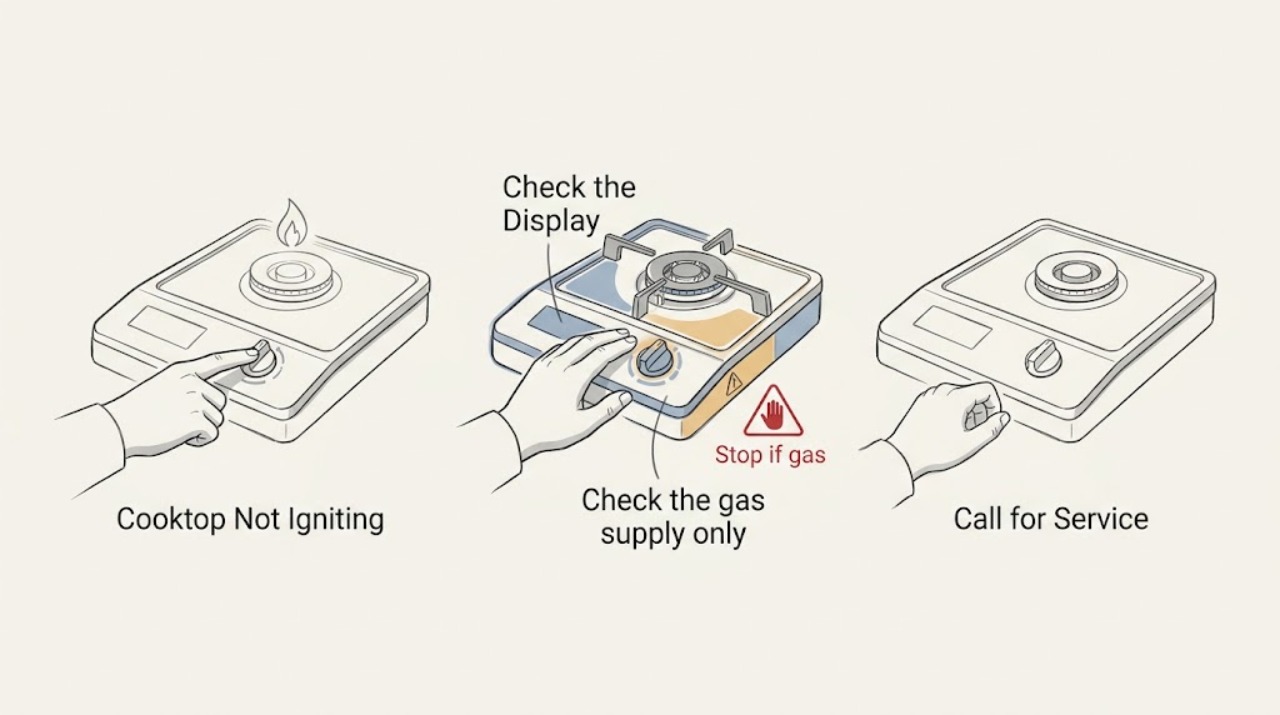
Work through in order
Diagnostic checks
Use only checks that match the exact appliance or system and its official guide.
-
Stop if gas or a dangerous ignition symptom is present
Before trying another burner, stop if there is gas odor, hissing, delayed ignition, a flare or bang, a yellow or unstable flame, smoke, scorching, or clicking with no safe stop. Do not light anything, touch electrical switches, unplug the cooktop, or use a phone inside; leave the area and call the gas supplier or emergency service from outside. Only shut a valve if it is already safely reachable without delaying evacuation or approaching the hazard.
Expected result: No gas or fire warning is present and the cooktop is cool with controls off, or any warning sign occurred or remains.
Next step: Continue only when no warning sign is present. For any warning sign, keep the cooktop unused and arrange gas or emergency service; do not return to test it until cleared.
Why this matters
Why: An unlit burner can release gas, and repeated ignition attempts can add an ignition source to accumulated gas. The safe response takes priority over identifying whether the cap or igniter is dirty.
-
Check power and the control lock without a live repair
From a dry, safe position, note whether the cooktop's igniters click when a control is pushed and turned to the ignition position, whether nearby power is available, and whether a control or cooktop lock is active. Check a plug and breaker only if they are cool, dry, intact, and safely accessible; do not repeatedly reset a breaker or open the appliance.
Expected result: No igniter clicks on any burner, only one burner lacks a spark, the control lock is active, or clicking occurs but the burner still does not light.
Next step: Use the exact owner's manual to clear a documented lock only when there is no gas odor or other hazard. If power is normal and the lock is not active, keep the cooktop off and arrange service rather than testing live ignition parts.
Why this matters
Why: No spark on every burner points toward power, lockout, shared ignition control, or supply wiring; one dead burner points more toward that electrode or its local area. Whirlpool notes that a lock can allow clicking or visible sparking while preventing lighting on some models.
-
Check the gas supply only from a safe position
Without moving the cooktop or touching a gas connection, use the installation information to note whether the appliance's gas shutoff is intended to be open and whether other gas appliances have normal supply. Do not investigate a leak, change a regulator, alter pressure, or turn a control on to purge a line.
Expected result: All burners fail and there is no confirmed gas supply, one burner fails while others work, or the supply appears normal with no odor.
Next step: If gas supply is uncertain, stop and have the gas supplier or licensed gasfitter confirm it. If the supply is normal but ignition fails, continue only with the cool, controls-off burner inspection.
Why this matters
Why: If all burners fail, a shared gas supply, power, lock, or ignition issue is more likely; one failed burner points toward its local cap, port, electrode, or valve. A normal supply observation does not rule out a leak or an internal gas fault.
-
Inspect the burner cap and base alignment while cool
With all controls off and the cooktop cool, inspect the affected burner for the correct cap on the correct base, centered and sitting flush with minimal side-to-side movement. Look for a spill or residue on the cap underside or around the accessible burner area. Do not perform this check while gas odor is present and do not force parts into place.
Expected result: The cap is displaced, mismatched, dirty, wet, or visibly damaged, or it is correctly matched, seated, clean, and dry.
Next step: If the manual allows it, clean and dry the accessible cap and reseat it correctly, then stop if the burner still fails. Do not use an external flame to prove that gas is present.
Why this matters
Why: Whirlpool says a correctly seated cap and a clean cap underside help the burner light and maintain an even flame. A correctly seated cap shifts attention to ports, supply, ignition, or a professional fault.
-
Check for moisture or blocked accessible burner ports
Only after the cooktop is cool, controls are off, and no gas odor is present, look for moisture or food residue around the cap, base, and accessible ports. Follow the exact Whirlpool manual for cleaning; where it permits port cleaning, use the specified small straight tool gently without enlarging or distorting openings, then let parts dry fully. Never use a wooden toothpick or aggressive chemical cleaner.
Expected result: Moisture, residue, or a visibly blocked port is present, or the accessible burner area is dry and clear.
Next step: Reassemble only as the model manual shows and leave the cooktop unused if it still does not light. Do not repeat ignition attempts to compensate for a blocked or wet burner.
Why this matters
Why: Whirlpool identifies clogged ports and wet or dirty burner components as causes of poor ignition or an uneven flame. A dry, clear burner with a spark but no flame points toward gas delivery or a deeper fault.
-
Separate no spark from spark without flame
Use the recorded symptom rather than creating a prolonged test: no click or spark, a click and spark with no flame, or a flame that lights but is unstable or quickly goes out. Do not keep a control in the ignition position, use a match or lighter, or inspect the electrode while energized.
Expected result: No spark is reported; a spark is visible but no flame establishes; or a flame establishes but is delayed, weak, yellow, unstable, or accompanied by continued clicking.
Next step: For no spark, arrange qualified electrical/appliance service. For spark without flame or an abnormal flame, stop the gas attempt and arrange licensed gasfitter or Whirlpool service; do not manually light it.
Why this matters
Why: No spark suggests power, lock, ignition control, electrode, or wiring. Spark without flame suggests gas flow, port, cap, or burner alignment. A delayed or abnormal flame can indicate a gas or combustion fault and is not a normal cleaning issue.
-
Check whether one or all burners are affected
Record whether the failure is limited to one burner or affects every burner, without repeatedly operating them. If other burners were already observed before the fault, note whether they click, spark, and light normally; do not use another burner to ignite the failed one.
Expected result: Only one burner fails, several burners fail, or all burners fail.
Next step: Use the affected-burner pattern to describe the fault to Whirlpool or a qualified technician. Keep the cooktop off if the fault is unresolved; do not cross-light burners or keep cycling controls.
Why this matters
Why: One-burner failure favors a local cap, port, electrode, or burner-base problem. Several or all burners failing favors shared power, lock, gas supply, or ignition-control causes. A gas smell changes either pattern into an emergency response.
-
Decide when to stop owner checks and call service
Gather the model, fuel type, affected burner count, spark/no-spark result, cap and port observations, power/lock observations, and any odor, delay, flame, smoke, scorch, or breaker symptom. Do not fit a guessed igniter, valve, regulator, or burner part based only on the symptom.
Expected result: The burner lights normally after a documented, safe cap/cleaning correction with no warning signs, or it remains unable to light or the fault recurs.
Next step: Keep the cooktop unused for an unresolved failure and arrange Whirlpool or qualified appliance/gas service. For gas odor, delayed ignition, abnormal flame, smoke, or fire, use the emergency or gas-supplier route before ordinary service.
Why this matters
Why: A successful low-risk correction can explain a misseated or contaminated burner, but recurrence or any gas, electrical, or combustion warning needs diagnosis. Whirlpool directs users to service when the documented checks do not resolve the problem.
Use your observations
Decision map
Find the observation that best matches what you see, then follow the next safe action.
-
PATH 01Safety boundary
What you see
Gas odor, hissing, delayed ignition, visible fire, smoke, or an abnormal flame is present
Do this next
Do not light, switch, unplug, or use a phone inside. Leave the area and contact the gas supplier or emergency service from outside; shut gas only if already safely reachable without delaying evacuation.
Why this path and its safety boundary
Safety stop: Do not return, search for the leak, or relight the cooktop until the authority or licensed professional clears it.
-
PATH 02Safety boundary
What you see
No burner makes a spark or all burners fail
Do this next
Check only safe power and lock indications, then arrange qualified service if the supply and documented lock state do not explain it.
Why this path and its safety boundary
Safety stop: Do not repeatedly reset the breaker, cross-light a burner, or open the control area.
-
PATH 03Safety boundary
What you see
Only one burner fails while other burners were already known to work
Do this next
With no odor and the cooktop cool, check that burner cap/base alignment, moisture, and accessible ports match the Whirlpool manual; arrange service if it remains unlit.
Why this path and its safety boundary
Safety stop: Do not use another burner or an external flame to ignite the failed burner.
-
PATH 04Safety boundary
What you see
There is no spark but power and lock indications appear normal
Do this next
Keep the cooktop off and arrange qualified appliance/electrical service for the electrode, ignition control, or wiring path.
Why this path and its safety boundary
Safety stop: Do not probe or replace energized ignition parts.
-
PATH 05Safety boundary
What you see
A spark is visible but no flame establishes
Do this next
Stop the attempt and arrange licensed gasfitter or Whirlpool service after checking only the safe, model-supported cap, port, and gas-supply information.
Why this path and its safety boundary
Safety stop: Do not hold the knob, manually light, or keep clicking while gas may be accumulating.
-
PATH 06Safety boundary
What you see
The cap is wet, dirty, displaced, or on the wrong burner base and there is no odor
Do this next
After cooling and with controls off, clean, dry, and reseat it only as the exact Whirlpool manual describes; stop if ignition remains abnormal.
Why this path and its safety boundary
Safety stop: Do not clean or reseat parts while gas odor is present and do not distort burner ports.
-
PATH 07Safety boundary
What you see
The burner lights but the flame is yellow, sputtering, delayed, weak, or the igniter keeps clicking
Do this next
Turn it off if safe, leave the burner unused, and contact a licensed gasfitter or Whirlpool support.
Why this path and its safety boundary
Safety stop: Do not adjust gas pressure, remove a regulator, or keep relighting it.
-
PATH 08Safety boundary
What you see
The cap, ports, supply, power, and lock checks are normal but the burner remains unlit
Do this next
Keep the cooktop off and arrange Whirlpool or qualified appliance/gas service with the model and spark/no-spark history.
Why this path and its safety boundary
Safety stop: Do not purchase or fit a guessed igniter, valve, module, or burner part from the symptom alone.
Helpful context
Understand the symptom
Confirm the cooktop is a gas model
A Whirlpool gas cooktop uses an electronic igniter and a gas burner; an electric-only cooktop has a different failure path. The checks here are for a gas model with burner caps and gas controls. Use the rating label and the exact owner's manual to confirm the model and fuel type. Do not test an uncertain appliance by turning a knob, and do not use a generic lighting instruction from another Whirlpool series.
The sound and the flame narrow the decision
If there is no clicking or spark at a safe, normal start command, focus on the cooktop's electrical supply, control lock, ignition control, or electrode path. If there is a visible spark but no flame, focus on whether gas is reaching the burner and whether the cap, base, ports, or accessible surfaces are correctly positioned and dry. If a flame appears but is yellow, unstable, sooting, delayed, or accompanied by odor, stop and use professional gas service rather than continuing to adjust or relight.
Keep cleaning and inspection low risk
Only inspect or clean a burner after all controls are off, the cooktop is cool, and no gas odor is present. Whirlpool permits model-specific cleaning of accessible burner ports and cap surfaces, but says not to enlarge or distort a port and not to use a wooden toothpick that can break off. Do not remove sealed components, alter a regulator, open the control area, probe the ignition circuit, or use an external flame to diagnose ignition.
Only after diagnosis
Potential parts
- burner cap or burner base
Only relevant after the appliance is safe and a qualified or model-specific diagnosis confirms a damaged or incorrect cap/base is causing poor ignition or flame quality.
Confirm the full Whirlpool model and fuel configuration before ordering; do not handle parts while gas odor is present. - spark electrode or ignition module
Only relevant when a qualified technician confirms that a no-spark fault is in the local electrode or shared ignition circuit after supply and lock checks.
Model-specific identification and qualified installation are required; do not test or replace ignition components yourself. - gas valve or regulator component
Only relevant if a licensed gasfitter confirms a gas-delivery, valve, regulator, or approved fuel-configuration fault.
Gas pressure and conversion work are professional tasks; never infer fit or adjust this component from a failed ignition alone.
When checks do not resolve it
Need a professional?
Provide the Whirlpool model and fuel type, affected burner count, whether there was a spark, power and lock observations, cap/port condition, gas-supply history, and any odor, hissing, delay, flame, smoke, scorch, or breaker symptom.
Safety scope: Do not use a Whirlpool gas cooktop with gas odor, delayed ignition, abnormal flame, repeated clicking, smoke, fire, damaged wiring, or unresolved no-spark/spark-without-flame symptoms until qualified service has assessed it.
Common questions
FAQ
Why does my Whirlpool gas cooktop click but not light?
With no gas odor and the cooktop cool, check the correct burner cap/base alignment, moisture or residue, accessible port blockage, gas supply information, and any control lock. If a spark is present but no flame establishes, stop rather than manually lighting and arrange qualified gas or appliance service.
What if my Whirlpool cooktop has no spark at all?
If all burners lack a spark, look only for safe power or lock indications and then arrange service if those do not explain it. If one burner lacks a spark while others work, provide that pattern to a technician; do not probe or replace the ignition circuit yourself.
Can I use a lighter when the Whirlpool igniter does not work?
Do not use an external flame as a workaround for an unexplained or continuing ignition fault, especially if there is any gas odor, delay, or abnormal flame. Stop and use the Whirlpool manual and qualified gas service path.
What should I do if I smell gas from the cooktop?
Do not light anything, operate electrical switches, unplug appliances, or use a phone inside. Leave the area and call the gas supplier or emergency service from outside. Only close a valve if it is already safely reachable without delaying evacuation or approaching the hazard, and do not return until cleared.
Read the exact guide
Official sources
- Nothing Will Work - Gas CooktopWhirlpool Product Help · Whirlpool gas cooktop power, gas supply, control lock, and ignition behavior
- Odors or SmellsWhirlpool Product Help · Whirlpool gas-cooktop odor, fuel type, flame quality, burner cap, and gas-safety response
- Burner Not Lighting - Gas CooktopWhirlpool Product Help · Whirlpool gas cooktop burner ports, burner caps, bases, ignition, and service guidance
- None of the Burners are LightingWhirlpool Product Help · Whirlpool gas cooktop all-burner failures, power, ports, cap alignment, gas valve, and service checks
- Range SafetyWhirlpool · Whirlpool gas-range emergency instructions and qualified installation/service boundary
- GAS BUILT-IN COOKTOP OWNER'S MANUALWhirlpool · Whirlpool gas built-in cooktop electronic ignition, cap/base placement, gas supply, and electrical safety
- Lighting the Burners - Electronic IgnitionWhirlpool Product Help · Whirlpool electronic ignition operation and burner-cap cleaning guidance
Community feedback
Share a repair observation
Share a plain-text repair observation. Accepted observations are published automatically; this page may take a moment to update.