
On this page
Start here
Quick answer
A Whirlpool dishwasher that appears to stop may be paused by an opened door or power interruption, waiting through a normal heating hold, or unable to drain or fill. Check the Start/Resume indicator and latch first, then look for standing water, a blocked filter or drain hose, a closed water valve, foam, or a displayed code. If the cycle only pauses while it heats and later advances, that can be normal; if it repeatedly stops, leaves water, shows a fault light, or has no response after a control reset, arrange qualified service.
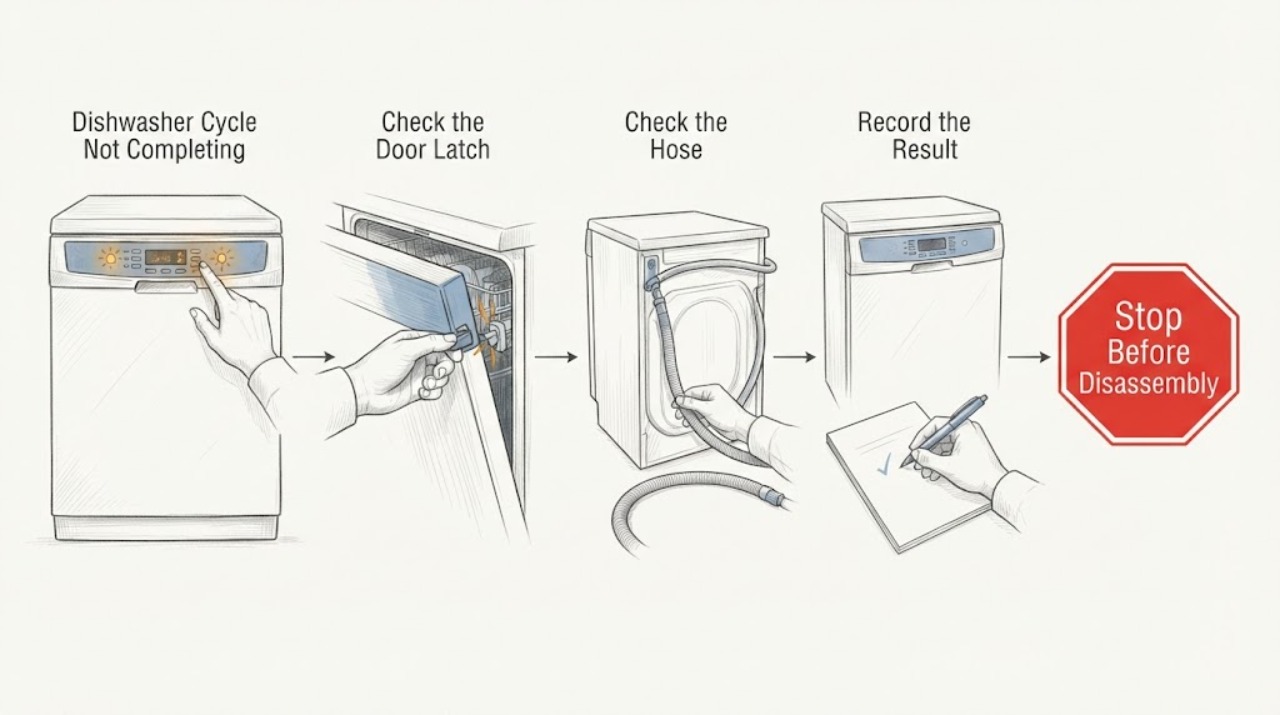
Work through in order
Diagnostic checks
Use only checks that match the exact appliance or system and its official guide.
-
Check 1
Look at the control panel before starting another cycle. If the Start/Resume light is flashing, press Start/Resume and close the door firmly within the time specified by your model; if the cycle was interrupted by a power outage, use Cancel or Drain first as the Whirlpool instructions describe. Check that the door latch engages instead of forcing the door.
Expected result: The Start/Resume indicator flashes, the door was opened, or power was interrupted; alternatively, the door latches and the controls show a normal idle state.
Next step: If the cycle resumes and advances, monitor it through completion. If the indicator keeps flashing, the door will not latch, or the dishwasher stops again, record any other light pattern and continue with the water and drainage checks.
Why this matters
Why: A flashing Start/Resume indicator is consistent with a paused cycle after a door opening or power interruption. A door that does not latch can prevent a cycle from resuming. A normal idle display with a secure latch makes a simple pause less likely.
-
Check 2
After the dishwasher is quiet, inspect the bottom of the tub for water above the filter area. If your model has removable filters, follow its manual to remove and rinse them under running water, inspect only the accessible sump for loose food debris, and reinstall every filter so it locks. From under the sink, look for a visibly kinked or crushed drain hose and confirm the disposer connection or air gap is clear; do not detach a hose unless the model instructions make that safe for you.
Expected result: Water remains in the tub, the filter is coated with food soil, the hose is kinked or sagging, the disposer was recently installed, or water is absent and the drain path looks clear.
Next step: Clean and correctly seat the filter, correct only a clearly accessible hose-routing problem, and run the model's short drain or rinse operation while observing whether water leaves the tub. If water remains, the pump only hums, grinding is heard, or the drain path needs disassembly, stop and arrange service.
Why this matters
Why: Standing water after an incomplete cycle makes restricted drainage, a hose or sink connection problem, or a pump issue more likely. A clean filter and clear visible hose make a simple blockage less likely, but they do not prove that the pump or control is working.
-
Check 3
If the dishwasher stops with little or no water, check the water-supply valve under the sink and make sure it is fully open. Look at the accessible drain hose routing for a model-required high loop or air gap, and check the overfill float only for an obvious obstruction that can be removed without tools. Do not open the inlet valve, wiring, or lower access panels.
Expected result: The supply valve is closed or restricted, the hose has no high loop where the model requires one, the float cannot move freely, or the supply and visible routing appear normal.
Next step: Open the supply valve fully, correct only an obvious accessible hose loop according to the installation instructions, or clear a loose float obstruction. Test once. If the dishwasher still stops before filling, shows a code, or needs access to a valve or float assembly, use model-specific service.
Why this matters
Why: A dishwasher needs water to fill, wash, and rinse; a closed supply, siphoning caused by incorrect drain routing, or an obstructed overfill float can stop progression. If those checks are normal, an inlet, sensor, or control problem becomes more likely and cannot be identified from this symptom alone.
-
Check 4
Notice whether the dishwasher is circulating water and simply holding at one stage, or whether it is silent and stuck. Before a new test, run the hot-water faucet nearest the dishwasher until the water is warm. Whirlpool says the incoming supply should be about 120°F (49°C) for best results; use your model manual and local plumbing guidance rather than raising the water heater beyond its safe setting.
Expected result: The dishwasher pauses two or three times and later advances, the display time changes very slowly while water is warm, or it remains at the same stage with cool water and never advances.
Next step: Allow a normal thermal hold to finish and compare the result with the model's expected cycle behavior. If the cycle never advances, a heating fault code appears, or dishes and water remain unusually cool after the hold, stop repeated testing and arrange qualified service.
Why this matters
Why: Short thermal holds can be normal because the dishwasher waits for water to reach its cleaning temperature. A long or repeated hold with cool incoming water makes water-heating or sensing trouble more likely, but it does not identify a failed heater or sensor by itself.
-
Check 5
Inspect the tub and dispenser area for foam or suds, and check whether the detergent is labeled for automatic dishwashers and whether the rinse-aid cap is seated. Do not add more detergent or use hand dish soap to compensate. If the panel is unresponsive after the checks above, cancel or drain the cycle, disconnect power using the accessible plug or the dedicated breaker, wait 30 seconds, and restore power before selecting a fresh cycle.
Expected result: Foam is present, the wrong detergent or an open rinse-aid cap is evident, the panel responds normally, or the panel remains unresponsive or shows an unexpected indicator after the reset.
Next step: Stop adding detergent and follow the model manual or contact Whirlpool if suds persist. After one reset, run one appropriate test. If the same stop or indicator returns, do not keep cycling power; arrange qualified appliance service.
Why this matters
Why: Whirlpool says suds can interfere with filling and normal operation, and its manual directs service when a cycle is not complete with suds or when the relevant clean indicator continues blinking. A reset can clear a transient control state, but a returning fault points to an underlying problem.
Use your observations
Decision map
Find the observation that best matches what you see, then follow the next safe action.
-
PATH 01Next step
What you see
The Start/Resume light flashes after the door was opened or power was interrupted, and the door now closes and latches.
Do this next
Press Start/Resume and close the door as directed for the model. If the cycle advances, let it finish; if the latch will not engage or the same pause returns, stop and have the latch or control diagnosed.
Why this path and its safety boundary
Why it matters: The cycle is more likely paused than mechanically failed. Whirlpool uses the flashing Start/Resume state to signal that the cycle needs to be resumed after an interruption.
-
PATH 02Next step
What you see
The dishwasher stops with water left in the tub, the filter or sump is visibly soiled, the drain hose is kinked, or the pump hums without moving water.
Do this next
Clean and seat the filter and check only the visible hose, disposer, or air-gap path. If standing water remains, grinding is heard, or pump access is needed, stop and arrange qualified service.
Why this path and its safety boundary
Why it matters: A restriction in the filter, sump, hose, sink connection, or drain pump is more likely than a simple door interruption. A hum without movement can point toward an obstruction or pump-area problem, but it does not identify a part to replace.
-
PATH 03Next step
What you see
The dishwasher stops before or just after filling, there is little or no water, the supply valve or float is obstructed, or the tub contains foam.
Do this next
Open the water valve, clear only a loose accessible obstruction, correct an obvious model-required hose loop, or stop adding detergent. Test once with the correct product. If the dishwasher still will not fill or the foam or indicator returns, use the model manual and arrange service.
Why this path and its safety boundary
Why it matters: A fill problem, siphoning or installation problem, obstructed overfill protection, or suds interference is more likely. These observations do not prove that the inlet valve, sensor, or control has failed.
-
PATH 04Next step
What you see
Water is circulating and the display pauses during a heating stage, then advances when the incoming water is warm; or the display remains stuck indefinitely with cool water, a recurring code, a blank panel, or repeated breaker trips.
Do this next
Let a normal hold complete. For an unresolved stop, perform one model-appropriate control reset only after canceling or draining; if it returns, stop using the dishwasher and arrange qualified appliance or electrical service. Do not test live wiring or repeatedly reset a tripped breaker.
Why this path and its safety boundary
Why it matters: A pause that resolves is consistent with a normal thermal hold. A pause that never resolves, a recurring error, loss of control response, or an electrical symptom makes a heating, sensor, motor, control, or power fault more likely.
Helpful context
Understand the symptom
Start by deciding whether the dishwasher is paused, still heating, or stopped because a required operation failed. A few short pauses during the main wash can be part of normal operation while the dishwasher heats the water. A cycle that stops at the same point, leaves water in the tub, or flashes a fault indicator needs a different check.
Keep hands out of the tub while spray or draining sounds are active. Use the model's Owner's Manual for controls that differ by model, and do not remove wiring covers, reach into the pump, or use drain-opening chemicals.
When checks do not resolve it
Need a professional?
Arrange qualified Whirlpool or appliance service when the dishwasher repeatedly stops after the latch, visible filter, hose, water-supply, suds, and one reset check; when standing water remains, a pump hums or grinds, a clean or fault indicator keeps blinking, the cycle stops before filling or heating, or a model-specific code returns. Stop using the dishwasher for smoke, a burning smell, damaged wiring, water near electrical parts, repeated breaker trips, or an uncontrolled leak. Do not remove access covers, test live circuits, reach into the pump, or use drain-opening chemicals.
Common questions
FAQ
Is it normal for a Whirlpool dishwasher to pause during a cycle?
Yes. Whirlpool says some cycles pause two or three times during the main wash while the dishwasher heats the water. A pause that later advances is different from a cycle that remains stuck, leaves standing water, flashes a fault indicator, or stops at the same stage every time.
Why does my Whirlpool dishwasher stop with water left inside?
Whirlpool identifies the filter, sump, drain hose, disposer or sink connection, and drain pump as possible parts of the drainage path. Clean and correctly seat the model's filter, check the accessible hose for a kink, and check the sink connection or air gap. If water remains or the pump hums without moving water, arrange service.
Can a power reset fix a Whirlpool dishwasher that stops mid-cycle?
A control reset can clear a transient control state. Cancel or drain the cycle, disconnect power using the plug or dedicated breaker, wait 30 seconds, and restore power as Whirlpool describes. If the same stop or indicator returns after one test, the reset has not corrected the cause and qualified service is appropriate.
Read the exact guide
Official sources
- Owner's ManualWhirlpool Brand Home Appliances · Whirlpool dishwasher troubleshooting for stops during a cycle, suds, incomplete cycles, blinking lights, and water temperature
- How to Clean the Dishwasher FiltersWhirlpool Product Help · Whirlpool dishwasher filter types, cleaning, seating, and filter-related performance
- 5 Reasons Why Your Dishwasher Is Not Getting WaterWhirlpool · Whirlpool dishwasher fill symptoms, overfill float, and the case where a dishwasher fills then stops
- Will Not Fill With Water - DishwasherWhirlpool Product Help · Whirlpool dishwasher water supply, drain-loop siphoning, door interruption, and Start/Resume behavior
- Dishwasher Water Temperature TroubleshootingWhirlpool Product Help · Whirlpool dishwasher cool-water symptoms, heating time, and model-specific heater or sensor service boundary
- Stops Mid Cycle - DishwasherWhirlpool Product Help · Whirlpool dishwasher cycles that stop or pause mid-cycle
- Not Draining - Newly Installed - DishwasherWhirlpool Product Help · Whirlpool dishwasher disposer knockout plug, high loop, air gap, and visible drain-line checks
- Resetting the Dishwasher's Controls (Cycle Power)Whirlpool Product Help · Whirlpool dishwasher control reset, cancel or drain sequence, one-minute power-down guidance, and control-lock context
- How Water Temperature Affects Cycle TimeWhirlpool Product Help · Whirlpool dishwasher thermal holds, cycle progression, and incoming hot-water guidance
- Dishwasher Not DrainingWhirlpool Product Help · Whirlpool dishwasher drainage path, filter, sump, hose, sink connection, pump clues, and service boundary
Community feedback
Share a repair observation
Share a plain-text repair observation. Accepted observations are published automatically; this page may take a moment to update.