
On this page
Start here
Quick answer
For a whirlpool dishwasher with dishwasher does not dispense detergent, first identify the exact model and record what works, then perform only the accessible checks in the matching manufacturer guidance. Whirlpool says caked or damp detergent can stick, an upper rack can block the dispenser, and fresh detergent in a dry dispenser with correct loading is the first check; a failed door or dispenser needs model-matched service. Stop for smoke, burning odor, sparks, damaged wiring, water near electrical parts, repeated breaker trips, or a door that cannot safely close; do not open sealed or energized components.
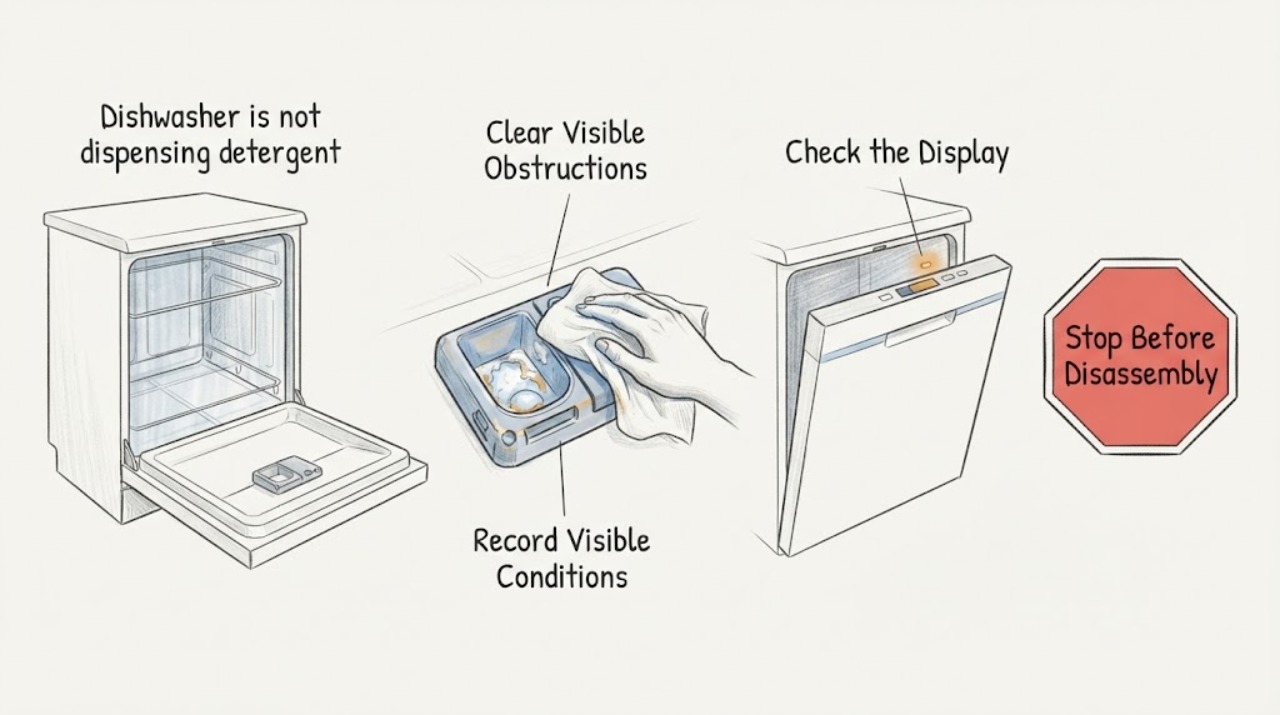
Work through in order
Diagnostic checks
Use only checks that match the exact appliance or system and its official guide.
-
Check 1
With the dishwasher cool and safe, record the exact model, the visible control or error state, and when dishwasher does not dispense detergent. Do not remove panels or touch wiring.
Expected result: The model and symptom are clear, or the display is blank, the code changes, or another function also fails.
Next step: Use the matching branch below and the exact model manual. If the model cannot be identified without disassembly, stop and arrange service.
Why this matters
Why: The exact model and symptom pattern determine which manufacturer instructions apply; one working function does not prove the affected circuit is healthy.
-
Check 2
When the appliance is cool, check only accessible setup conditions related to the detergent dispenser, rack loading, and detergent: closure, loading, visible obstruction, filter or vent position, normal control selection, or documented mode.
Expected result: The accessible condition is corrected, or it is already normal and the symptom remains.
Next step: Make one normal operating check only if the appliance is safe. If the symptom remains, record timing and stop.
Why this matters
Why: A setup or airflow condition can mimic a component fault; a persistent symptom after that check needs model-specific diagnosis.
-
Check 3
Only if there is no smoke, burning odor, sparking, moisture near electrical parts, visible damage, or repeated protection trip, perform one power or control reset explicitly documented for the exact model.
Expected result: The appliance returns to normal, the symptom returns, or the control remains inactive.
Next step: Leave the appliance off if the symptom returns and arrange qualified appliance service.
Why this matters
Why: A documented reset can clear a transient control state but does not prove an internal repair. A returning symptom is evidence for service.
-
Check 4
Prepare the model number, display code or sound description, timing, settings, and results of the external checks for the manufacturer or qualified technician. Do not access sealed, energized, gas, refrigerant, or high-temperature components.
Expected result: The symptom persists, a component diagnosis would require access, or any hazard appears.
Next step: Stop use and arrange qualified service; use emergency or electrical/gas help for an immediate hazard.
Why this matters
Why: The remaining possibilities include internal control, sensor, heater, motor, latch, wiring, or installation faults that cannot be separated safely from outside.
Use your observations
Decision map
Find the observation that best matches what you see, then follow the next safe action.
-
PATH 01Next step
What you see
The accessible setup or control condition was wrong and the appliance completes one normal safe cycle after correction.
Do this next
Keep the documented setting, loading, closure, and ventilation conditions, and monitor for recurrence.
Why this path and its safety boundary
Why it matters: The original symptom may have been an operating condition rather than a failed component.
-
PATH 02Next step
What you see
The appliance remains usable but the target symptom persists after the documented external check.
Do this next
Stop repeated testing and arrange qualified service with the model and observations.
Why this path and its safety boundary
Why it matters: The fault is not identified by the accessible checks; an internal component, installation, or model-specific control path remains possible.
-
PATH 03Next step
What you see
The display, sound, temperature, closure, or function worsens, or a code returns after one reset.
Do this next
Leave the appliance off and request manufacturer or qualified service.
Why this path and its safety boundary
Why it matters: A recurring fault should not be treated as a settings issue or cleared by repeated cycling.
-
PATH 04Next step
What you see
Smoke, burning odor, sparks, water near electrics, damaged glass or wiring, gas odor, uncontrolled heat, or repeated breaker trips appears.
Do this next
Stop immediately, keep clear, isolate power or gas only from a safe accessible location, and obtain qualified or emergency help as appropriate.
Why this path and its safety boundary
Why it matters: This is a safety boundary outside routine user troubleshooting.
Helpful context
Understand the symptom
Identify the exact symptom and model
Record the model label, the control or display state, when dishwasher does not dispense detergent, and whether the symptom affects one function or the whole appliance. The manufacturer guidance is model-dependent, so do not infer a component from the symptom alone.
Perform the accessible check
Whirlpool says caked or damp detergent can stick, an upper rack can block the dispenser, and fresh detergent in a dry dispenser with correct loading is the first check; a failed door or dispenser needs model-matched service. Keep the appliance cool and dry, and follow only normal user controls and visible access points.
Stop when the pattern persists
If the symptom returns after one normal documented check, or any safety sign appears, stop using the appliance and arrange qualified service with the model and observations. Do not repeatedly reset protection or dismantle the appliance.
Common questions
FAQ
Is dishwasher does not dispense detergent always a failed part?
No. First match the exact model and check the accessible operating conditions documented by the manufacturer. A persistent or unsafe symptom needs service.
When should I stop troubleshooting?
Stop for a returning code, persistent failure after the documented check, visible damage, smoke, burning odor, sparks, water near electrics, gas odor, or repeated breaker trips.
Read the exact guide
Official sources
- Detergent Remains at End of Cycle - Product HelpWhirlpool · Whirlpool guidance relevant to dishwasher, dishwasher does not dispense detergent, and model-specific troubleshooting; verify exact model instructions.
Community feedback
Share a repair observation
Share a plain-text repair observation. Accepted observations are published automatically; this page may take a moment to update.