
On this page
Start here
Quick answer
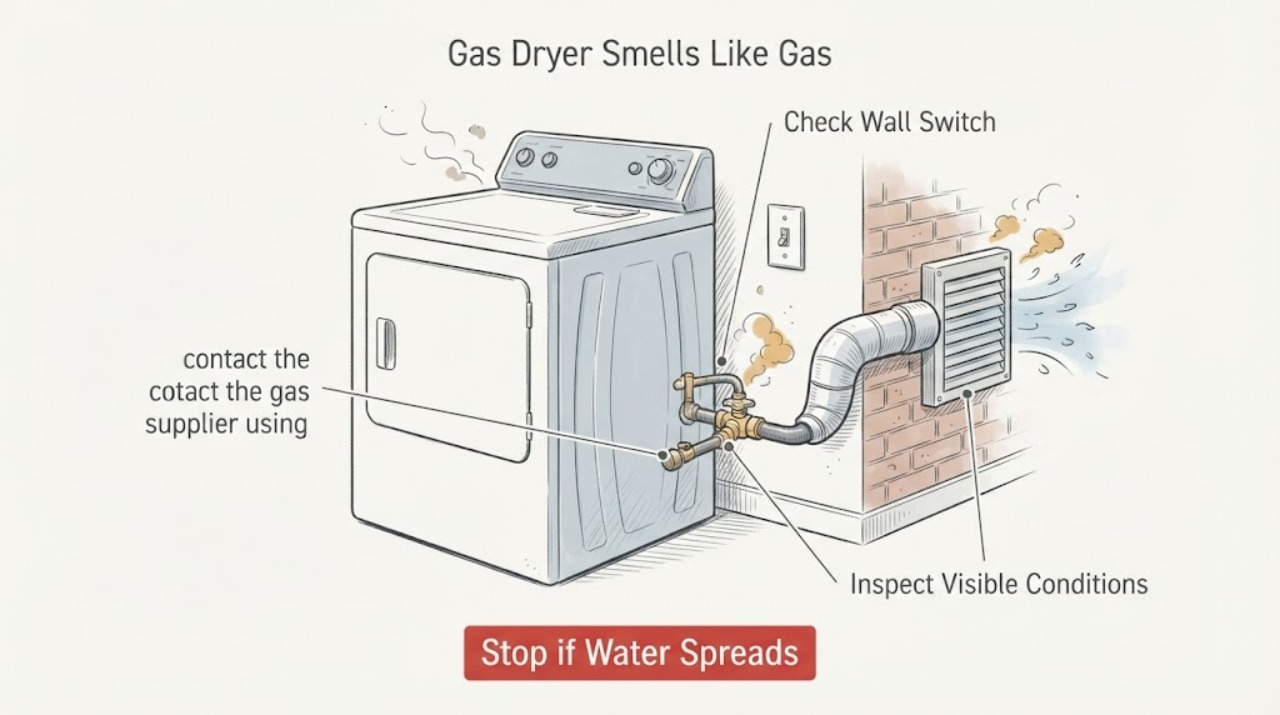
A strong or persistent gas-like odor at the outside exhaust of a Whirlpool gas dryer is not a smell to test or explain away as normal dryer exhaust. Stop using the dryer, do not try to light or restart any appliance, do not operate electrical switches or use a phone inside the building, and clear people from the area. From a safe location, close the dryer gas shutoff only if it is immediately accessible and local emergency guidance says it is safe; otherwise leave it for the gas supplier or emergency responders. Call the gas supplier from outside or a neighbor's phone, and call the fire department or local emergency service if the supplier cannot be reached. Whirlpool says gas-dryer installation and service must be handled by a qualified installer, service agency, or gas supplier. This page uses Whirlpool's U.S. safety and venting guidance; the exact model manual and local emergency rules control outside that scope.
Work through in order
Diagnostic checks
Use only checks that match the exact appliance or system and its official guide.
-
Check 1
Stop using the Whirlpool dryer immediately when the exhaust area smells like gas. Do not start another cycle, relight any appliance, operate an electrical switch, use a phone inside the building, or perform a soap test or vent-disconnection test.
Expected result: The odor is present now, returns while the dryer is running, or remains strong or persistent after the cycle stops.
Next step: Leave the building or affected area with all occupants. Do not return to troubleshoot or restart the dryer until the gas supplier or emergency responders say it is safe.
Why this matters
Why: Whirlpool treats a gas smell as a fire or explosion hazard. The odor location at the outside exhaust does not prove that the dryer or gas supply is safe.
-
Check 2
From outside the odor area, contact the gas supplier using a neighbor's phone or another phone outside the building and follow its instructions. If the gas supplier cannot be reached, call the fire department or local emergency service.
Expected result: The supplier or emergency responders give evacuation, shutoff, or re-entry instructions, or cannot be reached promptly.
Next step: Follow the responder's local instructions. Close the dryer gas shutoff only if it is immediately accessible without entering the odor area and the responder or local emergency guidance says to do so; otherwise leave the valve and appliance untouched.
Why this matters
Why: Whirlpool's gas-smell procedure assigns the hazard response to the gas supplier or fire department rather than to a homeowner diagnostic test.
-
Check 3
After the gas supplier or emergency responder has declared the area safe, give a qualified Whirlpool service technician or gas appliance professional the full model and serial information, the location of the odor, whether it occurred only during operation, and whether anyone observed an indoor odor.
Expected result: The technician can reproduce or document the report safely, or the model label, gas connection, exhaust route, or exterior hood needs inspection.
Next step: Keep the dryer out of service until that professional completes the gas-safety and venting assessment. Do not remove panels, loosen the flex connector, disconnect the vent, or replace a gas component based on the smell alone.
Why this matters
Why: The opened Whirlpool document requires installation and service by a qualified installer, service agency, or gas supplier and does not provide a homeowner procedure for identifying a gas leak source.
-
Check 4
Once the gas concern has been cleared, have qualified service inspect the dryer-to-wall vent run and the exterior exhaust hood for crushing, lint, debris, or other venting problems before normal use resumes.
Expected result: The vent run or exterior hood is obstructed or damaged, or the qualified inspection finds the venting intact and the gas odor source still unresolved.
Next step: Have the qualified service provider correct and verify the venting and investigate any remaining gas odor. Do not restart the dryer merely because the outlet looks clear.
Why this matters
Why: Whirlpool requires the dryer to exhaust outdoors and identifies a crushed or obstructed run and a lint-filled exterior hood as venting problems; those observations do not by themselves diagnose a gas leak or authorize a restart while the odor is unresolved.
Use your observations
Decision map
Find the observation that best matches what you see, then follow the next safe action.
-
PATH 01Next step
What you see
A gas-like odor is present, strong, persistent, or returns when the Whirlpool dryer operates.
Do this next
Evacuate, call the gas supplier from outside or a neighbor's phone, and call the fire department or local emergency service if the supplier cannot be reached. Do not restart or test the dryer.
Why this path and its safety boundary
Why it matters: This matches Whirlpool's gas-smell hazard scenario; the outside exhaust location is not a safe-normal classification.
-
PATH 02Next step
What you see
The odor is noticed only at the outdoor exhaust and no one has confirmed its source.
Do this next
Treat it as a possible gas hazard, clear the area, and obtain gas-supplier or emergency assessment before touching controls, the gas valve, the vent, or the dryer.
Why this path and its safety boundary
Why it matters: A location observation alone cannot distinguish combustion exhaust, a gas leak, or another unsafe condition; Whirlpool's safety response still applies to a reported gas smell.
-
PATH 03Next step
What you see
The gas supplier or emergency responder has cleared the area, but the qualified inspection finds a crushed, lint-filled, or obstructed vent run or exterior hood.
Do this next
Keep the dryer out of service while qualified personnel correct and verify the vent system and separately close out the gas-odor report.
Why this path and its safety boundary
Why it matters: The vent system needs qualified correction and cleaning; Whirlpool identifies outdoor exhaust, a clear run, and a clear exterior hood as venting requirements, but those findings do not prove the original gas odor was only a vent blockage.
-
PATH 04Next step
What you see
The gas supplier or qualified service provider finds no immediate hazard and gives explicit permission to resume use.
Do this next
Follow the exact Whirlpool model instructions and the provider's written guidance. Stop again and report it if a gas-like odor returns; do not run an air-only or heated cycle as an experiment.
Why this path and its safety boundary
Why it matters: Only the responsible gas or appliance professional can clear this report; Whirlpool's generic new-dryer odor example is limited to an initial semi-burning or oily smell and does not establish that a gas-like odor is normal.
Helpful context
Understand the symptom
Treat a gas-like exhaust odor as a safety report, not a vent test
The assigned question is about a Whirlpool gas dryer and an odor noticed where the exhaust leaves the house. The outside location does not establish that the odor is harmless: Whirlpool's opened safety instructions give a gas-smell response that applies before troubleshooting. They also state that combustion exhaust gases must be vented outdoors, but that requirement does not authorize a homeowner to keep running the dryer to compare smells, relight it, or test the gas train. The exact Whirlpool model and local gas-emergency procedure should be given to the responding gas supplier or qualified service technician.
A generic new-dryer odor page does not clear a gas smell
Whirlpool's odor-help page describes a semi-burning or oily smell during the first few cycles of a new gas or electric dryer. That limited new-appliance example should not be used to classify a strong or persistent gas-like smell from an established dryer as normal. If the odor resembles gas, follow the gas-smell emergency instructions and wait for professional clearance.
When checks do not resolve it
Need a professional?
Call the gas supplier or local emergency service immediately for a gas-like odor, especially if it is strong, persistent, returns during operation, or is accompanied by hissing, illness, or an indoor odor. After emergency clearance, use a qualified gas-appliance or Whirlpool service provider for the dryer, gas connection, burner/combustion system, and exhaust route. Do not relight, repeatedly reset, soap-test, remove panels, loosen gas fittings, disconnect the vent, or keep operating the dryer to see whether the smell changes.
Common questions
FAQ
Is a gas smell at the outside Whirlpool dryer vent normal?
Do not classify a strong or persistent gas-like smell as normal because it is outside. Whirlpool treats a gas smell as a fire or explosion hazard and requires gas-dryer combustion exhaust to be vented outdoors, but the exhaust location does not clear the appliance or gas supply. Evacuate and contact the gas supplier or emergency service from outside.
Can I run the Whirlpool dryer on air-only or restart it to see whether the smell returns?
No. Do not relight or restart an appliance, operate electrical switches in the building, or use a phone inside while responding to a gas smell. Wait for the gas supplier, emergency responders, or qualified service to clear the appliance; do not perform a comparison cycle.
Should I close the gas shutoff valve?
Only do so if the valve is immediately accessible without entering the odor area and the gas supplier or local emergency guidance says it is safe. Do not enter a gas-smelling area to reach it; evacuate and leave that decision to responders if safe access is uncertain.
Could a blocked dryer vent explain the smell?
Whirlpool identifies a crushed or obstructed vent run and a lint-filled exterior hood as venting problems, and requires combustion exhaust to go outdoors. Those observations do not diagnose a gas leak or make it safe to keep running the dryer. Have qualified service inspect the vent only after the gas concern has been cleared.
What if this is a new Whirlpool dryer with an oily or semi-burning smell?
Whirlpool's odor-help page describes a limited new-dryer example involving a semi-burning or oily smell during the first few cycles. That does not clear a strong or persistent smell that seems like gas; use the gas-smell safety response and obtain professional clearance.
Read the exact guide
Official sources
- Dryer Venting SpecificationsWhirlpool Corporation · Used for the gas-smell emergency response, qualified-service boundary, outdoor combustion-exhaust requirement, and post-clearance vent inspection scope. It is not used to infer a model-specific leak location or to authorize a restart while an odor is present.
- Removing Odors or Smells - Dryer - Product Help | WhirlpoolWhirlpool Corporation · Used only to distinguish Whirlpool's limited new-dryer semi-burning or oily smell example from a reported gas-like odor; it is not used to diagnose a gas leak or override the gas-smell safety response.
Community feedback
Share a repair observation
Share a plain-text repair observation. Accepted observations are published automatically; this page may take a moment to update.