
On this page
Start here
Quick answer
Treat a burning smell from a Whirlpool dryer as a stop-and-check symptom. Turn the dryer off, remove the load, and do not start another cycle until you know whether the smell came from a new-appliance odor, paint or varnish fumes in the room, contaminated clothing, lint or a restricted vent, or the dryer itself. Whirlpool says a burning scent with a hot dryer or long drying can indicate a clogged vent and says to call a professional when a dryer has a burning smell. Once the appliance is cool, check the lint screen, visible exhaust path, room fumes, and clothing only from ordinary safe access. If the odor returns, remains with the load removed, or comes with smoke, flame, gas or electrical odor, sparks, scorching, abnormal heat, or a damaged cord, leave the dryer out of service and arrange qualified service; leave the area and contact local emergency services for active smoke, fire, or gas odor.
Before you begin
Safety first
- This article covers stop-and-triage observation, load and room separation, ordinary-access lint and exhaust checks, and visible power-connection inspection only. Do not open the cabinet, probe live circuits, reach toward heat or drive parts, operate without the lint screen or exhaust, or restart a dryer with a recurring odor or hazard.
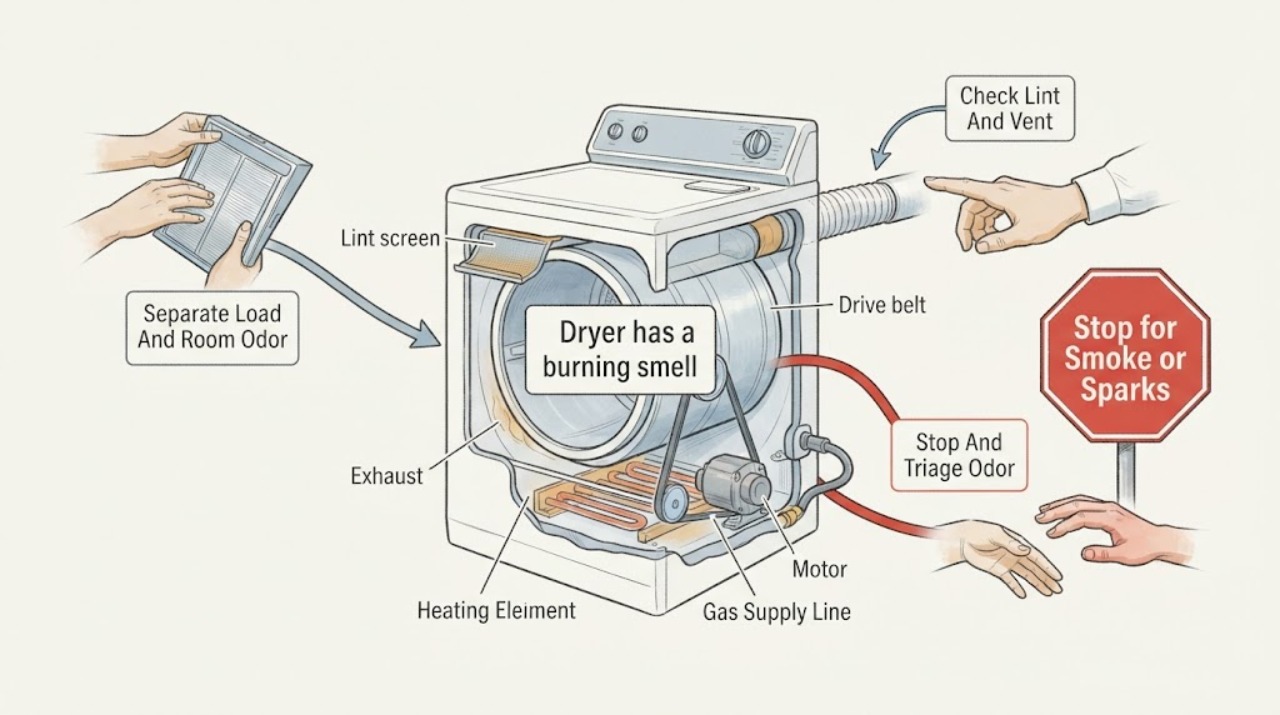
Work through in order
Diagnostic checks
Use only checks that match the exact appliance or system and its official guide.
-
Check 1
Stop the dryer immediately and note the odor from a safe position; press Power only if the controls respond normally, and do not touch a hot or damaged cord or operate switches when there is a gas odor.
Expected result: Record whether there is visible smoke or flame, a gas odor, an electrical or melting-plastic smell, scorching, a hot plug or cord, unusual cabinet heat, weak airflow, or an odor limited to the clothing.
Next step: For active smoke, fire, or gas odor, leave the area and contact local emergency services according to local guidance. Otherwise disconnect power only through a safe normal disconnect if appropriate, leave the dryer off, and continue only when it is cool and hazard-free.
Stop if: Do not restart for smoke, flame, gas odor, electrical smell, sparking, scorching, a damaged cord, or rapidly worsening heat.
Why this matters
Why: Smoke, flame, gas odor, electrical smell, scorching, or abnormal heat is an emergency or service boundary. A load-only odor can have a different cause, but it still requires removing the load before another heated cycle.
-
Check 2
With the dryer off and the load removed, identify whether the smell follows clothing, a rag, the drum, or the laundry-room air; ask whether the dryer is new or whether paint, stain, varnish, or refinishing recently occurred nearby.
Expected result: Record whether the odor is present on the clothing only, remains in an empty drum, began on first use, or appeared while the surrounding room contained fresh fumes; also note damp clothing left in the washer or dryer.
Next step: Ventilate a room affected by paint or refinishing, rewash clothing after fumes are gone, and rewash damp-stored loads; keep the dryer off and arrange service if an empty drum still smells burned.
Stop if: Do not run the dryer while paint, stain, varnish, or other fumes are present, and do not heat clothing with an unknown chemical or oily odor.
Why this matters
Why: Whirlpool identifies a first-use oily smell, nearby paint or varnish fumes drawn into the dryer, and damp loads left too long as separate odor sources. An odor that remains without clothing or room fumes points more toward the dryer, lint, exhaust, power, or an internal component.
-
Check 3
After the dryer is cool and safely disconnected, clean and fully dry the lint screen, confirm it is seated, and inspect only the accessible exhaust duct, outside hood, and area behind the dryer for lint, crushing, kinks, or blocked airflow.
Expected result: Record whether the screen is missing, damaged, wet, or heavily coated; whether the duct or hood is restricted; whether the dryer is hotter than usual or drying takes longer; and whether lint has accumulated behind the appliance.
Next step: Restore a clean, dry, correctly seated screen and have a qualified person clean the cabinet interior or inaccessible duct when lint is extensive or restriction remains; do not run the dryer without the screen.
Stop if: Do not disconnect the exhaust and operate the dryer, operate without the lint screen, reach into the cabinet, or keep testing a restricted or overheated vent path.
Why this matters
Why: Whirlpool says a burning scent, a dryer that is hot to the touch, or longer drying can indicate a clogged vent. Its care guidance says lint can obstruct airflow and contribute to overheating, while a missing or damaged screen is not an acceptable operating condition.
-
Check 4
From outside the appliance, inspect the plug, cord, outlet face, and visible connection for looseness, heat damage, discoloration, or scorching, and confirm that the dryer is not surrounded by combustible clutter or placed where exhaust is crushed.
Expected result: Record whether the plug fits securely, the cord or outlet is hot or damaged, a breaker has tripped, an extension cord is present, or the dryer was recently moved or installed.
Next step: Leave the dryer off and arrange qualified electrical or appliance service when the cord, plug, outlet, breaker, or connection is damaged, loose, hot, or repeatedly trips; clear only ordinary combustible clutter from a cool, safe area.
Stop if: Do not probe the outlet, tighten live terminals, use an extension cord, increase fuse capacity, handle scorched wiring, or repeatedly reset a breaker.
Why this matters
Why: A damaged or overheated power connection is an electrical service issue, not a lint-cleaning problem. A recently moved dryer may also have a kinked or crushed exhaust path; visible electrical damage requires a qualified electrician or appliance professional.
-
Check 5
After the load, room, lint, exhaust, and visible power checks reveal no hazard, do not perform repeated heat tests; document whether the odor disappeared while empty and provide the model and observations to qualified service if it returns.
Expected result: Classify the result as no odor after removing the load or correcting room fumes, odor only on a contaminated load, odor that remains with the empty drum, or odor that returns during safe operation; note unusual noise, weak airflow, drum resistance, smoke, or abnormal heat.
Next step: Keep the dryer out of service for any recurring or empty-drum burning smell and request qualified diagnosis; provide the model, odor timing, load and room history, airflow result, and photos of visible damage.
Stop if: Do not run repeated cycles, leave the dryer unattended, open the cabinet, or continue when the smell returns, intensifies, or is accompanied by smoke, sparks, scorching, or abnormal heat.
Why this matters
Why: A first-use or room-fume odor may resolve after the source is gone, while an empty-drum or recurring smell makes lint inside the cabinet, exhaust, electrical connection, heater, motor, belt, pulleys, or another internal component more likely. The smell alone cannot identify the failed part.
Use your observations
Decision map
Find the observation that best matches what you see, then follow the next safe action.
-
PATH 01Safety boundary
What you see
The dryer is new and the odor is a mild semi-burning or oily smell on first use, with no smoke, scorching, abnormal heat, or electrical or gas odor.
Do this next
Follow the model's owner guidance for a short empty first-use cycle only when there is no hazard, ventilate the area, and stop if the odor persists, intensifies, or changes character.
Why this path and its safety boundary
Why it matters: Whirlpool says this can be a normal first-use odor for a new gas or electric dryer, but the condition must remain limited and safe.
Safety stop: Do not continue an empty cycle for smoke, sparks, scorching, abnormal heat, electrical smell, gas odor, or any odor that remains beyond the initial safe first-use guidance.
-
PATH 02Safety boundary
What you see
The smell began after painting, staining, varnishing, or refinishing near the dryer and is present on the load or in the surrounding room.
Do this next
Ventilate until fumes are gone, rewash and dry the affected load only after the air is clear, and do not run the dryer during nearby refinishing.
Why this path and its safety boundary
Why it matters: Whirlpool says the dryer pulls in surrounding room air, so fumes can transfer to the load and smell like an appliance odor.
Safety stop: Do not heat a load while paint, varnish, stain, solvent, or other fumes remain in the room.
-
PATH 03Safety boundary
What you see
The odor follows clothing or a rag that was left damp for a long time, or may contain oil, grease, or another chemical residue, while the empty dryer has no burning odor.
Do this next
Rewash damp-stored items and follow their care labels; keep chemically or oily contaminated items out of the dryer until safely cleaned or otherwise dried away from heat.
Why this path and its safety boundary
Why it matters: Whirlpool identifies prolonged damp storage as an odor source; volatile or oily contamination can make heating a load unsafe even when the appliance appears normal.
Safety stop: Do not heat a load with an unknown oily, fuel, solvent, or chemical odor, and do not leave questionable items in a hot dryer or pile.
-
PATH 04Safety boundary
What you see
The dryer is hot to the touch, drying takes longer, airflow is weak, or lint and restriction are found at the screen, duct, hood, or behind the appliance.
Do this next
Leave the dryer off, clean and dry the screen, arrange qualified vent or cabinet cleaning when needed, and use the appliance only after the complete safe exhaust path is restored.
Why this path and its safety boundary
Why it matters: Whirlpool links a burning scent and excess heat with a possible clogged vent and warns that lint and restricted airflow can contribute to overheating.
Safety stop: Do not operate with a missing or clogged screen, a restricted or crushed duct, or a persistent burning smell; do not disconnect the exhaust and run the dryer.
-
PATH 05Safety boundary
What you see
The odor remains with the load removed, returns after safe lint and room checks, or is paired with unusual noise, drum resistance, a hot cord, scorching, or a breaker trip.
Do this next
Leave the dryer off and request qualified appliance or electrical diagnosis; provide the model, odor timing, load result, airflow result, and sound or heat observations.
Why this path and its safety boundary
Why it matters: An internal heater, motor, belt, pulley, drum, electrical connection, or another model-specific component may be involved; the accessible checks cannot identify the part safely.
Safety stop: Do not open the cabinet, probe live wiring, lubricate or adjust the belt or pulleys, force the drum, or order an internal part from the smell alone.
-
PATH 06Safety boundary
What you see
Visible smoke, flame, gas odor, electrical smell, sparks, scorching, rapidly increasing heat, or an active fire occurs.
Do this next
Leave the area and contact local emergency services for active smoke, fire, or gas odor. If there is no active emergency and it is safe, stop the cycle and disconnect power through the normal disconnect without touching damaged parts; keep the dryer out of service.
Why this path and its safety boundary
Why it matters: This is an immediate fire, gas, or electrical safety emergency rather than a dryer-maintenance branch.
Safety stop: Do not restart, open the cabinet, handle scorched wiring, use a phone in a gas-filled building, or keep resetting a tripping breaker.
Helpful context
Understand the symptom
Stop before deciding that the smell is harmless
A new gas or electric Whirlpool dryer may emit a semi-burning or oily smell during its first use, but an established dryer that suddenly smells burned needs a different response. Stop and distinguish a smell from the load, fumes from nearby painting or refinishing, a hot or restricted exhaust path, and an electrical, gas, heater, motor, or belt problem. Smoke, gas odor, scorching, sparks, or a hot cord always takes priority over routine troubleshooting.
Check the load, lint screen, and accessible ventilation
Remove the load and check whether clothing was left damp for a long time, exposed to room fumes, or soiled with oils or chemicals. When the dryer is cool and disconnected through its normal safe method, clean and dry the lint screen and look for obvious restriction at the accessible vent and outside hood. Whirlpool says lint buildup inside the dryer can affect the belt and pulleys, and its guidance warns that airflow restriction can cause overheating; cabinet or internal-duct cleaning belongs with qualified service.
Know when to stop investigating
A smell that remains with the drum empty, returns after the accessible checks, or is paired with unusual heat, poor airflow, smoke, electrical odor, or abnormal noise is not a cleaning-only problem. Do not remove panels, reach toward the heater or motor, probe live wiring, lubricate the belt or pulleys, or keep running cycles to locate the source. Give the technician the model, odor timing, load history, airflow result, and any visible damage.
Safety boundary
Stop conditions
- Stop immediately for smoke, flame, gas odor, electrical or melting-plastic smell, sparking, scorching, a hot or damaged cord, water near electrical parts, or a repeated breaker trip.
- Do not operate the dryer with a missing, wet, damaged, or clogged lint screen, or with a restricted, crushed, disconnected, or visibly damaged exhaust path.
- Do not heat clothing with gasoline, oils, solvents, paint, varnish, stain, cleaning-agent, or other unknown volatile or oily residue; keep questionable items away from heat until safely cleaned or air-dried.
- Do not open the cabinet, reach toward the heater or motor, probe live electrical parts, bypass a safety device, lubricate internal parts, or handle scorched wiring.
- Do not run repeated cycles to test a recurring or empty-drum burning smell; leave the dryer out of service until qualified diagnosis.
Only after diagnosis
Potential parts
- lint screen or filter assembly
Consider this category only when the exact model's screen is missing, damaged, or cannot be seated and a compatible replacement is confirmed safe.
Match the complete Whirlpool model and filter configuration; never operate with a missing, damaged, wet, or incorrectly fitted screen. - exhaust duct or vent component
Consider this category only when a qualified inspection confirms a crushed, damaged, or incompatible duct or hood is restricting airflow or collecting lint.
Follow the model installation guide and applicable requirements; restore the complete exhaust path before using the dryer. - belt or pulley assembly
Consider this category only when qualified diagnosis confirms belt or pulley wear, lint contamination, or abnormal resistance as the odor source.
Confirm the complete model, diagnosed failure, and belt or pulley design before ordering; cabinet access is required for diagnosis or replacement. - heater, motor, or electrical connection
Consider this category only after a qualified appliance technician or electrician confirms an internal overheating or electrical component as the odor source.
Confirm the complete model, diagnosis, and manufacturer parts information before ordering; never infer a part from the smell alone.
When checks do not resolve it
Need a professional?
Arrange qualified Whirlpool appliance service when the burning smell remains with the load removed, returns after safe room, load, lint, and exhaust checks, or is accompanied by unusual noise, abnormal heat, weak airflow, drum resistance, or a warning. Arrange qualified electrical service for a hot, loose, damaged, or discolored cord, plug, outlet, or repeated breaker trip. For gas odor, smoke, flame, or active fire, leave the area and contact local emergency services; do not continue troubleshooting.
Safety scope: This article covers stop-and-triage observation, load and room separation, ordinary-access lint and exhaust checks, and visible power-connection inspection only. Do not open the cabinet, probe live circuits, reach toward heat or drive parts, operate without the lint screen or exhaust, or restart a dryer with a recurring odor or hazard.
Common questions
FAQ
Is a burning smell from a new Whirlpool dryer normal?
Whirlpool says a new gas or electric dryer may emit a semi-burning or oily smell during first use. Follow the model guidance for a short empty first-use cycle only when there is no smoke, abnormal heat, electrical or gas odor, scorching, or damaged cord; stop and arrange service if the smell persists or intensifies.
Can a clogged Whirlpool dryer vent cause a burning smell?
It can. Whirlpool says a hot dryer, longer drying, or a burning scent can indicate a clogged vent. Stop the dryer, clean and dry the lint screen, inspect the accessible vent and hood, and arrange qualified vent or cabinet cleaning when restriction remains.
Why does my Whirlpool dryer smell after painting or varnishing?
Whirlpool says the dryer pulls in surrounding room air, so paint, stain, or varnish fumes can transfer to a load. Ventilate until the fumes are gone, rewash affected clothing, and do not run the dryer during nearby painting, staining, or refinishing.
What if the burning smell follows my clothes?
Remove the load and check whether the clothing was left damp for too long or contains oil, grease, solvent, fuel, or another chemical residue. Do not heat questionable items; follow their care instructions and keep using the dryer only if the appliance itself has no recurring odor or hazard.
When is a Whirlpool dryer burning smell an emergency?
Treat smoke, flame, gas odor, electrical or melting-plastic smell, sparks, scorching, rapidly increasing heat, or a hot or damaged cord as an immediate stop condition. Leave the area for active smoke, fire, or gas odor and contact local emergency services; otherwise keep the dryer off and arrange qualified repair.
Read the exact guide
Official sources
- How Hot Does a Dryer Get? - Temperature GuideWhirlpool · Whirlpool educational guidance for dryer heat; the installed model's controls and manual govern operation.
- Squealing or Squeaking Sound - Dryer - Product HelpWhirlpool · Whirlpool product-help guidance for dryer noise; internal parts and access are model-specific.
- Cleaning the Dryer Drum - Product HelpWhirlpool · Whirlpool product-help drum-care guidance; use only the installed model's approved access and cleaning method.
- Removing Odors or Smells - Dryer - Product HelpWhirlpool · Whirlpool product-help guidance for dryers; exact model instructions and local safety procedures also apply.
- How to Clean a Dryer Vent from Inside & OutsideWhirlpool · Whirlpool educational guidance for dryer vent care; consult the model Use and Care Guide and qualified service for inaccessible or internal work.
- Dryer Not Starting or No Operation - Product HelpWhirlpool · Whirlpool product-help guidance for dryer start and power conditions; exact controls and electrical work are model- and professional-specific.
Community feedback
Share a repair observation
Share a plain-text repair observation. Accepted observations are published automatically; this page may take a moment to update.