
On this page
Start here
Quick answer
First decide whether the Whirlpool dryer is completely dead, starts but the drum never moves, or briefly turns and then stops. Check the model-specific cycle, Start command, door latch, control lock, and accessible household supply. If the dryer is off, cool, empty, and safely disconnected, gently turn the drum by hand to distinguish an obvious obstruction or scraping from a drive fault; do not remove panels or test live parts. Electric dryers may use separate supply legs for the motor and heater, while gas and heat-pump models have different power and drying systems, so do not transfer a heating or wiring assumption between them. Stop immediately for smoke, burning smell, sparks, repeated breaker trips, a hot or damaged cord, gas odor, water near electrical parts, severe metal scraping, or abnormal heat. If the drum still will not spin after the safe checks, arrange qualified appliance service.
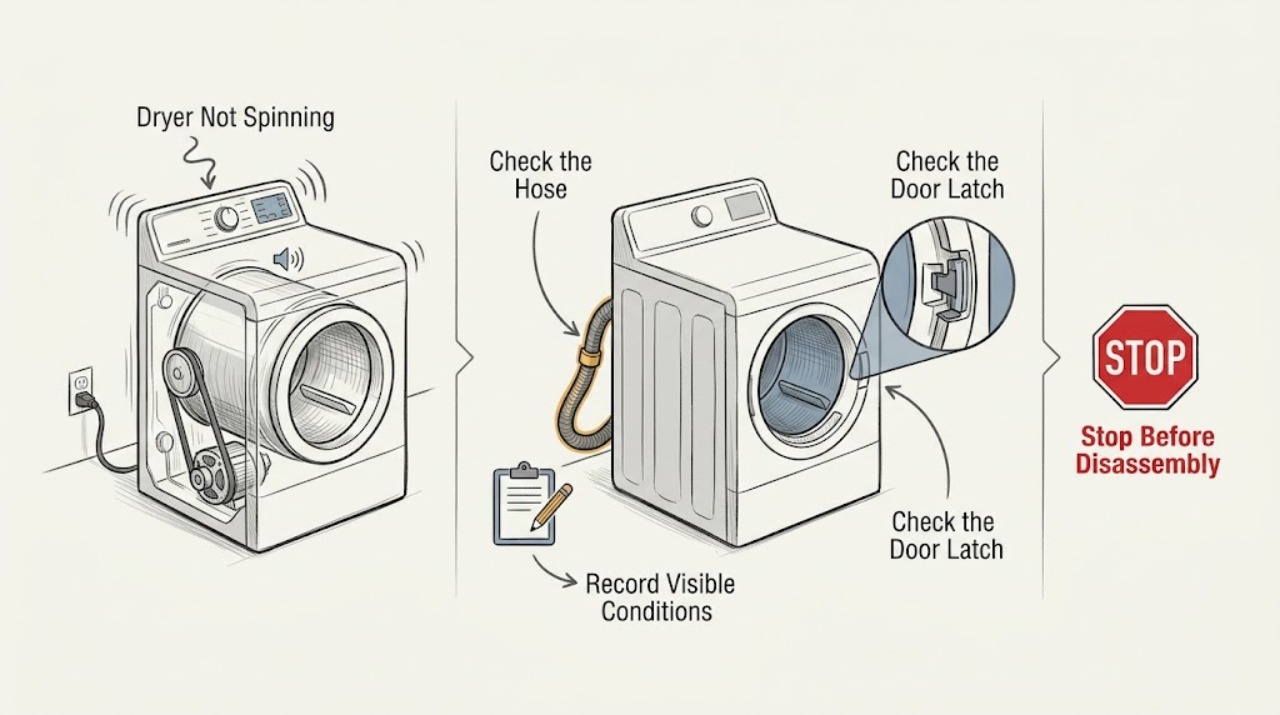
Work through in order
Diagnostic checks
Use only checks that match the exact appliance or system and its official guide.
-
Check 1
Stop the dryer and check for smoke, a burning or electrical odor, sparks or arcing, a hot or damaged cord, water near the outlet or appliance, gas odor, uncontrolled heat, or severe metal-on-metal noise. Do not restart it to reproduce any of those symptoms.
Expected result: There is no hazard sign, or there is smoke, odor, sparking, water contact, gas odor, abnormal heat, or a repeated protective-device event.
Next step: With no hazard, continue to identify the model and start state. With any hazard, keep the dryer out of service and use the appropriate local emergency, gas, electrical, or qualified appliance response from a safe location.
Stop if: Stop immediately for smoke, flame, gas odor, carbon-monoxide alarm, sparks, exposed conductors, water contacting energized equipment, or a breaker that trips again.
Why this matters
Why: A fire, gas, shock, wet-appliance, or mechanical-breakup risk takes priority over finding why the drum is stationary.
-
Check 2
Record the full model and serial information, whether the display or drum light works, the exact cycle, and whether the dryer is electric, gas, vented, condenser, heat-pump, or a combination design according to its label and manual. Do not infer the architecture from the symptom alone.
Expected result: The model manual identifies the power and drying design, or the model/type remains uncertain.
Next step: Use the exact manual for the matching branch. If the model cannot be confirmed, limit checks to the accessible door, controls, and household supply, then request model-specific service guidance.
Why this matters
Why: Power, heater, airflow, and user controls differ across Whirlpool dryer designs. A gas dryer, an electric dryer, and a heat-pump model should not be diagnosed with the same supply or heating assumptions.
-
Check 3
With no hazard, verify the door is fully latched, select an allowed Automatic Dry or Timed Dry cycle for the model, clear a Control Lock only with the manual's command, and press or hold Start/Push to Start exactly as specified. Dry the controls and hands before using a touch panel.
Expected result: The cycle starts and the drum moves, a lock or incorrect cycle was active, the door was not latched, or the control still refuses to start.
Next step: If the dryer starts and tumbles, monitor one short supervised cycle. If it remains unresponsive or the latch cannot engage, stop and arrange service rather than bypassing the interlock.
Stop if: Do not defeat the door switch, hold the latch closed by hand, or open the control console.
Why this matters
Why: Whirlpool notes that a Start command may need to be held, a wet touch panel may not respond, a door can look closed without latching, and Control Lock can prevent starting.
-
Check 4
If the display is dark or the motor does not respond, inspect only the accessible plug, household fuses, and breaker status. For an electric dryer, treat both supply legs as relevant and have a qualified electrician check voltage or cord installation; for a gas or heat-pump model, follow its exact supply instructions instead of applying electric-dryer assumptions.
Expected result: A breaker or fuse is open, the cord or outlet is visibly damaged, the dryer recovers after one safe reset, or accessible supply appears normal while the drum remains still.
Next step: If one reset restores operation and the protective device stays closed, run one supervised check. If the breaker trips again, the cord or outlet is hot/damaged, or the dryer remains dead, leave it off and use qualified electrical or appliance service.
Stop if: Never probe live terminals, remove a terminal cover, use an improvised fuse, or repeatedly reset a breaker.
Why this matters
Why: A supply or cord problem can stop the motor, and electric dryers can have distinct motor and heater supply behavior. A normal accessible supply with no motion shifts attention to the door circuit, control, or drive system.
-
Check 5
Stop the cycle and remove an obviously excessive or tightly packed load. With the dryer cool, check that no clothing, sheet, shipping material, or object is caught in the door or latch and that the door closes evenly; do not force the door or reach toward moving parts.
Expected result: The drum begins turning after the load or trapped item is corrected, the door cannot latch, or the drum remains still despite a clear, correctly closed door.
Next step: Run only one supervised check after a gentle correction. If the latch, door, gasket, or frame is damaged, or the drum still will not move, leave the dryer off and request service.
Stop if: Do not tape, clamp, or bypass the door latch, and do not use the dryer with damaged glass or a door that cannot close normally.
Why this matters
Why: Whirlpool identifies door-latch and cycle conditions as start interlocks and notes that clothing can block the latch. Continued no-spin with a clear closure suggests an internal drive or control fault.
-
Check 6
Disconnect power at the plug or approved disconnect, confirm the dryer is cool and empty, and gently rotate the drum by hand from the opening. Stop if it binds, scrapes, grinds, feels uneven, or has an object lodged in it; do not remove panels or reach around the drum.
Expected result: The drum turns smoothly, turns with clear rubbing or resistance, is blocked by an obvious accessible item, or turns freely but the motor never drives it during a valid cycle.
Next step: Remove only an obvious accessible item without tools. For binding, grinding, a loose-feeling drum, or no drive after smooth hand rotation, keep the dryer disconnected and arrange qualified diagnosis.
Stop if: Do not operate the dryer with metal scraping, a seized drum, loose panels, exposed belt parts, or any need to open the cabinet.
Why this matters
Why: A smooth, empty drum makes a gross obstruction less likely but does not prove the belt or motor is good. Binding or scraping points to a drum support, object, or mechanical fault; free rotation with no drive points toward the drive, motor, control, or interlock path.
-
Check 7
If the drum turns only briefly or the complaint includes no heat, note the program and architecture without continuing an abnormal run. For electric models, do not assume a heater-supply issue explains a no-spin motor; for gas models, do not open gas controls; for condenser or heat-pump models, use only the model's airflow and condensate instructions.
Expected result: The drum never moved, moved briefly then stopped, spins but does not heat, or the cycle reports an airflow/power message.
Next step: Record the exact code and program, perform only the documented user-level check, and stop if the no-spin symptom returns. Do not substitute a heater, gas-valve, belt, or heat-pump part based only on this observation.
Stop if: Stop for burning smell, smoke, abnormal heat, gas odor, arcing, repeated trips, or any need to access gas, wiring, or a sealed heat-pump circuit.
Why this matters
Why: Whirlpool separates no-tumble, no-heat, airflow, and power guidance. A no-heat symptom can coexist with or obscure a drive fault, while a code can point to supply or airflow rather than the drum itself.
-
Check 8
If the dryer displays a code or stops again, record the exact code, model, cycle stage, and whether the drum had moved. Follow one model-specific reset or user remedy, then run at most one short supervised check only if no hazard occurred.
Expected result: The code clears and the drum completes a normal cycle, or the code returns, an F/E-style service indication remains, or the dryer again stops without tumbling.
Next step: Leave the dryer out of service if the symptom returns and provide service with the model, code, power/door findings, hand-rotation result, and all hazard observations.
Stop if: Stop for recurring codes, a no-spin return, unusual noise, heat, odor, water, sparks, gas, or electrical trips.
Why this matters
Why: Whirlpool states that some codes indicate restricted airflow or power while others require service; a recurring code or no-spin condition is not resolved by repeatedly clearing the display.
Use your observations
Decision map
Find the observation that best matches what you see, then follow the next safe action.
-
PATH 01Next step
What you see
Smoke, burning smell, sparks, severe metal scraping, abnormal heat, gas odor, water near electrical parts, or repeated breaker trips is present.
Do this next
Stop immediately, do not restart the dryer, and use the appropriate emergency, gas, electrical, or qualified appliance response from a safe location. Do not touch a wet plugged-in appliance or operate electronics during a suspected gas leak.
-
PATH 02Next step
What you see
The controls and drum light are dark or the dryer will not start.
Do this next
Check the accessible plug, fuses or breaker, door latch, cycle, Control Lock, and Start command once. Repeated trips, cord damage, or a dead control requires qualified service.
-
PATH 03Next step
What you see
The cycle starts but the drum remains still and the door and load are correct.
Do this next
Disconnect power when cool and empty, gently hand-turn the drum, and stop for binding or scraping. Smooth rotation with no motor drive, or any abnormal mechanical sound, requires appliance service.
-
PATH 04Next step
What you see
The drum turns briefly and then stops.
Do this next
Stop the cycle, note whether the motor hums, the drum binds, or a code appears, and do not keep retrying. A drive, motor, interlock, control, load, or thermal fault needs model-specific diagnosis.
-
PATH 05Next step
What you see
The drum turns but the complaint also includes no heat or a drying code.
Do this next
Separate the symptoms by dryer architecture and follow only the exact model's heating, airflow, gas, condenser, or heat-pump instructions. Do not use a heater or gas check to justify opening the drive system.
-
PATH 06Next step
What you see
The no-spin symptom or an error returns after the safe external checks and one documented reset.
Do this next
Leave the dryer out of service and arrange qualified appliance service with the model, code, cycle, door and power findings, hand-rotation result, and any unusual noise or hazard information.
Helpful context
Understand the symptom
Not spinning can mean different things
A dark control panel, a cycle that will not start, a drum that hums but stays still, and a drum that turns briefly before stopping are different branches. Record the exact model, cycle, display code, and whether the drum moved at all. Use Whirlpool's model-based manuals and service guidance before interpreting a symptom as a belt or motor failure.
Check architecture before checking heat or supply
Whirlpool's guidance separates electric and gas dryers and notes that an electric dryer's motor and heater can depend on different supply legs. A vented, condenser, or heat-pump dryer can also have different airflow and drying components. For a no-spin complaint, use only the accessible controls and model instructions; leave wiring, motor, belt, drum support, gas, and sealed heat-pump work to qualified service.
Only after diagnosis
Potential parts
- door switch or latch
Only consider this category if the exact model does not recognize a correctly closed door after the accessible latch and clothing checks.
Confirm the complete model and qualified diagnosis before ordering or replacing any interlock part. - drum drive belt or support
Only consider the drive category if the cool empty drum has abnormal resistance or turns freely but is not driven during a valid cycle.
Drive layouts differ by model; do not open the cabinet or assume belt failure from no-spin alone. - drum motor
Only consider a motor category after supply, door, control, and mechanical-obstruction checks and qualified diagnosis of the no-drive symptom.
Verify exact model fitment and electrical diagnosis before replacement. - control or motor-control component
Only consider a control category if the dryer has correct accessible supply and door state but the motor is not commanded or a model-specific service code returns.
Use the exact model's service information and qualified installation; no generic control is implied.
Common questions
FAQ
Why does my Whirlpool dryer turn on but the drum does not spin?
Confirm the door latch, cycle, Control Lock, and Start command first. With the dryer cool, empty, and disconnected, gently hand-turn the drum. Binding or scraping suggests a mechanical problem; smooth rotation with no drive needs qualified diagnosis of the motor, belt, interlock, or control.
Can I keep resetting a Whirlpool dryer that will not spin?
No. One model-appropriate reset is reasonable only after the dryer is cool, dry, and free of hazards. A returning no-spin symptom, breaker trip, burning smell, smoke, spark, gas odor, or unusual metal noise means the dryer should remain out of service.
Does a Whirlpool electric dryer need more than one circuit for the drum?
Whirlpool explains that electric dryers can use separate supply legs for the motor and heater, so a supply problem can create different turning and heating symptoms. Do not test live wiring; use the installation instructions and a qualified electrician for supply or cord diagnosis.
Read the exact guide
Official sources
- Door Not Closing - Dryer - Product Help | WhirlpoolWhirlpool Product Help · Whirlpool dryer door obstruction, load, latch, and leveling guidance
- Error Codes in Dryers - Product Help | WhirlpoolWhirlpool Product Help · Whirlpool dryer error-code, airflow, low-voltage, power-failure, and service guidance
- Not Tumbling or Spinning - Dryer - Product Help | WhirlpoolWhirlpool Product Help · Whirlpool dryer no-tumble/no-spin operation, Start control, moisture on touch controls, and power-cord guidance
- Dryer is Not Heating - Product Help | WhirlpoolWhirlpool Product Help · Whirlpool dryer electric/gas supply, airflow, heat, and model-specific drying guidance
- Dryer Not Starting or No Operation - Product Help | WhirlpoolWhirlpool Product Help · Whirlpool dryer Start, power, door latch, cycle, and Control Lock troubleshooting
- CPSC Urges Flood Victims to Take Steps to Prevent CO Poisoning, Electrocution, Explosion and FiresU.S. Consumer Product Safety Commission · Wet-appliance electrical safety and gas-leak emergency guidance
Community feedback
Share a repair observation
Share a plain-text repair observation. Accepted observations are published automatically; this page may take a moment to update.