
On this page
Start here
Quick answer
If a Whirlpool dryer will not start, first decide whether the display and drum light are also dead or whether the controls have power but the cycle will not begin. For no power, inspect only the dry external plug, cord, outlet, and applicable household protection; electric and gas dryers use different supply arrangements. For a powered dryer, check the exact model's Control Lock or delay state, cycle selection, dry touch panel, firmly latched door, and Start procedure. Compact heat-pump or ventless models can also refuse to start when a model-specific bottom filter or pump reservoir is not correctly installed. Stop for gas odor, smoke, burning smell, overheating, sparks, arcing, a hot or damaged connection, or repeated trips, and arrange qualified service.
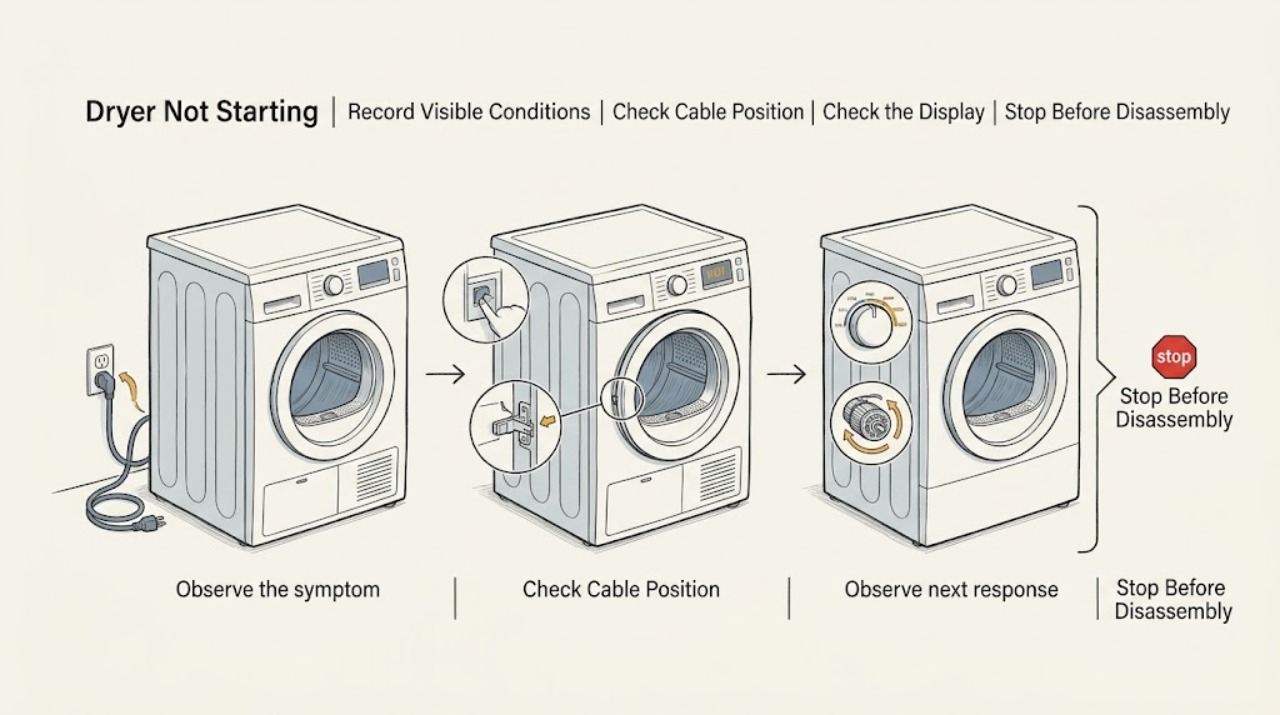
Work through in order
Diagnostic checks
Use only checks that match the exact appliance or system and its official guide.
-
Check 1
Record the complete Whirlpool model number, whether the dryer is electric, gas, conventional vented, compact heat-pump, or another model-specific ventless design, and whether the display, drum light, controls, or any code respond.
Expected result: Everything is blank, the display responds but Start does nothing, the dryer clicks or hums without turning, the door state is shown, or a code such as Loc, PF, L2, AF, or an F/E combination appears.
Next step: Use the matching branch below and preserve the display state for service. Do not press Start repeatedly to reproduce the failure.
Stop if: Stop immediately for gas odor, smoke, burning smell, scorching, overheating, sparks or arcing, a hot or damaged electrical connection, water near electrical parts, or repeated breaker trips.
Why this matters
Why: This separates a power or installation fault from a control, door, cycle, motor, airflow, or model-specific protection state. Codes must be interpreted against the exact model.
-
Check 2
For a blank display or drum light, inspect only from a dry, safe position whether the plug is fully seated, the cord and outlet look undamaged, and the applicable household fuse or circuit protection has operated; do not touch a hot or wet connection.
Expected result: The outlet or cord is hot, wet, loose, scorched, or damaged; protection has tripped; the electric dryer supply installation is uncertain; or the external condition appears normal but the dryer remains blank.
Next step: Leave a suspect installation to a qualified electrician or appliance technician. If the external connection is dry and safe, use only the model-approved supply check once; if the display stays blank, request service.
Stop if: Do not remove terminals or panels, make live measurements, use an extension lead, or keep resetting a breaker to make the dryer start.
Why this matters
Why: No display can reflect lost supply, an electric installation issue, or an internal fault. A damaged, wet, hot, or repeatedly tripping connection is a safety event, not a reason for repeated resets.
-
Check 3
If the display works, check the exact model's Control Lock or child-lock indicator, delay or cycle state, and whether the selected program is a startable Automatic or Timed Dry option rather than a wrinkle or standby feature.
Expected result: The controls are locked, a delay is active, the cycle is not a drying cycle, or the settings appear correct but the dryer still will not start.
Next step: Use the model guide to clear the lock or delay and select a valid cycle, then make one normal start attempt. A persistent no-start points to the door, control, motor, or another internal fault.
Stop if: Do not bypass the Control Lock, operate with an unlatched door, or cycle settings repeatedly while the appliance is hot, damaged, or producing an odor.
Why this matters
Why: Whirlpool says a locked control does not respond and some cycle positions intentionally do not start the dryer. Correct settings can be ruled out only after they are confirmed for the model.
-
Check 4
With dry hands and the dryer cool, confirm that the loading door closes and latches normally, that no clothing or packing material blocks the latch, and that the Start, Push to Start, or Hold to Start control is being used as the exact model indicates.
Expected result: The door looks closed but is not latched, clothing blocks the latch, the touch panel does not respond to moisture, the Start control is being tapped incorrectly, or the door and start input appear normal.
Next step: Remove only visible clothing from the latch area, dry the hands and accessible panel, close the door normally, and follow one model-approved Start action. If it still fails, leave the dryer off and arrange service.
Stop if: Never tape, hold, or bypass the door switch, and do not remove panels or reach into the motor or drum mechanism.
Why this matters
Why: A door interlock, blocked latch, wet touch surface, or model-specific Start input can prevent the motor from engaging. A normal external door and control check with no start suggests service rather than a bypass.
-
Check 5
For a conventional electric or gas dryer, identify the applicable supply without changing gas or internal electrical parts: confirm the model type, note whether the drum light and controls work, and check only the visible dry plug, cord, outlet, and household protection; for gas models, leave the gas valve and combustion system to qualified service if uncertain.
Expected result: An electric dryer has no control power or an L2-type supply indication, a gas dryer has control power but no heat or an uncertain gas condition, or the external supply appears normal but Start still does nothing.
Next step: Use a qualified electrician for a suspect electrical circuit and qualified gas-appliance service for supply or combustion concerns. Do not change a gas connection or repeatedly reset protection as a test.
Stop if: If there is gas odor, abnormal flame, smoke, burning smell, arcing, a hot outlet, or repeated trips, stop immediately and use emergency or qualified help from a safe location.
Why this matters
Why: Electric dryers can lose one part of their supply while appearing partly powered, and gas dryers still need electrical control power even though their heat source differs. Supply symptoms require installation-specific diagnosis.
-
Check 6
If the model is a compact heat-pump or ventless design, check only the model-specific bottom filter, water tank or pump reservoir, and discharge hose condition after the dryer is stopped and safely isolated; do not apply this step to a conventional vented model without matching instructions.
Expected result: The bottom filter is missing or incorrectly installed, the reservoir is full or not seated, a drain hose is kinked or blocked, or the ventless model has no such indicator and still will not start.
Next step: Correct only the filter, tank, or hose condition described by the exact manual and make one normal start attempt. If the protection returns or water cannot be controlled, request service.
Stop if: Do not bypass a filter or reservoir sensor, operate with a leak, expose water to electrical parts, or improvise a vent or drain.
Why this matters
Why: Whirlpool says some compact heat-pump models will not start when the bottom filter is not installed correctly and may shut down when the pump reservoir reaches its limit. These are model-specific protections, not universal dryer behavior.
-
Check 7
Read and preserve any complete code before clearing it, then use the exact Whirlpool code page or owner manual: Loc indicates a lock state, PF a power interruption, AF or Check Vent an airflow condition on applicable models, and an F/E combination may require service; use one documented clear or reset only when hazard-free.
Expected result: The code clears once and the dryer starts, returns immediately, changes to a different code, or remains after the model-approved step.
Next step: Leave the dryer off for a returning or unresolved code and give service the exact model, code, cycle, supply type, and prior observations. For AF or Check Vent, inspect only the accessible lint screen and vent path as the model permits.
Stop if: Do not run through smoke, overheating, scorching, gas odor, arcing, or a repeated trip, and do not diagnose an F/E code from another model.
Why this matters
Why: A single documented correction can distinguish a temporary lock or power event from a persistent control, supply, airflow, or motor fault. A returning code is not a reason for repeated resets.
Use your observations
Decision map
Find the observation that best matches what you see, then follow the next safe action.
-
PATH 01Next step
What you see
The display and drum light are blank, or an electric dryer has a supply or low-voltage indication.
Do this next
Inspect only the dry external plug, cord, outlet, and household protection; use a qualified electrician or appliance technician for persistent or damaged supply conditions.
Why this path and its safety boundary
Why it matters: Treat the symptom as a power or installation branch before diagnosing the controls or motor.
-
PATH 02Next step
What you see
The controls have power but Control Lock, delay, or a non-startable cycle state is active.
Do this next
Use the exact model guide to clear the state and select a valid drying cycle, then try Start once without hazards; persistent failure needs service.
Why this path and its safety boundary
Why it matters: A normal control state may be preventing the cycle from beginning.
-
PATH 03Next step
What you see
The door is not latched, clothing or packing blocks the latch, the touch panel is wet, or Start is not being used as the model requires.
Do this next
Correct only the visible, model-approved condition and make one normal start attempt. Never bypass the door switch; request service if it remains unable to start.
Why this path and its safety boundary
Why it matters: A door interlock or user-input condition may be inhibiting the motor.
-
PATH 04Next step
What you see
A compact heat-pump or ventless model shows a bottom-filter, reservoir, or drain condition.
Do this next
Follow the exact manual for filter seating, tank, or hose checks after safe isolation; leave it off for a leak, blocked drain, or returning protection state.
Why this path and its safety boundary
Why it matters: A model-specific airflow or condensate protection state may be preventing start.
-
PATH 05Next step
What you see
Loc, PF, AF or Check Vent, L2, or an F/E code remains or returns after one exact model-approved step.
Do this next
Remove the dryer from use and arrange qualified Whirlpool appliance, electrical, or vent service with the exact code and model information.
Why this path and its safety boundary
Why it matters: The underlying lock, power, airflow, control, or motor condition remains.
-
PATH 06Next step
What you see
A gas dryer has gas odor or abnormal combustion, or any dryer has smoke, burning smell, scorching, overheating, sparks, arcing, a hot or damaged connection, water near electrical parts, or repeated trips.
Do this next
Stop using the dryer, avoid switches and ignition sources during gas danger, leave active smoke, fire, or gas danger, and contact emergency or qualified professional help from a safe location.
Why this path and its safety boundary
Why it matters: There may be an immediate gas, fire, burn, water, or electrical hazard.
Helpful context
Understand the symptom
No power is different from no start
If the display and drum light are dark, begin with power and installation. If the display responds but the motor never begins, the likely decision changes to Control Lock, Start input, door latch, cycle selection, a moisture-affected touch panel, or an internal control or motor fault. Do not treat an unresponsive control as permission to open the cabinet or repeatedly cycle the breaker.
The model type controls the next check
A conventional electric dryer, gas dryer, and compact heat-pump or ventless model do not share identical supply, filter, or condensate checks. Use the complete Whirlpool model number and its owner's documentation. A gas dryer still needs electrical control power, while a heat-pump model may use a bottom filter or pump reservoir that a conventional vented model does not have.
Stop when starting becomes unsafe
A dryer that smells of gas or burning, emits smoke, sparks, arcs, overheats, scorches clothing, has a hot or damaged cord or outlet, or trips protection is not a reset exercise. Leave it off, avoid hazardous electrical or gas areas, and use emergency or qualified professional help from a safe location.
Only after diagnosis
Potential parts
- dryer door latch or door switch
Consider this only when the door closes normally but the exact model repeatedly fails to recognize the latch and qualified diagnosis confirms an interlock fault.
Confirm the complete model and do not bypass the door switch; internal safety work belongs to qualified service. - dryer motor or start-control component
Consider this only after qualified diagnosis finds that power, door, controls, cycle, and model-specific filter or reservoir conditions are correct but the motor does not start.
Do not infer a failed motor or control from a silent Start button; confirm exact model fitment and professional diagnosis. - compact dryer bottom filter or pump-reservoir component
Consider this only when a model-specific heat-pump or ventless dryer reports a filter, reservoir, or drain fault and qualified diagnosis identifies the component.
This is not a universal conventional-dryer part; confirm the complete model and never bypass its protection. - dryer electronic control component
Consider this only after a persistent no-start or F/E code is diagnosed as a control fault after supply, door, cycle, and lock checks.
Confirm the complete model and qualified diagnosis before ordering; do not work on energized controls.
When checks do not resolve it
Need a professional?
Arrange qualified Whirlpool appliance service when a dry external supply and model-approved control, door, cycle, and Start checks do not restore operation, a code or protection state returns, a compact heat-pump model has a filter or reservoir fault, or the dryer has a motor or control symptom. Provide the complete model, electric or gas and vented or ventless type, display state, code, cycle, door behavior, and all power, gas, heat, odor, and electrical observations. Use a qualified electrician for a suspect circuit and qualified gas-appliance help for gas-supply or combustion concerns.
Common questions
FAQ
Why is my Whirlpool dryer completely dead?
If the display and drum light are blank, begin with the dry external plug, cord, outlet, and applicable household protection. Electric and gas models differ, and a damaged or repeatedly tripping connection needs qualified electrical or appliance service.
Why does my Whirlpool dryer have power but not start?
Check Control Lock or delay, a valid drying cycle, the dry touch panel, the firmly latched door, and the model-specific Start procedure. If those conditions are correct and it still will not start, leave it off and arrange service rather than bypassing the door switch.
What does Loc mean on a Whirlpool dryer?
Loc indicates that Control Lock is enabled, so the dryer will not start or operate. Use the exact model's Control Lock procedure once; if the indication remains or another fault appears, request service.
What does PF mean on a Whirlpool dryer?
PF indicates that a power interruption affected the drying cycle. Follow the exact model's documented Start or Power response once when the dryer is safe. A returning PF or any hot, damaged, or tripping supply needs qualified service.
Can a Whirlpool heat-pump dryer refuse to start because of water or a filter?
Yes, on applicable compact heat-pump models a bottom filter, water tank, pump reservoir, or drain hose condition can inhibit starting. Use only the exact manual's cool, safely isolated checks and do not bypass the protection.
Should I keep trying to start a Whirlpool dryer that smells burnt or sparks?
No. Stop immediately for burning smell, smoke, sparks, arcing, overheating, scorched clothing, gas odor, a hot connection, or repeated trips. Leave it off and use emergency or qualified professional help from a safe location.
Read the exact guide
Official sources
- Dryer Not Starting or No OperationWhirlpool · Whirlpool dryer no-start, Start, door, cycle, control, power, and service checks
- Dryer Not Heating: Troubleshooting GuideWhirlpool · Whirlpool electric and gas dryer supply, heating, lint, airflow, and service guidance
- Not Starting or Not Operating - DryerWhirlpool · Whirlpool dryer power, Control Lock, Start input, door latch, obstruction, and cycle checks
- No Power - Electric DryerWhirlpool · Whirlpool electric dryer breaker, fuse, power-cord, and qualified-electrician guidance
- Error Codes in DryersWhirlpool · Whirlpool dryer AF, F/E, L2, and PF error-code interpretation and service escalation
- PF - Error Code - DryerWhirlpool · Whirlpool dryer PF power-failure indication and model-approved clear guidance
- Not Starting, Not Operating, No Power - Compact Heat Pump DryerWhirlpool · Whirlpool compact heat-pump dryer power, bottom-filter, door, lock, Start, reservoir, and drain checks
- Loc - Error Code - DryerWhirlpool · Whirlpool dryer Control Lock and Loc error state
Community feedback
Share a repair observation
Share a plain-text repair observation. Accepted observations are published automatically; this page may take a moment to update.