
On this page
Start here
Quick answer
A loud freezer fan and a water leak should be investigated together as two observed symptoms, but Whirlpool’s public guidance does not establish one universal cause. A soft airflow or steady fan sound can be normal, while water may come from an accessible supply line, a connection, condensation, or another model-specific path. First record where the water is appearing and whether the sound is airflow, buzzing, grinding, or an ice-maker fill sound. Keep the freezer door and water connections safe, shut off the water supply if an accessible line is leaking, and arrange service if water persists, food temperature is affected, or the sound is harsh or worsening. Do not remove freezer panels or diagnose a defrost part, fan motor, or sealed-system fault from these symptoms alone.
Before you begin
Safety first
- Keep checks to sound timing, visible water location, accessible supply connections, door/gasket/level/clearance observations, and model documentation. Do not remove freezer panels, reach near a fan, force a defrost drain, perform live electrical tests, or replace a guessed internal component.
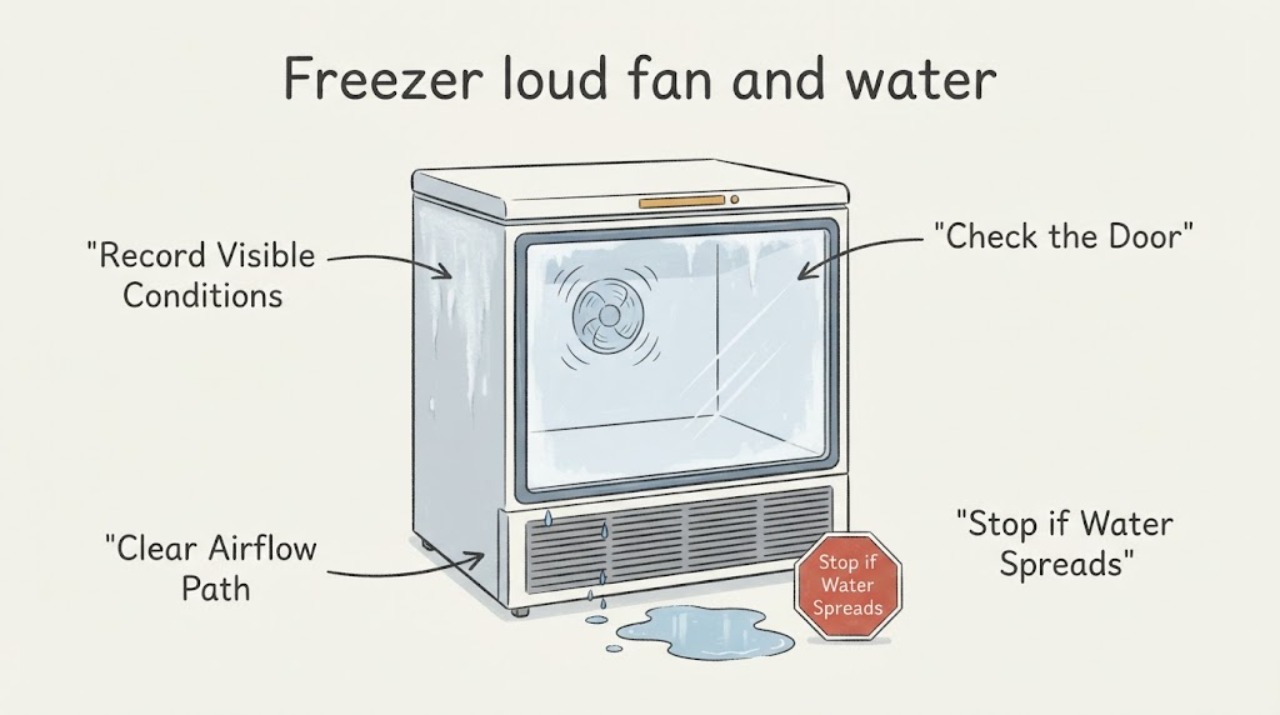
Work through in order
Diagnostic checks
Use only checks that match the exact appliance or system and its official guide.
-
Check 1
Record the noise location and character without opening the cabinet: inside the freezer, behind/under the unit, at the water line, or near the ice maker; note whether it is a soft airflow sound, buzz, high-pitched tone, or grinding.
Expected result: The sound matches a soft hum/whoosh or a brief fill-related buzz, or it is harsh, continuous, new, or worsening.
Next step: If the sound is soft and follows normal cooling or fill operation, continue checking the water symptom separately. If it is harsh, continuous, or worsening, keep the freezer in service only if safe and arrange model-specific assessment without opening panels.
Stop if: If the sound source cannot be located safely, do not move the unit or remove covers just to reproduce it; record the timing and request service.
Why this matters
Why: Whirlpool documents fan airflow, compressor operation, water-valve/ice-maker fill, and several airflow or refrigerant sounds as possible normal sounds; a harsh or changing sound cannot be assigned to a specific component from description alone.
-
Check 2
Document exactly where water appears: behind the freezer, at an accessible water connection, inside the freezer compartment, around the door, or on the floor.
Expected result: Water is at the rear supply line or fittings, or it is inside/under the freezer with no visible external line source.
Next step: If a rear line or fitting is visibly leaking, shut off the appliance water supply and keep the area dry; do not loosen fittings or continue dispensing ice/water. If the source is internal or unclear, stop before panel removal and arrange service.
Stop if: If no water is present now, record whether the event followed defrost, ice-maker fill, door opening, or condensation and use the exact manual/service path if it recurs.
Why this matters
Why: Whirlpool’s upright-freezer guidance supports an accessible supply-line and fitting check for a leak behind the unit; other locations require the exact freezer design and cannot be assigned to a single drain, ice-maker, or defrost cause here.
-
Check 3
Check external door/gasket closure, level, clearances, and visible airflow obstructions without removing panels or changing internal parts.
Expected result: The freezer is not level, the door or gasket has a visible gap, the unit is pressed tightly against surroundings, or vents/clearances are obstructed; alternatively these external conditions appear normal.
Next step: Correct only the visible obstruction or leveling issue allowed by the owner manual, then monitor without intentionally reproducing a leak or noise. If the gasket is damaged or moisture returns, arrange service.
Stop if: If the external checks are normal and both symptoms persist, keep the model information and symptom timeline for qualified service.
Why this matters
Why: Whirlpool says leveling, clearance, door sealing, humidity, and airflow can affect vibration, moisture, and operating sounds, but these observations do not identify a fan or defrost component.
-
Check 4
If the freezer has an ice maker or dispenser, note whether the noise occurs during a fill or dispensing event and inspect only visible tubing and connections from outside.
Expected result: The sound occurs only during ice-maker fill/dispensing, the water line is kinked or disconnected, or the sound and leak occur independently; alternatively there is no water/ice feature or no timing relationship.
Next step: Turn off the ice maker or appliance water supply only as the exact model instructions permit, keep any leaking connection closed, and arrange service if the sound or leak repeats.
Stop if: Do not assume the fan, valve, or ice maker is defective; continue with external observations and model-specific service.
Why this matters
Why: Whirlpool says a water valve can buzz or click during ice-maker fill and that water-line condition can affect noise; a timing relationship helps separate that event from a continuous fan sound but does not prove a shared failure.
-
Check 5
Provide the exact model, freezer style, noise timing, leak location, food-temperature changes, and any water/ice-maker configuration to qualified service.
Expected result: The record distinguishes normal operating sound from an abnormal noise and rear-line leak from an internal or unclear leak; alternatively the symptoms remain unlocalized.
Next step: Use the model-specific manual and service path; keep the appliance water supply closed if a connection leaked.
Stop if: Do not continue powered testing or open freezer panels to force a diagnosis from the compound symptom.
Why this matters
Why: Whirlpool’s public pages are family- and design-specific, and the available evidence does not support a universal defrost, fan, drain, valve, or sealed-system diagnosis.
Use your observations
Decision map
Find the observation that best matches what you see, then follow the next safe action.
-
PATH 01Next step
What you see
The freezer makes a soft airflow, hum, or brief fill-related buzz and there is no active water leak or temperature change.
Do this next
Monitor the timing, keep clearances and the freezer level, and use the exact model manual if the sound becomes harsh, constant, or louder.
Why this path and its safety boundary
Why it matters: Whirlpool identifies fan, compressor, airflow, and water-valve sounds that can be normal during cooling or ice-maker operation.
-
PATH 02Next step
What you see
Water appears behind the freezer at an accessible supply line or fitting.
Do this next
Shut off the appliance water supply, keep the area dry, and arrange service if the connection cannot be safely confirmed without moving or opening the appliance.
Why this path and its safety boundary
Why it matters: Whirlpool’s upright-freezer leak guidance treats a cracked line, loose connection, or leaking shutoff/saddle valve as the first external checks.
-
PATH 03Next step
What you see
Water is inside the freezer or on the floor and the fan noise is harsh, intermittent with frost/moisture, or worsening.
Do this next
Keep the appliance out of service if water can reach electrical parts, avoid panel removal or forced thawing, preserve the food-temperature and symptom timeline, and arrange qualified service.
Why this path and its safety boundary
Why it matters: The two observations may be temporally related, but the opened Whirlpool sources do not establish whether the cause is a drain, ice maker, door seal, fan obstruction, or another model-specific condition.
Helpful context
Understand the symptom
The two symptoms can be reported on the same freezer, but they are not automatically one fault. Whirlpool describes airflow and fan sounds as possible normal operating sounds, while its leak guidance uses the leak location and accessible water connections to narrow the next step. Start by separating the sound and water observations instead of naming a defrost component.
Write down whether the noise is a soft airflow hum, a buzz during ice-maker fill, a high-pitched or pulsating sound, or a harsh grinding sound. Also note whether water is inside the freezer, under the door, or behind the cabinet. A water line leak behind the unit is a different branch from moisture or condensation around a door, and neither observation alone proves a fan failure.
Keep checks external and model-bounded. If an accessible water connection is leaking, shut off the water supply feeding the appliance and keep the area dry. Do not remove the freezer back panel, disturb the evaporator fan, thaw a hidden drain, or replace a defrost part based on noise and water alone; give the exact model and the two symptom timelines to qualified service.
When checks do not resolve it
Need a professional?
Use the exact Whirlpool model manual and arrange qualified service for a persistent leak, harsh or worsening noise, cooling loss, water near electrical parts, or any internal diagnosis.
Safety scope: Keep checks to sound timing, visible water location, accessible supply connections, door/gasket/level/clearance observations, and model documentation. Do not remove freezer panels, reach near a fan, force a defrost drain, perform live electrical tests, or replace a guessed internal component.
Common questions
FAQ
Are a loud freezer fan and a water leak always the same problem?
No. Whirlpool documents normal fan/airflow and water-valve sounds separately from leak checks. The two symptoms can be reported together, but the leak location and noise timing must be established before treating them as one condition.
What should I check if water is leaking behind a Whirlpool freezer?
Whirlpool says to inspect the accessible household water line, tubing connections, and shutoff or saddle valve for cracks, loose insertion, or leakage. Shut off the appliance water supply if a connection is leaking and arrange service if it is not safely resolved externally.
Can a fan sound be normal?
It can be. Whirlpool says evaporator and condenser fans circulate air and that humming, whooshing, high-pitched, or pulsating sounds may occur during normal cooling. A harsh, new, or worsening sound needs model-specific assessment.
Should I remove the freezer back panel to find the leak or fan?
No. Without the exact model and verified procedure, do not remove panels or reach near the fan, drain, or defrost components. Record the sound and leak location and use qualified service.
Read the exact guide
Official sources
- Refrigerator Normal Sounds and NoisesWhirlpool · Opened Whirlpool Product Help page. It identifies fan airflow, compressor, water-valve, defrost-water, and other normal sound categories and advises model-specific manuals for operation.
- Moisture Forming Cabinet - Upright FreezerWhirlpool · Opened Whirlpool Product Help page. It documents normal condensation in humid conditions, frequent door openings, and gasket-seal observations; it does not identify a hidden leak or defrost component for this task.
- Leaking from Behind - Upright FreezerWhirlpool · Opened Whirlpool Product Help page. It directs owners to inspect the accessible household water line, tubing connections, and shutoff/saddle valve when water appears behind the freezer.
- Refrigerator Noise - BuzzingWhirlpool · Opened Whirlpool Product Help page. It says evaporator and condenser fans can hum/buzz, water-valve buzzing can occur during ice-maker fill, and external level/clearance checks may reduce noise.
- High Pitched Sound - Convertible Chest FreezerWhirlpool · Opened Whirlpool Product Help page for the documented convertible/chest-freezer family. It describes pulsating/high-pitched fan or compressor sounds as potentially normal for that family; it is not used to diagnose the unmodelled task freezer.
Community feedback
Share a repair observation
Share a plain-text repair observation. Accepted observations are published automatically; this page may take a moment to update.