
On this page
Start here
Quick answer
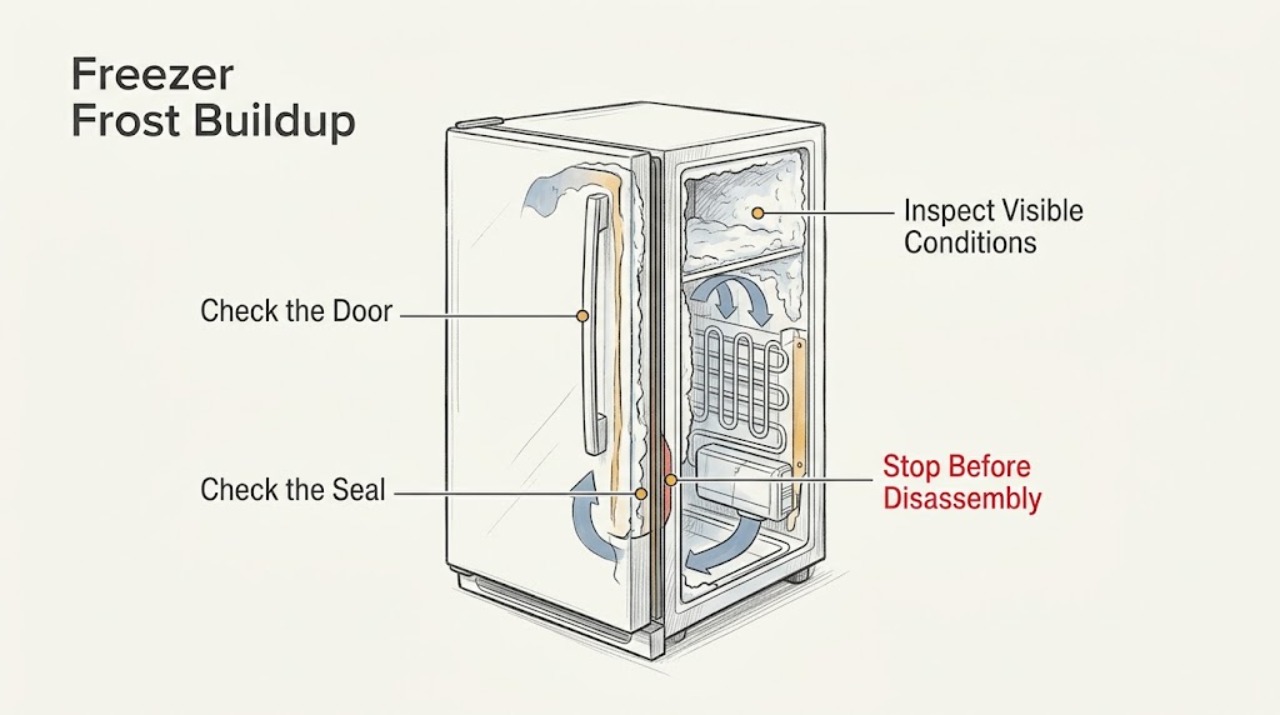
Whirlpool freezer frost usually comes from humid air entering through a door that is open, blocked, dirty, or not sealing, although blocked vents, overpacking, temperature conditions, and a defrost fault can also contribute. First note whether frost is a light, even layer or a thick patch around the door, back wall, vent, or drain. Keep the door closed, confirm the gasket and packages allow a full seal, leave room around visible vents, and follow the exact model manual for defrosting. Unplug before cleaning or defrosting, never chip sharp ice or use an unsafe heat source, and stop for water near electrical parts, a damaged gasket that leaves food warming, exposed sharp ice, smoke, burning odor, or repeated electrical trips.
Work through in order
Diagnostic checks
Use only checks that match the exact appliance or system and its official guide.
-
Check 1
Look at the frost without touching sharp ice and record where it is: around the door edge, on shelves or food, on the rear wall or vent, at the bottom near a drain, or evenly across the compartment. Also note whether food is still hard frozen and whether water is present.
Expected result: Frost is a light even layer, a thick door-edge band, a solid rear-wall sheet, a blocked vent, or a wet or thawing area.
Next step: Keep the door closed and follow the matching branch below. If food is warming, move it to a working freezer and arrange service before relying on the freezer again.
Why this matters
Why: A door-edge pattern makes warm-air entry more likely; a rear-wall or vent sheet can restrict airflow or defrosting; wet or thawing food raises an immediate food-safety concern.
-
Check 2
Check the complete door or lid perimeter for packages, baskets, shelves, shipping material, dirt, cracks, or a gasket that is folded or pulled away. Place a sheet of paper at several points between the gasket and cabinet, close the door normally, and feel for similar resistance as it is pulled out.
Expected result: The door is blocked, the paper pulls out with little resistance at one area, the gasket is brittle or torn, or the freezer is not level and the door does not sit square.
Next step: Reposition only loose packages or baskets and clean a reachable gasket with the model-approved method. If the gasket is damaged, the door is misaligned, or the paper test fails around the perimeter, stop and arrange service.
Why this matters
Why: A poor seal allows warm humid air into the freezer, which can create frost and temperature fluctuation; an obstruction can mimic a failed gasket.
-
Check 3
Review the recent use pattern: doors left open, frequent searches for food, warm or uncovered food added, a humid room, or a recent move or installation. Check that the door closes promptly after each opening.
Expected result: Frost appeared after extended or frequent openings, warm food, high humidity, or an installation event, without a persistent thick patch at one location.
Next step: Organize food so the door can close quickly, allow hot food to cool safely before storage, and monitor the same frost location without repeatedly opening the door. Escalate if frost returns quickly or food temperature rises.
Why this matters
Why: Humid room air can condense and freeze on cold surfaces; a short-term even layer may be normal, while rapid recurrence after normal use suggests a seal, airflow, or defrost problem.
-
Check 4
With the door open only briefly, inspect visible air vents and the space around them. Move loose packages away from the vents and avoid packing food tightly against the rear wall; do not remove a vent cover.
Expected result: A package blocks a vent, the compartment is overpacked, or a frost sheet covers the visible vent or rear air path.
Next step: Restore space around accessible vents. If a fixed cover is iced over, the freezer is warming, or the frost returns after a model-approved defrost, arrange service for airflow and defrost diagnosis.
Why this matters
Why: Blocked airflow can increase moisture and frost and make it harder for the freezer to hold its set temperature; frost covering a vent may be a consequence rather than the root cause.
-
Check 5
Read the exact model manual and check the freezer control, temperature setting, Fast Freeze or similar mode, and any alarm. Record whether the unit is a frost-free design or requires manual defrosting before changing settings.
Expected result: The control is set unusually cold, a special mode is active, an alarm or temperature display is abnormal, or the manual specifies manual rather than automatic defrosting.
Next step: Return settings only to the model's documented normal range and allow the freezer to stabilize. If the alarm, heavy frost, or temperature problem remains, stop changing settings and request service.
Why this matters
Why: Controls and defrost behavior vary by Whirlpool model; a setting can alter frost or temperature, while an alarm or recurring heavy frost can indicate a component problem.
-
Check 6
If the frost is thick enough to block the door or airflow, follow the exact model's defrost instructions: protect food, disconnect power before cleaning, provide a safe water path, and let ice soften naturally. Do not chip ice, use an open flame, or direct unsafe heat at the liner, gasket, or controls.
Expected result: Frost clears with a model-approved defrost and does not return quickly, or it returns rapidly in the same location.
Next step: Reconnect only after the interior is dry and the manual allows it. If frost returns rapidly, the freezer cannot hold temperature, or water reaches electrical areas, leave it off and arrange qualified service.
Why this matters
Why: A successful defrost can restore airflow when accumulated ice is the immediate obstruction; rapid recurrence points toward a sealing, defrost, drain, or control issue.
-
Check 7
After the freezer is operating safely, record whether frost returns, whether the compressor or fan sounds normal for the model, whether the door seal remains even, and whether the compartment holds a safe frozen-food temperature. Do not remove panels to inspect the evaporator or defrost parts.
Expected result: Frost rapidly returns, the freezer remains warm, the compressor or fan is unusually loud or silent, or the door seal and visible airflow are normal.
Next step: Keep food protected and arrange a qualified appliance service visit. Provide the frost location, recurrence pattern, model, settings, temperature trend, and any water or sound symptoms.
Why this matters
Why: Recurring frost with normal external sealing can involve the defrost timer, heater, sensor, fan, drain, or control; these require model-specific diagnosis.
Use your observations
Decision map
Find the observation that best matches what you see, then follow the next safe action.
-
PATH 01Next step
What you see
Food is thawing, water is near an electrical connection, smoke or burning odor is present, the cabinet is unusually hot, or a breaker keeps opening.
Do this next
Stop using the freezer, keep away from damaged or wet electrical parts, protect the food, and obtain qualified electrical or appliance help. Use emergency help for smoke or fire.
-
PATH 02Next step
What you see
Frost forms as a thick band around the door or lid, or a paper test has little resistance at part of the gasket.
Do this next
Remove only loose obstructions and clean the reachable gasket. A torn gasket, misaligned door, or continuing frost needs service rather than repeated defrosting.
-
PATH 03Next step
What you see
Frost follows long or frequent door openings, warm uncovered food, or humid conditions and is light and evenly distributed.
Do this next
Minimize door openings, organize food, close the door promptly, and monitor. Escalate if frost becomes thick, localized, or returns rapidly under normal use.
-
PATH 04Next step
What you see
A package or heavy frost blocks a visible vent or rear air path.
Do this next
Move loose packages away from the vent. Do not remove fixed covers; if the vent remains iced or the freezer warms, arrange service for airflow and defrost diagnosis.
-
PATH 05Next step
What you see
The model manual says the freezer requires manual defrosting and frost is obstructing the door or airflow.
Do this next
Protect food, disconnect power, and complete only the manual's safe defrost procedure. Do not chip ice or apply unsafe heat.
-
PATH 06Next step
What you see
Frost returns quickly after a complete model-approved defrost, while the door and visible vents are clear.
Do this next
Keep food protected and request qualified diagnosis of the gasket, defrost system, fan, drain, sensor, and control path. Do not remove panels.
-
PATH 07Next step
What you see
Frost is accompanied by a warm compartment, abnormal sound, standing water, sharp ice, or a returning temperature alarm.
Do this next
Stop relying on the freezer, keep the door closed, move food to a working unit when practical, and arrange service with the recorded symptoms.
Helpful context
Understand the symptom
The location and shape of the frost are more useful than its color. A thin, scattered layer after humid weather or frequent door opening can be moisture entering normally. A thick band around the gasket suggests a seal or obstruction; a solid sheet on a rear wall or vent can restrict airflow and point toward a defrost or circulation issue. Whirlpool has upright, chest, and refrigerator-freezer designs, so the correct defrost method depends on the model.
Protect food while you inspect. Keep the door closed as much as possible, and move food to a working freezer if the compartment is warming or the freezer must be off for defrosting. Do not use sharp tools to break ice, pour water into electrical areas, or remove fixed covers.
Only after diagnosis
Potential parts
- freezer door or lid gasket
Relevant only when the paper test, visible inspection, or professional diagnosis confirms a sealing problem after obstructions are removed.
Confirm the exact model and door or lid configuration before replacement. - defrost heater, timer, or sensor
Relevant only when heavy frost returns after a complete safe defrost and qualified testing isolates a defrost control or heating fault.
Use the complete model identity and qualified fit verification; do not infer a component from frost alone. - evaporator or circulation fan
Relevant only when airflow remains poor with clear visible vents and professional testing confirms a fan or fan-control fault.
Fan access and fit vary by model and require safe de-energized service. - defrost drain or drain-pan path
Relevant only when recurring bottom ice or standing water is traced to a drain problem after safe external checks.
Confirm model-specific drain design and safe water handling before any repair.
When checks do not resolve it
Need a professional?
Call a qualified appliance technician when frost returns quickly after a model-approved defrost, the door gasket or hinge does not seal, the freezer remains warm, a high-temperature alarm returns, a vent or rear wall is repeatedly iced, water cannot be controlled, or the compressor or fan behaves abnormally. Stop immediately for smoke, burning odor, unusual heat, water near electrical parts, sharp ice that cannot be safely cleared, or repeated electrical trips.
Common questions
FAQ
Why is my Whirlpool freezer building up frost around the door?
A thick door-edge band usually makes warm humid air entering through an obstruction or poor gasket seal more likely. Check packages, baskets, gasket cleanliness, and the paper seal result without forcing the door; a damaged gasket or returning frost needs service.
Is a small amount of frost in a Whirlpool freezer normal?
A light layer or small ice droplets can occur with humidity and door openings, but thick or rapidly recurring frost is not something to ignore. Check the seal and airflow, then use the exact model manual for defrost guidance.
Can blocked vents cause Whirlpool freezer frost?
Yes. Whirlpool notes that blocked vents can contribute to moisture and excessive frost and can reduce air circulation. Move loose packages away from visible vents, but do not remove fixed covers or rely on this check if the freezer is warming.
How should I defrost a Whirlpool freezer with heavy frost?
Use the exact model manual because some freezers require manual defrosting and others use an automatic system. Protect food, disconnect power before cleaning, and let ice soften naturally; never chip sharp ice or use an unsafe heat source.
When should I call service for Whirlpool freezer frost buildup?
Call when frost returns quickly after a complete model-approved defrost, the freezer is warming, the gasket fails, water accumulates, a vent or rear wall repeatedly ices over, or the fan or compressor behaves abnormally. Stop for smoke, burning odor, unusual heat, water near electrical parts, or repeated electrical trips.
Read the exact guide
Official sources
- Owner's ManualWhirlpool · Whirlpool upright freezer electrical safety, frost, airflow, temperature, and food-preservation instructions
- 7 Freezer Problems & How to Help Fix ThemWhirlpool · Whirlpool freezer frost, airflow, defrost, compressor, fan, drain, and reset context
- Frosting in the Freezer Section - RefrigeratorWhirlpool · Whirlpool freezer-section frost, door openings, door seals, moisture, and vent checks
- Checking for Items Preventing Door or Lid ClosureWhirlpool · Whirlpool freezer door or lid closure, packages, baskets, level, seal, and frost obstruction
- How to Avoid Frost Build UpWhirlpool · Whirlpool freezer frost causes, moisture, door sealing, food, airflow, and defrost guidance
- Freezer door is Sealing - Forming Frost - Upright FreezerWhirlpool · Whirlpool upright-freezer door seal, opening habits, and manual-defrost guidance
Community feedback
Share a repair observation
Share a plain-text repair observation. Accepted observations are published automatically; this page may take a moment to update.