
On this page
Start here
Quick answer
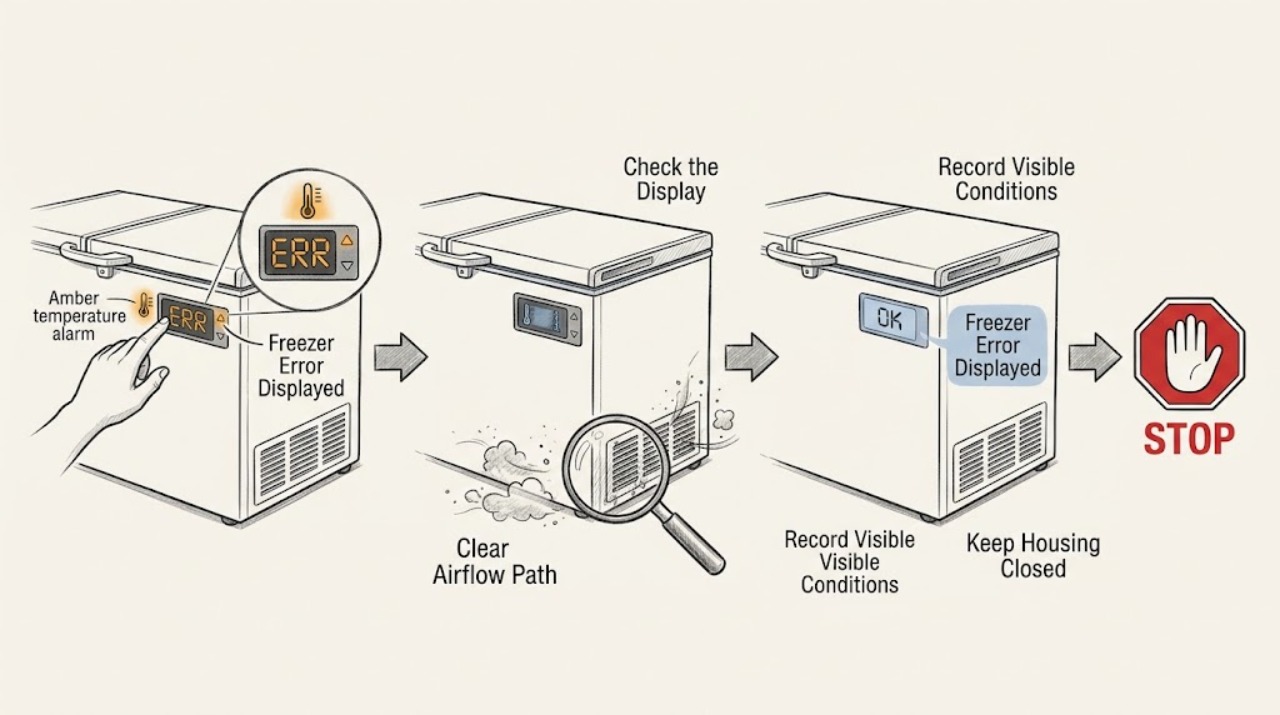
Do not guess what a Whirlpool freezer code means from a different model. Record the exact characters, flashing pattern, indicator color, alarm sound, model number, freezer type and the time or event when it appeared. Keep the door closed and protect food if the cabinet is warming. Whirlpool's freezer guidance covers temperature, over-temperature and door-ajar alarms, while its manuals emphasize that features and controls vary by model. Check only the accessible door, control, airflow, plug and breaker conditions described by the exact manual; do not remove panels or test live wiring. A single manual-approved reset is reasonable only when the appliance is dry and safe. If the same code returns, cooling does not recover, water reaches electrical parts, the unit smells scorched, overheats, sparks, or repeatedly trips protection, stop using it and arrange qualified service.
Before you begin
Safety first
- Only ordinary-access, dry and non-invasive checks are described. Do not open panels, test live circuits, defeat door or control safeties, handle refrigerant, chip ice or repeatedly reset a hazardous appliance.
Work through in order
Diagnostic checks
Use only checks that match the exact appliance or system and its official guide.
-
Check 1
Without changing settings, photograph or write down the exact display characters, decimal points, dashes, flashing pattern, indicator color and alarm sound. Record the complete Whirlpool model and serial information from the safe location specified by the manual, plus the freezer type, food condition, displayed temperature if present, and when the event began.
Expected result: The display may show an over-temperature or door-ajar indicator, a power-related message, a model-specific letter-number code, a flashing light, or no display at all. The cabinet may still be cold, partly thawed or warm.
Next step: Keep the door closed and continue only with dry, accessible checks if there is no hazard. Protect food and arrange service if the compartment is warming or the display remains in a fault state.
Stop if: Stop immediately for a burning or scorched odor, smoke, sparks, abnormal heat, water near electrical parts, a damaged cord or outlet, or a breaker that trips again.
Why this matters
Why: The exact code and model determine which manual branch applies. A warm cabinet with an alarm is a food-protection issue even when the code clears; a code that returns after a safe correction suggests a persistent control, sensor, door, power or cooling problem.
-
Check 2
Use Whirlpool's Manuals and Literature page with the exact model number, then read the control, alarm, indicator and troubleshooting sections for that freezer. Compare the display only with that manual; do not assume that a code or light pattern from an upright, chest, convertible or refrigerator-freezer applies to yours.
Expected result: The manual may define a temperature alarm, over-temperature alert, door-ajar alarm, power interruption, control-off state or a service code, or it may require service for the displayed condition.
Next step: Follow only the manual's low-risk acknowledgement or setting step. If the manual does not define the code, record it unchanged and arrange Whirlpool or qualified appliance service.
Stop if: Do not enter a service mode, change wiring, remove covers or keep acknowledging a code while the freezer is hot, wet, smoking or electrically abnormal.
Why this matters
Why: Whirlpool publishes model-dependent alarm behavior and explicitly directs owners to the Owner's Manual. The meaning of the display is not established until the appliance type and model match.
-
Check 3
With the freezer dry and safe, inspect the closed-door seal, visible packages, interior vents and the surrounding clearance without dismantling anything. If the model has an ice maker or water connection, look only for an obvious external leak or an ice-maker state described by the manual; do not disconnect a water line or reach into moving parts.
Expected result: A package may hold the door open, the seal may have a gap, vents may be blocked, the freezer may be packed with unfrozen food, or an external water leak may be present. The display may show normal cooling, an over-temperature history or a door alarm.
Next step: Remove only a visible package obstruction, close the door normally and leave vents clear as the manual directs. Keep food protected and arrange service if the code returns, the seal cannot close, the freezer remains warm or water is present.
Stop if: Do not force the door, chip ice, touch a damaged water connection, or continue if water reaches electrical parts, the cabinet is hot, or there is odor, smoke, sparks or a breaker event.
Why this matters
Why: Whirlpool's manual links blocked vents and poor door closure to temperature problems, and its support pages distinguish door-ajar and temperature alarms. A leak or water near electrics changes this from a normal control check to a safety and service event.
-
Check 4
From a dry position, check that the accessible plug is fully seated in the grounded outlet and that the manual's cooling control is on. Inspect the household breaker only as an external control; do not repeatedly reset it or open the electrical connection. Note whether the display and interior light respond and whether the freezer has recently been moved, defrosted or affected by an outage.
Expected result: The control may be off, the display may be blank, the light may work while cooling is off, the breaker may have tripped, or the freezer may have power but still show a code and warm temperature.
Next step: Correct only an accessible, documented control or plug condition once. If the breaker trips again, the display remains abnormal or cooling does not return, leave the unit off or closed as appropriate and arrange service.
Stop if: Do not touch wet or damaged electrical parts, use an adapter or extension cord, remove panels, test live circuits or keep resetting a tripped breaker.
Why this matters
Why: Whirlpool documents a control-off state in which the freezer will not cool and lists external power checks for a non-operating freezer. Power restored with a recurring code or no cooling does not identify a failed part.
-
Check 5
If the exact manual provides a normal power reset and there is no food, water or electrical hazard, perform that one documented reset and observe the display and cooling state. Do not use a reset to erase evidence: record the code first, and do not enter diagnostic mode or defeat a safety control.
Expected result: The code may clear and stay away, return immediately, return after the freezer warms, or be replaced by an alarm. Cooling may resume, remain absent or become abnormal.
Next step: Provide service with the exact model, unchanged code, timing, food temperature, door and vent observations, power history, water findings and reset result. Protect food while waiting.
Stop if: Do not re-energize the freezer after smoke, sparks, abnormal heat, a burning smell, water near electrical parts, inability to control it or repeated breaker operation.
Why this matters
Why: A cleared display can represent a transient power or alarm event, but it is not proof that a sensor, control, fan, compressor, defrost system or ice-maker circuit is healthy. Recurrence or no cooling needs model-specific diagnosis.
Use your observations
Decision map
Find the observation that best matches what you see, then follow the next safe action.
-
PATH 01Safety boundary
What you see
The exact characters or light pattern do not appear in the manual matched to the complete Whirlpool model.
Do this next
Leave the display unchanged, protect food, and arrange Whirlpool or qualified appliance service with the model, serial information, exact code and timing.
Why this path and its safety boundary
Why it matters: The code may be model-specific, from a different appliance type, or a service condition that cannot be safely interpreted from a generic list.
Safety stop: Do not guess a part, enter a service mode, alter wiring or repeatedly reset the appliance.
-
PATH 02Safety boundary
What you see
The manual identifies an over-temperature or power-related alarm, and the freezer was recently unplugged, moved, defrosted, heavily loaded or affected by an outage.
Do this next
Keep the door closed, follow the model manual's single acknowledgement step, and monitor the displayed temperature and food condition. Escalate if the temperature does not recover or the alarm returns.
Why this path and its safety boundary
Why it matters: The display may be reporting a temperature event or power history rather than naming a failed component.
Safety stop: Do not keep using the freezer if it smells scorched, overheats, leaks near electrics, smokes, sparks or trips protection.
-
PATH 03Safety boundary
What you see
The manual points to a door-ajar condition, a package holding the door open, a poor seal or a blocked internal vent.
Do this next
Remove only visible obstructions, close the door normally and keep vents clear. Arrange service for a damaged seal, recurring alarm or freezer that stays warm.
Why this path and its safety boundary
Why it matters: Warm air entry or restricted circulation can cause a temperature alarm without proving an internal control failure.
Safety stop: Do not force the door, scrape bonded ice or continue when water, heat, smoke, sparks or electrical damage is present.
-
PATH 04Safety boundary
What you see
The code or alarm occurs with an ice-maker or water connection, and an external leak, ice-maker state or water-related indicator is visible.
Do this next
Follow the exact manual for the model's ice-maker state and keep the area dry. Arrange service for a leak, recurring indicator or any internal water-path diagnosis.
Why this path and its safety boundary
Why it matters: The water or ice system may be contributing to the event, but a display alone cannot identify a valve, sensor or control part.
Safety stop: Stop using the appliance if water approaches electrical parts, a line is damaged, the floor is wet or the freezer is overheating.
-
PATH 05Safety boundary
What you see
The code returns after one safe manual-approved reset, the freezer remains warm, the display is unresponsive or the compressor, fan or control behavior is abnormal.
Do this next
Stop user troubleshooting, protect food and arrange qualified Whirlpool appliance service. Give the technician the unchanged code and all observations.
Why this path and its safety boundary
Why it matters: A persistent sensor, control, fan, compressor, defrost, door or ice-maker fault remains possible and requires model-specific testing.
Safety stop: Do not open panels, test live parts, defeat interlocks, handle refrigerant or keep cycling the power.
-
PATH 06Safety boundary
What you see
There is a burning or scorched odor, smoke, sparks, abnormal heat, water near electrical parts, a damaged cord or outlet, suspected fire, or a breaker that trips again.
Do this next
Stop using the freezer. Disconnect power only if it can be done safely from a dry, undamaged position; leave the area and seek emergency help when needed, then arrange qualified appliance or electrical service.
Why this path and its safety boundary
Why it matters: This is a fire, electrical or water-safety event, not an ordinary display-code check.
Safety stop: Do not re-energize, open panels, touch wet parts, keep testing or reset the breaker again.
Helpful context
Understand the symptom
A displayed code is evidence, not a diagnosis
Whirlpool uses different freezer designs and control layouts. An audible alarm or flashing light can indicate temperature, door or power history, while a letter-number code may be model-specific. Preserve the display and consult the manual matched to the model instead of borrowing a code meaning from a refrigerator, another freezer type or an online list.
Protect food while you identify the event
Keep the door closed as much as practical and move food to safe cold storage if the compartment is warming. Note thawing, ice crystals, a rising temperature, a recent power interruption, a long-open door, a large load or a recent cleaning or move. Food condition and the time of the alarm matter even if the display later clears.
Use only model-specific controls and external checks
A control may be off, an alarm may have recorded a warm period, or a door and vent obstruction may be visible. Whirlpool's manuals and support pages make clear that some features are present only on certain models. Do not remove a rear cover, defeat a door switch, handle refrigerant tubing or substitute a part from a different model.
Safety boundary
Stop conditions
- Burning or scorched odor, smoke, sparks, abnormal heat, a damaged cord or outlet, inability to control the appliance, or repeated breaker operation.
- Water or another leak near electrical parts, standing water, a damaged water connection or a wet control area.
- A recurring code, no cooling, a failed door seal, unusual compressor or fan behavior, or an unresponsive display after the model-specific safe checks.
- Any need to remove panels, test live circuits, defeat a door or control safety, chip ice, handle refrigerant tubing or enter an undocumented service mode.
- Food warming or thawing while the alarm remains active; protect food and arrange service rather than repeatedly acknowledging the display.
Only after diagnosis
Potential parts
- freezer door gasket
Consider only when the exact model has a confirmed torn, deformed or non-sealing gasket after visible door obstructions are removed.
Confirm the complete Whirlpool model and manufacturer fit information before ordering. - temperature sensor
Consider only when qualified diagnosis links the recurring code or temperature alarm to the sensor or its harness rather than a door, power, airflow or loading condition.
Sensor design and fit vary by model; do not infer compatibility from the display alone. - ice-maker water valve
Consider only when the model has an ice maker and service confirms a valve or water-path fault after ruling out supply, leak and control conditions.
Water-path parts require exact model matching and safe installation; a code alone is not a fitment diagnosis. - freezer control module
Consider only after qualified testing confirms a control fault and rules out a transient power event, setting, door, sensor, airflow or cooling-system cause.
Electrical modules require exact model matching and qualified installation.
When checks do not resolve it
Need a professional?
Arrange Whirlpool or qualified appliance service when the exact code is not defined by the matching manual, the display returns after one safe documented reset, the freezer remains warm, a door or seal will not close, a sensor, fan, compressor, defrost or ice-maker circuit needs diagnosis, or an alarm persists. Treat smoke, sparks, abnormal heat, water near electrical parts, a burning odor, a damaged cord or repeated breaker trips as an immediate stop event and use the appropriate emergency or electrical service route.
Safety scope: Only ordinary-access, dry and non-invasive checks are described. Do not open panels, test live circuits, defeat door or control safeties, handle refrigerant, chip ice or repeatedly reset a hazardous appliance.
Common questions
FAQ
What should I record when my Whirlpool freezer displays an error?
Record the exact code characters, flashing pattern, indicator color and alarm sound, plus the complete model, freezer type, temperature, food condition, timing and event that preceded it. Do not clear the display before recording it.
Can I use an error-code list from another Whirlpool freezer?
No. Whirlpool directs owners to the manual for the specific model, and upright, chest, convertible and refrigerator-freezer controls differ. Use only the manual matched to the complete model.
What can cause a Whirlpool freezer alarm without a failed part?
Depending on the model, a door left open, a poor seal, blocked vents, a recent power interruption, a large load, cooling turned off or a temperature rise can trigger an alert. Those possibilities do not rule out a fault if the code returns or cooling stays poor.
Should I reset a Whirlpool freezer after an error appears?
Only if the exact manual documents a normal reset and the appliance is dry and safe. Record the code first, perform at most one documented reset, and arrange service if it returns or the freezer remains warm.
When should I stop using the freezer immediately?
Stop for burning or scorched odor, smoke, sparks, abnormal heat, water near electrical parts, a damaged cord or outlet, inability to control the unit, or repeated breaker operation. Protect food and obtain qualified appliance, electrical or emergency help as appropriate.
Read the exact guide
Official sources
- Using the Alarm FeatureWhirlpool Product Help · Whirlpool freezer alarm support, with examples for chest freezers; exact controls vary by model.
- User Guide: Upright FreezerWhirlpool · Opened Whirlpool manual for an upright freezer; use the exact manual for another model.
- Alarm Sound - Upright FreezerWhirlpool Product Help · Whirlpool upright freezer support; alarm equipment and behavior vary by model.
- Whirlpool Manuals & LiteratureWhirlpool · Whirlpool official manual finder for appliances including freezers.
- Alarm Sound - Convertible Chest FreezerWhirlpool Product Help · Whirlpool convertible chest freezer support; alert thresholds and controls are model-dependent.
Community feedback
Share a repair observation
Share a plain-text repair observation. Accepted observations are published automatically; this page may take a moment to update.