
On this page
Start here
Quick answer
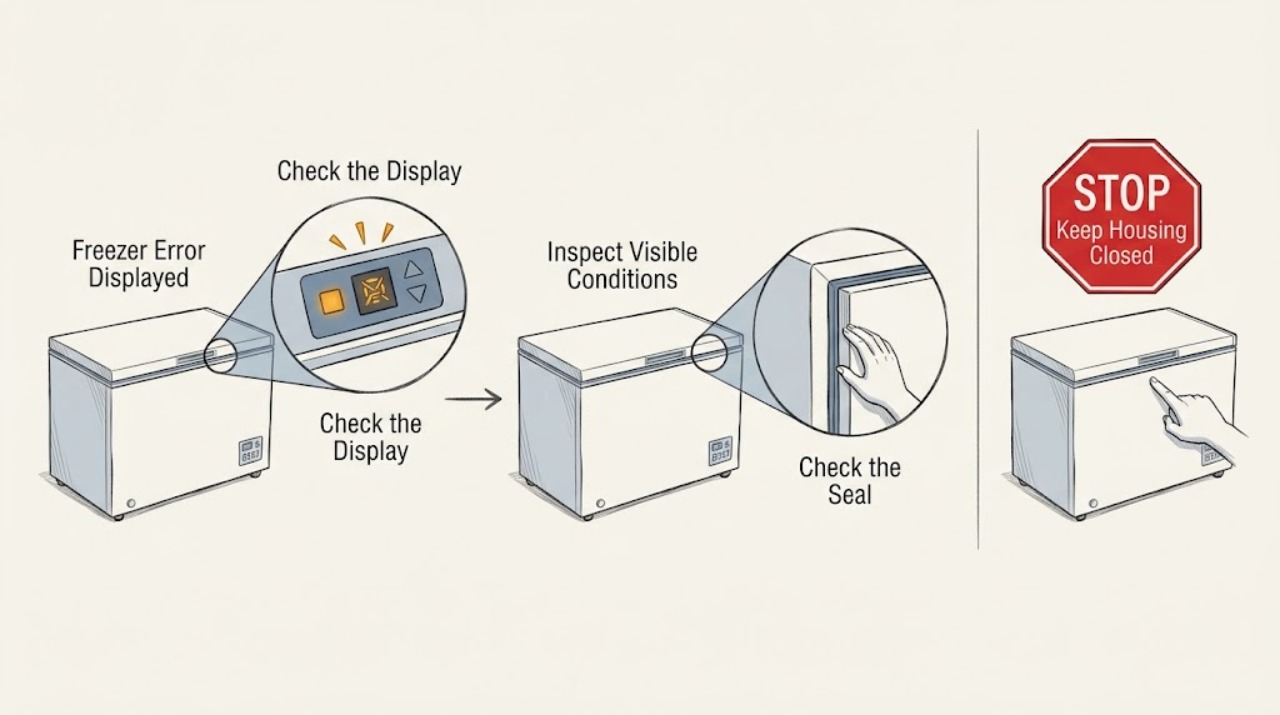
A GE freezer display may be showing a high-temperature or door alarm rather than a failed part, or it may be showing a model-specific electronic fault. Record the exact message before resetting it. High Temp or a temperature alarm can occur after startup, a power interruption, a door left open, or a large warm load; Door Open points to the door not closing. On many electronic upright freezers, E7 means a button was held too long, while E8 and E9 indicate thermistor faults. Check power, door closure, gasket, airflow, and food condition from the user-accessible side, then use the exact manual. If a fault returns after one documented reset, the freezer stays warm, or the door or controls are abnormal, stop resetting and arrange qualified service.
Work through in order
Diagnostic checks
Use only checks that match the exact appliance or system and its official guide.
-
Check 1
Read the display or indicator exactly, including spaces, letter case, and whether it says High Temp, Door Open, PF, E7, E8, E9, another code, or only shows an alarm light. Note whether the freezer is cold, warm, silent, running continuously, or recently installed or defrosted.
Expected result: The message matches a high-temperature or door alarm, a documented upright-freezer fault code, or an unlisted code that returns.
Next step: Record the code and continue with the matching check below. If the code is unlisted or returns after the applicable check, stop repeated resets and arrange qualified service.
Why this matters
Why: GE has separate guidance for temperature alarms, door alarms, and electronic upright-freezer codes. The model type and operating symptom determine whether a user check is appropriate.
-
Check 2
For High Temp, PF, or a temperature alarm, confirm that the freezer has user-visible power, check whether there was a recent outage or startup, and look at the frozen food without leaving the door open. Check that the freezer is not packed against its air vents and allow the appliance to run with the door closed.
Expected result: There was a power interruption, initial cool-down, defrost, or large addition of unfrozen food, or the freezer remains warm without one of those explanations.
Next step: If the cause is temporary, keep the door closed and monitor recovery using the model manual. If the freezer remains warm, has no power, or the alarm returns after recovery time, arrange service and protect food as appropriate.
Why this matters
Why: GE describes high-temperature alarms as warnings that the freezer is too warm; startup, an outage, defrosting, or a large warm load can trigger them. A persistent warm condition is not fixed merely by silencing the alarm.
-
Check 3
For Door Open or a door-related alarm, inspect the opening for a bin, package, basket, frost, or drawer obstruction. Close the door and check that the gasket contacts evenly around the cabinet without pulling the gasket out or removing door parts.
Expected result: The door closes and the alarm clears, or a gap, obstruction, damaged gasket, or alignment problem remains.
Next step: Remove only an accessible obstruction and clean the gasket using the model's care instructions. If the door will not seal or the alarm returns while closed, stop resetting and arrange qualified service.
Why this matters
Why: GE says the door alarm can remain displayed until the door is closed. A door that cannot seal lets warm air in and can keep a high-temperature warning active.
-
Check 4
For an E7, E8, or E9 code on an electronic upright freezer, note which buttons were being used and whether the display returns after the model's documented one-time power reset. Do not open the control area or try to test the thermistor yourself.
Expected result: E7 appears after a button was held too long, E8 or E9 returns, or the code clears and the freezer resumes normal operation.
Next step: If the code returns, leave the freezer unplugged as GE recommends until it is serviced and arrange qualified repair. If it clears, monitor the display and use the exact manual if it reappears.
Why this matters
Why: GE identifies E7 as a button held for more than 30 seconds, E8 as a shorted thermistor, and E9 as an open thermistor. The latter two are component faults, not door or food alarms.
-
Check 5
If the alarm remains despite a closed door and the freezer feels cold, compare the displayed state with the model manual and check the food condition. If the freezer cannot reach a cold state, listen only for normal compressor or fan operation from outside and do not remove panels.
Expected result: The alarm can be silenced and the freezer is cold, or the alarm cannot be reset, the freezer is warm, or cooling sounds and operation are abnormal.
Next step: If the appliance is cold and the alarm is cleared, monitor it. If it remains warm or abnormal, stop user-level troubleshooting and arrange qualified service with the recorded display and model information.
Why this matters
Why: GE recommends service when an alarm will not stop or the freezer cannot get cold after the basic checks. A quiet or warm freezer with an error display requires more than a reset.
Use your observations
Decision map
Find the observation that best matches what you see, then follow the next safe action.
-
PATH 01Safety boundary
What you see
The display is High Temp, PF, or a temperature alarm after startup, a power event, defrosting, or adding a large amount of warm food, and the freezer is otherwise operating.
Do this next
Keep the door closed, allow the freezer to cool according to the model manual, and monitor both the food and the displayed alarm.
Why this path and its safety boundary
Safety stop: If the freezer remains warm or the alarm returns without a temporary cause, arrange qualified service after recording the message.
-
PATH 02Safety boundary
What you see
The display is Door Open and an accessible package, bin, frost buildup, or gasket issue is preventing the door from sealing.
Do this next
Correct the accessible obstruction, close the door, and confirm the alarm clears without forcing the door or removing parts.
Why this path and its safety boundary
Safety stop: If the door is closed and sealed but Door Open remains, stop repeated resets and arrange service for the door-sensing or alignment problem.
-
PATH 03Safety boundary
What you see
An electronic upright freezer displays E7, E8, or E9 and the code returns after the documented one-time power reset.
Do this next
Stop user-level diagnosis, keep the appliance unplugged as GE recommends until service, and arrange a qualified repair visit.
Why this path and its safety boundary
Safety stop: If a button was held too long and E7 clears, monitor it; if E8 or E9 clears only temporarily, treat the recurrence as a service condition.
-
PATH 04Safety boundary
What you see
The display is unlisted or recurring, the freezer is not cold, food is thawing, or the appliance shows smoke, burning odor, damaged wiring, or another abnormal symptom.
Do this next
Stop troubleshooting, keep the door closed where practical, and arrange qualified appliance service. Do not remove covers or work on sealed refrigeration or electrical parts.
Why this path and its safety boundary
Safety stop: If the message clears and the freezer is cold and operating normally, continue monitoring with the exact model manual available.
Helpful context
Understand the symptom
GE uses different display and alarm systems across upright and chest freezers. A high-temperature warning can be expected during initial cool-down or after a power event, while a recurring code can indicate a sensor or control problem. Chest freezers may use an alarm light or buzzer rather than the E7/E8/E9 display described for many electronic upright models, so the exact model manual controls the interpretation.
Keep the freezer door closed while it recovers from a warm condition, except for a brief accessible inspection. Do not remove covers, probe sealed refrigeration parts, or work on wiring or the control board. If frozen food has started to thaw after a prolonged warm period, make the food-safety decision separately from the appliance reset.
A reset can clear an intermittent display, but it does not prove that the cause is fixed. Write down the message, the time it appeared, whether power was interrupted, and whether the freezer is actually cold before deciding that the warning is resolved.
When checks do not resolve it
Need a professional?
Escalate for recurring or unlisted codes, persistent High Temp or Door Open, failed cooling, a door that will not seal, thawing food, smoke, burning odor, or any internal electrical or refrigeration work.
Have this ready
- Provide the exact display or indicator, freezer type, model and serial information, recent power or installation history, door and gasket condition, food temperature or thawing symptoms, and the result of the one-time user-accessible check.
Common questions
FAQ
What does High Temp mean on a GE freezer?
It means the freezer temperature is above the alarm threshold. Startup, a power interruption, defrosting, a door left open, or a large warm load can trigger it. Keep the door closed and monitor recovery; if the freezer remains warm or the alarm returns, arrange service.
What does Door Open mean on a GE upright freezer?
The control senses that the door has remained open. Check for a package, bin, frost, or gasket problem preventing a seal, then close the door and confirm the alarm clears. A persistent message with a closed, sealed door needs service.
What do E7, E8, and E9 mean on a GE freezer?
On many electronic upright models, GE identifies E7 as a button held for more than 30 seconds, E8 as a shorted thermistor, and E9 as an open thermistor. A one-time power reset may be attempted according to the model guidance, but a returning code requires service.
When should I stop resetting a GE freezer error display?
Stop when a code returns, the freezer stays warm, food is thawing, the door will not seal, or the display is paired with smoke, burning odor, damaged wiring, or another abnormal symptom. Do not remove covers or attempt sensor, control, or sealed refrigeration repairs.
Read the exact guide
Official sources
- Upright & Chest Freezer - Alarm OperationGE Appliances · Official GE Appliances guidance for GE upright and chest freezers, including temperature monitors and alarms.
- Upright Freezer - Error, Fault or Function CodesGE Appliances · Official GE Appliances guidance for electronic upright freezers, including model-specific code behavior.
- Upright & Chest Freezer - Temperature ControlGE Appliances · Official GE Appliances guidance for upright and chest freezer temperature controls, food-temperature checks, and service escalation.
- Upright Freezer - Freezer Alarm / Alarm Reset PadGE Appliances · Official GE Appliances guidance for upright freezers with front control panels, including door and high-temperature alarms.
Community feedback
Share a repair observation
Share a plain-text repair observation. Accepted observations are published automatically; this page may take a moment to update.