
On this page
Start here
Quick answer
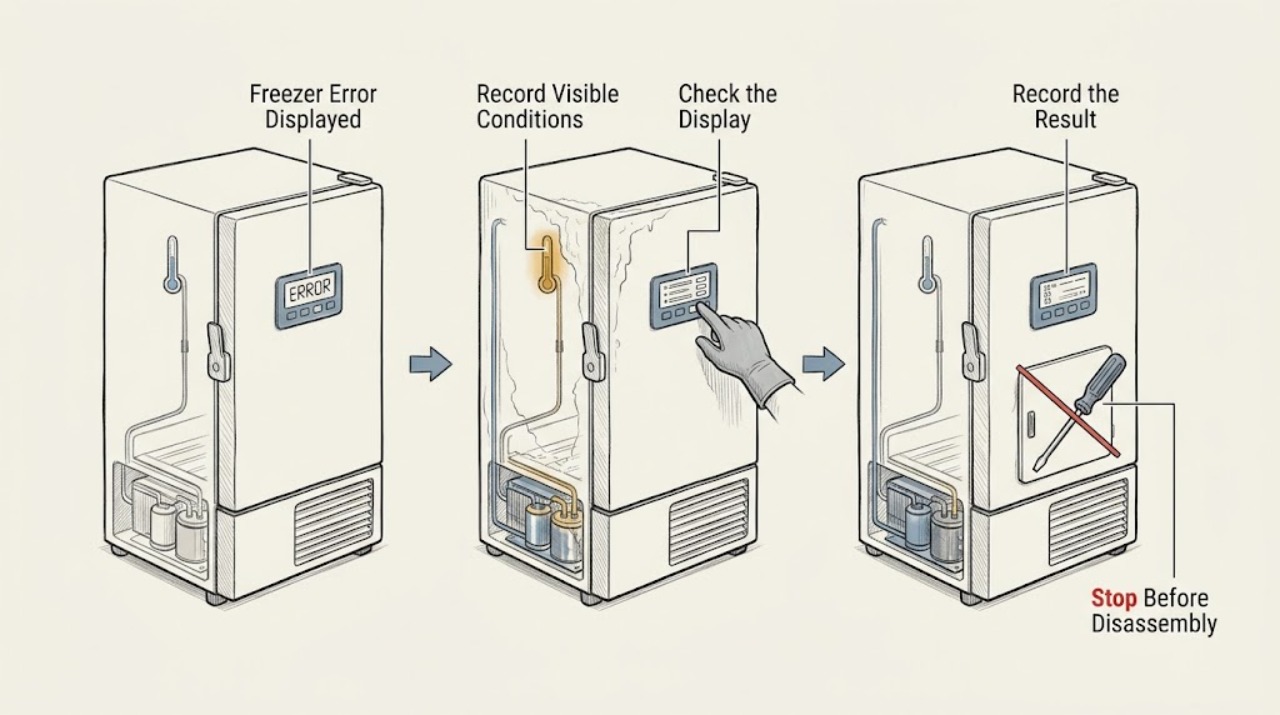
When an Insignia freezer displays an error or temperature alert, record the exact code and model before resetting anything, keep the door closed, and check whether food is still staying frozen. Insignia's freezer FAQ identifies E2 as a temperature-sensor issue, E5 as a defrost-sensor issue, and E7 as an ambient-temperature-sensor issue for the covered models; temperature alerts can also result from blocked ventilation, frost buildup, a door-seal gap, or a warm room. Check the visible power connection, control lock, door seal, airflow openings, and frost without opening the cabinet. A code that returns, a freezer that is warming, or a damaged cord or hot electrical smell requires food-protection steps and qualified appliance service.
Work through in order
Diagnostic checks
Use only checks that match the exact appliance or system and its official guide.
-
Record the display and protect the food
Photograph or write down the exact code, symbols, alarm lights, and whether the freezer is in freezer or convertible mode. Keep the door closed and check the food only briefly for signs that it is softening.
Expected result: The display shows a specific code such as E2, E5, or E7, a high-temperature or out-of-range alert, or an unclear flashing pattern; the food remains hard or is beginning to thaw.
Next step: Keep the code and model information for the owner guide or technician. If food is thawing, transfer it to a known-working freezer while minimizing door opening; if smoke, sparking, or an electrical burning smell is present, stop using the appliance and seek qualified help.
Why this matters
Why: The exact message and food condition determine whether this is a documented sensor fault, a temperature warning, or a cooling problem that needs urgent attention.
-
Match the code to the exact model guidance
Use the freezer's model label and the corresponding Insignia owner guide to compare the displayed message. Do not assume that a code from another freezer family has the same meaning, and do not erase the code before recording it.
Expected result: The model guide identifies the code, or the display is not listed or remains ambiguous.
Next step: For a documented sensor code, leave the freezer operating only if it is maintaining a safe temperature and arrange service. For an unknown or recurring code, keep the display record and request model-specific support rather than guessing a part.
Why this matters
Why: Insignia documents E2, E5, and E7 sensor meanings for particular upright or chest freezer FAQ families, while other models can use different messages or controls.
-
Check visible power and control lock conditions
Verify that the plug is fully seated in a working outlet and look at the household fuse or breaker panel for a tripped circuit. If the control panel appears locked, follow the model guide's unlock instruction; do not open the electrical compartment.
Expected result: The freezer and display recover after a visible power issue or unlock, or the code returns and the unit remains unresponsive or does not cool.
Next step: If a breaker trips again or the freezer remains unresponsive, leave it disconnected when safe and arrange qualified electrical or appliance service. Do not repeatedly cycle power while food is warming.
Why this matters
Why: Insignia lists a working outlet, fuse or breaker, and an automatically locked control panel as basic checks for freezers that appear not to work or whose controls do not respond.
-
Inspect airflow, frost, and the door seal
With the door closed afterward, look around the accessible ventilation openings for dust or stored items, inspect for heavy frost, and check whether the door gasket meets the cabinet all the way around. Do not chip ice with a sharp tool or remove interior panels.
Expected result: Ventilation is blocked or dusty, frost is excessive, the gasket has a visible gap, or these areas look clear while the alert remains.
Next step: Clear only loose external dust or items and close the door fully. If the seal, frost, or cooling problem needs disassembly or the alert returns after the accessible check, arrange service and protect the food elsewhere.
Why this matters
Why: Insignia lists blocked ventilation, frost buildup, and door-seal gaps as possible causes of high-temperature or out-of-range freezer alerts.
-
Interpret a temperature alert without hiding the cause
After the door is closed and airflow is clear, observe whether the compressor or normal cooling operation resumes and whether the alert clears according to the model guide. Do not silence an alert and assume the freezer is fixed if its contents are warming.
Expected result: The freezer returns to its normal temperature and the alert clears, or the alert remains or returns while the interior is warming.
Next step: If the alert persists or food is thawing, move food to safe cold storage and arrange qualified appliance service. Do not use a factory reset as a substitute for diagnosing cooling or sensor faults.
Why this matters
Why: Insignia says high-temperature and out-of-range alerts can turn off when the freezer returns to its normal range, but a persistent alert indicates it is still having trouble maintaining temperature.
-
Escalate sensor codes and electrical symptoms
For E2, E5, or E7, or for any code that returns after the accessible checks, leave the cabinet closed and record the code, food condition, temperature-alert history, and any recent power interruption or frost event for the technician.
Expected result: The same sensor or unknown code returns, the panel behaves abnormally, or the freezer cannot maintain a safe temperature.
Next step: Arrange qualified appliance service and keep food in a known-working freezer. Do not replace sensors, bypass a control, or open the sealed cooling system as a user repair.
Why this matters
Why: Insignia's FAQ associates E2, E5, and E7 with temperature, defrost, and ambient sensor faults for the covered models; these are not resolved by changing food placement alone.
Use your observations
Decision map
Find the observation that best matches what you see, then follow the next safe action.
-
PATH 01Next step
What you see
The message is a temporary high-temperature or out-of-range alert, the freezer returns to its normal temperature, and food remains properly frozen.
Do this next
Keep the door closed, confirm that ventilation, frost, and sealing remain clear, and monitor for a recurrence.
-
PATH 02Next step
What you see
The display shows E2, E5, or E7 on a model covered by the Insignia freezer FAQ.
Do this next
Treat it as a sensor-related service condition, record the code, protect the food, and arrange model-specific appliance service.
-
PATH 03Next step
What you see
The code is unknown, returns after power or lock checks, or the freezer is warming despite clear vents and a closed door.
Do this next
Leave the freezer out of normal use, transfer food to safe cold storage, and request qualified service rather than guessing a reset or replacement part.
-
PATH 04Next step
What you see
A damaged cord, smoke, sparking, electrical burning smell, or other immediate electrical hazard is present.
Do this next
Stop using the freezer, disconnect power only if safe, keep clear, and seek qualified electrical or emergency assistance.
Helpful context
Understand the symptom
An error display is a symptom, not a universal code set. Insignia has upright, chest, connected, and convertible freezer models, so use the model's own guide to interpret a code. A high-temperature alert can clear after the freezer returns to its normal range; a sensor code generally needs service rather than repeated resets.
Protect the food while you diagnose. Keep the freezer closed as much as possible, move food to a known-working freezer if it is thawing, and do not taste food to decide whether it is safe. Stop if the power cord is damaged, the cabinet smells electrically hot, or the unit shows smoke or sparking.
When checks do not resolve it
Need a professional?
Arrange qualified appliance service for E2, E5, E7, an unknown code that returns, a persistent temperature alert, a freezer that is warming, abnormal controls, or any condition requiring panel or sealed-system access. Stop immediately for a damaged cord, smoke, sparking, or an electrical burning smell and seek qualified electrical or emergency assistance.
Common questions
FAQ
What does E2 mean on an Insignia freezer?
For the Insignia freezer FAQ models that document it, E2 indicates a temperature-sensor problem. Record the exact model and code, protect the food if the freezer is warming, and arrange service rather than guessing a replacement part.
Why is my Insignia freezer showing a high-temperature alert?
Insignia lists blocked or dusty ventilation, heavy frost, door-seal gaps, and a warm room among possible causes. Check those accessible conditions and arrange service if the alert persists or food is thawing.
Should I reset an Insignia freezer when an error appears?
Record the code first. A reset may hide a symptom without correcting a sensor or cooling fault; use only model-specific instructions and seek service for a returning code or a freezer that cannot maintain temperature.
Read the exact guide
Official sources
- Upright Freezer FAQsInsignia · Insignia upright freezer power, lock, temperature alerts, and E2, E5, and E7 display guidance
- Chest Freezer FAQsInsignia · Insignia chest freezer power, lock, temperature alerts, and E2 and E7 display guidance
Community feedback
Share a repair observation
Share a plain-text repair observation. Accepted observations are published automatically; this page may take a moment to update.