
On this page
Start here
Quick answer
A Whirlpool freezer may run more often after a large food load, frequent door openings, a warm room, or a control setting colder than needed. First determine whether the freezer is actually holding its target temperature, then check the control setting, door or lid seal, clearance around the cabinet, and signs of frost or restricted airflow without removing panels. If it runs nearly continuously while the freezer stays warm, develops heavy frost, shows an alarm or code, leaks refrigerant-like oil, or makes repeated clicking or harsh noise, stop changing settings and arrange qualified appliance service.
Before you begin
Safety first
- This article covers temperature and run-pattern observation, control review, ordinary-access loading and closure checks, visible frost and clearance checks, and safe documentation. It does not authorize compressor-compartment access, live electrical testing, refrigerant or sealed-system work, defrost-heater testing, liner disassembly, or part replacement.
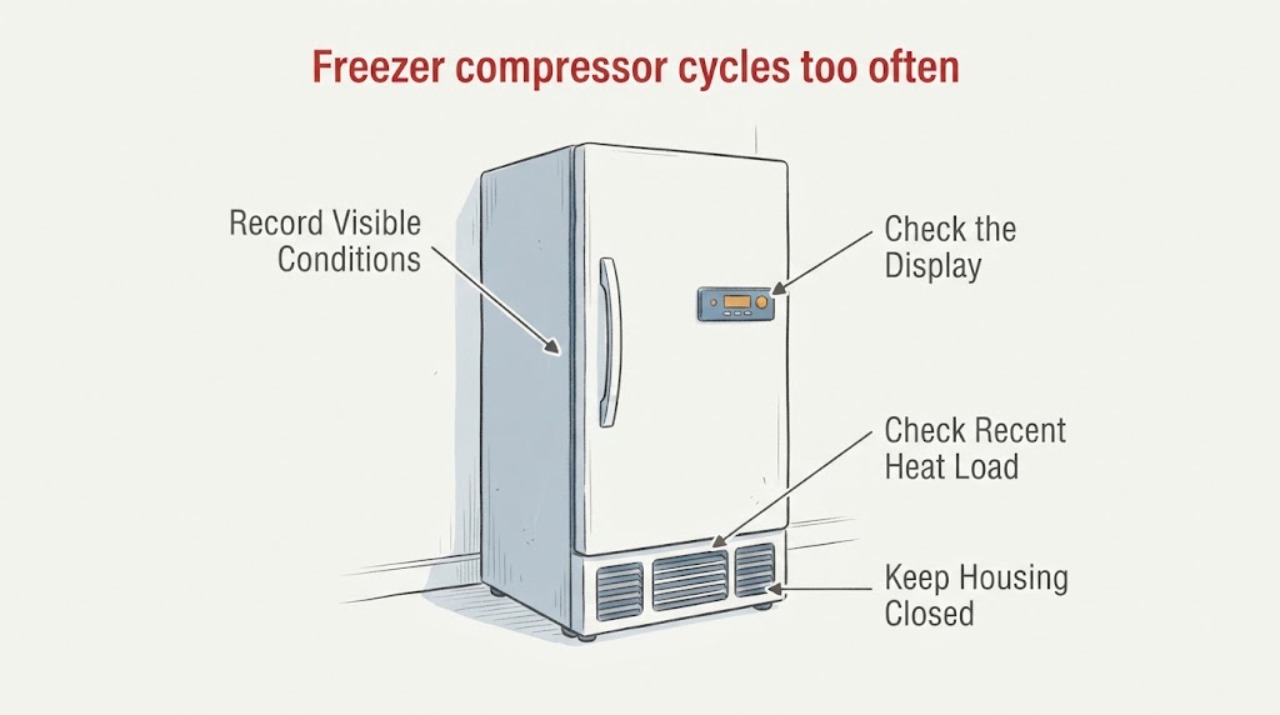
Work through in order
Diagnostic checks
Use only checks that match the exact appliance or system and its official guide.
-
Check 1
For one observation period, note whether the compressor runs continuously or in repeated short intervals, whether the freezer contents remain solid, whether a visible temperature display or appliance thermometer trends warmer, and whether an alarm appears. Do not touch the compressor or reach behind covers.
Expected result: The compartment is at its normal cold condition with occasional cycles; it is warming while the compressor runs almost continuously; or the compressor starts and stops after only a brief attempt with clicking or an alarm.
Next step: Use the stable-temperature, warm-running, or failed-start branch below. Keep the door closed as much as practical while observing and arrange service for a warm freezer, repeated failed starts, or hazardous symptoms.
Stop if: Stop using the freezer and seek qualified help for smoke, burning odor, arcing, a hot plug or outlet, a damaged cord, refrigerant-like oil or hissing, or repeated electrical trips.
Why this matters
Why: Stable frozen contents with intermittent cycles can reflect normal cooling demand. Warm contents during long operation suggest the freezer cannot remove heat efficiently. Brief failed starts, alarms, or unusual sounds point toward a fault that ordinary setting checks cannot prove.
-
Check 2
Read the current freezer control setting and compare it with the model owner's guidance and the setting used before the problem began. If the setting was recently changed colder, return only to the model's ordinary recommended range and make no further change while the compartment stabilizes.
Expected result: The control is set colder than the normal guidance, has been changed repeatedly, or is already at the ordinary setting and the freezer remains warm or cycles excessively.
Next step: Leave the control at the model-recommended setting long enough to judge a stabilized compartment. If the pattern persists at that setting, continue with loading, door, clearance, and frost checks instead of turning it colder again.
Why this matters
Why: A colder setting can increase compressor run time without indicating a compressor failure. If the ordinary setting still produces long running and poor cooling, the setting is less likely to be the root cause.
-
Check 3
Record whether a large quantity of unfrozen food was recently added, the freezer was recently installed or powered back on, the room became unusually warm, or the door was left open for a long time. Keep new packages arranged so air can circulate and close the door promptly.
Expected result: The long run began after a large load, installation, power restoration, a warm-room event, or an extended opening; or none of those events matches the timing.
Next step: Allow the freezer to recover without repeatedly opening it. If it remains warm or excessively active after the documented disturbance has passed, proceed to seal and frost checks and prepare for service.
Why this matters
Why: A temporary heat load can keep the compressor running until the freezer recovers. If the run pattern began without a recent heat event or does not settle after recovery, an environmental or internal issue becomes more likely.
-
Check 4
With the freezer closed and powered normally, inspect the visible door or lid gasket and the closing edge for a package, ice, debris, or shipping material that prevents a complete seal. Also observe whether the cabinet has the model-required clearance and is away from an obvious heat source; do not remove panels or force a warped door.
Expected result: A package or debris holds the door open, the gasket does not contact evenly, frost is concentrated around the opening, the freezer is crowded against a wall or heat source, or the seal and clearance look normal.
Next step: Rearrange only accessible packages and clear visible debris without damaging the gasket. If the door still fails to seal, frost recurs at the edge, or clearance is inadequate, arrange service or qualified installation correction.
Why this matters
Why: A leaking seal or poor installation environment lets heat enter and can increase compressor run time. A normal visible seal does not rule out a concealed gasket, hinge, airflow, or refrigeration fault.
-
Check 5
Look through the open door at visible frost, blocked interior air passages, and the cabinet's exterior ventilation area without removing an interior cover. Note whether frost is light and even, heavily concentrated in one area, or thick enough to obstruct storage or airflow; keep hands away from fans and coils.
Expected result: There is heavy or rapidly returning frost, one-sided frost, blocked food vents, or no unusual frost and the visible air path is open.
Next step: Do not chip ice with a sharp object or dismantle the liner. If frost is heavy, uneven, or returns quickly, protect the food and arrange model-specific service; if the visible pattern is normal, use the electrical and symptom branch before replacing parts.
Stop if: Stop if you find damaged liner, exposed wiring, a fan that will not stop, liquid near electrical components, or an odor suggesting overheating or refrigerant leakage.
Why this matters
Why: Heavy or uneven frost can indicate a sealing, defrost, airflow, or cooling problem that forces longer operation; blocked food vents can also disrupt temperature distribution. No visible frost does not rule out a sealed-system or control fault.
-
Check 6
From a dry, safe position, note whether the freezer loses power, the plug or outlet becomes hot, a breaker trips, the compressor clicks without starting, or an alarm or error returns. Check only visible controls and the electrical panel; do not test live wiring or repeatedly reset a tripping circuit.
Expected result: Power is stable and the compressor starts normally; the compressor repeatedly clicks or fails to start; an alarm or code returns; or the outlet, cord, or breaker shows an electrical symptom.
Next step: Keep the freezer off for unsafe electrical or repeated failed-start symptoms and arrange qualified appliance or electrical service. For stable power with persistent warm running, provide the full observation record to an appliance technician.
Stop if: Do not bypass a control, open the compressor compartment, probe wiring, or continue resetting a breaker that trips again.
Why this matters
Why: Stable power with poor cooling points more toward temperature sensing, airflow, defrost, fan, or sealed-system diagnosis. Failed starts, repeated alarms, or electrical symptoms require professional evaluation and should not be treated as a thermostat-setting problem.
Use your observations
Decision map
Find the observation that best matches what you see, then follow the next safe action.
-
PATH 01Next step
What you see
Frozen contents remain stable, the compressor cycles intermittently, and the pattern follows a recent loading, warm-room, or frequent-opening event without abnormal noise or alarm.
Do this next
Keep the control at the model-recommended setting, organize contents to close the door fully, and monitor the pattern. Escalate if the freezer warms or the run pattern remains excessive after the disturbance has passed.
Why this path and its safety boundary
Why it matters: The compressor is likely responding to normal heat load rather than failing; run time should decline as the compartment recovers and door openings decrease.
-
PATH 02Next step
What you see
The setting was recently made colder, the cabinet is in an unusually warm location or near a heat source, or air space around the freezer is restricted, while the food remains adequately frozen.
Do this next
Return only to the model's ordinary control guidance, restore required visible clearance, and let the freezer stabilize. If it still runs excessively or temperatures rise, continue to service rather than making further setting changes.
Why this path and its safety boundary
Why it matters: The compressor may be meeting a higher cooling demand caused by the control or installation environment rather than a direct compressor defect.
-
PATH 03Next step
What you see
Frost concentrates around the door or lid edge, packages or debris interfere with closure, or the gasket does not contact evenly and the compressor runs more as the interior warms.
Do this next
Clear only accessible obstructions without damaging the gasket. If the seal cannot close, frost returns, or the gasket or hinge is damaged, arrange qualified service and avoid sharp tools or liner disassembly.
Why this path and its safety boundary
Why it matters: Heat and moisture are likely entering through the closure path, making the compressor compensate; persistent frost can also indicate a defrost or airflow issue that needs model-specific diagnosis.
-
PATH 04Next step
What you see
The freezer remains warm or food softens while the compressor runs for long periods, with no recent loading or door event that explains the change.
Do this next
Protect perishable food, minimize door openings, and arrange qualified appliance service. Do not keep turning the control colder or attempt sealed-system work.
Why this path and its safety boundary
Why it matters: The pattern is less consistent with normal demand and more consistent with a cooling-capacity, airflow, defrost, temperature-sensing, or sealed-system fault.
-
PATH 05Next step
What you see
The compressor repeatedly clicks or fails to start, an alarm or code returns, the plug or outlet is hot, or a breaker trips during the cycling complaint.
Do this next
Stop operation for hazardous or repeated symptoms and arrange qualified appliance or electrical diagnosis. Keep the cabinet and compressor compartment closed and provide the exact sound and power pattern.
Why this path and its safety boundary
Why it matters: This is a start, control, or electrical fault pattern, not a safe temperature-setting experiment; repeated attempts can worsen an electrical or compressor problem.
Helpful context
Understand the symptom
What counts as too much cycling
A freezer compressor is expected to turn on and off as needed. Longer operation is also normal while a new freezer cools, after a large amount of unfrozen food is added, or after the door has been open. The more useful test is the combination of run pattern and temperature: frequent starts with stable frozen food can be a response to heat load, while near-continuous operation with a warm interior points toward a cooling, sealing, airflow, or control problem.
Check the causes that change cooling demand
Whirlpool's freezer guidance emphasizes the control setting, surrounding room conditions, the amount of food added, and how long or often the door or lid is open. Packages or shipping material can also prevent a door or lid from closing. These checks matter because they can warm the compartment without a failed compressor; correcting the cause should let the run pattern settle after the freezer has had time to stabilize.
Do not diagnose by sound alone
A brief hum or buzz at startup can be part of normal operation, but a repeating click, harsh mechanical sound, scorching odor, or a compressor that will not restart normally changes the safety decision. Likewise, a warm cabinet exterior can be normal because the appliance rejects heat into the room. Use food condition, compartment temperature, frost pattern, door seal, and the timing of the cycles together rather than treating one sound or surface temperature as proof of a failed part.
When the check stops
The public checks end at the controls, food arrangement, door or lid, surroundings, and visible frost or airflow observations. Compressor, sealed-system, fan, sensor, relay, and control testing requires model-specific procedures and qualified service. Keep a record of the temperature trend, cycle pattern, recent loading, room conditions, door behavior, frost, alarms, and sounds so the service visit starts with useful evidence.
Safety boundary
Stop conditions
- Stop using the freezer for smoke, burning odor, arcing, a hot plug or outlet, a damaged cord, repeated breaker trips, refrigerant-like oil or hissing, or liquid near electrical components.
- Do not open the compressor compartment, probe live wiring, bypass a control, chip frost with a sharp object, or attempt sealed-system or refrigerant work.
- If the freezer remains warm while the compressor runs continuously, protect the food and arrange qualified service rather than repeatedly changing the control.
Only after diagnosis
Potential parts
- temperature control or sensor
Consider only if service testing finds that the freezer is receiving an incorrect temperature signal or the control is not regulating compressor operation after environmental and closure causes are excluded.
Confirm the exact freezer model and manufacturer fit information before ordering any component. - door or lid gasket
Consider only when the visible closure check and service diagnosis confirm a damaged or deformed gasket that prevents a reliable seal.
Gasket shape and fit vary by model; verify model-specific compatibility before ordering. - start device or compressor relay
Consider only when repeated clicking or failed starts are confirmed by qualified testing as a start-circuit fault rather than a supply or compressor fault.
Do not substitute a start component based on appearance; confirm the exact model and diagnosis. - defrost or airflow component
Consider only when heavy or uneven frost and service testing identify a failed defrost, fan, or airflow component.
The required component depends on freezer style and exact model; verify fitment with the manufacturer or technician.
When checks do not resolve it
Need a professional?
Arrange qualified appliance service when the freezer stays warm while the compressor runs nearly continuously, heavy or uneven frost returns, the door or lid cannot seal, the compressor repeatedly clicks or fails to start, an alarm or code returns, or the run pattern persists after the control, loading, room, closure, and visible clearance checks. Use qualified electrical help for a hot outlet, damaged cord, or breaker problem.
Safety scope: This article covers temperature and run-pattern observation, control review, ordinary-access loading and closure checks, visible frost and clearance checks, and safe documentation. It does not authorize compressor-compartment access, live electrical testing, refrigerant or sealed-system work, defrost-heater testing, liner disassembly, or part replacement.
Common questions
FAQ
Is it normal for a Whirlpool freezer compressor to run for a long time?
Longer operation can be normal after startup, a large food load, extended door opening, or warm surroundings. Judge the run pattern with food temperature and recovery: a freezer that stays warm while running nearly continuously needs service diagnosis.
Can a colder control setting make the compressor run more often?
Yes. Whirlpool states that setting the controls colder can make the freezer run longer or more than needed. Return only to the model's ordinary guidance and allow the compartment to stabilize before judging the result.
Why does my freezer run constantly but still feel warm?
That pattern is less consistent with normal demand when no recent loading or door event explains it. Check closure, clearance, visible frost, and control setting, then arrange service for airflow, defrost, sensing, start, compressor, or sealed-system diagnosis.
When should I stop using the freezer?
Stop for smoke, burning odor, arcing, a hot plug or outlet, a damaged cord, repeated breaker trips, refrigerant-like oil or hissing, liquid near electrical parts, or repeated compressor clicking and failed starts. Keep the compartment closed and arrange qualified appliance or electrical help.
Read the exact guide
Official sources
- Motor or Compressor Runs Too Much - Upright FreezerWhirlpool Product Help · Whirlpool upright freezer compressor run time, control setting, room temperature, door closure, and service guidance
- How to Use the Controls (Chest and Upright Freezer)Whirlpool Product Help · Whirlpool chest and upright freezer compressor cycling, control operation, cooling recovery, and normal cabinet warmth
- Motor or Compressor Runs Too Much - Chest FreezerWhirlpool Product Help · Whirlpool chest freezer compressor run time, controls, room temperature, lid closure, and service guidance
- Not Freezing - Door is Sealing - Upright FreezerWhirlpool Product Help · Whirlpool upright freezer cooling, installation clearance, door opening, loading, frost, and service checks
Community feedback
Share a repair observation
Share a plain-text repair observation. Accepted observations are published automatically; this page may take a moment to update.