
On this page
Start here
Quick answer
Excessive frost in a Whirlpool freezer usually means warm, humid air is entering through frequent or prolonged door openings, a package or basket is blocking closure, a dirty or damaged gasket is leaking air, or airflow is restricted. Check the door seal, shelves or baskets, packages, vents, room conditions, and frost location without using sharp tools or removing panels. Follow the exact model manual for defrosting; if frost returns quickly, is heavy on one area, the fan is not operating, the freezer warms, or the gasket and hardware are damaged, stop and arrange qualified appliance service.
Before you begin
Safety first
- This article covers ordinary-access door, gasket, contents, vent, location, frost, and model-manual observations. It does not authorize sharp-tool or heated defrosting, interior panel removal, fan or coil access, live electrical testing, control bypass, refrigerant work, or internal part replacement.
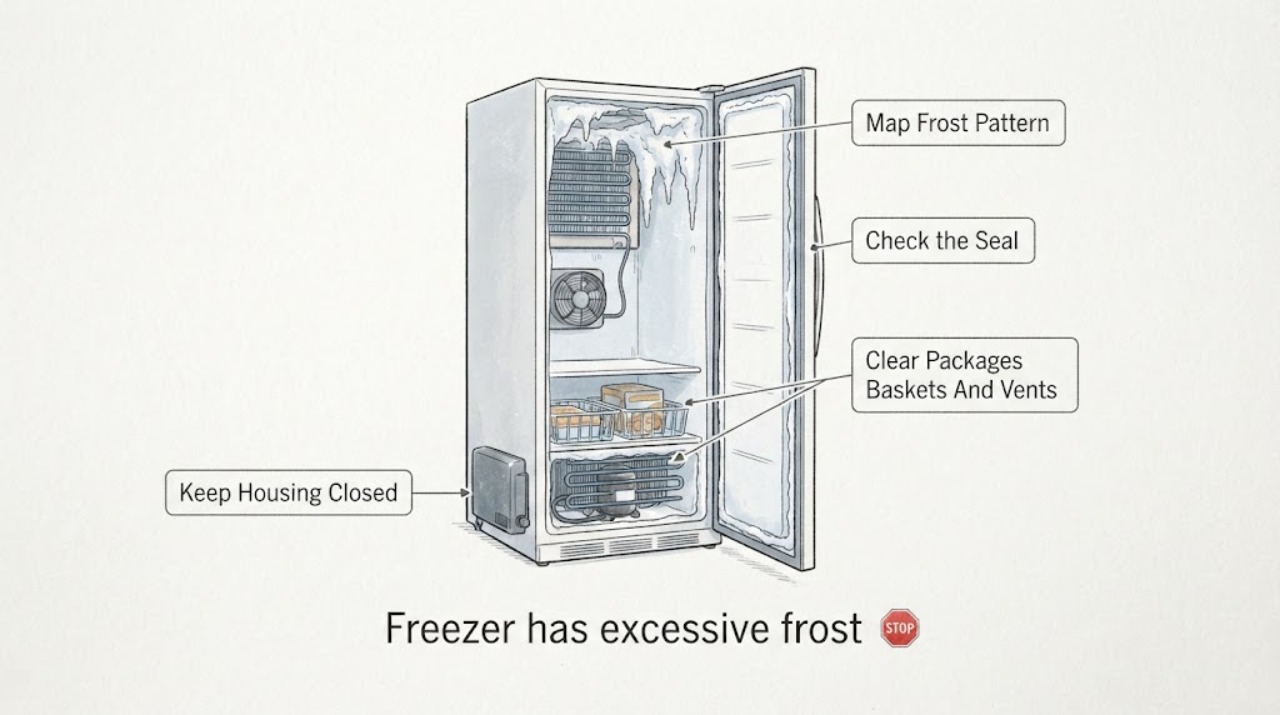
Work through in order
Diagnostic checks
Use only checks that match the exact appliance or system and its official guide.
-
Check 1
With the door open only briefly, note whether frost is around the door opening, on the rear wall, on shelves or food, or concentrated on one section. Record whether food remains solid, the freezer is warming, and whether a fan sound or alarm has changed; keep hands away from fans and interior covers.
Expected result: Frost is concentrated at the gasket or opening, spreads broadly across walls and contents, is heavy on one area, or appears with warming or a stopped fan.
Next step: Use the matching branch below. Keep the door closed as much as practical and arrange service for warming food, a stopped fan, or frost that is heavy and localized.
Stop if: Stop for exposed wiring, a damaged liner, liquid near electrical parts, a fan that will not stop, smoke, burning odor, or repeated electrical trips.
Why this matters
Why: Opening and sealing issues are more likely when frost is at the perimeter. Broad frost can follow humidity or frequent openings. One-sided heavy frost, warming, or a stopped fan raises concern for airflow, defrost, or cooling diagnosis.
-
Check 2
Inspect the visible gasket and cabinet contact around the entire freezer opening for food residue, folds, cracks, tears, or a section not touching evenly. Use a small sheet of paper only if the model guidance permits a seal check, and do not force the gasket or remove it.
Expected result: The gasket is dirty, loose, torn, folded, or has little contact at one section; or it is clean, intact, and contacts evenly.
Next step: Clean only with the model-approved method and reseat only a gasket section that the manual identifies as user-accessible. Arrange service for tears, persistent gaps, a damaged frame, or a gasket that will not stay seated.
Why this matters
Why: A damaged or uneven seal lets warm moist air enter and is a strong frost cause. An even seal shifts attention to packages, vents, humidity, location, or internal defrost and airflow conditions.
-
Check 3
Check that shelves, baskets, bins, and packages are in their intended positions, do not press against the rear wall or door, and do not block visible air vents. Remove only accessible packing material or rearrange containers so the door closes without force.
Expected result: A package, shelf, basket, or bin blocks the door or vent; the freezer is overpacked; or the visible storage and vent paths are open.
Next step: Rearrange accessible contents and check closure again. If frost or temperature problems continue with open vents and a proper seal, move to service rather than packing more tightly or changing controls repeatedly.
Why this matters
Why: A blocked closure path can leak warm air, while blocked vents can create moisture buildup and uneven frost. An open visible path does not rule out a deeper airflow or defrost fault.
-
Check 4
Record whether the freezer was left open, opened frequently, loaded with warm or uncovered food, or operated during unusually humid conditions. Keep food organized so future openings are brief and close the door promptly.
Expected result: The frost began after an extended opening, frequent access, warm food, uncovered food, or a humid period; or no recent moisture event matches the timing.
Next step: Correct only the ordinary loading and opening behavior and monitor the pattern. If frost remains heavy or returns, follow the model's defrost guidance and arrange service for an unresolved cause.
Why this matters
Why: A recent moisture event can create temporary frost that should decline after the door seals and openings are reduced. Frost without a matching event, or frost that returns quickly, makes a persistent seal, airflow, defrost, or cooling fault more likely.
-
Check 5
Observe whether the freezer is near an oven, radiator, other heat source, or a wall that restricts the clearances specified by the model instructions. Check only the visible installation space and do not move a loaded appliance or alter leveling hardware without the manual.
Expected result: The freezer is in a hot or humid location, clearance is visibly restricted, the cabinet is not level, or the installation environment appears normal.
Next step: Follow the exact installation guidance for clearance or leveling and arrange help before moving a heavy appliance. If the environment is normal and frost persists, stop at visible checks and schedule service.
Why this matters
Why: A warm location or poor clearance can increase cooling demand and contribute to frost or temperature fluctuation. A normal location makes door, contents, airflow, defrost, or cooling diagnosis more important.
-
Check 6
Use the exact Whirlpool owner manual to determine whether the freezer is frost-free or requires manual defrosting, then document the frost thickness or extent, food temperature condition, gasket result, vent and loading checks, and whether a permitted defrost changed the symptom. Do not use a knife, ice pick, hair dryer, heater, or panel removal.
Expected result: The model permits a user defrost and frost clears without damage; frost returns quickly; the model is frost-free but accumulates heavy ice; or defrosting requires service instructions.
Next step: Keep food protected and arrange qualified appliance service for recurrence, warming, a stopped fan, or any model that requires internal access. Provide the complete record rather than repeatedly defrosting without finding the cause.
Stop if: Stop defrosting if water approaches electrical parts, the liner is damaged, or the model instructions do not authorize the method being considered.
Why this matters
Why: A successful permitted defrost supports accumulated moisture or a temporary blockage but does not prove the underlying cause is fixed. Rapid recurrence or frost in a frost-free model raises the likelihood of sealing, defrost, fan, sensor, or control trouble.
Use your observations
Decision map
Find the observation that best matches what you see, then follow the next safe action.
-
PATH 01Next step
What you see
Frost is concentrated around the opening and the gasket has dirt, a fold, a loose section, a tear, or little contact at one point.
Do this next
Clear accessible obstructions and follow the model's gasket-care instructions. Arrange service for a torn gasket, frame or hinge damage, or a gap that remains.
Why this path and its safety boundary
Why it matters: Warm humid air is likely entering through the closure path; a gasket or obstruction issue is more likely than an isolated defrost failure.
-
PATH 02Next step
What you see
Frost followed frequent or extended openings, a warm or uncovered load, or humid conditions, while the door now seals and visible vents are open.
Do this next
Reduce openings, organize contents, and follow the exact model defrost instructions if needed. Escalate if frost remains heavy, returns, or the freezer warms.
Why this path and its safety boundary
Why it matters: Temporary moisture entry is more likely, although the frost may persist until the freezer has fully stabilized.
-
PATH 03Next step
What you see
A shelf, basket, package, or food load blocks a visible vent or rear wall, and frost is uneven or the freezer temperature is inconsistent.
Do this next
Rearrange accessible items to restore the model-directed airflow path. If uneven frost or warming persists with open vents, arrange service for the internal airflow and defrost system.
Why this path and its safety boundary
Why it matters: Storage-related airflow restriction can create moisture buildup and uneven frost even when the gasket appears intact.
-
PATH 04Next step
What you see
Heavy frost returns quickly after a permitted defrost and normal closure, opening, loading, and vent checks, or the model is labeled frost-free but accumulates substantial ice.
Do this next
Keep the freezer closed, protect food if it is warming, and arrange qualified appliance service. Do not remove interior covers or repeatedly force manual defrosting.
Why this path and its safety boundary
Why it matters: A recurring internal defrost, fan, sensor, control, seal, or cooling fault is more likely than ordinary humidity alone.
-
PATH 05Next step
What you see
Frost is localized or extensive and the freezer is warming, food is softening, an alarm appears, or the interior fan is not operating normally.
Do this next
Stop troubleshooting at the visible boundary and arrange qualified service. Keep food protected and avoid touching the fan, coil, wiring, or controls.
Why this path and its safety boundary
Why it matters: The frost is affecting cooling or reflects an airflow, defrost, sensor, or cooling fault rather than a cosmetic moisture issue.
Helpful context
Understand the symptom
Frost is a moisture-entry clue
Frost forms when moisture from room air or warm food freezes on cold surfaces. A little frost can be influenced by humidity, but a thick layer that reduces space or blocks airflow means the freezer is working harder and the cause should be found. The location matters: frost around the opening favors a seal or closure issue, while frost deep inside or on one area can point to airflow or defrost trouble.
Start with the door and contents
Whirlpool recommends minimizing door openings, organizing contents, and closing the door promptly. Packages, shelves, baskets, or shipping material can keep the gasket from contacting the cabinet. A gasket that is dirty, cracked, or not sealing evenly allows warm air in and can create a repeating frost cycle.
Do not mistake frost removal for a repair
A model that permits manual defrosting still needs the cause corrected. Defrosting can clear blocked space, but frost will return if the door leaks, vents are blocked, the freezer is overpacked, or a defrost or airflow component has failed. Use only the exact owner instructions and keep sharp tools, unapproved heaters, and cabinet disassembly out of this check.
When service is the next safe step
Arrange service when frost returns soon after a permitted defrost and closure correction, when the fan is not running, when food is softening, or when a gasket, hinge, frame, liner, or control problem is visible. Record the frost pattern and recent door or loading history so a technician can distinguish moisture entry from an internal defrost or cooling fault.
Safety boundary
Stop conditions
- Stop for exposed wiring, water near electrical parts, a damaged liner, smoke, burning odor, a fan that will not stop, or a freezer that is warming and softening food.
- Do not chip frost with a knife or ice pick, use a hair dryer or heater, remove interior covers, bypass controls, or force a door or basket into position.
- If heavy frost returns after the model-permitted defrost and closure checks, arrange qualified appliance service rather than repeatedly defrosting without diagnosis.
Only after diagnosis
Potential parts
- freezer door or lid gasket
Consider only when inspection and service diagnosis confirm a damaged or persistently nonsealing gasket after the closure path is clear.
Confirm the exact Whirlpool model and manufacturer fit information before ordering. - defrost heater or defrost sensor
Consider only when a frost-free model repeatedly accumulates heavy ice and qualified testing identifies a defrost circuit or sensor fault.
Do not select a defrost component from frost alone; verify exact model compatibility and diagnosis. - evaporator fan
Consider only when airflow is absent or abnormal and service testing confirms a fan fault rather than a blocked vent or ice obstruction.
Fan fit depends on freezer style and exact model; confirm before ordering. - temperature sensor or electronic control
Consider only when qualified testing links recurring frost or temperature fluctuation to the sensor or control after seal, airflow, and defrost causes are assessed.
Use exact model information and technician diagnosis to identify a compatible component.
When checks do not resolve it
Need a professional?
Arrange qualified Whirlpool appliance service when heavy frost returns quickly, a frost-free model accumulates ice, the gasket is torn or will not seal, the door or freezer is misaligned, the fan is not operating, the freezer warms, or frost persists after the exact model's permitted defrost and ordinary-access checks.
Safety scope: This article covers ordinary-access door, gasket, contents, vent, location, frost, and model-manual observations. It does not authorize sharp-tool or heated defrosting, interior panel removal, fan or coil access, live electrical testing, control bypass, refrigerant work, or internal part replacement.
Common questions
FAQ
Why does my Whirlpool freezer have so much frost?
Frequent or extended openings, humid air, warm or uncovered food, a poor door seal, packages or baskets blocking closure, and blocked vents are common causes. Frost location and whether the freezer warms help distinguish moisture entry from airflow or defrost trouble.
Can a bad freezer door gasket cause excessive frost?
Yes. A dirty, loose, cracked, torn, folded, or unevenly contacting gasket can let warm moist air into the freezer. Clear obstructions and follow the model's gasket-care instructions; arrange service for damage or a persistent gap.
Should I use a hair dryer or knife to remove freezer frost?
No. Do not use a hair dryer, heater, knife, ice pick, or other sharp tool. Use only the exact Whirlpool owner instructions for your model's defrost method, and arrange service if frost is heavy, recurring, or requires panel access.
When should I call for Whirlpool freezer service?
Arrange service when frost returns quickly, a frost-free model accumulates heavy ice, the freezer warms, the fan is not operating, the gasket or hinge is damaged, or the frost remains after ordinary closure and model-permitted defrost checks.
Read the exact guide
Official sources
- How to Avoid Frost Build UpWhirlpool Product Help · Whirlpool freezer frost causes, humidity, door sealing, food loading, airflow, and frost management
- Frosting in the Freezer Section - Top Freezer RefrigeratorWhirlpool Product Help · Whirlpool top-freezer frost from openings, sealing, blocked vents, levelness, and service
- Door is Not Sealing - Forming Frost - Upright FreezerWhirlpool Product Help · Whirlpool upright freezer door-seal testing, levelness, baskets, closure obstructions, location, and frost
Community feedback
Share a repair observation
Share a plain-text repair observation. Accepted observations are published automatically; this page may take a moment to update.