
On this page
Start here
Quick answer
If a Whirlpool freezer is not turning on, first separate a completely dead appliance from a freezer that has lights but is not cooling. Check the cord and outlet, inspect the accessible breaker or GFCI once, and confirm that the freezer and cooling controls are on rather than in an off or demonstration state. Keep the door closed during a power interruption, protect the food, and use the exact model manual for control and reset instructions. A freezer that remains silent, a breaker that trips again, a damaged cord, burning smell, smoke, sparks, or water near electrical parts needs qualified service; do not open the cabinet or repeatedly restore power.
Before you begin
Safety first
- Owner checks stop at external power and control observations, one safe accessible circuit reset, door and gasket inspection, airflow observation, and the model-approved reset. No cabinet, compressor, live electrical, refrigerant, or bypass work is included.
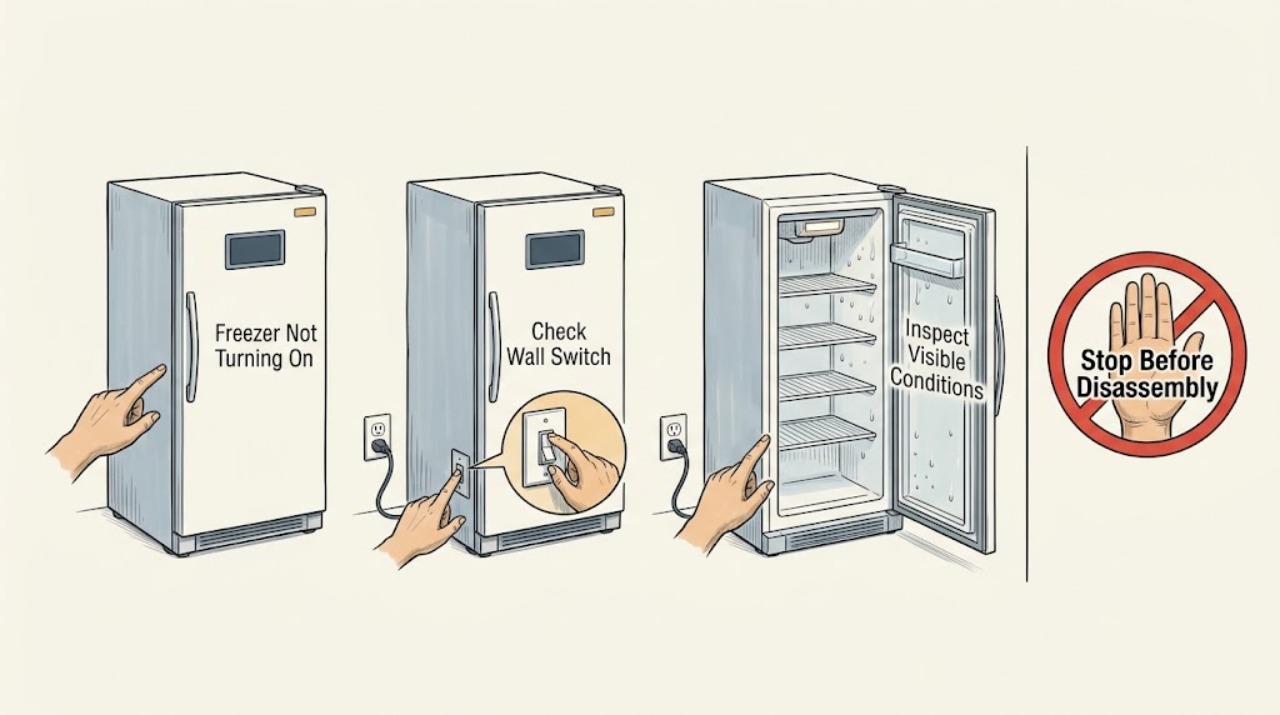
Work through in order
Diagnostic checks
Use only checks that match the exact appliance or system and its official guide.
-
Check 1
Identify the freezer type and model number, then check the interior light, display, alarm, fan sound, and compressor hum without opening any cover. Note whether the freezer is completely silent or has power but is not cooling.
Expected result: No light or display works, some controls work but cooling is absent, or the freezer makes a click or hum and then stops.
Next step: Record the symptom and model before any reset. Continue only if there is no burning smell, smoke, spark, water near electrics, damaged cord, or unsafe heat.
Why this matters
Why: A completely dead unit points toward the supply or control path. Power with no cooling shifts the diagnosis to the cooling control, airflow, frost, compressor, or start-system path; clicking without a sustained run needs service rather than repeated starts.
-
Check 2
From a dry, safe position, inspect that the power cord is fully seated in the intended wall outlet and that the outlet is not controlled by a wall switch. Test the outlet with a small lamp only if the area is dry and the cord and receptacle show no damage; do not use an extension cord.
Expected result: The outlet is dead, the outlet works but the freezer remains dead, or the cord or receptacle is damaged or warm.
Next step: Do not open the freezer or use a damaged outlet. If the outlet is dead, arrange qualified electrical help; if it works and the freezer remains dead, continue only with the accessible breaker and control checks.
Why this matters
Why: A dead outlet points to the household circuit or outlet. A working outlet with a dead freezer points toward the appliance cord, internal power entry, or controls. Heat or visible damage is an electrical stop condition.
-
Check 3
Check the accessible household breaker or GFCI for a trip. Reset it once only if the floor, outlet, cord, and hands are dry and there is no burning odor or visible damage; then observe whether the freezer display or light returns.
Expected result: Power returns and stays on, the breaker or GFCI trips again, or the freezer remains unpowered.
Next step: Leave the appliance off after a repeat trip and arrange qualified electrical or appliance service. Protect food with the door closed while deciding what can be safely moved.
Why this matters
Why: A single restored circuit can follow a temporary interruption. A repeat trip indicates a circuit or appliance fault and is not a prompt to keep resetting. A persistent dead freezer after a sound circuit check needs service.
-
Check 4
Use the exact Whirlpool model manual to confirm that the freezer control or cooling function is on and that no off, showroom, Sabbath, vacation, or similar mode is active. Check the temperature setting and any power-outage or alarm message without repeatedly changing the setting.
Expected result: The control is off or in a special mode, the control is on but unresponsive, or the control is on and the freezer still has no cooling.
Next step: Follow only the manual's documented user control change or reset once. If the panel remains unresponsive or cooling does not resume, stop adjusting settings and arrange service.
Why this matters
Why: A control state can make a powered freezer appear inactive. A responsive control with no cooling keeps the cooling-system branch open; an unresponsive panel after sound power checks points toward model-specific service.
-
Check 5
Inspect the closed door and gasket from the outside. Look for food packages preventing closure, a visibly torn or displaced gasket, blocked internal vents, heavy frost, or a freezer placed next to a heat source; do not remove covers or chip ice with a tool.
Expected result: The door seals and vents look normal, the gasket or closure is compromised, or frost and blocked airflow are visible.
Next step: Move only a plainly misplaced package and close the door. Do not force the gasket, chip frost, or access hidden coils; use the manual or request service if the seal, frost, or airflow problem persists.
Why this matters
Why: A poor seal or blocked airflow can make a powered freezer lose temperature even though it appears not to be working. Heavy or rapidly returning frost can indicate an underlying defrost or airflow fault that needs model-specific guidance.
-
Check 6
If the freezer recently lost power, follow Whirlpool's outage guidance: keep the door closed, note the outage duration and food condition, and after power is restored use the manual's reset sequence. Observe whether a steady compressor hum returns and whether the freezer begins cooling without abnormal noise or heat.
Expected result: The compressor resumes and cooling begins, the freezer remains silent after power is restored, or it clicks, overheats, trips, or shows a warning.
Next step: Keep the door closed during recovery and follow the model manual. If the freezer does not resume normal operation or any unsafe symptom appears, stop testing and arrange qualified service.
Why this matters
Why: A short interruption may require time for cooling to stabilize. Whirlpool notes that temperature recovery can take time after a reset, but a silent compressor, repeated click, abnormal heat, trip, or warning indicates a fault rather than a need for another reset.
Use your observations
Decision map
Find the observation that best matches what you see, then follow the next safe action.
-
PATH 01Next step
What you see
The outlet is dead or the accessible breaker or GFCI will not stay on.
Do this next
Leave the freezer off and arrange qualified electrical help. Keep the door closed and protect food while the circuit is assessed.
-
PATH 02Next step
What you see
The outlet works but the freezer has no light, display, or response.
Do this next
Confirm the model and use the manual's power and control guidance. If it remains dead, arrange appliance service without opening the cabinet.
-
PATH 03Next step
What you see
The display or light works, but cooling is off or the compressor does not run.
Do this next
Confirm the cooling control and mode, then observe once after the manual-approved reset. Persistent silence, clicking, or no cooling requires service for the control or cooling system.
-
PATH 04Next step
What you see
The door does not seal, vents are blocked, or frost is obstructing airflow.
Do this next
Correct only a plainly displaced package and use the manual's approved care guidance. Do not chip frost or remove covers; request service for a damaged seal or returning frost.
-
PATH 05Next step
What you see
The freezer was affected by a power outage.
Do this next
Keep the door closed, move food if the interruption is prolonged, and follow the model reset after power returns. Check food condition before consuming it.
-
PATH 06Next step
What you see
There is smoke, burning smell, spark, damaged cord, water near electrical parts, abnormal heat, or a repeated trip.
Do this next
Stop immediately and keep people away. Isolate power only from a safe, dry position if possible, then arrange qualified electrical or appliance service; do not restart the freezer.
Helpful context
Understand the symptom
“Not turning on” has two meanings
A dead display or interior light points first to power, a control state, or the appliance's electrical system. If the light works but there is no cooling, the freezer is receiving some power and the next clues are the control setting, door seal, airflow, frost, compressor sound, and recent outage. Identify whether it is a chest freezer, upright freezer, or refrigerator-freezer combination because controls and accessible parts differ.
Protect food while you diagnose
Keep the door closed as much as possible during an outage or no-power event. Move food to another working freezer or an approved frozen-food locker when the interruption is prolonged, and discard food whose condition is questionable. The model manual controls the appliance reset and any temperature alarm procedure; do not use a colder setting as a substitute for a running compressor.
Use external checks only
Do not remove the rear cover, touch compressor terminals, bypass a thermostat or door switch, or repeatedly reset a breaker. Stop for a damaged cord, hot outlet, burning odor, smoke, sparks, water around electrical parts, or a breaker that trips again. Those observations should be passed to a qualified appliance technician or electrician.
Safety boundary
Stop conditions
- Stop immediately for smoke, burning odor, sparks, a hot or damaged cord or outlet, abnormal cabinet heat, water near electrical parts, or a breaker or GFCI that trips again.
- Do not remove the rear cover, touch compressor terminals, bypass a control or door switch, use an extension cord, or chip frost with a sharp tool.
- Stop repeatedly resetting or changing controls when the freezer remains silent, clicks without running, or shows a persistent warning.
- Keep the freezer out of service until qualified help assesses a persistent no-power, no-cooling, electrical, or structural condition. Protect food according to the outage duration and its observed condition.
Only after diagnosis
Potential parts
- freezer electronic control or thermostat
Consider this category only when the display or controls are unresponsive or a qualified diagnosis confirms that the control path prevents cooling.
Confirm the complete model and control design before selecting a part; a dead freezer does not prove control failure. - freezer start relay or compressor start component
Consider this category only when a qualified diagnosis confirms repeated clicking, no compressor start, or a start-system fault after supply and control checks.
Compressor-start work is an internal service boundary; use model-specific service information. - freezer door gasket
Consider this category only when the exact model's gasket is visibly damaged or fails to seal and a technician confirms it contributes to the temperature problem.
Verify the complete model and door design before selecting a gasket. - freezer defrost or airflow component
Consider this category only when heavy or recurring frost and blocked airflow are confirmed and qualified diagnosis identifies the underlying component.
Do not assume a frost symptom identifies a heater, sensor, fan, or timer; confirm through approved service information.
When checks do not resolve it
Need a professional?
Arrange qualified Whirlpool appliance service when a known-good outlet and accessible circuit do not restore operation, when the controls are on but cooling does not resume, when the compressor remains silent or repeatedly clicks, or when door, frost, or control faults persist. Use qualified electrical help for repeated trips, damaged wiring, smoke, sparks, or unsafe water contact.
Safety scope: Owner checks stop at external power and control observations, one safe accessible circuit reset, door and gasket inspection, airflow observation, and the model-approved reset. No cabinet, compressor, live electrical, refrigerant, or bypass work is included.
Common questions
FAQ
Why is my Whirlpool freezer completely dead?
Check the cord and outlet, then inspect the accessible breaker or GFCI once if everything is dry and undamaged. If the outlet works but the freezer has no light or display, use the model manual and arrange service rather than opening the cabinet.
What if my Whirlpool freezer has a light but is not cooling?
The freezer has some power, so confirm that cooling is on and no special mode is active, then check the door seal, vents, frost, and compressor sound. Persistent no cooling or repeated clicking requires service.
Can I reset a Whirlpool freezer after a power outage?
Follow the exact model manual and Whirlpool's outage guidance. Keep the door closed, allow the refrigeration system to equalize after power returns, and do not repeat resets if the unit stays silent, clicks, overheats, or trips the circuit.
How do I protect food while the Whirlpool freezer is off?
Keep the door closed as much as possible. If the outage is prolonged, move frozen food to a working freezer or approved frozen-food locker and check food condition before consuming it.
Should I replace the compressor or start relay first?
No. A no-run symptom can come from power, controls, thermostat, start components, or the compressor. A qualified technician should confirm the model and failed component before any internal part is selected.
Read the exact guide
Official sources
- 7 Freezer Problems & How to Help Fix Them | WhirlpoolWhirlpool · Whirlpool freezer troubleshooting context for controls, doors, frost, airflow, compressor sounds, and reset behavior
- What to do with my Freezer during a Power Outage? - Upright FreezerWhirlpool · Whirlpool upright-freezer power-outage, food-protection, recovery, and post-outage service guidance
- Kitchen And Laundry Appliance Manuals | WhirlpoolWhirlpool · Whirlpool manuals and literature for freezers and model-specific installation, operation, and troubleshooting instructions
- Owner's ManualWhirlpool · Whirlpool upright-freezer owner guidance for electrical supply, temperature controls, power interruptions, food protection, and no-operation symptoms
Community feedback
Share a repair observation
Share a plain-text repair observation. Accepted observations are published automatically; this page may take a moment to update.