
On this page
Start here
Quick answer
A Whirlpool freezer that is not working may be completely without power, turned off at its controls, running but too warm, unable to seal, blocked by frost or airflow, or experiencing a refrigeration or component fault. Start by keeping the door or lid closed and protecting the food, then determine whether the display or indicator is dark, whether the compressor or other normal operating sounds are present, whether the temperature is rising, and whether an alarm or frost pattern is visible. From a dry, safe position check the outlet and breaker once, confirm the freezer is on, inspect the door or lid and gasket for an obstruction, verify ordinary-access airflow, and use the model manual for controls or defrosting. Do not chip ice, open the sealed refrigeration system, or keep using the appliance after water reaches electrical parts, a burning smell, smoke, unusual heat, arcing, or a repeat breaker trip. If it remains off, warm, alarmed, leaking, or unable to seal after these checks, arrange Whirlpool or qualified appliance service and handle thawed food conservatively.
Before you begin
Safety first
- This article covers food protection, visible power and control checks, ordinary-access seal, airflow, frost, alarm, and leak observations only. It does not authorize live electrical testing, sealed-system work, internal disassembly, ice removal with force or heat, or component replacement.
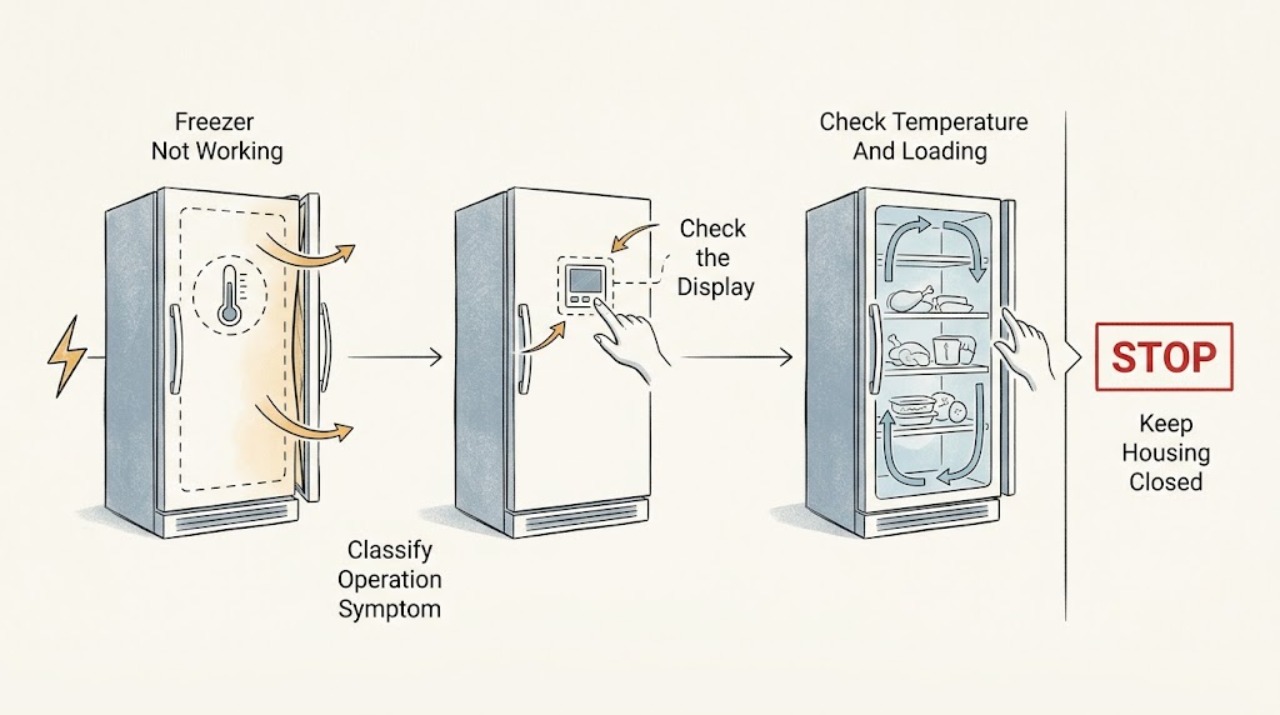
Work through in order
Diagnostic checks
Use only checks that match the exact appliance or system and its official guide.
-
Check 1
From a safe, dry position, record the Whirlpool model and serial information, identify the freezer as upright, chest, or convertible, and note whether the light or display is active, the controls respond, the compressor or normal operating sounds are present, and the temperature or alarm state is changing.
Expected result: The freezer is completely dark and silent, the controls are active but cooling is off, it runs but is warm, it has heavy frost, an alarm sounds, or water is present.
Next step: Keep the door or lid closed, protect the food, and follow the matching power, control, cooling, frost, alarm, or leak branch below.
Stop if: Stop if water is near electrical parts, the cabinet or cord is damaged, there is smoke, burning smell, unusual heat, arcing, or a repeat breaker trip.
Why this matters
Why: A dark, silent unit points first to power or control state; an active but warm unit points toward settings, door seal, airflow, loading, environment, defrost, or refrigeration; frost, alarm, and water add separate branches that should not be collapsed into a generic no-power diagnosis.
-
Check 2
With the floor and outlet area dry, verify that the power cord is fully seated in the intended outlet, check the visible breaker, fuse, or GFCI state once, and confirm the freezer's on/off or cooling control is enabled using the model owner's manual.
Expected result: The outlet or protective device is off, the outlet works but the freezer remains dark, the freezer was turned off at its control, the device trips again, or the power state is uncertain.
Next step: Record the result and arrange an electrician or Whirlpool service for a repeat trip, persistent no-power, damaged cord, or uncertain installation; do not use an extension cord or open the freezer.
Stop if: Do not repeatedly reset a breaker or GFCI, touch exposed wiring, handle a wet outlet, or continue if smoke, burning smell, arcing, water, or abnormal heat is present.
Why this matters
Why: Whirlpool identifies an incorrect connection, tripped breaker or fuse, and a freezer turned off at its control as distinct no-operation causes. A repeat trip or persistent dark display can indicate a supply, installation, cable, or component fault and is not a normal reset condition.
-
Check 3
If the freezer is running, check the model's temperature control and whether it was recently installed, had a large amount of unfrozen food added, or sits near a heat source; keep the door or lid closed between observations and make only the manual-directed adjustment.
Expected result: The control is off or not at the intended setting, the freezer was recently installed, a large warm load was added, the room is unusually hot, or the unit has been running with no clear improvement.
Next step: Record the setting and timing, allow the model's documented stabilization period, and arrange service if temperature does not recover or food safety is in doubt.
Stop if: Do not repeatedly change the control, leave the door open to test temperature, or continue storing food when it is thawing or the cabinet has an electrical or thermal hazard.
Why this matters
Why: Whirlpool says settings, recent installation, large warm loads, and surrounding conditions can make a running freezer appear not to work while it stabilizes. Persistent warmth with a normal setting and no recent load points toward sealing, airflow, defrost, or a refrigeration component rather than a reason to keep changing the control.
-
Check 4
From ordinary access, check that packages, shelves, baskets, or shipping material are not preventing the door or lid from closing; inspect the visible gasket for gaps or damage, use a paper-resistance check along the seal if the model guidance permits, and verify that the freezer has its required surrounding clearance and unobstructed internal vents.
Expected result: The door or lid does not close squarely, paper pulls out with little tension along part of the gasket, a package or basket obstructs closure, frost is concentrated around a gap, or the clearance and vents are unobstructed.
Next step: Remove only a visible package or shipping obstruction, close the door, and record the seal result; arrange service for a damaged gasket, distorted door, heavy frost, blocked concealed airflow, or persistent warmth.
Stop if: Do not force the door, puncture or cut the gasket, chip frost, dismantle vents, or continue if water, damaged insulation, smoke, burning smell, or abnormal heat is present.
Why this matters
Why: Whirlpool links poor sealing or obstruction with warm moist air, frost buildup, and longer compressor operation. A localized package or gasket obstruction can be corrected without opening the appliance; a damaged gasket, distorted door, heavy frost, or normal seal with persistent warmth needs service or a different branch.
-
Check 5
Map any frost, alarm, or water from a dry safe position: note whether frost is a thin surface layer or a heavy buildup, whether the alarm is temperature or door-ajar related according to the manual, and whether water is inside, beneath, or behind the freezer; do not remove panels or enter pooled water.
Expected result: Frost follows a door gap or frequent opening, the model requires manual defrosting, the alarm follows a warm or open-door event, water comes from a visible supply line, or the source is concealed or near electrical parts.
Next step: Follow only the owner's manual for a model-approved defrost or alarm procedure, keep food protected, and arrange service for persistent alarm, heavy or recurring frost, concealed leakage, or water near electrical parts.
Stop if: Do not chip ice, use a sharp tool or improvised heat, remove an evaporator cover, operate a wet appliance, or continue after smoke, burning smell, arcing, or abnormal heat.
Why this matters
Why: Whirlpool links open doors and poor seals with frost and identifies temperature and door-ajar alarms as model-dependent. A visible water-supply issue may be isolated from cooling, but concealed water, heavy frost, or an alarm that persists after closure can indicate a drain, defrost, seal, or refrigeration fault.
-
Check 6
Prepare a service record with the exact model, freezer type, display or indicator state, temperature trend, control setting, door-seal and frost pattern, alarm type, power result, recent installation or load, leak location, and food condition; do not keep reopening the freezer or repeating resets to obtain a different symptom.
Expected result: The freezer returns to normal operation, remains warm or silent, works only intermittently, continues alarming, develops recurring frost or leakage, or has food that is thawed or questionable.
Next step: Use the record to request Whirlpool or qualified appliance service, and move or discard food according to its condition and applicable food-safety guidance.
Stop if: Do not continue normal use after a repeat trip, water near electrical parts, smoke, burning smell, arcing, unusual heat, severe frost, or an unresolved warm cabinet.
Why this matters
Why: A complete record helps separate power, control, seal, airflow, defrost, alarm, water, and sealed-system causes. Temporary recovery does not confirm a repair, and questionable food is a food-safety decision rather than evidence that the appliance is safe to use.
Use your observations
Decision map
Find the observation that best matches what you see, then follow the next safe action.
-
PATH 01Safety boundary
What you see
Is water leaking near the cord, outlet, controls, or other electrical parts, or are there smoke, burning smell, arcing, abnormal heat, or visible cable damage?
Do this next
Stop using the freezer, keep people away, and isolate power only from a dry safe position without touching water or exposed parts; arrange qualified service and protect the food.
Why this path and its safety boundary
Safety stop: Do not touch a wet electrical area, move a heavy freezer through water, remove panels, or restore power to a repeat-tripping appliance.
-
PATH 02Safety boundary
What you see
Is the freezer dark and silent, with no active display, light, control response, or normal operating sound?
Do this next
Check the visible outlet, breaker, fuse, or GFCI state once and confirm the freezer is turned on in the manual; arrange electrical or appliance service for persistent no-power.
Why this path and its safety boundary
Safety stop: Do not repeatedly reset power, use an extension cord, or open the electrical system.
-
PATH 03Safety boundary
What you see
Is the freezer running but not reaching its intended frozen condition?
Do this next
Check the model-directed control setting, recent installation or warm load, surrounding conditions, door seal, internal airflow, and frost pattern while keeping the door closed between checks.
Why this path and its safety boundary
Safety stop: Do not keep storing questionable food, repeatedly change the control, or open sealed refrigeration components.
-
PATH 04Safety boundary
What you see
Is the door or lid obstructed or unsealed, is frost concentrated around the gasket, or are internal vents blocked?
Do this next
Remove only visible package or shelf obstructions, close the door, and follow the exact manual for model-approved defrosting; arrange service for damaged seals, heavy frost, or persistent warmth.
Why this path and its safety boundary
Safety stop: Do not force the door, cut the gasket, chip ice, use improvised heat, or dismantle vents or covers.
-
PATH 05Safety boundary
What you see
Is an alarm sounding, is the freezer temperature rising, or is frozen food thawed or of questionable condition?
Do this next
Identify whether the alarm is temperature or door-ajar from the owner manual, keep the door closed, protect or relocate food, and arrange service if the alarm or warmth persists.
Why this path and its safety boundary
Safety stop: Do not silence or disable an alarm as a substitute for finding the temperature or door condition, and do not rely on questionable food.
-
PATH 06Safety boundary
What you see
Does the freezer remain off, warm, alarmed, leaking, or severely frosted after the safe model-specific checks?
Do this next
Keep the freezer out of service as appropriate, protect the food, and arrange Whirlpool or qualified appliance service with the complete observation record.
Why this path and its safety boundary
Safety stop: Do not treat a temporary restart or silenced alarm as a confirmed repair, and do not continue use after any electrical, thermal, leak, or food-safety hazard returns.
Helpful context
Understand the symptom
Define what not working means before changing anything
A dark light or display is a power or control symptom; a running freezer that is warm is a cooling, airflow, door-seal, loading, environment, or component symptom. An audible alarm can be a temperature or door-ajar warning, while frost can be a consequence of warm moist air entering through a seal or an open door. Record the pattern, including whether the freezer is upright, chest, or convertible, before using instructions for a different product type.
Protect food while you diagnose
Keep the door or lid closed as much as practical. Whirlpool advises keeping it closed during a shorter power outage and moving frozen food to suitable storage when an outage is prolonged. Food with ice crystals may sometimes be refrozen, but quality can suffer; discard food when its condition is questionable and follow applicable local food-safety guidance. Do not use a freezer that has water near electrical parts or a fault that can contaminate or overheat its contents.
Frost, leaks, and heat can change the safety decision
A door or lid that does not seal allows warm moist air in, which can create frost and make the compressor run longer. Packages, shelves, baskets, level, and the installation clearance can all affect sealing. A small ordinary-access obstruction is different from a concealed drain, sealed-system, or electrical fault. Do not pry ice, use heat to force a defrost, open panels, or continue operating when frost, water, smoke, burning smell, or abnormal heat points beyond normal user checks.
Safety boundary
Stop conditions
- Stop immediately for water near electrical parts, smoke, burning smell, arcing, abnormal heat, visible cable damage, or a breaker that trips again; isolate power only from a dry safe position and arrange qualified service.
- Do not open the sealed refrigeration system, remove evaporator or electrical covers, probe live parts, or repair a compressor, fan, defrost, drain, or control component from the symptom alone.
- Do not chip or puncture ice, use sharp tools or improvised heat, force the door, cut the gasket, or dismantle vents as a routine check.
- Keep the door or lid closed while food is at risk, follow the model manual for defrost or alarm procedures, and discard questionable food according to applicable food-safety guidance.
- Do not keep operating a freezer that remains warm, alarmed, leaking, severely frosted, or unable to seal after safe ordinary-access checks.
Only after diagnosis
Potential parts
- model-specific freezer door or lid gasket
Consider this category only when a seal check confirms a damaged, deformed, or non-sealing gasket after visible package and alignment checks.
Confirm the exact Whirlpool model, freezer type, gasket profile, and manufacturer fit information; do not force the door or cut a gasket to compensate for a mismatch. - model-specific freezer control or thermostat
Consider this category only when qualified diagnosis confirms a control or thermostat fault after power, on/off state, setting, seal, and temperature checks.
Verify the complete model and electrical configuration with Whirlpool or a qualified technician; a warm freezer or blank display alone does not identify a replacement. - model-specific freezer fan or defrost component
Consider this category only when a technician isolates a fan or defrost fault after the visible airflow, frost, seal, control, and food-protection checks.
Confirm the exact model, component position, and qualified installation requirements; do not remove covers or replace a defrost or fan component from the symptom alone.
When checks do not resolve it
Need a professional?
Arrange Whirlpool or qualified appliance service when the freezer remains dark or silent after the visible power and control checks, the breaker or GFCI trips again, the cabinet stays warm, the control or cooling function will not stay on, a door seal or door alignment is damaged, frost is heavy or recurring, an alarm persists, water is concealed or near electrical parts, or food safety is uncertain. Treat smoke, burning smell, arcing, abnormal heat, visible cable damage, and repeat trips as urgent safety boundaries.
Safety scope: This article covers food protection, visible power and control checks, ordinary-access seal, airflow, frost, alarm, and leak observations only. It does not authorize live electrical testing, sealed-system work, internal disassembly, ice removal with force or heat, or component replacement.
Common questions
FAQ
Why is my Whirlpool freezer completely dark and silent?
Check the visible outlet, breaker, fuse, or GFCI once and confirm the freezer is on according to the owner manual. If power is available but the freezer remains dark, or the protective device trips again, stop resetting it and arrange qualified service.
Why is my Whirlpool freezer running but not freezing?
Check the model-directed temperature setting, recent warm loads or installation, surrounding conditions, door seal, package obstruction, vents, and frost pattern. If it remains warm with a normal setting and a sound seal, arrange service and protect questionable food.
Can a bad door seal make a Whirlpool freezer stop cooling?
Yes. A gap or obstruction can admit warm moist air, create frost, and make the compressor run longer. Check closure and gasket tension from ordinary access, but do not cut or force the gasket; a damaged seal or persistent warmth needs service.
What should I do if my Whirlpool freezer is alarming?
Identify whether the model's alarm is for temperature, over-temperature, or door-ajar status using the owner manual. Keep the door closed, check closure and temperature from safe access, protect the food, and arrange service if the alarm or warmth persists.
Should I chip ice out of a Whirlpool freezer?
No. Do not chip or puncture ice or use improvised heat. Follow only the exact owner-manual defrost procedure for a model that permits manual defrosting; heavy, recurring, or concealed frost should be assessed by qualified service.
When should I stop using a Whirlpool freezer?
Stop for water near electrical parts, smoke, burning smell, arcing, abnormal heat, a damaged cord, a repeat breaker trip, severe frost, unresolved warmth, or food of questionable condition. Keep the door closed, protect or discard food as appropriate, and arrange qualified service.
Read the exact guide
Official sources
- Not Freezing - Door is Sealing - Upright FreezerWhirlpool Product Help · Official Whirlpool support for upright freezers that run but do not freeze adequately while the door seals.
- Door is Not Sealing - Forming Frost - Upright FreezerWhirlpool Product Help · Official Whirlpool support for upright freezers forming frost around a door that may not seal.
- What to do with my Freezer during a Power Outage? - Upright FreezerWhirlpool Product Help · Official Whirlpool guidance for upright freezers during power loss and after power restoration.
- Setting the Controls for a FreezerWhirlpool Product Help · Official Whirlpool control guidance for freezer settings, including models that require a control action after power restoration.
- Not Powering On - Not Operating - Upright FreezerWhirlpool Product Help · Official Whirlpool support for upright freezers that do not power on or operate.
- Alarm Sound - Upright FreezerWhirlpool Product Help · Official Whirlpool support for upright freezer alarms; the exact alarm and controls vary by model.
- Leaking from Behind - Upright FreezerWhirlpool Product Help · Official Whirlpool support for upright freezer or connected appliance water leakage from behind.
- Door is Not Sealing - Not Cooling - Upright FreezerWhirlpool Product Help · Official Whirlpool support for upright freezers whose door does not seal and that are not cooling.
Community feedback
Share a repair observation
Share a plain-text repair observation. Accepted observations are published automatically; this page may take a moment to update.