
On this page
Start here
Quick answer
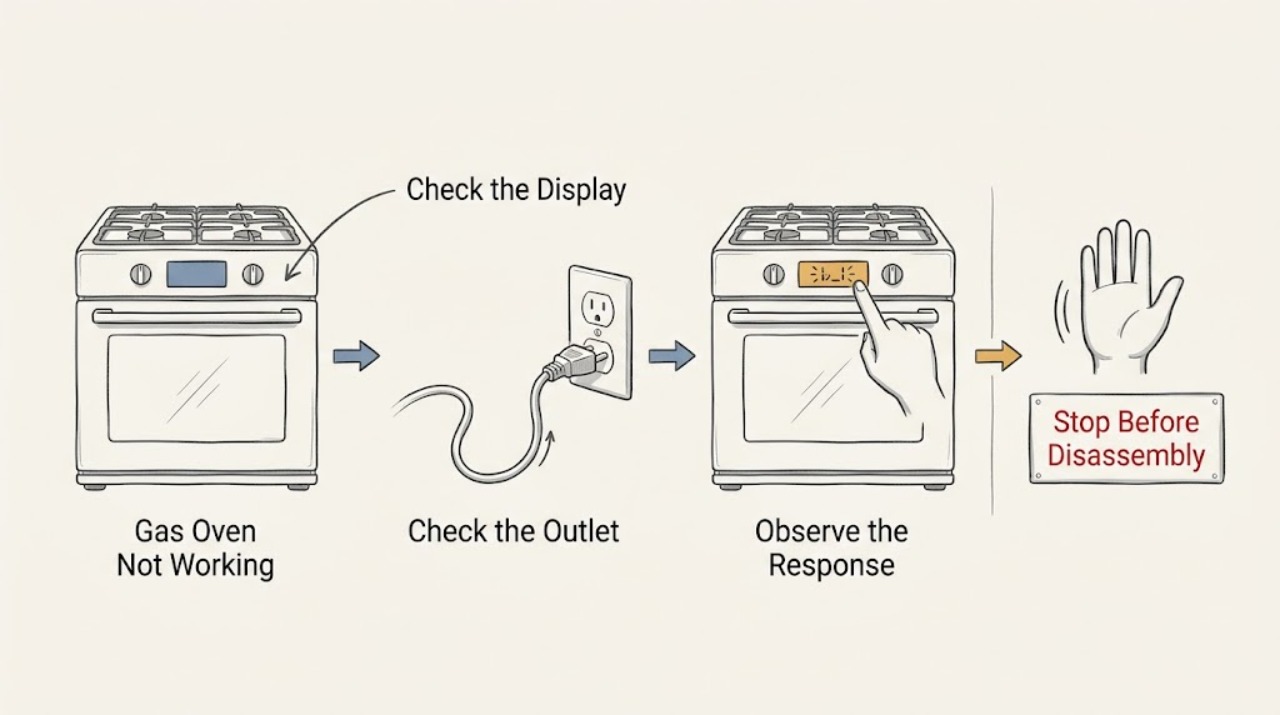
First separate a completely dead Whirlpool gas oven from an oven with power that will not start, will not ignite, or will not heat. If you smell gas, hear hissing or delayed ignition, see an abnormal flame, smoke, arcing, or a carbon-monoxide alarm, stop immediately, leave the area, and use emergency or gas-supplier guidance from a safe location. With no danger signs, check the display, control lock, delayed start or demo mode, the grounded outlet and breaker, the external gas shutoff, the closed door, and any exact error code. Do not manually light the oven, find a gas leak, repeat breaker resets, or open the range; persistent faults need qualified appliance service.
Work through in order
Diagnostic checks
Use only checks that match the exact appliance or system and its official guide.
-
Check 1
Classify the symptom without starting another heat cycle: check whether the display is blank, the display works but commands are ignored, the oven starts but does not ignite, or the burner ignites but the cavity does not heat normally.
Expected result: The range may have no display, a locked or delayed display, an error message, clicking without flame, no clicking, a flame that goes out, or an oven that runs without reaching expected heat.
Next step: Record the exact display, sound, flame status, and stage at which the failure occurs, then follow the matching checks below. Stop for gas odor, smoke, abnormal flame, or arcing.
Why this matters
Why: Each symptom points to a different decision path: supply or power, control settings, ignition and gas delivery, or temperature and burner service. Do not treat every symptom as a bad igniter.
-
Check 2
From a safe position, check for a gas odor, hissing, smoke, soot, an unexpected flame, a hot or damaged cord or outlet, arcing, or a carbon-monoxide alarm before touching controls.
Expected result: There may be no danger sign, a faint brief odor associated with a documented ignition event, a persistent or strong gas smell, visible smoke or flame, or symptoms such as headache, dizziness, nausea, or shortness of breath.
Next step: For danger signs or possible exposure, do not light, switch, reset, or investigate further; leave and use emergency or gas-supplier instructions from a safe location. Resume ordinary checks only when no danger sign is present.
Why this matters
Why: Persistent gas odor, hissing, abnormal combustion, smoke, fire, electrical damage, or possible carbon-monoxide exposure is a safety event, not a troubleshooting branch. Carbon monoxide cannot be detected by smell.
-
Check 3
If there is no gas odor, smoke, heat damage, or arcing, read the display and inspect the accessible power connection. Confirm the plug is seated in a grounded, working outlet and note whether a household breaker is tripped; do not use an adapter or extension lead.
Expected result: The display may return after power is restored, the outlet may be dead, the breaker may be tripped, or the oven may still show no response with normal household power.
Next step: Have a qualified electrician inspect an uncertain outlet or supply. Do not repeatedly reset a breaker, and leave the range unused if it trips again, smells hot, sparks, or damages the receptacle.
Why this matters
Why: The oven igniter and controls need electrical power and a ground path. A dead outlet or supply issue is not an oven gas diagnosis; a tripped breaker that trips again indicates an electrical fault.
-
Check 4
Without moving the range or touching gas fittings, look at the accessible main gas shutoff position only if it is plainly visible and safe to view. Note whether the cooktop works while the oven does not, and whether the range was recently installed or reconnected.
Expected result: The main valve may appear off, the cooktop may work while the oven does not, or the appliance may have been recently reconnected; a gas odor or uncertainty may also be present.
Next step: If the valve position is unclear, the range must be moved, or gas odor is present, stop and use a licensed gas or appliance professional. Never open a fitting, test for a leak with flame, or manually ignite the oven.
Why this matters
Why: The oven can have a separate regulator shutoff condition even when surface burners work, and air or a connection issue may follow recent installation. Visual observation cannot confirm pressure, leaks, or regulator operation.
-
Check 5
With the oven cool, inspect the control for Control Lock, LOC, Delayed Start, Demo Mode, Showroom Mode, or a timer state. Confirm the door is fully closed and the selected function and temperature are appropriate for the model.
Expected result: A lock or LOC message may disable commands, a future start time may be set, demo mode may show a product or showroom message, or the door may not be fully closed; there may be no such indication.
Next step: Use only the owner's manual's model-specific unlock, cancel, or demo-mode instructions. If the control remains unresponsive or the door will not close without force, request service.
Why this matters
Why: These settings can make a sound range appear dead or prevent a heating function from starting. A door or control indication changes the next step before any ignition diagnosis.
-
Check 6
If the cooktop works and there is no gas odor, observe one normal oven start from outside the cavity without leaning over the burner or attempting a manual light. Note whether there is normal clicking, a prompt flame, delayed ignition, no flame, or an unusual flame.
Expected result: The igniter may click and light promptly, click without a flame, remain silent, produce a delayed whoosh, or show an uneven, yellow, lifting, or sooty flame.
Next step: Turn the control OFF and stop for delayed ignition, gas odor, an abnormal flame, smoke, or a loud pop. Give the observation to a qualified appliance technician; do not clean or adjust hidden gas parts.
Why this matters
Why: Clicking without prompt ignition, delayed ignition, or an abnormal flame can indicate an igniter, burner, regulator, gas-pressure, or control issue. A delayed ignition can release gas before ignition and is not a safe repeat-test condition.
-
Check 7
With the appliance cool and power isolated only by the normal user controls, look inside the cavity for shipping material, foil, a liner, heavy food residue, or a rack or door obstruction. Do not remove burner covers, reach behind the bottom panel, or move the range.
Expected result: The oven bottom may be covered, the door may not close fully, the storage drawer may be crowded near the igniter area, or the cavity may be clear.
Next step: Remove only a loose, cool obstruction that is clearly safe to handle and permitted by the manual. If the obstruction is attached, hot, contaminated by gas, or the fault persists, stop and request service.
Why this matters
Why: Whirlpool notes that a liner or foil can block air or gas flow and that door or storage-drawer conditions can affect an oven function on supported models. A clear cavity shifts attention to service-level ignition or control checks.
-
Check 8
Write down every error code or indicator exactly, including when it appears, then perform at most one model-authorized power reset only when there is no gas odor, smoke, heat damage, water, or repeated breaker trip.
Expected result: The code may clear and the oven may operate, or the same code, no-start condition, ignition fault, or breaker trip may return.
Next step: If the code or failure returns, leave the oven unused and give the technician the model, code, function, flame behavior, and power observations. Do not repeat the reset or open the appliance.
Why this matters
Why: A single reset can clear a transient control state, but it cannot establish that gas delivery, ignition, temperature sensing, wiring, or a safety control is sound.
Use your observations
Decision map
Find the observation that best matches what you see, then follow the next safe action.
-
PATH 01Next step
What you see
There is persistent gas odor, hissing, delayed ignition, an abnormal flame, smoke, fire, arcing, or a carbon-monoxide alarm or symptom.
Do this next
Arrange qualified service and follow the exact model guidance.
Why this path and its safety boundary
Why it matters: Stop using the oven, do not operate switches or attempt a test, leave the area, and use emergency or gas-supplier guidance from a safe location. Do not search for the leak.
-
PATH 02Next step
What you see
The display is blank, the outlet is dead, or the household breaker is tripped without any gas or fire warning.
Do this next
Arrange qualified service and follow the exact model guidance.
Why this path and its safety boundary
Why it matters: Treat it as a power path issue. Have an uncertain outlet or supply checked by a qualified electrician, and do not repeatedly reset a breaker.
-
PATH 03Next step
What you see
The display works but shows Control Lock, LOC, Delayed Start, Demo Mode, or Showroom Mode.
Do this next
Arrange qualified service and follow the exact model guidance.
Why this path and its safety boundary
Why it matters: Follow the exact owner's manual for that model to unlock, cancel the schedule, or exit demo mode; do not guess a button combination.
-
PATH 04Next step
What you see
The cooktop works but the oven does not ignite or heat.
Do this next
Arrange qualified service and follow the exact model guidance.
Why this path and its safety boundary
Why it matters: Check only the external door, cavity, foil or liner, accessible gas-valve indication, and documented control state. No ignition, delayed ignition, or an abnormal flame needs qualified appliance service.
-
PATH 05Next step
What you see
The oven clicks without a prompt flame, stays silent, or shows a repeated ignition or heating failure.
Do this next
Arrange qualified service and follow the exact model guidance.
Why this path and its safety boundary
Why it matters: Turn the oven control OFF and stop testing. A technician should assess the igniter, burner, gas delivery, sensing, and controls without user disassembly.
-
PATH 06Next step
What you see
A code or no-start condition returns after one documented reset, or the breaker trips again.
Do this next
Arrange qualified service and follow the exact model guidance.
Why this path and its safety boundary
Why it matters: Leave the oven unused and arrange qualified appliance or electrical service, depending on whether the symptom follows the oven or the household supply.
Helpful context
Understand the symptom
A Whirlpool gas oven needs both gas and electricity: the gas provides heat, while the control and igniter rely on electrical power. That is why a working cooktop does not always prove that the oven will operate. Start with safety, then identify whether the fault is no power, no command, no ignition, or no heat.
Do not use a flame to look for a leak, manually ignite a modern oven, slide the range out to inspect a gas connection, remove a panel, or test live wiring. Whirlpool's model guidance also matters: control-lock, demo-mode, door, regulator, igniter, and error behavior can vary by range and region.
A brief odor at first use or during ignition can have a different explanation from a persistent gas smell, but do not assume that an odor is harmless. If gas odor continues, an ignition attempt is delayed, a flame is abnormal, or anyone feels unwell, stop the checks and leave the area.
Safety boundary
Stop conditions
- Stop immediately for persistent gas odor, hissing, delayed ignition, an abnormal flame, smoke, fire, arcing, or a carbon-monoxide alarm or symptom; leave and use emergency or gas-supplier guidance from a safe location.
- Do not light the oven manually, use a flame to check for a leak, track down a suspected leak, or move the range to inspect a gas fitting.
- Do not remove panels, reach behind the oven bottom, adjust a regulator, test live wiring, or replace an internal gas or electrical part.
- Do not repeatedly reset a breaker or keep testing after a breaker trips, a plug or receptacle becomes hot, or electrical odor or visible damage appears.
- Stop using the appliance for a door that will not close, a loud pop, an ignition delay, an abnormal flame, a repeated code, or a fault that returns after one documented reset.
When checks do not resolve it
Need a professional?
Request qualified appliance service when the Whirlpool gas oven remains dead or will not heat after the safe external checks, when the igniter clicks without prompt ignition, when a code returns, or when the door, regulator indication, burner, sensor, or control appears faulty. Use a qualified electrician for an uncertain outlet, wiring supply, or repeated breaker trip. For gas odor, hissing, delayed ignition, abnormal flame, smoke, fire, or carbon-monoxide concern, leave and use emergency or gas-supplier guidance from a safe location rather than arranging a routine test.
Have this ready
- Give the technician the model, display state or exact code, whether the cooktop works, the programme and temperature, door condition, gas-valve observation, clicking or flame behavior, breaker history, and any odor, smoke, pop, or carbon-monoxide concern.
Common questions
FAQ
Why is my Whirlpool gas oven not working while the cooktop works?
The oven and cooktop share some supplies but can have different ignition, regulator, door, control, or burner conditions. Check the exact model's external door, control, gas-valve indication, and error guidance; clicking without prompt ignition or an abnormal flame needs service.
Can a Whirlpool gas oven work without electricity?
The gas oven's controls and igniter require the electrical connection specified for the model, even though gas supplies the heat. A blank display or failed outlet is a power-path issue, not permission to manually light the oven.
What should I do if the Whirlpool oven displays LOC or a lock symbol?
The control lock can disable commands and, on supported ranges, lock the oven door. Confirm the oven and timer are off, then use the exact owner's manual procedure for that model; do not force the door or guess a code.
Is a brief gas smell during oven ignition normal?
A brief faint odor can occur during ignition, but persistent or strong gas odor, hissing, delayed ignition, abnormal flame, headache, dizziness, or nausea is not a test opportunity. Stop, leave, and use emergency or gas-supplier guidance from a safe location.
Should I keep resetting the breaker if the gas oven will not start?
No. At most, follow one model-authorized reset only when there are no gas, smoke, water, heat-damage, or electrical warning signs. If the breaker trips again or the failure returns, leave the appliance unused and arrange qualified service.
Read the exact guide
Official sources
- Locked, Lock or Loc - RangeWhirlpool · Whirlpool range control lock, oven-door lock, model manual, single power reset, and service boundary
- Oven Not Working - GasWhirlpool · Whirlpool gas-oven power connection, grounding, gas valve, recent reconnection, and service guidance
- Why does my oven smell like gas?Whirlpool · Whirlpool gas-odor distinction, delayed ignition warning, suspected leak response, and professional service boundary
- What to do if your gas oven is not heatingWhirlpool · Whirlpool gas oven power, gas connection, igniter, thermostat, sensor, door, and licensed service guidance
- Nothing is Working - GasWhirlpool · Whirlpool gas range no-operation checks for gas valve, power, control lock, delayed start, demo mode, and service
- Oven Not Working - Cooktop Working - ClickingWhirlpool · Whirlpool gas oven clicking with working cooktop, door, gas regulator shutoff, drawer, and oven-bottom obstruction checks
- Protect Your Family from Carbon Monoxide PoisoningU.S. Consumer Product Safety Commission · Carbon-monoxide properties, gas range and oven safety, alarms, and exposure symptoms
Community feedback
Share a repair observation
Share a plain-text repair observation. Accepted observations are published automatically; this page may take a moment to update.